Showing posts with label Oppianos. Show all posts
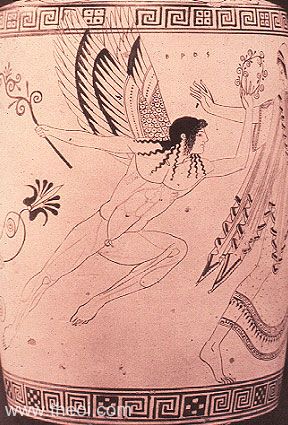
On this Valentine's day, it only seems fair that I give due to Eros (Ερως), God of love and sexual desire, eternal companion of Aphrodite and either Her son or self-born into the cosmos before anyone else, as love is the binding and creative force that makes up the universe. Pausanias, for example, in his 'Description of Greece' writes:

"Most men consider Love [Eros] to be the youngest of the gods and the son of Aphrodite. But Olen the Lycian, who composed the oldest Greek hymns, says in a hymn to Eileithyia that she was the mother of Love. Later than Olen, both Pamphos and Orpheus wrote hexameter verse, and composed poems on Love, in order that they might be among those sung by the Lycomidae to accompany the ritual. I read them after conversation with a Torchbearer. Of these things I will make no further mention. Hesiod, or he who wrote the Theogony fathered on Hesiod, writes, I know, that Chaos was born first, and after Chaos, Earth, Tartarus and Love." [9.27.2] 

Oppianos of Apamea was a third century AD author whose surviving work focusses solely on hunting. The Halieutica is made up of four parts of which the fourth seems incomplete. In this fourth part, however, we find a beautiful description of love as it affects Gods, mankind, and animals alike:

"O cruel Love [Eros], crafty of counsel, of all gods fairest to behold with the eyes, of all most grievous when thou dost vex the heart with unforeseen assault, entering the soul like a storm-wind and breathing the bitter menace of fire, with hurricane of anguish and untempered pain. The shedding of tears is for thee a sweet delight and to hear the deep-wrung groan; to inflame a burning redness in the heart and to blight and wither the bloom upon the cheek, to make the eyes hollow and to wrest all the mind to madness. Many thou dost even roll to doom, even those whom thou meetest in wild and wintry sort, fraught with frenzy; for in such festivals is thy delight. 

Whether then thou art the eldest-born among blessed gods and from unsmiling Chaos didst arise with fierce and flaming torch and didst first establish the ordinances of wedded love and order the rites of the marriage-bed; or whether Aphrodite of many counsels, queen of Paphos, bare thee a winged god on soaring pinions, be thou gracious and to us come gentle and with fair weather and in tempered measure; for none refuses the work of Love. 

Everywhere thou bearest sway and everywhere thou art desired at once and greatly feared; and happy is he who cherishes and guards in his breast a temperate Love. Nor doth the race of Heaven suffice thee nor the breed of men; thou rejectest not the wild beasts nor all the brood of the barren air; under the coverts of the nether deep dost thou descend and even among the finny tribes thou dost array thy darkling shafts; that naught may be left ignorant of thy compelling power, not even the fish that swims beneath the waters."

While Cupid is better know nowadays, Eros has much of the same attributes--including His quiver of arrow. Nonnus of Panopolis was a Greek epic poet, wrote in his Dionysiaca about this quiver of arrows, of which twelve were dedicated and meant for Zeus:

"Now Eros the wise, the self-taught, the manager of the ages, knocked at the gloomy gates of primeval Chaos. He took out the divine quiver, in which were kept apart twelve firefed arrows for Zeus, when his desire turned towards one or another of mortal women for a bride. Right on the back of his quiver of lovebolts he had engraved with letters of gold a sentence in verse for each:
"The first takes Cronion to the bend of heifer-fronted Io.”
"The second shall Europa woo for the bold bull abducting.”
"The third to Pluto’s bridal brings the lord of high Olympos.”
"The fourth shall call to Danaë a golden bed-companion.”
"The fifth shall offer Semele a burning fiery wedding.”
"The sixth shall bring the King of heaven an eagle to Aigina.”
"The seventh joins Antiope to a pretended Satyr.”
"The eighth, a swan endowed with mind shall bring to naked Leda.”
"The ninth a noble stallion gives unto Perrhaibid Dia.”
"The tenth three fullmoon nights of bliss gives to Alcmena’s bedmate.”
"The eleventh goes to carry out Laodameia’s bridal.”
"The twelfth draws to Olympias her thrice-encircling husband.”" [110]

Eros has let loose many an arrow on the Gods of Olympos; whenever a God falls for a mortal--or even another God--Eros is involved. He, however, had his own love story as well, described beautifully and lavishly by Apuleius, in 'The Golden Ass', which I will not post here for length. I can summarize the tale, however. 

Psyche (Psykhê, Ψυχη) was once a mortal princess who was so beautiful, men stated worshipping her instead of Aphrodite. Aphrodite commanded Eros make Psyche fall in love with the most hideous of men, but Eros couldn't; He fell in love with her Himself, and carried her away to His secret palace. He commanded Psyche to never look at His face, and hid His true identity, but of course, Psyche eventually was tricked into looking at the God. Quickly, He abandoned her. In her despair, she searched throughout the world for her lost love, and eventually came into the service of Aphrodite. The goddess commanded her perform a series of difficult labours which culminated in a journey to the Underworld. In the end Psykhe was reunited with Eros and the couple wed in a ceremony attended by the Gods.

I hope you have a beautiful Valentine's day with a loved one, friends, or family, and that Eros may bless you richly in life. Like the God of love itself, I wish you love as well, and hope his arrows touch your life, and guide your heart.

Image source: theoi.com
It's my nine-year anniversary with my girlfriend today and while we won't be celebrating it with anything other than a nice dinner out, I will most likely have Blogger post this one automatically so I can be in bed with my girl a little longer. As such, I am going to keep this short and sweet and leave you with Oppianos's glorious description of Eros--which was hilariously written in an essay about fish and fishes.

Eros is the God of love and sexual desire, eternal companion of Aphrodite and either Her son or self-born into the cosmos before anyone else, as love is the binding and creative force that makes up the universe. Oppianos of Apamea was a third century AD author whose surviving work focusses solely on hunting. The Halieutica is made up of four parts of which the fourth seems incomplete. In this fourth part, however, we find a beautiful description of love as it affects Gods, mankind, and animals alike:


"O cruel Love [Eros], crafty of counsel, of all gods fairest to behold with the eyes, of all most grievous when thou dost vex the heart with unforeseen assault, entering the soul like a storm-wind and breathing the bitter menace of fire, with hurricane of anguish and untempered pain. The shedding of tears is for thee a sweet delight and to hear the deep-wrung groan; to inflame a burning redness in the heart and to blight and wither the bloom upon the cheek, to make the eyes hollow and to wrest all the mind to madness. Many thou dost even roll to doom, even those whom thou meetest in wild and wintry sort, fraught with frenzy; for in such festivals is thy delight. 

Whether then thou art the eldest-born among blessed gods and from unsmiling Chaos didst arise with fierce and flaming torch and didst first establish the ordinances of wedded love and order the rites of the marriage-bed; or whether Aphrodite of many counsels, queen of Paphos, bare thee a winged god on soaring pinions, be thou gracious and to us come gentle and with fair weather and in tempered measure; for none refuses the work of Love. 

Everywhere thou bearest sway and everywhere thou art desired at once and greatly feared; and happy is he who cherishes and guards in his breast a temperate Love. Nor doth the race of Heaven suffice thee nor the breed of men; thou rejectest not the wild beasts nor all the brood of the barren air; under the coverts of the nether deep dost thou descend and even among the finny tribes thou dost array thy darkling shafts; that naught may be left ignorant of thy compelling power, not even the fish that swims beneath the waters."


I'm going back to snuggling with my girlfriend now, so I wish you a fond farewell. May you always have and hold love in your heart.
Time for another Pagan Blog Post with a letter that isn't in the Hellenic alphabet! As such, I get to be creative and provide you with an overview of the life of a fisherman in ancient Hellas, and of the great importance of fish in the ancient Hellenic diet. In ancient Hellas, fishery was a valued but underpaid skill, and one practiced for centuries. The earliest representation of a fishing scene in ancient Hellas dates from the year 1500 BC, and is found on a vase dug up on the island of Melos (Μῆλος), a volcanic Greek island in the Aegean Sea, just north of the Sea of Krete. It's extremely likely, however, that the act of fishing was practiced long before that.

While fish was a staple food of the ancient Hellenes, those who caught it were considered amongst the lowest of society. It wasn't a very glamorous job, and it paid very little. Fresh fish had to be consumed within one to three days of being caught. It is assumed that most fresh fish was taken to the local agora and sold there. Fish appeared only as a luxury item beyond the coastal towns. There is evidence of fish being transported in amphorai across water, and also that the ancient Hellenes knew how to preserve fish in a manner of ways.

Amongst others, fish could be preserved by salting, smoking, drying, or being made into fish sauce. Fish sauce, also know as garon (γάρον), was prepared from the intestines of small fishes through the process of bacterial fermentation. Makers of fish sauce would pick out the parts of the fish they wanted, and would then macerate them. Following that, they were cured in the sun for up to three months. Eventually the mixture fermented and liquefied. The clear liquid that settled on the top was skimmed off and sold as garon, the rest was used (probably locally) to flavor dishes. Garon was high in nutrients and contained a high amount of protein and amino acids. It kept for a good while and from the fourth or third century BC on, it was made and transported throughout Hellas. Fish processing facilities dating back as far as the 5th century BC have been found along the Atlantic and Mediterranean coasts of modern Spain, Morocco, Portugal, and in the Northern Black Sea region.

Hómēros makes several references to the methods of fishing in ancient Hellas, amongst which nets, lines, and harpoons. It was common for fishermen to post watchmen on the cliffs to look out for shoals of fish at sea, after which they signaled the boats below. Hómēros gives the names of only two distinct species--the dolphin and eel--but Hellenic writer Oppianos (Ὀππιανός) describes a large variety of fishes which were known to the ancient Hellenes, either in his time (around the third century AD), or earlier. His writings include: grey and red mullet, muraena, mormyrus, basse, tunny, ox-ray, sea-sheep, skate, hake, bonito, fox-shark, torpedo, cuttle-fish, squid, anthias, cantharus or black sea-bream, admos, saupe, melanurus, sword-fish, needle-fish, and dentex, but also prawn, crab, oyster, star-fish, lobster, sting-ray and turtle. It can be assumed a large section of these fish served as dinner.

Oppianos' Halieutica is one of the greatest sources of knowledge about the fishing tactics in ancient Hellas we have to this day: very little writing and pottery decorations were made about the lowly job of fishermen, and even fewer have survived. From Oppianos, for example, we know how a fishermen was supposed to present himself, and who of the Theoi favored them:

"First of all the fisher should have body and limbs both swift and strong, neither over fat nor lacking in flesh. For often he must fight with mighty fish in landing them — which have exceeding strength so long as they circle and wheel in the arms of their mother sea. And lightly he must leap from a rock; and, when the toil of the sea is at its height, he must swiftly travel a long way and dive into the deepest depths and abide amongst the waves and remain labouring at such works as men upon the sea toil at with enduring heart. Cunning of wit too and wise should the fisher be, since many and various are the devices that fishes contrive, when they chance upon unthought-of snares. Daring also should he be and dauntless and temperate and he must not love satiety of sleep but must be keen of sight, wakeful of heart and open-eyed. He must bear well the wintry weather and the thirsty season of Sirius; he must be fond of labour and must love the sea. So shall he be successful in his fishing and dear to Hermes."

It is clear that the ancient Hellenes loved their fish. It was the most preferred dish to accompany their basic grain diet, the favorite relish, or 'opson' (ὄψον). Hellenic rhetorician and grammarian Athenaeus of Naucratis, who lived around the beginning of the third century AD, wrote one of the best summaries of the opinion on fish as a dietary staple:

"It is no wonder, my friends, that among all the specially prepared dishes which we call an opson, the fish is the only one which has won its way, on account of its excellent eating qualities, to be called by this name, because people are so mad for this kind of food."