Showing posts with label archeology. Show all posts

The Ministry of Culture and Sports announced the completion of the preliminary and exploratory works for the year 2021 on the Shipwreck of Antikythera. The new five-year underwater research programme is being conducted by the Swiss School of Archaeology under Dr. Angeliki G. Simosi, Head of the Euboea Ephorate of Antiquities and Lorenz E. Baumer, Professor of Classical Archaeology at the University of Geneva. Based on the results of this year’s research, a detailed programme will be prepared for the following years (2022-2025), in collaboration with all competent bodies involved. As noted in the announcement, maximum results were achieved in this year’s short expedition despite quite difficult weather conditions.

The first expedition of the second five-year programme took place between October 1-10 and focused on a detailed mapping of the site of the Antikythera wreck and the creation of its complete photogrammetric three-dimensional model in high resolution. On the one hand the mapping allows a much more accurate analysis of the distribution of the findings on the sea floor, fundamental to the accurate representation of the sinking of the ship in the 1st century BC. On the other hand it offers a new cutting-edge tool for an accurate planning of further research.

The successive integration of new and older findings in the model will result in the shipwreck’s complete documentation. It also makes it possible to access the space virtually through the internet. Moreover, this year’s expedition recorded most of the wreck’s surroundings, providing new and important information that will be investigated in future expeditions .

Despite the plethora of findings salvaged from the shipwreck from 1900 to the present, recent research between 2014 and 2019 shows that the scientific community is on the verge of discovering more important archaeological evidence that will help to better understand the site, answering key questions that have remained unanswered for more than 100 years.

The purpose of the investigation is to complete the collection of data necessary to draw conclusions regarding the following : the existence of other remnants of the Antikythera Mechanism at the site of the shipwreck, the ship and its cargo that remain covered as a result of a landslide, the possible connection between wrecks A and B, as well as the number of people aboard ship wreck A. An equally important goal is the discovery and collection of findings which include human skeletal remains, parts of the Antikythera ship and cargo which are exposed and vulnerable to possible human interventions and the adverse effects of the environment.

The most important find is part of a marble statue trapped under a heavy boulder. The initial analysis and documentation of the artefact was carried out by in situ photogrammetry and in due course will be further investigated. During the research, some smaller wooden and bronze structural elements of the ship were retrieved, as well as fragments of ceramics that give valuable information on the cargo’s dating and composition.This and other findings yielded by the future excavation will contribute to a more complete understanding of the valuable cargo on board the ship.

The field teams were coordinated by commodore Alexandros Palatianos and the director of underwater research was Alexandros Sotiriou, a collaborating archaeologist at the University of Geneva, with the participation of members of the Special Diving Team of the Submarine Missions Unit of the Coast Guard, underwater archaeologist Orestis Manousos and Italian researcher Dr. Elisa Costa of Ca ‘Foscari University in Venice.

The research is being conducted by the Swiss School of Archaeology under the supervision of the Ephorate of Underwater Antiquities and with the funding of the Ekaterini Laskaridis Foundation and Swiss Watch Manufacturer Hublot. The Athanasios K. Laskaridis Public Benefit Foundation has provided the Norwegian ship Typhoon, while Cosmote supports the project’s telecommunications.

The project is under the auspices of President of the Hellenic Republic Katerina Sakellaropoulou and actively supported by the Municipality of Kythera and the people of Antikythera.

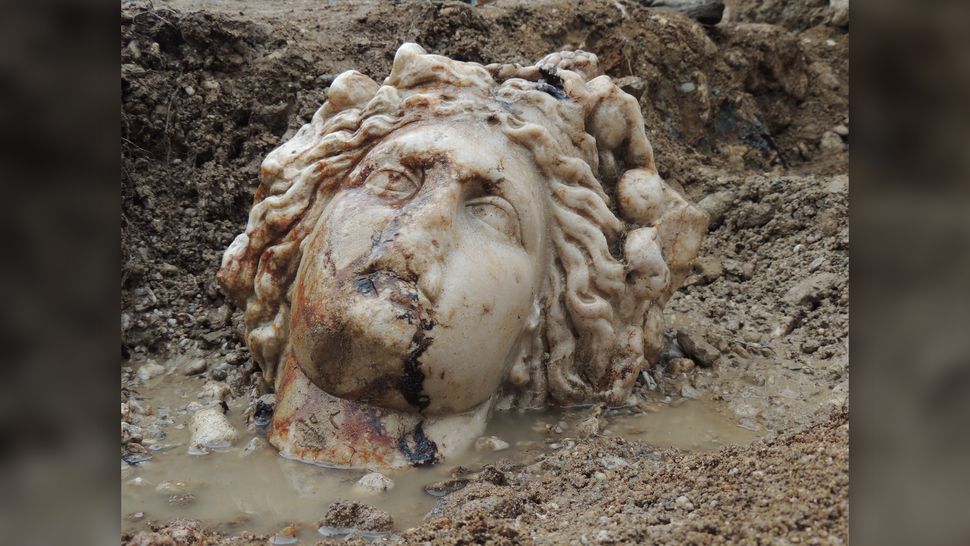
According to Hellenic mythology, the deities Aphrodite and Dionysos had a grand love affair. So, perhaps it's fitting that archaeologists found the ancient statuary heads of the Goddess of love and the reveler near each other during a dig in the ancient city of Aizanoi, in western Turkey.


The discovery of the deities' heads helps top off a previous find; on an earlier dig, archaeologists found the statues' headless bodies, Gokhan Coskun, an archaeologist at Kütahya Dumlupınar University in Turkey and the excavation coordinator, told Anadolu Agency, a Turkish state-run news organization. 

"These are important findings for us, as they show that the polytheistic culture of ancient Greece existed for a long time without losing its importance in the Roman era," Coskun said. "The findings suggest that there may have been a sculpture workshop in the region."

The ancient city of Aizanoi has a rich history filled with ancient Greek and Roman period settlements. Its earliest settlement dates to the second millennium B.C., but many of its remaining ruins date to the Roman Empire, including its Roman baths, Zeus temple and macellum, or Roman indoor market. Aizanoi is listed as a "tentative" World Heritage Site by the United Nations Educational, Scientific and Cultural Organization (UNESCO). 

Archaeologists found the Roman-era heads of Aphrodite and Dionysos buried in a creek bed in the ancient city. Each head is made of limestone, with Aphrodite's head measuring 19 inches (50 centimeters) and Dionysus' head measuring 17 inches (45 cm) tall, according to the news site GEO. It's unknown how the statues' heads became separated from their bodies.

Previously, archaeologists in Aizanoi uncovered the statue of Hygieia, Goddess of health, cleanliness and hygiene, according to GEO. 

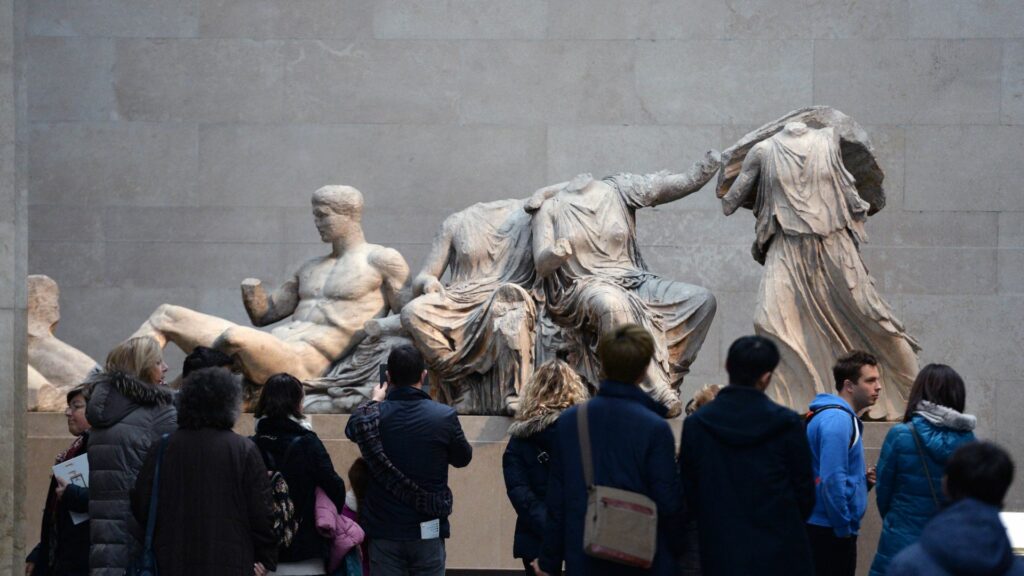
A white, hermetically sealed door, secured by an electronic lock, is what visitors to the British Museum encounter when they attempt to admire the Parthenon Sculptures. The Sculpture Room, like five other rooms with Greek exhibits, has remained inexplicably closed for ten months, heightening fears in the international lobby for the return of the Sculptures that the damage to the Museum's glass roof, which has resulted in water dripping next to (!) the Marbles, has not been repaired.

A recent inspection of the British Museum, in Bloomsbury, Central London, revealed that the Duveen Gallery, the room housing the priceless ancient Greek treasures sculpted by Pheidias, is still inaccessible to the public, unlike the other rooms that have been open since last May, when the last lockdown in Britain ended. This is despite assurances from officials at the beginning of the summer that 'the "Greek" galleries will open soon'. A spokesman for the museum was unable to give specific answers, speaking generally of a "programme of repairs and maintenance" being carried out on the halls. As for when they will reopen? Sometime "later this fall"...

In total, six rooms with ancient Greek exhibits remain closed: rooms 15, 16, 17 and 18 (ed. the last one exhibits the Sculptures), which are not open due to "repairs", and rooms 19 and 20, which do not admit visitors due to "compliance with measures for the coronavirus". Surprisingly, Museum officials, when asked, give different versions of both the reason for keeping the "Greek" halls closed, from December 2020, and when they will reopen. We asked four members of the Museum's staff who have the authority to answer questions from the public, and received four different answers! "We don't know exactly when they will open. Maybe in a month. Do you live in London? If so, come back in a while or give us a call," the first employee told us. Why are the halls closed? Because of a leak in the roof, I asked her. "Yes, and also for general maintenance." "We hope the halls will be open by the end of the year," said the second museum employee we asked, also admitting that what is keeping them closed is the water leak. "You know, it's an old building", she explained. A third employee made the same admission. "We are working to address the leak," she noted, adding that "our expectation is that the halls will reopen before the end of 2021." However, a fourth employee disagreed with the previous officials: "Renovation work is taking place. The reports of leakage are rumours and are very 'far-fetched'. I think the hall will be opened soon," he said.

Representatives of the campaign to repatriate the Marbles are alarmed, even expressing concern about the integrity of the sculptures. On August 15, the International Association for the Restoration of the Parthenon Sculptures (IARPS), which represents 21 national commissions from around the world, wrote to the museum's president Sir Richard Lambert, its director Dr. Hartwig Fischer and its commissioners on the issue. In the letter - shown here - the Union expresses its "deep concern" that the hall remains closed, stressing that the "potential moisture problem creates a dangerous situation for the sculptures". At the same time, it calls on the Museum to "reconsider its position on the ongoing division of the Sculptures", noting its "moral obligation" to reunite all the surviving Sculptures in the Acropolis Museum". "It is sad that Room 18 has remained closed since last December until further notice," IARPS president Dr. Chris Titgutt said, noting that "the inadequate air conditioning conditions in the room are a cause for concern." "I hope," he added, "that we don't have to wait another 22 years to admire the Parthenon Sculptures in London again, as happened in 1940 when the Duveen Gallery was hit by a bomb and remained closed until 1962! Then, of course, the Sculptures were kept in a safe place and remained intact."

Almost two months later, the museum has not responded to the letter, which Dr. Titgutt calls "regrettable." "That they have not responded is extremely disappointing. I wonder if this is how they are having a dialogue on such a pressing issue? It is time for the British Museum and Britain to move into the 21st century," added Paul Cartledge, a renowned Cambridge Hellenist, vice-chairman of IARPS and the British Commission on Sculpture (BCRPM).

"I would be happy if Room 18 were closed permanently, rather than temporarily as it is now, because it would mean that the magnificent sculptures snatched by the looter Lord Elgin would be reunited in the Acropolis Museum," said Janet Susman, chair of the British Committee for the Reunification of the Sculptures (BCRPM). "No one can say with certainty what kind of works are being done in the Greek halls of the British Museum and for how long," the internationally renowned Shakespearean actress added, stressing that "the poor conditions of the Sculptures' display have been pointed out by the BCRPM on many occasions: portable heaters in winter, open fire exits in summer, water leaking from the roof when it rains. We call on the British Museum to allow the Sculptures to be reunited in the iconic Acropolis Museum."

The "Greek" halls were closed to the public on 16 December 2020, when the building was locked due to the lockdown imposed by the British government. The museum reopened five months later, on 17 May 2021. However, the halls of Ancient Greece remained closed, with officials continually postponing the date of their reopening. According to reports, the heavy rainfall on 25 July in London caused, once again, water to leak into the Marble Hall, within inches of the exhibits. Advocates for the return have expressed concerns that the moisture could damage the ancient works of art. The British Museum's website states that the "Greek" rooms are "closed until further notice" due to "regular maintenance work". Museum visitors walking to Room 18 - known as the Duveen Gallery - which houses the sculptures, are forced to stop at Room 23. There, a plywood door, recently installed as part of a temporary structure, blocks the entrance to the other Greek exhibitions.

The problem of leaking water in room 18 was first highlighted in December 2018. Since then, it has remained unresolved, with many commentators calling the situation unacceptable and embarrassing for a museum of Britain's stature. The poor exhibition conditions of the sculptures were also highlighted by UNESCO ten days ago, expressing "concern that the Duveen Hall is not open to the public due to necessary repairs" and adding that it "looks forward to its reopening in due course". Almost every time it rains torrentially and the rain is lengthy, water accumulates on the roof, which sometimes drips into the Sculpture Hall. Usually, the situation is handled with buckets placed next to the Marbles and rags spread on the floor! At the same time, signs of mould have been evident on the ceiling for at least 20 years. This time, however, it appears that the problem is more serious and has kept the hall closed for almost a year. 

In an exclusive interview in January 2019, the museum's director Dr. Hartwig Fischer had claimed that it was "a small leak" that was "fixed immediately". Reality, however, contradicts him. "It is shocking that a world-class museum has to close its rooms because of water or moisture leaks. Almost three years later, it seems that this 'minor leak' has still not been fixed. Instead, it has led to the closure of the hall for several months," said Marlene Godwin, International Relations Officer of the British Commission. She added: "The fact that we are not being told when it will open shows a lack of professionalism, to say the least." The last time the issue was raised was in August. "The conditions under which the sculptures are displayed at the British Museum range from offensive to dangerous," Culture Minister Lina Mendoni had said. However, a museum source claimed that "the problem with the leaks has been fixed".

In her statement, the Museum's spokeswoman refrained from answering when exactly the Greek halls will open and what kind of work is underway.

"The British Museum is housed in a historic and listed building. Its facilities are under constant evaluation. We have a team of experts who carry out regular inspections throughout the museum to identify risks to its collection and ensure they are managed appropriately. The care of the collection and the safety of our visitors and staff are our highest priorities.

"The necessary work being carried out is part of a programme of repair and maintenance of the building, which will enable other projects to be carried out on the Museum site in the future. Alongside these essential repairs, we are developing a strategic masterplan for the transformation of the British Museum in the future. This includes refurbishing our historic buildings and grounds, improving the experience of our visitors and an ambitious presentation of our collections in a different way over the next few years.

"Temporarily, rooms 15 to 18 on the ground floor are not accessible to the public. The Museum is developing a programme of work in these rooms. However, the scheduling of the work has been delayed due to the impact of the pandemic on the Museum's schedule. Additional work and inspections were carried out over the summer. These halls are currently closed to ensure the safety of our visitors and our collection while these inspections take place. In the past there has been some water intrusion in some areas of our halls that have been closed. We have not set a date for their reopening, but the goal is to open them later this fall."

Le Monde recently devoted an extensive report to the issue of the return of the Parthenon Sculptures in response to the "urgent" appeal made by UNESCO's Intergovernmental Committee to the United Kingdom to reconsider its position. "Athens has been claiming these marble sculptures for 40 years, with a persistence that demands admiration," commented Michel Guerin, editor-in-chief of the French newspaper. He pointed to both the "ocean of support" for the Greek request and the silence of the major Western museums, which see the British position as a "floodgate": "If it collapses, it could open the floodgates of returns, and these involve tens of thousands of works acquired in questionable circumstances."

The first season of this year’s excavation on the Trapeza plateau, eight kilometers southeast of Aegion (Northwest Peloponnese), has been completed, bringing to light, among other things, valuable assemblages of grave gifts and bronze swords. The site has been identified as Rhypes, a city that flourished in early historical times and participated in colonization, founding Croton in Magna Graecia.

The excavation focused on investigating the Mycenaean necropolis which extends across the plateau’s southwestern slope and is located on the ancient road that led to the acropolis of historical times. The tombs are chambered, carved into the soft sandy subsoil. Already during the Early Palace period of the Mycenaean world, their use was long and intensive, in parallel with the prosperity of the great centers of Mycenae, Tiryns and Pylos. Significant reuse of the tombs dates back to the 12th century B.C. when they were repeatedly reopened, being at once a place for conducting burials and complex ritual practices until the end of the Bronze Age in the 11th century BC.

The excavation of the necropolis has yielded valuable assemblages of grave gifts consisting of vases, a number of seal stones and all kinds of beads and tesserae of various materials – glass, faience, gold, carnelian and rock crystal – for the making of necklaces and ornaments such as the gold talismans shaped like bulls’ heads, suggesting trade relations with the eastern Aegean and Cyprus.

The rectangular shaped chamber of tomb 8, investigated this year, presented a complex stratigraphy. In the first layer of tombs of the 12th c. BC, three burials containing stirrup jars (amphorae) were investigated in situ. The bones inside the older tombs had been removed and placed reverently and very carefully in two successive piles at the back of the chamber, in contact with the walls of the tomb. Three decorated clay alabastron flasks and an amphora found on top of these bone collections, date these first burials to the Early Palace period (14th century BC).

An exceptionally well preserved bronze sword had also been placed among the bones and offerings such as carnelian and glass beads and a clay horse figurine that accompanied these earlier burials. At the base of the pile of bones two more intact bronze swords were also found with part of their wooden grips/handles. The three swords belong to different types, namely Sandars D and E, and date back to the heyday of the Mycenaean Palace period. The presence of these weapons as well as the long spears of the same time period found during the excavation in neighbouring tombs in the Trapeza necropolis is particularly important. It is distinguished from the other necropoleis of Achaia, emphasizing the direct dependence of the local community on the powerful palace centers. The weapons are products of the palace workshops, perhaps of Mycenae, thus consistent with the genre of the homeric epos and the mythological tradition handed down to us. According to the latter, Achaia belonged to the kingdom of Agamemnon who as ruler of Mycenae gathered the men of most value in neighbouring Aegion to discuss how the campaign against the state of Priam should take place.

The location of the Mycenaean settlement of Trapeza is still not entirely clear. Probably, during the early cycle of use of the necropolis, the settlement was situated on a hill about 100 meters south of Trapeza. This year, at the same time as researching the Mycenaean necropolis, the excavation of an area of the settlement revealed part of a building, perhaps a mansion. It is a wide rectangular chamber with a hearth in the center and typical pottery that dates it to the 17th century BC.

The excavation at Trapeza, Aigion (ancient Rhypes) is led by Dr. Andreas G. Vordos, archaeologist of the Achaia Ephorate of Antiquities. Participating in the interdisciplinary research programme of the Mycenaean necropolis and the prehistoric settlement is Elisabetta Borgna, Professor of Aegean Archaeology at the University of Udine with a group of students from the Universities of Udine, Trieste and Venice, as well as postgraduate students from Greek Universities. The main sponsor of the excavation at Trapeza Aigialeias (ancient Rhypes) is the A.G Leventis Foundation. The excavation work is also supported by Olympia Odos SA.

 International Archaeology Day, celebrated on October 16 every year, is a time to take stock of the pieces of looted art and antiquities from all around the world that are still missing and consider how much of our global cultural heritage has been lost through this kind of theft.

Greece has been no stranger to this tragedy of stolen heritage, which with some antiquities amounts to a culture genocide; of its list of missing antiquities worldwide, currently Interpol has no less than 1,159 that were taken from Greece. 

Ranging from an unknown female marble sculptural figurine from the Late Hellenic or Early Roman times, to a head dating back to the Archaic Period that was chipped away from a frieze, to priceless Byzantine-era icons, the list is a long and ignominious one.

Archaeological sleuths such as Greece’s Dr. Christos Tsirogiannis have dedicated their lives to finding treasures such as these and getting them repatriated back to their original countries. Museums around the world have historically engaged in shady deals with people who call themselves art collectors but who are indeed nothing more than thieves or middlemen at best, in the trade in looted antiquities.

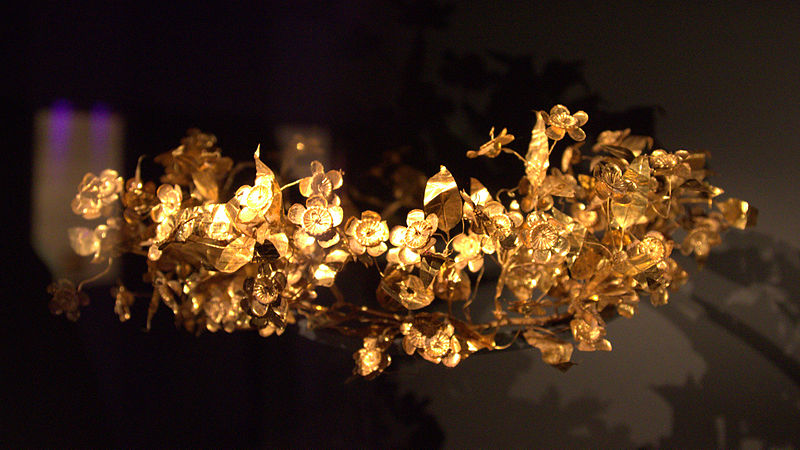
The famous case of the 4th-century BC gold wreath from Macedonia which was once worn by an unknown nobleman is just one of the best-known and most visually spectacular of these looted antiquities.

Used as a case study by Greek scholar Bettina Tsigarida as part of her master’s thesis, the infamous theft was the result of not only the original looting but of Greek and other authorities looking the other way, as well, allowing such cultural theft to take place. In addition, the Getty Museum’s acquisition of the golden wreath was made possible by what can only be charitably described as sloppy record-keeping on the part of one of the world’s largest museums.

The sum total of what can happen to a looted objet d’art or artifact can be seen in the Odyssey taken by the gold wreath in its journey from a grave to the Getty Museum, located in in Los Angeles, California.

Finally taking its rightful place in the Archaeological Museum of Thessaloniki in 2007, there was no guarantee that this happy ending would ever become a reality.

And it would not have happened at all without the likes of Dr. Tsirogiannis; journalist Nikolas Zirganos; prosecutor Ioannis Diotis; the then-head of the Greek police’s art squad, the late police Captain Giorgos Gligoris; and two Greek lawyers, Costantinos Kyriopoulos and Renia Stamatoudi.

They not only successfully liberated the priceless golden wreath from Macedonia but a marble archaic kore statue from Paros, a funerary stela from Orchomenos and a votive relief from Thasos Island as well, which had all been in the holdings of the huge Los Angeles museum.

The golden wreath, depicting myrtle flower branches, even still has some traces of green and blue enamel on it after the passage of millennia. Dating back to late 4th century BC, its first appearance on the black market for looted art dates back to 1990.

 An Italian man called Gianfranco Becchina received two photographs of the wreath that had been sent to him by a Greek smuggler in 1990. However, they did not come to an agreement as to the price for the wreath; it then somehow appeared in Munich in 1992.

It was part of an art exhibition in February of that year in Germany. A Serbian who went by the name of Kovacevits, and two Greek men named Tsatalis and Kagia, feasted their eyes on the treasure as part of the exhibition.

A painter, George Seliachas, told the three men that if they wanted to make deal for it, a good person to contact might be Christophe Leon — who ended up being the one to sell the wreath to Getty after stating on the official acquisition papers that it had come from a “private Swiss collection.” Conveniently, Leon hadn’t even filled in the box for the name of the country of origin for the priceless wreath. The Getty gave Leon a cool $1,150,000 for the looted grave goods, which had once graced the head of a Macedonian nobleman or noblewoman. However, questions had been asked of officials in Greece and Italy as to the provenance of the artifact and whether or not it had been stolen — to which the Greek officials answered in the negative.

After the Greek Art Squad asked the Ministry of Culture to work with it to get to the bottom of the theft, the Ministry refused, telling them in a confidential memorandum that it was taking care of the issue by diplomatic means. Greek journalist Nikos Zirganos unearthed these documents, publishing his exposé of the case in Epsilon magazine.

Eventually, Greek officials made a 180-degree turn, opening up a criminal investigation –not only of the Getty Museum but its curator as well. As a consequence, Marion True, Christoph Leon, the two Greek looters (now named as Georgios Tsatalis and Georgios Kagias) and the Serb middleman, Kovasevic, had charges brought against them in November of 2006.

Thanks to the tireless work of Tsirogiannis and the others, Greece negotiated the return of three other antiquities from the Getty as well — resulting in the repatriation of a 5th century BC marble relief from Thassos, a grave stele from Boeotia dating back to 400 BC. and a Kore statue.

All of the priceless looted artifacts finally returned home to Greece on March 26, 2007. The wreath now is displayed in all its splendor in the Archaeological Museum of Thessaloniki.

A special exhibit titled “The End of Antiquities Trafficking” was staged in 2007 at the Museum to highlight the cultural theft represented by these repatriated treasures. With a special section titled “The Abduction of History,” it highlighted the extraordinary objects that thankfully had been repatriated due to the efforts of Tsirogiannis and others.

Tsirogiannis told Greek Reporter in an exclusive interview this week “This wreath is a unique late 4th century B.C. artifact made by a highly-skilled Greek artist in central Macedonia, at the area around Thessaloniki. Other wreaths made with this technique and characteristics are attributed to the same Greek workshop.

“This wreath was most probably looted from a tomb, which remains unknown to us, so the story of the distinguished ancient Greek who was buried with this wreath and an unknown number of other artefacts, is erased and lost forever, because some people chose to steal from all of us and profit by selling our looted common heritage.

The subsequent trafficking took this wreath in the early 1990s to Germany and then to California, at the Getty museum, before we managed to bring it back to our homeland in 2007. I will always be proud for being one of the six-member team that represented Greece and brought this significant archaeological object back.”

But that kind of dogged determination on the part of art sleuths is rarely rewarded with such spectacular results. In its recent video on the subject of looted art, Interpol officials say that, tragically, there has been no letup recently in the trade of looted art and antiquities; quite the opposite is the case.

“The coronavirus has created a global crisis that threatens our shared cultural heritage. The antiquities coalition has already documented a worrisome increase in conditions that make the looting and the illicit trafficking of cultural material more likely right now. Tragically, we expect to see more looted artifacts on the market.” 

The Antiquities Coalition is now taking action to combat this shameful global trade.

Perhaps most disturbingly, looting — including from national museums — is helping to fund insurgency and civil war in a country that the UN says is suffering the worst humanitarian crisis in the world, Interpol notes. A case in point is a stunning alabaster stone with inscriptions from the third century AD that was taken from the Awam temple in Marib, Yemen as a result of the ongoing insurgency in that embattled nation.

For his part, Tsirogiannis is happy to continue to do what he can do ensure that priceless works of art that are part of his own heritage are returned to their rightful owners in Greece. He says that he is gratified that his life’s work has had an impact, stating “I am glad as a Greek, but also as a citizen of the world, I am contributing to helping governments repatriate their cultural property.” He tells Greek Reporter that his respect for our ancient ancestors is what drives him:

“It is the responsibility we have to our ancient ancestors and their feelings that have been brutally violated by the barbaric extraction of these objects. Some of these objects were buried in the tombs of the ancient people. They were dedicated to them. People grieved for their loss. They put these objects there with love and affection. Other objects were at the homes of ancient people, or they were dedicated to ancient gods, placed in sanctuaries and temples.” 

Tsirogiannis says “Thousands of years later, it is sacrilege for these antiquities to be looted for money and profit. This is what drives me mostly to continue my research.”

Oh, this is fun! Podcaster Dan has created a historic tour of Ancient Hellas using Assassin’s Creed The Odyssey to create a magnificent view of the Acropolis back in its glorious days. Learn about the history of ancient Hellas both in audio and video and check your understanding at the end of the episode. 


Ephesus, an ancient Hellenic city on the coast of Ionia, is one of the greatest archaeological treasures on Earth, with the entire city listed as a UNESCO World Heritage site. The great city, which went through endless transformations over the years as a result of earthquakes, wars and conquests, was founded in the 10th century BC on the site of the former Arzawan capital by Attic and Ionian Greek colonists.


The city was famous in its day for the nearby Temple of Artemis (completed around 550 BC), which was considered one of the Seven Wonders of the Ancient World. Its many monumental buildings included the Library of Celsus and a theater capable of holding no less than 24,000 spectators. Archaeologists estimate that the population of any ancient city was ten times that of the capacity of its largest theater; therefore, they believe the population of Ephesus was approximately 250,000.

Ephesus also had one of the “seven churches of Asia” referred to in the Book of Revelation. The Gospel of John may also have been written there, and it was the site of several 5th-century Christian Councils, including the Councils of Ephesus that took place in 431, 449 and 475 AD.

The city was destroyed by the Goths in their invasion in the year 263; although it was rebuilt, its great importance as a commercial center declined as its harbor was slowly silted up by the Meander River. In the year 614, it was partially destroyed by an earthquake. Eventually abandoned, this might have been a blessing in disguise for Ephesus, as its ancient ruins lie in plain sight, rather than being buried under centuries of buildings.

Today, the ancient city of Ephesus is a huge draw for international tourists and scholars because of its ancient provenance and its many historical treasures.

The areas around Ephesus were settled as far back as the Neolithic Age (about 6000 BC), as shown by evidence from excavations at the nearby artificial mounds known as “tells” in Arvalya and Cukurici. After being founded as an Attic-Ionian colony in the 10th century BC, the ruler Androklos drove away most of the native Carian and Lelegian inhabitants of the city and united his people with the remainder. He was a successful warrior, and as a king he was able to join the twelve cities of Ionia together into the Ionian League. During his reign the city began to prosper. Androklos and his dog are depicted on the Hadrian temple frieze, dating from the 2nd century.

A temple dedicated to the Egyptian god Serapis, which was also rediscovered in the ancient Greek city, was built in the 2nd century A.D. as a symbol of devotion to the Egyptian god; it is considered the best preserved and largest temple in all of Anatolia. It was constructed in an area measuring an astounding 7,700 square meters (194,520,997 square feet) while  the building alone measures over 1,000 square meters (10,764 square feet).

Although it was shaken by the earthquake, almost all of the temple’s pieces are still intact. The Ephesus Foundation has undertaken the restoration project, following the restoration of the city’s illustrious Celsius Library.

The Goddess Artemis and the great Anatolian Goddess Kybele were identified and worshipped together as “Artemis of Ephesus.” The many-breasted “Lady of Ephesus”, identified with Artemis, was venerated in the Temple of Artemis, which was the largest building in the ancient world, according to Pausanias.

The Temple of Artemis, one of the Seven Wonders of the Ancient World, once stood 418 feet by 239 feet with over 100 marble pillars each 56 feet high. The temple earned the city the title “Servant of the Goddess”.

Pliny tells us that the magnificent structure took 120 years to build but is now represented only by one lonely column, revealed during an archaeological excavation by the British Museum in the 1870s and still standing alone in the center of the ruins in a grassy field.

About 560 BC, Ephesus was conquered by the Lydians under King Croesus, who treated the inhabitants with respect and even became the main contributor to the reconstruction of the temple of Artemis. His signature has been found on the base of one of the columns of the temple (now on display in the British Museum). The city later fell to the Persian army commander Harpagos in 547 BC. The Persians then incorporated the Greek cities of Asia Minor into their Achaemenid Empire.

Ephesians participated in the Ionian Revolt against Persian rule in the Battle of Ephesus in 498 BC, which instigated the Greco-Persian wars. In 479 BC, the Ionians, together with Athens, were able to oust the Persians from the shores of Asia Minor. In 478 BC, the Ionian cities with Athens entered into the Delian League against the Persians.

During the Classical Roman period, which lasted from 129 BC to 395 AD, Ephesus, as part of the kingdom of Pergamon, became a subject of the Roman Republic, coming under its yoke in 129 BC after the revolt of Eumenes III was suppressed. Mark Antony was welcomed by Ephesus when he was proconsul of Rome; and again in 33 BC with Cleopatra ,when he gathered his fleet of 800 ships before the decisive Battle of Actium with Octavius. When Augustus became emperor in 27 BC, he made Ephesus the capital of proconsular Asia. According to the geographer Strabo, it was second in importance and size only to Rome.

Ephesus also served as an important center for early Christianity beginning as early as the AD 50s. From 52–54, the apostle Paul lived in Ephesus, working with the congregation and apparently organizing missionary activity into the hinterlands of Asia Minor. Initially, according to the Acts of the Apostles, Paul attended the Jewish synagogue in Ephesus, but after three months he became frustrated with the stubbornness of some of the Jews, and moved his base to the school of Tyrannus. Later a silversmith named Demetrios stirred up a mob against Paul, saying that he was endangering the livelihood of those making silver Artemis shrines.

Between 53 and 57 AD Paul wrote the letter known as 1 Corinthians from Ephesus — possibly from the “Paul tower” near the harbor, where he was imprisoned for a short time. Later, he wrote his Epistle to the Ephesians while he was in prison in Rome, around 62 AD. The Gospel of John might have been written in Ephesus a bit later, c. 90–100. Ephesus was one of the seven cities addressed in the Book of Revelation, indicating that the church of the city was already a major presence.

According to Eusebius of Caesarea, Saint Timothy was the first bishop of Ephesus. A legend, which was first mentioned by Epiphanius of Salamis in the 4th century, purported that the Virgin Mary may have spent the last years of her life in Ephesus. The Ephesians derived the argument from the apostle John’s presence in the city, and Jesus’ instructions to John to take care of his mother, Mary, after his death. Epiphanius, however, pointed out that while the Bible says John was leaving for Asia, it does not say specifically that Mary went with him. He later stated that she was buried in Jerusalem.

Since the 19th century, The House of the Virgin Mary, about 7 km (4 miles) from Selçuk, has been considered to have been the last home of Mary. It is still a popular place of Catholic pilgrimage. The city and temple were destroyed by the Goths in 263. This marked the first precipitous decline of the city’s ages of splendor. However, the emperor Constantine the Great rebuilt much of the city and even constructed new public baths. The Church of Mary near the harbor of Ephesus was the setting for the Third Ecumenical Council in 431, which resulted in the condemnation of Nestorius. A Second Council of Ephesus was held in 449.

Ephesus remained the most important city of the Byzantine Empire in Asia, however, after Constantinople, in the 5th and 6th centuries.The basilica of St. John was built during the reign of emperor Justinian I in the 6th century.

The importance of the city as a commercial center declined as the harbor was slowly silted up by the river despite repeated dredging during the city’s history. The loss of its harbour caused Ephesus to lose its access to the Aegean Sea, which was important for trade. People started leaving the city for the surrounding hills.

Eventually, the ruins of its great temples were tragically used as building blocks for new homes. Precious marble sculptures from antiquity were ground to powder to make lime for plaster. Sackings by the Arabs, first in the year 654–655 and later in 700 and 716, hastened the decline of the great city of Ephesus even further. By the time the Seljuk Turks conquered Ephesus in 1090, it was just a small village.

The Byzantines resumed control in 1097 and changed the name of the town to Hagios Theologos. They kept control of the region until 1308 — but by that time, the exquisite Temple of Artemis had been completely forgotten by the local population. It would have been lost to human memory completely if it were not for the excavation and restoration efforts of modern archaeologists.

The town surrendered, on October 24, 1304, to a Turkish warlord. Nevertheless, contrary to the terms of the surrender the Turks pillaged the church of Saint John and deported most of the local population to Thyrea, Greece. During these events many of the remaining inhabitants were cruelly massacred. The once-shining city of Ephesus, with its sweeping public spaces, temples and library, was completely abandoned by the 15th century.

But the city is still beloved by those who walk its broad, stone-paved central street and take in the breathtaking ruins of days gone by. Moreover, the ancient Greek city is set to once again have a harbor on the Aegean coast, as the result of an ambitious new project.

In the ancient era Ephesus, which is today one of Turkey’s top tourist attractions, was connected to a harbor on the Aegean Sea with a spacious canal, but the port and the canal became silted up by the river in the years since.

An ambitious canal project proposed by Turkey in 2018 pledged to uncover the canal and eventually link the ancient harbor city to the sea once again after a 6,130-meter length of the canal became covered with alluvial deposits over the centuries. So far, however, nothing has been done to make this project a reality.

The ruins of the once-glorious city still stand, however, and welcome visitors today from all over the world, continuing to tell the stories of its many illustrious inhabitants over the millennia.

The ancient Hellenic cremation burial site known as the “Tomb of Nestor’s Cup” found in 1954 on the island of Ischia in Italy has revealed some of its secrets, according to researchers, Live Science (LS) reported on October 6. Previously thought to contain the remains of a child, new analysis found that the nearly 3,000-year-old tomb “instead held the remains of at least three adults,” LS reported.

“This could help to explain a longstanding mystery: the presence in the tomb of a cup with a racy inscription that seemed out of place in a child's grave,” LS reported, adding that “the clay vessel, known as Nestor's Cup, bears a three-line boast ending with a promise that whoever drank from the cup would be smitten with desire for Aphrodite, goddess of beauty and love” and “experts have long puzzled over why such a message would be preserved in the burial of a child, and the recent findings may help to explain it, scientists reported in a new study.

“We can say that we re-opened a cold case,” lead study author Melania Gigante, a postdoctoral researcher in the Department of Cultural Heritage at the University of Padua in Italy, told LS in an email.

The burial is part of an ancient site called Pithekoussai, an ancient Greek city and necropolis on the island of Ischia in Italy,” LS reported, noting that “it dates to the eighth century BC, and archaeologists excavated approximatel LS reported, noting that “it dates to the eighth century BC, and archaeologists excavated approximately 1,300 tombs there between 1952 and 1982.”

"One of the tombs, identified as ‘Cremation 168,’ is more widely known as the ‘Tomb of Nestor's Cup’ after an inscribed vessel for drinking wine, known as a kotyle, that was discovered there,” LS reported, adding that “the cup bears one of the oldest surviving examples of Greek writing, the study authors reported Oct. 6 in the journal PLOS One.

In the epic Greek poem The Iliad, Homer described a beautiful golden cup that only its owner, the hero Nestor, could lift,” LS reported, noting that “according to legends of the time, adventurers would drink a fortifying beverage from its depths.

“By comparison, the clay vessel found in Tomb 168 is a simple cup,” LS reported, pointing out that “its inscription claims otherwise in a nod to Nestor's mythical goblet, according to the Joukowsky Institute for Archaeology and the Ancient World at Brown University in Providence, RI.

Three lines of text in the Greek alphabet are written on the clay cup in hexameter (a line of verse with six accents), thought to be an allusion to Homer's poetry,” LS reported, adding that “the text reads: ‘I am Nestor's cup, good to drink from. Whoever drinks this cup empty, straightaway Desire for beautiful-crowned Aphrodite will seize him,’ according to the institute.

“The burial held 195 bone fragments, and the researchers used microscopy to examine details in the surfaces and internal tissues, with some conclusive results on 175 fragments,” LS reported, noting that “to their surprise, they found that only 130 of the bones were human; 45 bone fragments came from animals. Some of those bones likely belonged to sheep, and other bones may have belonged to dogs and birds, but the pieces were so broken that the scientists were unable to identify most of the fragments with certainty, according to the study.

“When the scientists looked at the human bones — mostly bits of large bones from the arms and legs — they examined formations that emerge as bone tissue renews itself over time,” LS reported, adding that “by comparing the density of these formations across specimens, they saw that the fragments belonged to three individuals” and “the bones also indicated that the people were adults that were no longer growing; while it wasn't possible to determine how old they were or if they were related, the findings ruled out the possibility that the tomb held a child, the researchers wrote.

“Unfortunately, given the high fragmentation of the samples and the fire action, we are unable to say more. Human and animal remains showed similar burn patterns, hinting that they were burned together or using the same methods, and the animals in the grave may represent food offerings for the dead ‘or companions in the journey to the afterlife,’ according to the study.

I am not surprised to have received yet another confirmation of how much there is still to be discovered about Pithekoussai,” Gigante told LS. “This study is only the first step towards a more complete interpretation not only of the Tomb of Nestor's Cup, but also of the customs and funerary uses at the dawn of Magna Graecia [Greater Greece].” y 1,300 tombs there between 1952 and 1982.”

One of the tombs, identified as ‘Cremation 168,’ is more widely known as the ‘Tomb of Nestor's Cup’ after an inscribed vessel for drinking wine, known as a kotyle, that was discovered there,” LS reported, adding that “the cup bears one of the oldest surviving examples of Greek writing, the study authors reported Oct. 6 in the journal PLOS One.

In the epic Greek poem The Iliad, Homer described a beautiful golden cup that only its owner, the hero Nestor, could lift,” LS reported, noting that “according to legends of the time, adventurers would drink a fortifying beverage from its depths.

By comparison, the clay vessel found in Tomb 168 is a simple cup,” LS reported, pointing out that “its inscription claims otherwise in a nod to Nestor's mythical goblet, according to the Joukowsky Institute for Archaeology and the Ancient World at Brown University in Providence, RI.

Three lines of text in the Greek alphabet are written on the clay cup in hexameter (a line of verse with six accents), thought to be an allusion to Homer's poetry,” LS reported, adding that “the text reads: ‘I am Nestor's cup, good to drink from. Whoever drinks this cup empty, straightaway Desire for beautiful-crowned Aphrodite will seize him,’ according to the institute.

The burial held 195 bone fragments, and the researchers used microscopy to examine details in the surfaces and internal tissues, with some conclusive results on 175 fragments,” LS reported, noting that “to their surprise, they found that only 130 of the bones were human; 45 bone fragments came from animals. Some of those bones likely belonged to sheep, and other bones may have belonged to dogs and birds, but the pieces were so broken that the scientists were unable to identify most of the fragments with certainty, according to the study.

When the scientists looked at the human bones — mostly bits of large bones from the arms and legs — they examined formations that emerge as bone tissue renews itself over time,” LS reported, adding that “by comparing the density of these formations across specimens, they saw that the fragments belonged to three individuals” and “the bones also indicated that the people were adults that were no longer growing; while it wasn't possible to determine how old they were or if they were related, the findings ruled out the possibility that the tomb held a child, the researchers wrote.

Unfortunately, given the high fragmentation of the samples and the fire action, we are unable to say more. Human and animal remains showed similar burn patterns, hinting that they were burned together or using the same methods, and the animals in the grave may represent food offerings for the dead ‘or companions in the journey to the afterlife,’ according to the study.

I am not surprised to have received yet another confirmation of how much there is still to be discovered about Pithekoussai,” Gigante told LS. “This study is only the first step towards a more complete interpretation not only of the Tomb of Nestor's Cup, but also of the customs and funerary uses at the dawn of Magna Graecia [Greater Greece].”

I love learning about women's hair from the ancient Hellenic period. Hair has long had an important role in society and religion. During the classical period female citizens wore their hair long except when they were in mourning during which they cut their hair short. Before the fifth century BC women's hair was allowed to fall over the shoulders and back, but it was often fastened by a headband or diadem, and the front section of the hair was restrained. After that, hair was often restrained.  Female citizens, especially, wore their hair long, and after their marriage--usually at a very early age--they wore their hair up in elaborate styles. Typically, only their immediate family and servants saw Hellenic women with their hair undone.

This video (link here in case the embed function craps out) shows some of the ellaborate hairstyles for women from the classical age. Enjoy! 

The source of marble for a statue of Apollon on the Greek island of Delos has been a mystery to art historians and archaeologists for decades. The stone’s chemistry pointed geochemists to the southern end of the nearby island of Naxos, but no one thought there were ancient marble quarries there. A geoarchaeologist believes he found the source.

“We had actually been told that we were not going to find what we were looking for,” says geoarchaeologist Scott Pike of Willamette University. But after two field seasons traipsing across Mediterranean shrublands, Pike believes he has found the source. He is presenting his findings on Monday, 11 October 2021 at the Geological Society of America’s GSA Connects 2021 annual meeting in Portland, Ore.

The Greek Archaic period (approximately 800 to 480 B.C.E.) is known in part for its “larger-than-life” kouros statues, which depicted young men. Together, the massive Apollon kouros on Delos would stand around ten meters (33 feet) high, although today it is broken into several parts. The massive marble chunks are white and worn; at a glance, some of the pieces hardly resemble parts of a human figure. But the statue has drawn researchers all the same. Searching for its source was sparked in part by an ambiguous inscription at its base, roughly translated as, “I am of the same stone, statue and plinth,” with a later addition stating that the kouros was “from the Naxians, to Apollo,” according to Pike.

It was not clear whether the inscription referred to the statue’s structure, being hewn from a single piece of marble, or the origin of its stone. Pike sampled various parts from the statue — a hand, the upper and lower torso, a bit of leg — and analyzed its carbon and oxygen isotopic composition. That composition can be used to trace the marble source by comparing it against other analyzed marbles, like finding a fingerprint match in a database.

“The analyses showed the marble came from Naxos, but from a region where there hasn’t been any evidence of ancient quarrying. We know that there are two quarries in the northern part of the island, where there are still large kouroi in place in the quarries. But we didn’t know of any ancient quarries in the south,” says Pike.

Pike headed to the southern side of Naxos, despite locals assuring him his efforts were in vain. He relied on local knowledge of other archaeological sites and geologic maps to guide him as he “scoured the landscape” looking for, essentially, outcrops of white marble and possible small pits. Remnants of Archaic quarries bear little resemblance to the vast open-pit mines humans create today and were difficult for Pike to find.

After a couple of weeks of searching, Pike began finding small bands of white marble that were not marked on the geologic maps. Some were close to archaeological sites, giving Pike some confidence that these small quarries could be the source.

“Finding what we were looking for was exciting because being told several times that you’re not going to find anything is discouraging, but we knew,” Pike says. “The evidence pointed to the south. I felt the most Indiana Jones I’ll ever be.”

Back in the lab, Pike analyzed his marble samples and found that two of the newly-uncovered southern white marbles were good matches for the Apollon kouros at Delos. Knowing that these early marble quarries exist in the south of the island will be helpful for tracing the source for other ancient marble artifacts, such as older Bronze Age Cycladic figurines that have puzzled geoarchaeologists. It also has implications for knowledge of commerce at the time.

“Knowing now that there is a marble source on Naxos for these Bronze Age statues and figurines will place the region more in the center of commerce, trade and influence than had been previously understood,” Pike says.


The British government has said that it will not abide by a recent UNESCO decision on the Parthenon Marbles.

It also insisted that “the Parthenon Sculptures were acquired legally” and rejected UNESCO’s call to reconsider its position and to negotiate with Greece on the return of the 2,500-year-old cultural treasures. Speaking to Greek newspaper Ta Nea, a government spokesperson said that the UK government “disagrees” with the decision, adding that it intends to challenge it before UNESCO.

The response came after the UNESCO’s Intergovernmental Committee for Promoting the Return of Cultural Property (ICPRCP) voted unanimously for the first time at its 22nd session to include the return of the Parthenon Marbles in its decision document, marking a major step forward since Greece first introduced the request to the meeting’s agenda in 1984.

ICPRCP’s decision says that Greece’s request for the return of the Parthenon Sculptures is “legitimate and rightful” and calls on Britain “to reconsider its stand and proceed to a bona fide dialogue with Greece on the matter”.

Most importantly, the Committee acknowledges for the first time that “the case has an intergovernmental character and, therefore, the obligation to return the Parthenon Sculptures lies squarely on the UK Government “.

This is in stark contrast to the UK government’s assertion that it is for the British Museum, not the government, to discuss the issue and make decisions related to it.

“We disagree with the Committee’s decision adopted in the closing minutes of the session and are raising issues relating to fact and procedure with UNESCO,” a UK government spokesperson told Ta Nea.

A British Museum spokesperson told Ta Nea that “the Trustees of the British Museum have a legal and moral responsibility to preserve and maintain all the collections in their care,” adding that “the Parthenon Sculptures are an integral part of (the Museum’s collection) story and a vital element in this interconnected world collection”.

Greece insists that it is the rightful owner of the Parthenon Marbles. The Greek government says that the sculptures were illegally removed from the Parthenon during the Ottoman occupation of Greece in the early 1800s.

In his first interview with a European newspaper since becoming the UK’s prime minister, Boris Johnson dashed Greece’s hopes of getting the Marbles back, telling Greek daily Ta Nea that they were “legally acquired by Lord Elgin under the appropriate laws of the time and have been legally owned by the British Museum’s Trustees since their acquisition.”

Britain had previously rejected Greece’s request to hold talks on returning the Marbles after Athens proposed a meeting between experts from the two countries.

“We are all very glad about the outcome of the UNESCO meeting in Paris last week, where the Parthenon Sculptures were an item on the Agenda, and this now for nearly 40 years, ever since Melina Mercouri raised the issue in 1984. We congratulate Greece for its efforts to achieve this outcome and do hope that the UK will finally reconsider its stand and enter in a dialogue with Greece”, Dr Christiane Tytgat, President of the International Association for the Reunification of the Parthenon Sculptures (IARPS), told Ta Nea.

“The Trustees and the British Museum cannot eternally ignore the growing pressure to return the Parthenon Sculptures, nor can they close their eyes for a growing consciousness when it comes to the legitimated acquisition of artefacts. The day will come when we see the Parthenon Sculptures reunited in the Acropolis Museum. At least, there they can be seen, shining through the glass wall of the Parthenon room, even if the Museum is closed, day and night, 7 days a week, at the foot of the Acropolis, in visual contact with the Parthenon,” Dr Tytgat added.


The British Museums’ comment to Ta Nea in full:

“The British Museum has a long history of collaboration with UNESCO and admires and supports its work. The Trustees of the British Museum have a legal and moral responsibility to preserve and maintain all the collections in their care and to make them accessible to world audiences. The Trustees want to strengthen existing good relations with colleagues and institutions in Greece, and to explore collaborative ventures directly between institutions, not on a government-to-government basis. This is why we believe that working in partnership across the world represents the best way forward. Museums holding Greek works, whether in Greece, the UK or elsewhere in the world, are naturally united to show the importance of the legacy of ancient Greece. The British Museum is committed to playing its full part in sharing the value of that legacy.

“The Museum takes its commitment to be a world museum seriously. The collection is a unique resource to explore the richness, diversity and complexity of all human history, our shared humanity. The strength of the collection is its breadth and depth which allows millions of visitors an understanding of the cultures of the world and how they interconnect – whether through trade, migration, conquest, conflict, or peaceful exchange.

“The Parthenon Sculptures are an integral part of that story and a vital element in this interconnected world collection, particularly in the way in which they convey the influences between Egyptian, Persian, Greek and Roman cultures. We share this collection with the widest possible public, lending objects all over the world and making images and information on over four million objects from the collection available online.

“The approach of the Acropolis Museum and the British Museum are complementary: the Acropolis Museum provides an in-depth view of the ancient history of its city, the British Museum offers a sense of the wider cultural context and sustained interaction with the neighbouring civilisations of Egypt and the Near East which contributed to the unique achievements of ancient Greece”.

The Tomb of Nestor’s Cup, a burial that contained one of the oldest known Greek inscriptions, housed the cremated remains of at least three individuals, it turns out. A new study sheds some light on this enigmatic burial from nearly 2,800 years ago on a southern Italian island, but still doesn’t tell us who exactly was laid to rest there, or why they were memorialized with a dirty limerick that mocks the epic poetry of Homer’s Iliad and Odyssey.

First uncovered in the 1950s, the tomb was one of thousands of burials in the necropolis of Pithekoussai, one of the first overseas colonies of the ancient Greeks, located on the picturesque island of Ischia, just off Naples.

The burial contained a rich set of grave goods, including a silver brooch and two dozen fragmented pottery vessels. But what captured the attention of the archaeologists was a small ceramic wine cup dated to second half of the eighth century B.C.E.

Decorated with simple black geometric motifs, the cup had been imported from the Greek island of Rhodes. At some point after it was made, somebody scribbled on it the following text: “I am Nestor’s cup, good to drink from. Whoever drinks this cup empty, straightaway desire for beautiful-crowned Aphrodite will seize him.”

The inscription is fragmentary so the exact translation is a matter of some debate, and some scholars read the first part as reciting “Nestor’s cup was good for drinking, but whoever drinks from this cup… etc. etc.

The text is a clear, if somewhat parodic, reference to Nestor, king of Pylos and one of the Greek heroes in Homer’s Iliad. Nestor owned a giant golden chalice so heavy that, when it was filled with wine, “another man could scarce have availed to lift that cup from the table.” (Iliad, book 11, 635)

Previous studies of those fragments concluded that the tomb belonged to a child ages 10 to 14. That was even more surprising: yes, children in ancient Greece could be the introduced to wine as early as age 3 (especially since alcohol could often be safer than water taken form polluted sources). But still, a funerary offering with an inscription promising lustful delights seemed more suited for a raucous banquet than a child’s burial.

Now, a new study, published Wednesday in the journal PLOS ONE, has reexamined those burnt fragments performing a microscopic analysis of the bone tissues.

Of 195 fragments in the tomb, only about 130 were human, while at least 45 belonged to animals, including goats and possibly dogs. These may have been included as food and/or companions for the deceased, says Melania Gigante, a bioarchaeologist at the University of Padua, who led the study.

As for the human fragments, Gigante and colleagues analyzed the amount of bone remodeling that had occurred in the remains. During our lifetime, old bone tissue is constantly being replaced with newly formed bone, in a process that leaves microscopic evidence of how much remodeling has occurred, Gigante explains. This in turn can give us an indication of an individual’s age at death, she says.

The bone fragments could be grouped into three distinct age groups, the researchers found, meaning that at least three individuals were buried in the tomb. While heat damage from the cremation made it impossible to determine their ages with precision, none of the bones belonged to a child, Gigante and colleagues conclude.

The triple burial is unique in Pithekoussai’s necropolis, where all the tombs that contained non-cremated remains were found to house one or two individuals at most, Gigante tells Haaretz. Burial within the same tomb usually indicates there was a bond between the deceased, but whether in the Tomb of Nestor’s Cup these ties were familial, social or of some other kind we will probably never know. The extensive damage from the cremation fire makes it impossible to extract DNA from the remains to check whether the deceased were kin, she notes.

Still, Gigante hopes future research will be able to reveal more about those buried with Nestor’s Cup. This artifact and its context have fascinated scholars for decades, for a number of reasons.

Firstly, the cup gives us some crucial information about the history of Homer’s poems and their composition. It suggests that by the eighth century B.C.E. the oral traditions that formed the epic story of the Trojan war must have already been put in writing and widely circulated across the Mediterranean – to the point that they could inspire satirical imitation at Pithekoussai.

The inscription also gives us information about the early history of the alphabet itself. Nestor’s Cup is considered one of the two earliest known texts written in the Greek alphabet. The other is the Dipylon inscription, a shorter text which was found in the Dipylon Cemetery in Athens. It too is dated to the second half of the eighth century B.C.E. and scribbled on a wine jug (apparently the ancient Greeks really liked to drink and write).

The phonetic alphabet that eventually became the basis for most modern western writing systems is believed to have first been developed nearly 4,000 years ago by Canaanite laborers in Egypt who couldn’t handle hieroglyphics. Over the centuries, the alphabetic system spread back to the Levant and was adopted by the Phoenicians. Sailing from the coast of what is today northern Israel and Lebanon, Phoenician merchants and colonists spread throughout the Mediterranean taking with them their script and giving rise to variants of their alphabet used to write Hebrew, Arabic, Greek, Latin and other languages.

We don’t know exactly where the Phoenicians and the ancient Greeks first met, but Pithekoussai was most probably one of the earliest points of contact. The settlement on Ischia was founded by Greeks from the island of Euboea in the early eighth century B.C.E. – and is considered the first Greek colony in the western Mediterranean. At the same time the Phoenicians had already expanded across the region, founding colonies like Carthage, in today’s Tunisia, which would later play its own key role in history.

Pithekoussai was in an ideal position to function as a key trading post, not only with the Phoenicians, but also with the Etruscans, Latins and other local Italic peoples.

And in fact, archaeological finds at the ancient settlement and its necropolis have shown that the residents of the colony, who numbered in the thousands, likely hailed from all these groups and formed a cultural melting pot. 

Different funerary rites, like the co-existence of cremation and burial; artifacts of Greek, Italic and Phoenician origin; and ancient written sources all point to “Pithekoussai as a mixed society composed of different cultural and ethnic identities where people with non-native ancestries and origins lived together with the locals,” Gigante says.

Nothing exemplifies better this Mediterranean melting pot as Nestor’s cup: a ceramic vessel from Rhodes, inscribed with a reference to Greek myths on a war in Anatolia written in an alphabet influenced by the Phoenicians, buried in a tomb on an Italian island.

Perhaps Nestor’s Cup and its bawdy limerick were nothing more than the result of a drinking game or the halting debut of an aspiring poet, but for us they open up a glimpse onto an entire world from thousands of years ago. This world has long turned to dust, but it has also influenced our present in more ways than we can imagine – including by shaping the letters you are reading right now.

In a potentially game-changing development in Athens’ near 40-year campaign to repatriate the Parthenon Marbles, currently exhibited at the British Museum, a UNESCO committee has issued a decision urging the United Kingdom to enter into talks with Greece over the dispute.

Sources told Ekathimerini the decision by the “Return and Restitution” intergovernmental committee, also known as ICPRCP, at its session in Paris late September “shook” British officials as it effectively elevated the dispute between Greece and the London-based institution into a government-to-government issue.

The decision marks a shift in ICPRCP policy, which had over the past 34 years issued 17 recommendations.

Speaking to Ekathimerini, a spokesperson for the British Museum did not directly comment on the development.

“Museums holding Greek works… are naturally united to show the importance of the legacy of ancient Greece,” the spokesperson said, adding that the institution “is committed to playing its full part in sharing the value of that legacy.”

“The trustees want to strengthen existing good relations with colleagues and institutions in Greece, and to explore collaborative ventures directly between institutions, not on a government-to-government basis,” the spokesperson said. 

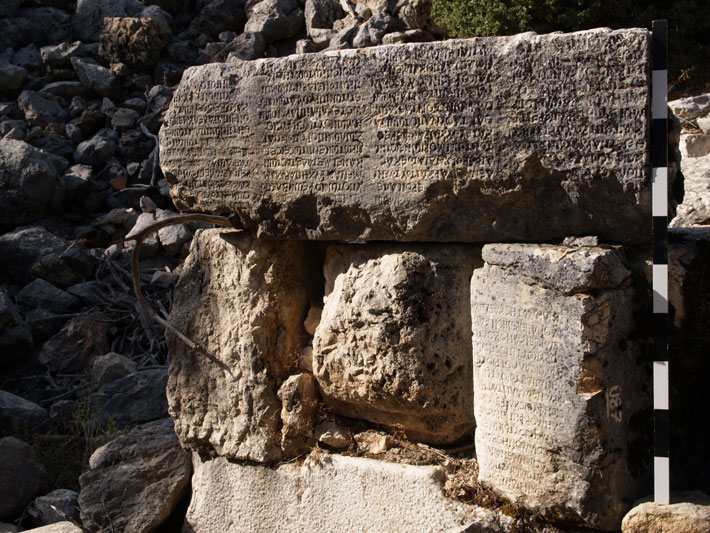
At a remote site in Turkey, archaeologists recently discovered fragments of the ancient world’s most massive inscription — and of course, it was in Greek — touting the benefits of the philosophy of Epicureanism.

The inscription, a quote from the Second century AD philosopher Diogenes, exhorts readers to follow Epicureanism, the way of life that encourages its adherents to seek modest, sustainable pleasure in the form of a state of ataraxia (tranquility and freedom from fear) through knowledge of the workings of the world, and limiting their desires.

One of ancient Hellas’s most notable schools of philosophy, it was created by Epicurus, who lived in the fourth century BC. Originally meant as a challenge to Platonism, it propounded the avoidance of all things that would cause pain in life along with the seeking of all that was just and desirable. Later opposed by the Stoics, it has at times been equated with the inordinate love of food and all things sensual, but this was far from the ideal as espoused by Epicurus.

One of the many schools of the ancient Hellenic philosophers, Epicureanism had one of its most zealous believers in Diogenes of Oenoanda, a wealthy disciple, who had a portico wall inscribed with tenets of the philosophy erected in the ancient Hellenic city of Oenoanda, Lycia.

Epicurus was an atomic materialist, leading him to assail the evils of superstition and divine intervention in every single event — such as weather — that occurred on the Earth.

Although Epicureanism is a form of hedonism insofar as it declares pleasure to be its sole intrinsic goal, its concept that the absence of pain and fear constitutes the greatest pleasure, and its advocacy of a simple life, make it very different from hedonism, or the unbridled pursuit of bodily pleasures.

Epicureanism flourished in the Late Hellenistic era and during the Roman era, and its followers established their own communities, such as those in Antiochia, Alexandria, Rhodes, and Herculaneum.

By the late 3rd century AD Epicureanism all but died out, however, being opposed by other philosophies (mainly Neoplatonism) that were now in the ascendant, as well as early Christianity. But interest in Epicureanism was resurrected in the Age of Enlightenment and it continues today in the modern era.

In Oinoanda, we can see just how much the philosophy meant to Diogenes, who inscribed his words in support of Epicureanism on the wall of a stoa, or portico, in a public square. Later dismantled and reused as building material by the Ottomans, the monumental rock with its inscription has at least survived to this day, a testament to a bygone world.

In the winter of 1884, two young French epigraphers who were exploring the ruins of the ancient city, located in what is now southwestern Turkey, discovered five stone fragments inscribed with the writings of the long-forgotten philosopher now known as Diogenes of Oinoanda.

Scattered in ruins on a hilltop that was by then covered in cedar trees, they found the massive stone with its inscription, in which Diogenes explains why he committed his thoughts to posterity.

“The majority of people suffer from a common disease, as in a plague, with their false notions about things, and their number is increasing. …I wished to use this stoa to advertise publicly the (medicines) that bring salvation.”

His words, now made immortal by having them carved into stone, make clear that he hoped Oinoandans and others who gazed at the stone would consider his words and be converted to the Epicurean school of thought.

After the discovery of the five fragments was published and their significance understood, French and Austrian archaeological teams visited the area between 1885 and 1895, recovering another 83 fragments of the inscription.

Today, it remains the only ancient philosophical text from the Hellenic and Roman world to have survived in its original form, according to Archaeology Magazine. A translation of the entire stone reads, in part: 

“As for the first bodies, also called elements, which on the one hand have subsisted from the beginning and are indestructible, and on the other hand generate things, we shall explain what they are after we have demolished the theories of others.”

Epicureanism argued that pleasure was the chief good in life, advocating living in such a way as to derive the greatest amount of pleasure possible during one’s lifetime, yet doing so moderately in order to avoid the suffering incurred by overindulgence in such pleasure.

The philosophy is often misunderstood, with an emphasis actually placed on pleasures of the mind rather than on physical pleasures. Unnecessary desires were to be suppressed, according to Epicurus.

The philosopher also sought to eliminate the irrational fear of the Gods and of death, seeing those two fears as chief causes of strife in life. He also actively recommended against passionate love, as an unnecessary desire that should be avoided.

“I learn that your bodily inclination leans most keenly towards sexual intercourse. If you neither violate the laws nor disturb well established morals nor sadden someone close to you, nor strain your body, nor spend what is needed for necessities, use your own choice as you wish. It is sure difficult to imagine, however, that none of these would be a part of sex because sex never benefitted anyone.”

Epicurus taught and gained followers in Mytilene, the capital of the island Lesbos, and then in Lampsacus and Athens, Epicurus bought a property in Athens for his school, which he called the “Garden.” Emphasizing friendship as an important ingredient of happiness, the Epicurean schools were very open to new adherents and fairly cosmopolitan by Athenian standards of the day — even including women and slaves among their ranks.

Epicurus laid such emphasis upon developing friendships as the basis of a satisfying life that he said, as quoted by Cicero:

“Of all the things which wisdom has contrived which contribute to a blessed life, none is more important, more fruitful, than friendship.”

The philosophy’s popularity grew and it became, along with Stoicism, Platonism, Peripateticism, and Pyrrhonism, one of the dominant schools of Hellenistic philosophy, lasting through the later Roman Empire.

Deciphered carbonized scrolls obtained from the library at the Villa of the Papyri in Herculaneum contain a large number of works by Philodemus, a late Hellenistic Epicurean, and even Epicurus himself, attesting to the school’s enduring popularity.

While the pursuit of pleasure formed the focal point of the philosophy, this was largely directed to minimizing pain, anxiety and suffering. In fact, Epicurus referred to life as a “bitter gift” in his “Letter to Menoeceus”.

“When we say … that pleasure is the end and aim, we do not mean the pleasures of the prodigal or the pleasures of sensuality, as we are understood to do by some through ignorance, prejudice or wilful misrepresentation. By pleasure we mean the absence of pain in the body and of trouble in the soul. It is not by an unbroken succession of drinking bouts and of revelry, not by sexual lust, nor the enjoyment of fish and other delicacies of a luxurious table, which produce a pleasant life; it is sober reasoning, searching out the grounds of every choice and avoidance, and banishing those beliefs through which the greatest tumults take possession of the soul.”

The Epicurean understanding of justice was inherently self-interested; it was deemed good because it was seen as mutually beneficial.

Epicureanism rejects immortality. From this doctrine arose the Epicurean Epitaph, “Non fui, fui, non sum, non curo (“I was not; I have been; I am not; I do not mind.”), which is inscribed on the gravestones of his followers and seen on many ancient gravestones of the Roman Empire.

Regarding ataraxia (tranquility, freedom from fear) and aponia (absence of pain) as the height of happiness, Epicurus considered prudence an important virtue, and perceived excess and overindulgence to be contrary to the attainment of ataraxia and aponia.

Epicurus preferred “the good”, and “even wisdom and culture”, to the “pleasure of the stomach,” dividing pleasure into two broad categories: the pleasures of the body and the pleasures of the mind.

One can only experience pleasures of the body in the moment, meaning they only exist as a person is experiencing them, while pleasures of the mind involve mental processes and states; feelings of joy, the lack of fear, and pleasant memories.

These pleasures of the mind do not only exist in the present, but also in the past and future, since memory of a past pleasant experience or the expectation of some potentially pleasing future can both be pleasurable experiences. Because of this, the pleasures of the mind are considered to be greater than those of the body.

“Vain and empty” desires, according to Epicurus, are neither innate to humans nor required for happiness or health; indeed, they are also limitless and can never be fulfilled. Desires of wealth or fame would fall in this class, and such desires are to be avoided because they will ultimately only bring about discomfort.

Epicurus was also one of the first Western thinkers to develop the notion of justice as a social contract. The point of living in a society with laws and punishments is to be protected from harm so that one is free to pursue happiness, he believed. Because of this, laws that do not contribute to promoting human happiness are not just.

“It is impossible to live a pleasant life without living wisely and well and justly, and it is impossible to live wisely and well and justly without living a pleasant life.”

Epicureanism, which incorporated much of social contract theory, attempts to address issues with the society described in “Plato’s Republic.” The Epicurean way of life also resembles Buddhism in its temperateness, including the belief that great excess leads to great dissatisfaction.

The Epicureans believed that all sense perceptions were true, and that errors arise in how we judge those perceptions. For example, if someone sees a tower from far away that appears to be round, and upon approaching the tower they see that it is actually square, they would come to realize that their original judgement was wrong and correct their wrong opinion.

Since Epicureans thought that sensations could not deceive, sensations are the first and main criterion of truth for Epicureans. Even in cases where sensory input seems to mislead, the input itself is true and the error arises from our judgments about the input.

For example, when one places a straight oar in the water, it appears bent. The observer makes the error in assuming that the image he or she receives correctly represents the oar and has not been distorted in some way.

In order to not make erroneous judgments about perceivable things and instead verify one’s judgment, Epicureans believed that one needed to obtain “clear vision” (enargeia) of the perceivable thing by closer examination.

One adherent to the teachings of Epicurus included the poet Horace, whose famous statement Carpe Diem (“Seize the Day”) illustrates the philosophy.

“If I had time I would add to my little book the Greek, Latin and French texts, in columns side by side. And I wish I could subjoin a translation of Gassendi’s Syntagma of the doctrines of Epicurus, which, notwithstanding the calumnies of the Stoics and caricatures of Cicero, is the most rational system remaining of the philosophy of the ancients, as frugal of vicious indulgence, and fruitful of virtue as the hyperbolical extravagances of his rival sects.”

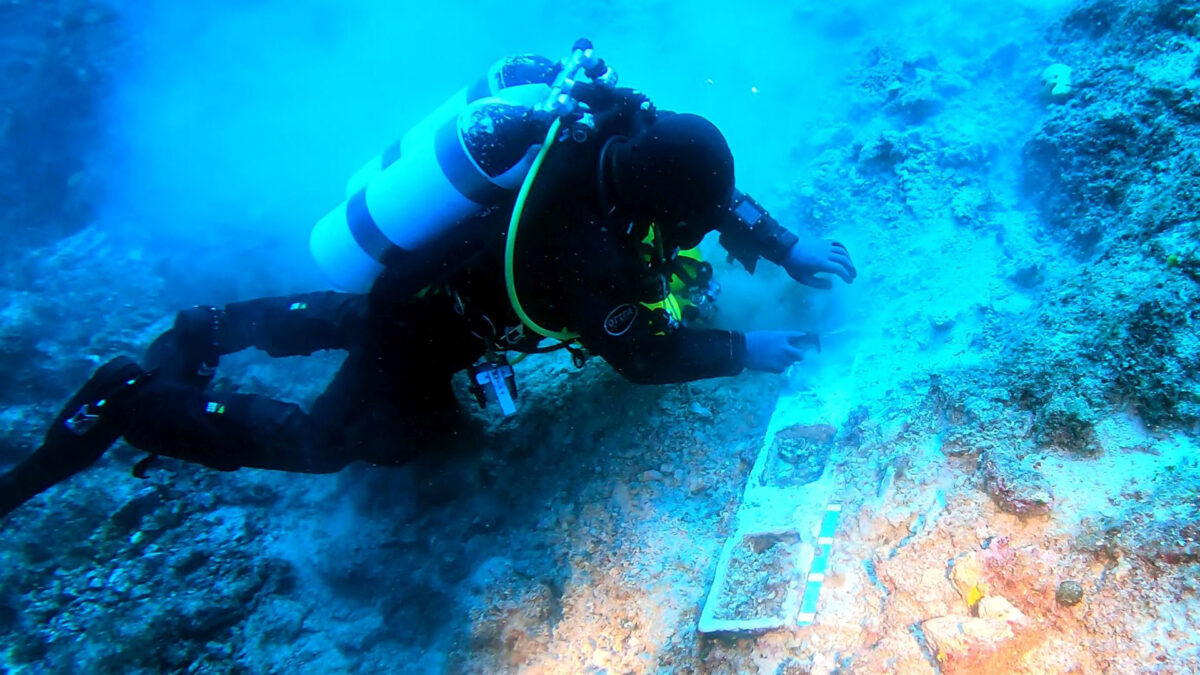
Cambridge Journals present a brand new research collection on the Battles of Thermopylae and Salamis – marking 2500 years since the Persian invasion of 480 BC descended on the Greek peninsula. 

Foreword from Chris Carey, a British classical scholar and Professor Emeritus of Greek at University College London.

“2500 years ago this year a massive Persian force descended into Greece. How massive we cannot say. Ancient figures for Persian numbers are wildly exaggerated from the very start. Just a few years after the war an inscription at Thermopylae, site of the first engagement between Greek forces and the invaders, gave a figure of 3 million for the land army. Modern figures by different means generally reduce that figure to about 200,000. Even that may be far too high. But on any calculation this was the biggest force ever seen on the Greek peninsula at that date... It is this pivotal moment which forms the focus of the essays and chapters contained in this selection of works from the classical journals. It designedly contains work published at different periods over the last century. It makes no attempt at comprehensive cover, if that were possible. But it does contain some superb scholarship, and hopefully food for thought.”

The full article collection can be found here on the Cambridge University Press website.

Access to these Cambridge Journal academic articles is free until the end of October 2021.

An archaeological discovery in Turkey resulted in the unearthing of dozens of terracotta figurines depicting ancient Hellenic Gods, men, women, and animals. The artifacts, which are over 2,000 years old, were found in the ancient town of Myra, which is now called Demre, in Turkey. Some of the figurines incredibly still had paint on them, and others had inscriptions, providing archaeologists with a view of life in the region in the 1st and 2nd centuries BC.

Nevzat Çevik, the leader of the excavation team and Archaeology Professor at Akdeniz University in Turkey, told Live Science that “Myra is one of the most important ancient settlements in Lycia.” Myra remained an important site throughout history, as the ancient Hellenes, Romans, Byzantines, and later the Ottomans inhabited the town.

In the modern era, the town was home to a rich and vibrant Greek population that was forced to leave Turkey during the population exchange between Greece and the country in the 1920s. 

The figurines give “rich clues about what existed in the mysterious Myra under a thick silt layer in the first and second centuries BC,” Çevik added.

The archaeological team was excavating parts of a 4th-century Roman theater between June and October of 2020 when they suddenly unearthed a second, smaller theater below the Roman remains. The older structure underneath dates back to the Hellenistic period, from 323 BC — at the time of the death of Alexander the Great — to the beginning of the Roman Empire in 30 BC.

What the researchers found was the massive collection of terracotta figurines scattered amongst the remains, along with the Hellenistic theater.

“It is as if the people of ancient Myra were resurrected and ran through the time tunnel all together and came to our day,” Çevik told his team when they found the figurines. There is an almost uncountable number of ancient Hellenic and Byzantine archaeological and historical sites in Turkey, many of which attract hundreds of thousands, even millions, of visitors every year.

Many of them are landmarks not to be missed by any travelers to Turkey, and they should especially not be missed by Greek travelers, since they are incontrovertible evidence of their people’s long, rich history and contributions to Western civilization.

New research into a little-known text written in ancient Hellenic shows that "stressed poetry," the ancestor of all modern poetry and song, was already in use in the 2nd Century CE, 300 years earlier than previously thought.


In its shortest version, the anonymous four-line poem reads "they say what they like; let them say it; I don't care." Other versions extend with "Go on, love me; it does you good."

The experimental verse became popular across the eastern Roman Empire and survives because, as well as presumably being shared orally, it has been found inscribed on twenty gemstones and as a graffito in Cartagena, Spain.

By comparing all of the known examples for the first time, Cambridge's Professor Tim Whitmarsh (Faculty of Classics) noticed that the poem used a different form of meter to that usually found in ancient Greek poetry. As well as showing signs of the long and short syllables characteristic of traditional "quantitative" verse, this text employed stressed and unstressed syllables.

Until now, "stressed poetry" of this kind has been unknown before the fifth century, when it began to be used in Byzantine Christian hymns. Professor Whitmarsh says:

"You didn't need specialist poets to create this kind of musicalized language, and the diction is very simple, so this was a clearly a democratizing form of literature. We're getting an exciting glimpse of a form of oral pop culture that lay under the surface of classical culture."

The new study, published in The Cambridge Classical Journal, also suggests that this poem could represent a "missing link" between the lost world of ancient Mediterranean oral poetry and song, and the more modern forms that we know today.

The poem, unparalleled so far in the classical world, consists of lines of 4 syllables, with a strong accent on the first and a weaker on the third. This allows it to slot into the rhythms of numerous pop and rock songs, such as Chuck Berry's "Johnny B. Goode." Whitmarsh says: 

"We've known for a long time that there was popular poetry in ancient Greek, but a lot of what survives takes a similar form to traditional high poetics. This poem, on the other hand, points to a distinct and thriving culture, primarily oral, which fortunately for us in this case also found its way onto a number of gemstones."

Asked why the discovery hasn't been made before, Whitmarsh says:

"These artifacts have been studied in isolation. Gemstones are studied by one set of scholars, the inscriptions on them by another. They haven't been seriously studied before as literature. People looking at these pieces are not usually looking for changes in metrical patterns."

Whitmarsh hopes that scholars of the medieval period will be pleased: 

"It confirms what some medievalists had suspected, that the dominant form of Byzantine verse developed organically out of changes that came about in classical antiquity."

In its written form (which shows some minor variation), the poem reads:

Λέγουσιν            They say
ἃ θέλουσιν         What they like
λεγέτωσαν         Let them say it
οὐ μέλι μοι         I don’t care
σὺ φίλι με           Go on, love me
συνφέρι σοι       It does you good

The gemstones on which the poem was inscribed were generally agate, onyx or sardonyx, all varieties of chalcedony, an abundant and relatively inexpensive mineral across the Mediterranean region.

Archaeologists found the most beautiful and best-preserved example around the neck of a young woman buried in a sarcophagus in what is now Hungary. The gem is now held in Budapest's Aquincum Museum.

Whitmarsh believes that these written accessories were mostly bought by people from the middle ranks of Roman society. He argues that the distribution of the gemstones from Spain to Mesopotamia sheds new light on an emerging culture of "mass individualism" characteristic of our own late-capitalist consumer culture.

The study points out that "they say what they like; let them say it; I don't care" is almost infinitely adaptable, to suit practically any countercultural context. The first half of the poem would have resonated as a claim to philosophical independence: the validation of an individual perspective in contrast to popular belief. But most versions of the text carry an extra two lines which shift the poem from speaking abstractly about what "they" say to a more dramatic relationship between "you" and the "me." The text avoids determining a specific scenario but the last lines strongly suggest something erotic.

The meaning could just be interpreted as "show me affection and you'll benefit from it" but, Whitmarsh argues, the words that "they say" demand to be reread as an expression of society's disapproval of an unconventional relationship.

The poem allowed people to express a defiant individualism, differentiating them from trivial gossip, the study suggests. What mattered instead was the genuine intimacy shared between "you" and "me," a sentiment which was malleable enough to suit practically any wearer.

Such claims to anticonformist individuality were, however, pre-scripted, firstly because the 'careless' rhetoric was borrowed from high literature and philosophy, suggesting that the owners of the poetic gems did, after all, care what the classical litterati said. And secondly because the gemstones themselves were mass-produced by workshops and exported far and wide. Whitmarsh says: 

"I think the poem appealed because it allowed people to escape local pigeon-holing, and claim participation in a network of sophisticates who 'got' this kind of playful, sexually-charged discourse. The Roman Empire radically transformed the classical world by interconnecting it in all sorts of ways. This poem doesn't speak to an imposed order from the Imperial elite but a bottom-up pop culture that sweeps across the entire empire. The same conditions enabled the spread of Christianity; and when Christians started writing hymns, they would have known that poems in this stressed form resonated with ordinary people."

Whitmarsh made his discovery after coming across a version of the poem in a collection of inscriptions and tweeting that it looked a bit like a poem but not quite. A Cambridge colleague, Anna Lefteratou, a native Greek speaker, replied that it reminded her of some later medieval poetry. Whitmarsh says:

"That prompted me to dig under the surface and once I did that these links to Byzantine poetry became increasingly clear. It was a lockdown project really. I wasn't doing the normal thing of flitting around having a million ideas in my head. I was stuck at home with a limited number of books and re-reading obsessively until I realized this was something really special."

There is no global catalog of ancient inscribed gemstones and Whitmarsh thinks there may be more examples of the poem in public and private collections, or waiting to be excavated.