Showing posts with label Kharon. Show all posts

I get a lot of questions from readers, and most of the time, the answers are fairly short. When I feel the question or the reply would be valuable to others as well, I make a post with a collection of them and post them in one go. Today is one of those posts.


"Hey! I'd really like to do short, easy rituals before I study (30 seconds or less) in dedication to Athena/Apollo (or maybe others depending on the situation) and was wondering if you had any ideas? I would mostly like to do something in terms of miniature sacrifice/self cleansing (or something similar) if possible, words never really work so well for me. Thank you so much!!"

Let me first say one thing I think is very important: Hellenismos is a religion that works on kharis--religious reciprocity. Otherwise put: you get out of it what you put in. So I am not against mini rituals atop of festival celebrations and perhaps daily rituals, but solely mini rituals...? I'm not a big fan. As for not using words: in the ancient Hellenic religion, it was important to raise one's voice when hymns were sung, and especially so when prayers were made.

That having been said, I suppose it's possible to condense the ritual down to its very bare bones:
- Set out a bowl of water
- Light a candle to Hestia with a match
- Drop the match into the bowl of water and use it as khernips or make a weekly batch on Sunday if you really want to.
- Wash your hands and face and flick the access water off over your shrine to cleanse it.
-  Say a few words to Hestia. Stick the Homeric Hymn 24 to Hestia on your wall and recite it:
"Blessed Goddess Hestia, you who tend the holy house of the lord Apollo, the Far-shooter at goodly Pytho, with soft oil dripping ever from your locks, come now into this house, come, having one mind with Zeus the all-wise—draw near, and withal bestow grace upon my song."
 
- Pour some wine out to Hestia (straight out of the bottle into the khernips bowl if you have to. This will dilute it, as it is supposed to be sacrificed).
- Recite a hymn to Athena/Apollon. You can pick a short one if you'd like and stick it up to your wall next to the hymn to Hestia.
- Pour some wine out to Athena/Apollon (straight out of the bottle into the khernips bowl if you have to. This will dilute it, as it is supposed to be sacrificed).
- Say your prayers.
- Blow out the candle and clean up.
 
I just tried it and it took me one minute and twenty-one seconds. Since thirty seconds is... not enough for pretty much anything, I'd say that is a fairly short ritual. Again, I am not a fan, but it will work.
 
~~~
 
"Hey so I was thinking about the offering the coin to Charon thing. And I how it isn't wholly the monetary value, but the act of it. And what do you think about a tattoo of a coin? Like just a small little thing so you always have the offering with you and ready to give at a moments notice?"
 
The ancient Hellenes believed that the moment a person died, their psyche--spirit--left the body in a puff or like a breath of wind. Proper burial was incredibly important to the ancient Hellenes, and to not give a loved one a fully ritualized funeral was unthinkable. It was, however, used as punishment of dead enemies, but only rarely. Funerary rites were performed solely to get the deceased into the afterlife, and everyone who passed away was prepared for burial according to time-honoured rituals. As part of thse rituals, a coin could be presented to the dead, and laid under or below the tongue, or even on the eyes, as payment to Kharon.
 
This ritual was widespread in literature, but archareological evidence tells us it didn't always happen. In fact, only a small percentage (only about 5 to 10 percent) of known ancient Hellenic burials contain coins. Among these there are widespread examples of a single coin positioned in the mouth of a skull or with cremation remains.
 
The coin for Kharon is conventionally referred to in Hellenic literature as an obolos (ὀβολός), one of the basic denominations of ancient Hellenic coinage, worth one-sixth of a drachma, or other relatively small-denomination gold, silver, bronze or copper coin in local use. You are, thus, right that it wasn't solely abou the monetary value, but it was definitey something that had to have monetary value. It was also something that you could 'physically' give to Kharon. It as payment, after all: 'I give you this coin and you don't leave me stranded on the banks of the river Akheron to wander around as a shade for all eternity'.
 
So, the coin was not standard practice, but if you would like to have one, tell your family or have it registered. I'm not sure how it is in other countries, but here in the Netherlands, we have insurance to pay for our funeral when we go. As part of that, we get to fill in our wishes for the funeral itself. Get it recorded that you want to be buried with a coin you buy off the internet, or a low value coin of your local currency, in your mouth. Personally, I don't think a coin tattoo will work, not even if you have it tattooed on your tongue.
 
~~~
 
"Do you think it's possible to practice witchcraft and Hellenic polytheism respectfully?"
 
I... think that depends on your goal. If you mean a Recon approach to Hellenismos coupled with the modern practice of Witchcraft, based on the work of Crowley and Gardner, then no, I do not think that is possible. the two are entirely incompatible. If you want to practice a version of Reformed Hellenic Polytheism combined with modern witchcraft then.... it does not have my personal preference but it could work. If you want to practice Traditional Hellenismos with ancient Hellenic witchcraft then... yeah, I think that could be done respectfully.
 
Something I often hear about the ancient Hellenic religion, and prescribed about its modern equivalent, is that there was no magic in ancient Hellas. This is true. It's also a lie. It all depends on your definition of magic, and for the purpose of this reply, we are going to see magic as a form of prayer and ritual, conducted outside of the usual ritual steps. The Theoi were always invoked, but for magic, the sacrifices were usually to the khthonic, or Underworld Gods.
 
The ancient Hellenes were a competitive people, and struggled with many of the issues we do today: the urge to perform well, the desire for justice to be served, and a need for love. Prayers for these things were made often, usually in their normal ritualized form at the house altar. If these requests were made against, or at the expense of another person, however, they were generally taken out of the realm of regular worship and kharis, and into the realm of the khthonic. The preferred form were katadesmoi.

Katadesmoi are relatively small tablets, inscribed with a desire asked of the Theoi to fulfil. The Katadesmoi that have survived were generally made out of very thin sheets of lead, which were then rolled, folded or pierced with nails. Wax, papyrus, stone, precious metals, and precious minerals would also have been used as a medium. Some katadesmoi were accompanied by a small doll representing the intended victim or even a lock of their hair, especially in the case of love spells. Katadesmoi were usually deposited where they would be closest to the Underworld: in chasms, pools of water, wells, caves, temples to the deity in question, buried underground, or placed in graves. In general, the katadesmoi always included the name of the intended victim and the name(s) of the appropriated Gods--most often Hades, Kharon, Hekate, and Persephone. Exceptions have been found, of course.

In general, katadesmoi were used out of desperation: regular channels had been exhausted, human courts would never convict the perpetrator of a crime, or the murderer could no be found. Pleading with the Gods--who knew more, saw more, had a much farther reach--was considered the only alternative to get justice. This was even the case in many love spells. Katadesmoi were not made willy-nilly: there needed to be a strong incentive to make one.
 
So I think you can practice witchcraft and Hellenismos, but no, I don't believe modern witchcraft and Hellenismos are compatible and I have exlained why before.

~~~

"I do oracle readings to communicate to aphro/apollo but I fear that most of my readings can get invaded is there a secret password I can use to tell if it's them and how can I do this?"

Yeah... sadly, you can't. I'm curious, though: who or what do you think might 'invade' your readings?
Divination played a fairly large role in Hellenic every day life, even though divination of any kind was rarely turned to to predict the future. To desire knowledge of the future was considered hubris. Instead, oracles and seers were petitioned to help answer questions about the present or to advice on a decision which had to be made in the very near future. 'Shall I go to war?', ' Shall I put my sheep out on the high pasture?'. Most often, oracular questions were posed in a way which made it easy for the God(dess)--and the seer--to answer; they did not ask 'Shall I go to war?', they asked 'Don't you think I ought to go to war?'. Most likely, the answer of seers (and perhaps even oracles) depended on the offertory; if it was large enough, the answer was 'yes', if the offertory was dissatisfactory, the answer would be 'no'.

Oracles given directly, like at Delphi, were rare and called chesmomancy. All other forms of divination practiced in ancient Hellas were performed by seers, not oracles. Seer staples were divination through the spotting of birds (ornithomancy and augury), dream interpretation (oneiromancy) and animal sacrifice (hieromancy, haruspicy, empyromancy and extispicy) but other forms of divination were definitely used, including cledonomancy (listening to words spoken by a crowd), oneiromancy (divination through the reading of birthmarks) and Phyllorhodomancy, the reading of the sound rose petals make when slapping them together with your hands. The biggest difference between oracles and seers was that oracles gave long answers which usually needed some for of interpretation while seers usually answered yes-or-no questions.

Many divinatory practices remain today but most modern Hellenics divine differently than the Hellens of old. Tarot has become a staple in divination, for example. On very, very, very, rare occasions I do divinatory readings for myself or others, though mostly for others. These readings are done with my Olympus Tarot or through ornithomancy, something I am still developing but which I am slowly getting better at. Reading is morally complicated for me. It is hard to balance the line between helpful and hubris. I'm not an oracle, I'm not even a seer. At most I am someone with good meditative abilities and a pack of tarot cards I can read instinctively. I have very clear ideas on the interpretation of signs and they always play through my mind before I start. Once I start reciting hymns, though, and giving sacrifice, my doubts fade. There is no room for them.

At the end of the day, you present your reading and you hope it's truthful. That whoever gave it decided to give you the (full) truth and that you interpreted things correctly. There is a reason I think divination of any type is not something to be messed with and taken as advice at best: you never truly know how much truth is in it. 
I was talking to someone yesterday about the practice of 'a coin for Kharon' upon death. They believed it to be an absolute must--an always applied part of Hellenic burial tradition. It wasn't, actually.


The ancient Hellenes believed that the moment a person died, their psyche--spirit--left the body in a puff or like a breath of wind. Proper burial was incredibly important to the ancient Hellenes, and to not give a loved one a fully ritualized funeral was unthinkable. It was, however, used as punishment of dead enemies, but only rarely. Funerary rites were performed solely to get the deceased into the afterlife, and everyone who passed away was prepared for burial according to time-honored rituals.

They believed the Underworld was a neutral place. One did not desire to go there in the least, but it was part of life, and as far as the afterlife went, it was dull and sunless but nothing like the hell of Christianity. The worst part about it is being without the touch of loved ones, and forgetting who you were.

A burial or cremation had four parts: preparing the body, the prothesis (Προθησις, 'display of the body'), the ekphorá (ἐκφορά 'funeral procession'), and the interment of the body or cremated remains of the deceased. Preparation of the body was always done by women, and was usually done by a woman over sixty, or a close relative who was related no further away from the deceased than the degree of second cousin. These were also the only people in the ekphorá. The deceased was stripped, washed, anointed with oil, and then dressed in his or her finest clothes. They also received jewelry and other fineries. A coin could be presented to the dead, and laid under or below the tongue, or even on the eyes, as payment to Kharon.

This ritual was widespread in literature, but archaeological evidence tells us it didn't always happen. In fact, only a small percentage (only about 5 to 10 percent) of known ancient Hellenic burials contain coins. Among these there are widespread examples of a single coin positioned in the mouth of a skull or with cremation remains.
The specific coin presented to Kharon is conventionally referred to in Hellenic literature as an obolos (ὀβολός), one of the basic denominations of ancient Hellenic coinage, worth one-sixth of a drachma, or other relatively small-denomination gold, silver, bronze or copper coin in local use. You are, thus, right that it wasn't solely about the monetary value, but it was definitely something that had to have monetary value. It was also something that you could 'physically' give to Kharon. It as payment, after all: 'I give you this coin and you don't leave me stranded on the banks of the river Akheron to wander around as a shade for all eternity'.
So, the coin was not standard practice, but if you would like to have one, get it recorded that you want to be buried with a coin you buy off the internet, or a low value coin of your local currency, in your mouth. It's not a must, but I admit, it's an idea that appeals to me as well.
I get a lot of questions from readers, and most of the time, the answers are fairly short. When I feel the question or the reply would be valuable to others as well, I make a post with a collection of them and post them in one go. Today is one of those posts.


"Hey! I'd really like to do short, easy rituals before I study (30 seconds or less) in dedication to Athena/Apollo (or maybe others depending on the situation) and was wondering if you had any ideas? I would mostly like to do something in terms of miniature sacrifice/self cleansing (or something similar) if possible, words never really work so well for me. Thank you so much!!"

Let me first say one thing I think is very important: Hellenismos is a religion that works on kharis--religious reciprocity. Otherwise put: you get out of it what you put in. So I am not against mini rituals atop of festival celebrations and perhaps daily rituals, but solely mini rituals...? I'm not a big fan. As for not using words: in the ancient Hellenic religion, it was important to raise one's voice when hymns were sung, and especially so when prayers were made.

That having been said, I suppose it's possible to condense the ritual down to its very bare bones:
- Set out a bowl of water
- Light a candle to Hestia with a match
- Drop the match into the bowl of water and use it as khernips or make a weekly batch on Sunday if you really want to.
- Wash your hands and face and flick the access water off over your shrine to cleanse it.
-  Say a few words to Hestia. Stick the Homeric Hymn 24 to Hestia on your wall and recite it:
"Blessed Goddess Hestia, you who tend the holy house of the lord Apollo, the Far-shooter at goodly Pytho, with soft oil dripping ever from your locks, come now into this house, come, having one mind with Zeus the all-wise—draw near, and withal bestow grace upon my song."
 
- Pour some wine out to Hestia (straight out of the bottle into the khernips bowl if you have to. This will dilute it, as it is supposed to be sacrificed).
- Recite a hymn to Athena/Apollon. You can pick a short one if you'd like and stick it up to your wall next to the hymn to Hestia.
- Pour some wine out to Athena/Apollon (straight out of the bottle into the khernips bowl if you have to. This will dilute it, as it is supposed to be sacrificed).
- Say your prayers.
- Blow out the candle and clean up.
 
I just tried it and it took me one minute and twenty-one seconds. Since thirty seconds is... not enough for pretty much anything, I'd say that is a fairly short ritual. Again, I am not a fan, but it will work.
 
~~~
 
"Hey so I was thinking about the offering the coin to Charon thing. And I how it isn't wholly the monetary value, but the act of it. And what do you think about a tattoo of a coin? Like just a small little thing so you always have the offering with you and ready to give at a moments notice?"
 
The ancient Hellenes believed that the moment a person died, their psyche--spirit--left the body in a puff or like a breath of wind. Proper burial was incredibly important to the ancient Hellenes, and to not give a loved one a fully ritualized funeral was unthinkable. It was, however, used as punishment of dead enemies, but only rarely. Funerary rites were performed solely to get the deceased into the afterlife, and everyone who passed away was prepared for burial according to time-honoured rituals. As part of thse rituals, a coin could be presented to the dead, and laid under or below the tongue, or even on the eyes, as payment to Kharon.
 
This ritual was widespread in literature, but archareological evidence tells us it didn't always happen. In fact, only a small percentage (only about 5 to 10 percent) of known ancient Hellenic burials contain coins. Among these there are widespread examples of a single coin positioned in the mouth of a skull or with cremation remains.
 
The coin for Kharon is conventionally referred to in Hellenic literature as an obolos (ὀβολός), one of the basic denominations of ancient Hellenic coinage, worth one-sixth of a drachma, or other relatively small-denomination gold, silver, bronze or copper coin in local use. You are, thus, right that it wasn't solely abou the monetary value, but it was definitey something that had to have monetary value. It was also something that you could 'physically' give to Kharon. It as payment, after all: 'I give you this coin and you don't leave me stranded on the banks of the river Akheron to wander around as a shade for all eternity'.
 
So, the coin was not standard practice, but if you would like to have one, tell your family or have it registered. I'm not sure how it is in other countries, but here in the Netherlands, we have insurance to pay for our funeral when we go. As part of that, we get to fill in our wishes for the funeral itself. Get it recorded that you want to be buried with a coin you buy off the internet, or a low value coin of your local currency, in your mouth. Personally, I don't think a coin tattoo will work, not even if you have it tattooed on your tongue.
 
~~~
 
"Do you think it's possible to practice witchcraft and Hellenic polytheism respectfully?"
 
I... think that depends on your goal. If you mean a Recon approach to Hellenismos coupled with the modern practice of Witchcraft, based on the work of Crowley and Gardner, then no, I do not think that is possible. the two are entirely incompatible. If you want to practice a version of Reformed Hellenic Polytheism combined with modern witchcraft then.... it does not have my personal preference but it could work. If you want to practice Traditional Hellenismos with ancient Hellenic witchcraft then... yeah, I think that could be done respectfully.
 
Something I often hear about the ancient Hellenic religion, and prescribed about its modern equivalent, is that there was no magic in ancient Hellas. This is true. It's also a lie. It all depends on your definition of magic, and for the purpose of this reply, we are going to see magic as a form of prayer and ritual, conducted outside of the usual ritual steps. The Theoi were always invoked, but for magic, the sacrifices were usually to the khthonic, or Underworld Gods.
 
The ancient Hellenes were a competitive people, and struggled with many of the issues we do today: the urge to perform well, the desire for justice to be served, and a need for love. Prayers for these things were made often, usually in their normal ritualized form at the house altar. If these requests were made against, or at the expense of another person, however, they were generally taken out of the realm of regular worship and kharis, and into the realm of the khthonic. The preferred form were katadesmoi.

Katadesmoi are relatively small tablets, inscribed with a desire asked of the Theoi to fulfil. The Katadesmoi that have survived were generally made out of very thin sheets of lead, which were then rolled, folded or pierced with nails. Wax, papyrus, stone, precious metals, and precious minerals would also have been used as a medium. Some katadesmoi were accompanied by a small doll representing the intended victim or even a lock of their hair, especially in the case of love spells. Katadesmoi were usually deposited where they would be closest to the Underworld: in chasms, pools of water, wells, caves, temples to the deity in question, buried underground, or placed in graves. In general, the katadesmoi always included the name of the intended victim and the name(s) of the appropriated Gods--most often Hades, Kharon, Hekate, and Persephone. Exceptions have been found, of course.

In general, katadesmoi were used out of desperation: regular channels had been exhausted, human courts would never convict the perpetrator of a crime, or the murderer could no be found. Pleading with the Gods--who knew more, saw more, had a much farther reach--was considered the only alternative to get justice. This was even the case in many love spells. Katadesmoi were not made willy-nilly: there needed to be a strong incentive to make one.
 
So I think you can practice witchcraft and Hellenismos, but no, I don't believe modern witchcraft and Hellenismos are compatible and I have exlained why before.

~~~

"I do oracle readings to communicate to aphro/apollo but I fear that most of my readings can get invaded is there a secret password I can use to tell if it's them and how can I do this?"

Yeah... sadly, you can't. I'm curious, though: who or what do you think might 'invade' your readings?
Divination played a fairly large role in Hellenic every day life, even though divination of any kind was rarely turned to to predict the future. To desire knowledge of the future was considered hubris. Instead, oracles and seers were petitioned to help answer questions about the present or to advice on a decision which had to be made in the very near future. 'Shall I go to war?', ' Shall I put my sheep out on the high pasture?'. Most often, oracular questions were posed in a way which made it easy for the God(dess)--and the seer--to answer; they did not ask 'Shall I go to war?', they asked 'Don't you think I ought to go to war?'. Most likely, the answer of seers (and perhaps even oracles) depended on the offertory; if it was large enough, the answer was 'yes', if the offertory was dissatisfactory, the answer would be 'no'.

Oracles given directly, like at Delphi, were rare and called chesmomancy. All other forms of divination practiced in ancient Hellas were performed by seers, not oracles. Seer staples were divination through the spotting of birds (ornithomancy and augury), dream interpretation (oneiromancy) and animal sacrifice (hieromancy, haruspicy, empyromancy and extispicy) but other forms of divination were definitely used, including cledonomancy (listening to words spoken by a crowd), oneiromancy (divination through the reading of birthmarks) and Phyllorhodomancy, the reading of the sound rose petals make when slapping them together with your hands. The biggest difference between oracles and seers was that oracles gave long answers which usually needed some for of interpretation while seers usually answered yes-or-no questions.

Many divinatory practices remain today but most modern Hellenics divine differently than the Hellens of old. Tarot has become a staple in divination, for example. On very, very, very, rare occasions I do divinatory readings for myself or others, though mostly for others. These readings are done with my Olympus Tarot or through ornithomancy, something I am still developing but which I am slowly getting better at. Reading is morally complicated for me. It is hard to balance the line between helpful and hubris. I'm not an oracle, I'm not even a seer. At most I am someone with good meditative abilities and a pack of tarot cards I can read instinctively. I have very clear ideas on the interpretation of signs and they always play through my mind before I start. Once I start reciting hymns, though, and giving sacrifice, my doubts fade. There is no room for them.

At the end of the day, you present your reading and you hope it's truthful. That whoever gave it decided to give you the (full) truth and that you interpreted things correctly. There is a reason I think divination of any type is not something to be messed with and taken as advice at best: you never truly know how much truth is in it. 
Sometimes reader questions are hard to answer, either because I simply don't know the answer, or because I know the answer, but it's probably not what they want to hear. He's an example of the latter:

"First off, thank you so much for your daily blog posts! I read them daily and it has really helped me on my short journey in being a recon. So my question is that, I have a friend who unfortunately has a father is close to death. Is there a gift that I could give him that has a good meaning for the Gods and would be appropriate? Thanks again! Joel"

First of all, I'm sorry for your, and of course your friend's, immanent loss. I can't imagine losing your father. When he passes, may the judges judge him kindly. As for your question, Joel; the ancient Hellenes did not generally leave elaborate grave goods, and gifts were generally given to the family of the deceased. These gifts would have consisted--much like today--of food and other things to get through the trying time ahead where grief prevented them from doing the daily chores.

To answer your question, I'm going to do a bit of cutting and pasting from previous posts instead of just linking you to them, but you can read more about the practices described by following the provided links.

Sacrifices and gifts given to the Ouranic deities were given to establish kharis: the act of giving to the Gods so They might give something in return. It's religious reciprocity. Kharis need not be established with Khthonic deities: for us humans, we will go to the Underworld regardless of good standing--Haides always accepts us, if we can pay our way to Him. Any gifts given are for the dying or the deceased themselves--or their family.

The ancient Hellenes believed that the moment a person died, their psyche--spirit--left the body in a puff or like a breath of wind. Proper burial was incredibly important to the ancient Hellenes, and to not give a loved one a fully ritualized funeral was unthinkable. It was, however, used as punishment of dead enemies, but only rarely. Funerary rites were performed solely to get the deceased into the afterlife, and everyone who passed away was prepared for burial according to time-honoured rituals.

They believed the Underworld was a neutral place. One did not desire to go there in the least, but it was part of life, and as far as the afterlife went, it was dull and sunless but nothing like the hell of Christianity. The worst part about it is being without the touch of loved ones, and forgetting who you were.

A burial or cremation had four parts: preparing the body, the prothesis (Προθησις, 'display of the body'), the ekphorá (ἐκφορά 'funeral procession'), and the interment of the body or cremated remains of the deceased. Preparation of the body was always done by women, and was usually done by a woman over sixty, or a close relative who was related no further away from the deceased than the degree of second cousin. These were also the only people in the ekphorá. The deceased was stripped, washed, anointed with oil, and then dressed in his or her finest clothes. They also received jewelry and other fineries. A coin could be presented to the dead, and laid under or below the tongue, or even on the eyes, as payment to Kharon.

During the actual funeral, a related mourner first dedicated a lock of hair, then provided the deceased with offerings of honey, milk, water, wine, perfumes, and oils mixed in varying amounts. Any libation was a khoe; a libation given in its entirety to the deceased. None was had by the mourners. A prayer to the Theoi--most likely Hermes Khthonios--then followed these libations. It was also possible to make a haimacouria before the wine was poured. In a haimacouria, a black ram or black bull is slain and the blood is offered to the deceased. This blood sacrifice, however, was probably used only when they were sacrificing in honour of a number of men, or for someone incredibly important. Then came the enagismata, which were offerings to the dead that included milk, honey, water, wine, celery, pelanon--a mixture of meal, honey, and oil--and kollyba--the first fruits of the crops and dried fresh fruits.

Unlike the ancient Egyptians, the ancient Hellenes placed very few objects in the grave, but monumental earth mounds, rectangular built tombs, and elaborate marble stelai and statues were often erected to mark the grave and to ensure that the deceased would not be forgotten. Grave gifts were allowed in many places, but could not cost more than a set amount all together. These elaborate burial places served as a place for the family members to visit the grave with offerings that included small cakes and libations. The goal  was to never be forgotten; if the dead was remembered always, and fed with libations and other offerings, their spirit would stay 'alive' forever. That said, especially in Athens, names on grave markers were restricted to women who died in childbirth and men who died in battle.

The epitaphios logos, or funerary oration, was deemed an indispensable component of the funeral ritual, especially in ancient Athens, where it came into practice around 470 BC for the honoured (war) dead. A large part of Hellenic rituals of the dead speak of honouring the dead by name, so their names will never be forgotten, their honour never lost. This practice starts with the epitaphios logos, in which the deceased is remembered for their greatest of deeds. Because Plato was eternally weary of the abilities of others to conduct the oration in the way it was intended, he made a guide for it, describing the four steps. It started with the preamble, which describes why this oration is held and how the audience should behave during it and after it. This part tends to include an apology from the speaker that he or she will never do true justice to the achievements of the dead. Following that, there is a long talk of the origin and ancestors of the deceased, followed by an account of the bravery and other good attributes of the dead. this part tended to include they devotion to the Athenian Polity. Finally, there was an epilogue, which constitutes a consolation and an encouragement for the families of the dead. The epilogue employs a traditional dismissal of the mourners.

Many modern funeral rites bear striking resemblance to the customs of the ancient Hellenes, so do not worry to much about the funeral. An addition would be the khoe to Hermes Khthonios where you  present him with coin(s) for the dead. Tell him you will pay for your friend's father's passage, should he need it, and pray that He and Kharon will accept. Grieve loudly, especially if you are a woman. Tell stories of the deceased, and make sure your friend's father is never forgotten. This preservation of their memory is, perhaps, the greatest gift you can give someone who has passed; the Gods, really, are only marginally involved with the dead and dying.
A very good friend of mine lost someone tonight, and came to me for spiritual advice on how to deal with this grief. He is not Hellenistic, but values the lessons of Hellenismos on life and religion, and as such, he wanted to hear about funerary traditions within Hellenismos, and ancient Hellenic practice. What came out what a bit of a rambled Facebook message that was vague enough for interpretation but was anywhere from complete. As such, I write this today--in a hurry before an appointment--with love and sorrow in my heart, for a friend who suffers, and a young girl who lost her life.

The ancient Hellenes believed that the moment a person died, their psyche--spirit--left the body in a puff or like a breath of wind. Proper burial was incredibly important to the ancient Hellenes, and to not give a loved one a fully ritualized funeral was unthinkable. It was, however, used as punishment of dead enemies, but only rarely. Funerary rites were performed solely to get the deceased into the afterlife, and everyone who passed away was prepared for burial according to time-honored rituals.

A burial or cremation had four parts: preparing the body, the prothesis (Προθησις, 'display of the body'), the ekphorá (ἐκφορά 'funeral procession'), and the interment of the body or cremated remains of the deceased. Preparation of the body was always done by women, and was usually done by a woman over sixty, or a close relative who was related no further away from the deceased than the degree of second cousin. These were also the only people in the ekphorá. The deceased was stripped, washed, anointed with oil, and then dressed in his or her finest clothes. They also received jewelry and other fineries. A coin could be presented to the dead, and laid under or below the tongue, or even on the eyes, as payment to Kharon.

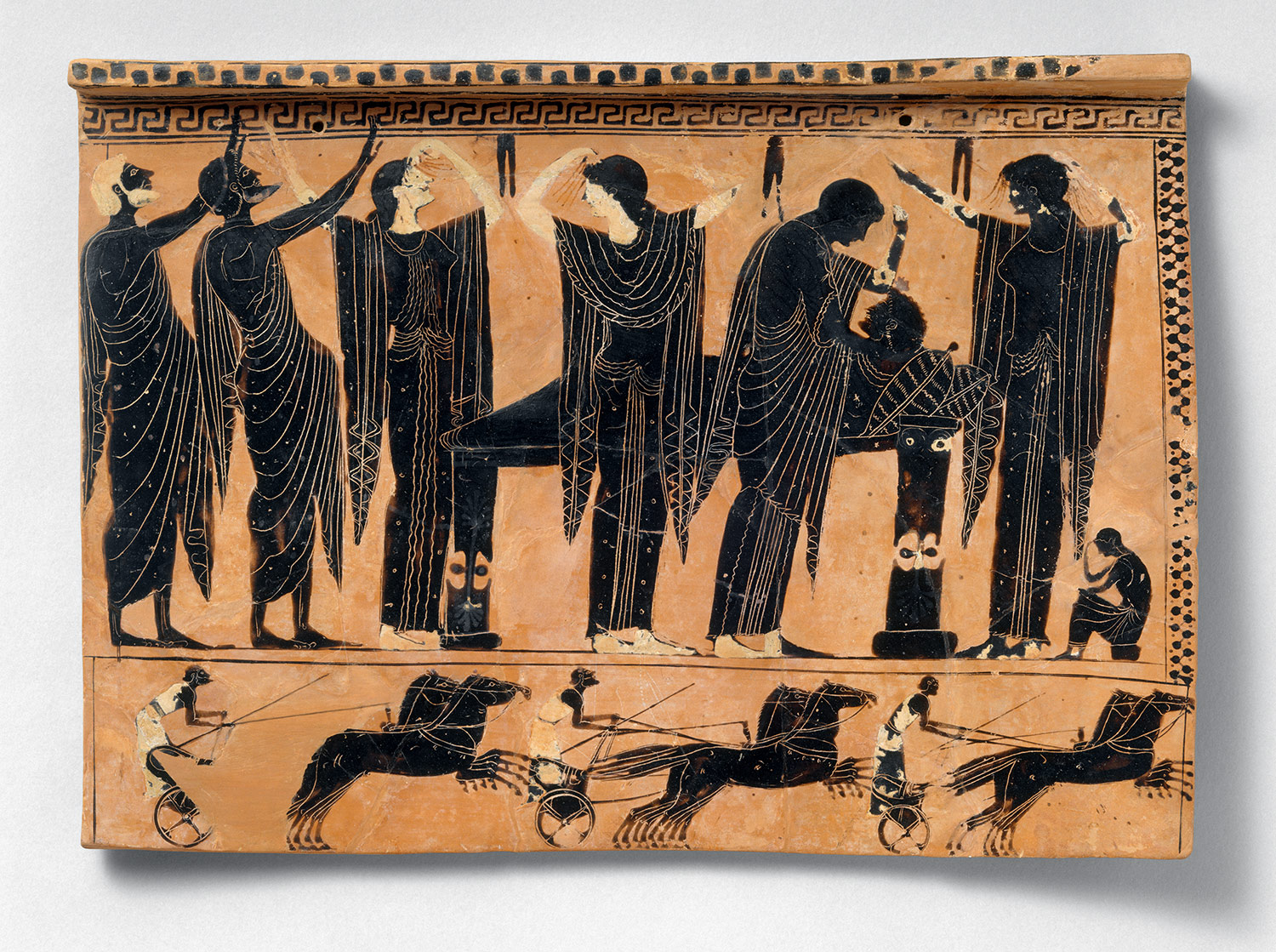
During the prothesis, the body was put out in the courtyard for a day, placed on a bier (as seen on the funerary plaque to the right). Relatives and friends came to mourn and pay their respects. Everyone, but women especially, grieved loudly and respectfully. It was possible to hire professional keeners, who sang ritualized laments and dirges, tore at their hair and pounded their chests in lamentation of the dead. The more grief was shown, the higher the level of respect for the dead.

Right before sun up on the next day, the ekphorá took place. At this time of day, not too many people were outside yet, and this way, miasma was limited to only the grieving family. Women played a major role in funerary rites, a much bigger role than men, but both walked the procession. Men cremated or inhumed the body and gave the final offerings. They also, obviously, constructed the tomb or grave. Men led the way to the cemetery--carrying the bier--followed by the women, and then the children. There was a flute player who served as an indicator that there was a funeral going on, so other inhabitants of the city or village could avoid miasma.

After arriving at the tomb or cemetery, the women turned back, most likely to prepare a large supper at home, and certainly to purify it. The men remained and burned the body (a mostly Athenian practice) or otherwise set up the body. A related mourner first dedicated a lock of hair, then provided the deceased with offerings of honey, milk, water, wine, perfumes, and oils mixed in varying amounts. Any libation was a khoe; a libation given in its entirety to the deceased. None was had by the mourners. A prayer to the Theoi--most likely Hermes Khthonios--then followed these libations. It was also possible to make a haimacouria before the wine was poured. In a haimacouria, a black ram or black bull is slain and the blood is offered to the deceased. This blood sacrifice, however, was probably used only when they were sacrificing in honor of a number of men, or for someone incredibly important. Then came the enagismata, which were offerings to the dead that included milk, honey, water, wine, celery, pelanon--a mixture of meal, honey, and oil--and kollyba--the first fruits of the crops and dried fresh fruits.

Unlike the ancient Egyptians, the ancient Hellenes placed very few objects in the grave, but monumental earth mounds, rectangular built tombs, and elaborate marble stelai and statues were often erected to mark the grave and to ensure that the deceased would not be forgotten. Grave gifts were allowed in many places, but could not cost more than a set amount all together. These elaborate burial places served as a place for the family members to visit the grave with offerings that included small cakes and libations. The goal  was to never be forgotten; if the dead was remembered always, and fed with libations and other offerings, their spirit would stay 'alive' forever. That said, especially in Athens, names on grave markers were restricted to women who died in childbirth and men who died in battle.

After the burial, the family stayed in mourning for a month. During this time, or perhaps a little less long, they were ritually polluted due to exposure to the underworld through the deceased. As such, they could not take part in festivals, nor offer to the Theoi, nor visit temples. They would frequent the grave or tomb often, however, and present the dead with khoes and burnt sacrifice of cakes and fruit.

So, how do we perform these rites when our loved ones are not Hellenistic? How do we give them the best Hellenic chance in the afterlife, or deal with our personal grief in a religion that was not their own? And what if it was their own, how do we deal with it then? Many modern funeral rites bear striking resemblance to the customs of the ancient Hellenes. The body is washed and cleaned, then laid out to be visited. There is often a procession to the burial place or crematorium. We are still allowed and encouraged to show our grief during the funeral or cremation. There is always a place where the deceased can be visited; either a grave, a field where the ashes were strew out, or an urn. Some funeral homes allow family members to help with washing and dressing of the deceased, and you can pretty much request anything you want in your own will, including the inclusion of a coin.

At home, when you are not actively involved in the funerary rites, you can still make the khoe to Hermes Khthonios, and present him with coin(s) for the dead. Tell him you will pay for their passage, should they need it, and pray that He and Kharon will accept. Grieve loudly, especially if you are a woman. Tell stories of the deceased, and make sure they are never forgotten. After the funeral or cremation, cleanse yourself and the house thoroughly. I would not recommend bringing the ashes of the deceased home with you, as this would permanently pollute the house.

I feel for my friend who lost someone, and for her family. May Hermes Khthonios carry this girl safely to where she wants to be, and may the Theoi look kindly upon the mourners. Ease their suffering and alleviate their pain. May the deceased always be remembered, and live on through story and laughter.


Image source: attic funerary plaque
"Death came suddenly and it was mercilessly painful. You are aware you have passed: you can hear the keening of the women in your family, taste the metal of the oboloi in your mouth. You are no longer cold, or hot, and there is no pain. Sensation is for the living, and your memories start to fade already. You are no longer part of the living. You are dead, and your guide is waiting for you. 

Hermes Psychopompos, the winged guide of the newly dead, descends and takes your hand. Below you is the ocean: Oceanos' divine body. You used to watch it glisten in Helios' bright rays, but today, everything is dull and lifeless. You are speeding west, guided by the blessed Immortal. Below you, you can see land again and a mighty river. The land draws you down, and you stand on the ground without feeling it. It is here that Hermes Psychopompos leaves you, in the capable hands of Kharon, on the bank of the river Acheron. 

The ferryman looks old and ageless at the same time. He holds out his hand, but you can't understand what he wants from you. Then, his hand closes around a coin, and he steps aside to let you into his boat. Without moving, you are suddenly on the boat, looking to the shore where shadowy figures of the dead gather, longing to make the journey with you. But they have no coin to hand over, and are forced to wander the bank of the Kokytos river year after year, until the ferryman takes pity on them. Today is not their day.

The river fades into the darkness of a cave. The river of woe joins with the river of hate; the river Styx that seems to have no end. Kharon moves the boat forward in a steady rhythm. You reach the dock sooner than you expected to. Kharon waits silently for you to get off of his boat. You dare not move. Beyond is a field of grey, a sunless cavern filled with the shadows of the dead. The fields of Asphodel; the dreary resting place of the common Hellen. Before the fields stand a huge gate, and an equally huge dog, with three growling heads, foaming at each mouth. Kharon waits, and then you are in the field. The gate stands behind you, Kerberos a constant reminder you can never go back.

You wander, still remembering much of your life. The fall you took as a child that gave you a weak knee, the smile of your spouse on your wedding day. You remember your child being born. It makes being here impossible to bear. The memories will not fade, because before your judgement, you are not allowed to forget. You hold on to them as long as you can, but then you walk through the field, to the compound in the distance. Hades' compound, where the Dread Lord and His beautiful wife live. You walk to forget. Thus, you come upon the judges. 

Rhadamanthys, Minos and Aiakos wait for you at the trivium in the courtyard of the compound; the trivium, Hekate's sacred crossroads. If you still had a heart, you would feel it beating in your throat now. But you do not. Any decision the judges make is alright. The memories hurt. You are cut off from your loved ones, from Helios' powerful rays. Tartaros is not your place, you know that much. You have honored the Theoi, you have done right by your family. You do not fear judgement. You wish to go back to the Asphodel meadows and drink from the river Lethe; you wish to forget. More, you wish to reach Elysium, the island of the blessed. In the distance, the Lord of the Dead and his Queen Persephone must be.

Your life is judged, you are judged. You wait, and look to each side. Left for Tartaros, where the river Phlegethon burns, but leaves everything it touches intact. Right for Elysium, where the ghosts of the blessed reside amongst the blameless heroes. Or back the way you came for the meadows where Lethe flows free, where the dead flutter around like bats, and those initiated into the Mysteries drink from Mnemosyne, so they will not forget their previous life when they reincarnate. You wait, and are judged."

For the ancient Hellens, this is what dying would look like. This is how I see my 'life' after death. When I pass, I will walk to my judgement. Sadly, life after death may be the closes I will ever get to the ancient Hellens, and the Theoi, so because of that, I have a great bit of interest in the Hellenic Underworld. So lets look at the short story I wrote--I won't call it a meditation, because traveling to the Underworld is something one should not attempt in any way, shape or form--to learn a bit more about the last resting place of the ancient Hellens and modern Hellenists.

The Underworld is described as lying in the west in the Odysseia, and there is an entrance that can be reached overseas. Yet, the dead enter the Underworld through one of five rivers surrounding the Underworld.

Acheron (Αχέρων) - The river of woe. This is the river that Kharon ferries the dead across, from the land of the living, to the realm of Hades.
Kocytus (Κωκυτός) - The river of lamentation. Those who could not pay Kharon, were destined to walk the banks of this river--a side river to the river Acheron--for one hundred years.
Phlegethon (Φλεγέθων) - The river of fire in the Underworld. It's a side river of the river Styx and is said to be permanently on fire, yet never burn anything it touches. It's located in Tartaros.
Lethe (Λήθη) - The river of forgetfulness. It runs through the Asphodel meadows, and the dead have to drink from it to completely forget about their lives on Earth. Those who were initiated in the Eleusinian Mysteries--linked to Demeter and Persephone--were allowed to drink from Mnemosyne and are allowed to remember.
Styx (Στύξ) - The river of hate. The Acheron joins with the Styx at the moment the land of the living makes way for the Underword, and as such, She is a portal, and the most famous of the five rivers. It is said to wrap around the Underworld nine times. Styx was also the river upon which the Theoi, and mankind, swore oaths which could not be broken, an arrangement agreed upon by Zeus and the Goddes Styx in return for her aid in the Titan Wars. If a Theos or Theia did break an oath made upon the river Styx, they were forced by Zeus to drink from the river, upon which They fell into a deep coma for a year, and were then cut off from Their worshippers for nine more. For mortals, breaking an oath on the river Styx was something you simply did not do, and it's the gravest vow to make, one that is not made lightly.

The Underworld has various areas where the dead are housed, but also where the various Gods and Goddesses of the Underworld--called 'Theoi Khthonioi'--reside. Several of the Gods and Goddesses have already been discussed; all the rivers are Gods or Goddesses who have their home in the Underworld, and there are Kharon, Kerberos, and the judges: Rhadamanthys, Minos and Aiakos. Yet, there are a lot more. The most well known are Hades and His consort, Persephone.

Hades, brother of Zeus, son of Kronos, is the Lord of the Dead. The Underworld is His domain. He rules it with his beautiful wife--and niece--Persephone, whom He stole away. She resides with Him in their home, a large mansion at the crossroads between the Asphodel meadows, Tartaros and Elysium. This crossroads is sacred to Hekate, and located in the courtyard of the mansion. The maiden Goddess Hekate is a companion of Persephone, whom she led out of the Underworld after Zeus decreed it to be so. She vowed to Demeter to stay with Persephone in the months She spent under the earth, and takes this vow very seriously.

Kronos is an Underworld deity as well: Zeus eventually released His father and made Him king of the Elysian Islands. Other Gods, like HypnosErebos, Nyx, Makaria (daughter of Hades and Persephone, who watched over the blessed dead, who had been initiated into the Mysteries), and the Erinyes (three Goddesses of vengeance and retribution) also make their home in (a part of) the Underworld. The Moirai, the three Goddesses of fate, have their own space in the Underworld as well. Other Immortals who share the Underworld are deamons and nymphs.

In the daímōn-section, we have the the Arai (daímōnes of curses), Askalaphos (who tended to the orchards of Hades and was transformed into a screech owl by Demeter for bringing Her bad news about Her daughter), Kakodaimones (Deamones which cause all kinds of harm), Empousa (a daímōn with flaming hair, the leg of a goat and a leg of bronze, who parents vowed would come after their children if they didn't behave), the Oneiri (dream spirits) and Epiales (the daímōn of nightmares). Other daímōnes include: Eurynomos (who stripped the flesh off of the corpses of the dead), the Lamiai and Mormolykeia (vampiric, succubus-like, daímōnes in the following of Hekate), Melinoe (who led the souls of the dead back to earth to haunt the living). Menoites, furthermore, herds the black-skinned cattle of Hades, and Thanatos, the winged daímōn of death, is Hades' minister.

There are also a few Underworld nymphs: Daeira (a companion of Persephone), the Lampades (torch bearing nymphs in Hekate's following who may have looked over the blessed dead on their way to Elysium), Leuke (a nymph abducted by Hades and transformed into a white poplar which stands in the Elysian fields), Mynthe (a beowed nymph of Hades, who Persephone turned to dust and Hades turned into the mint plant), and Orphne (wife of Acheron).

As for the dead, they had three places to go in the Underworld: Tartaros, where those who were punished for all eternity remained, the Asphodel meadows, where everyone who had lived a good life wandered about endlessly, and the Elysian fields, where the children of Gods, the blessed dead and those who had lead extraordinarily honorable, brave or otherwise well-respected lives resided.

The ancient Hellens believed the Underworld was a neutral place. One did not desire to go there in the least, but it was part of life, and as far as the afterlife went, it was dull and sunless but nothing like the hell of Christianity. The worst part about it is being without the touch of loved ones, and forgetting who you were. In the Odysseia, Odysseus meets his mother's spirit at one of the entrance points to the Underworld. She tells him:

"Oh, my child, most unfortunate of men, Persephone, Zeus’ daughter, does not deceive you: this is the way it is with mortals after death. The sinews no longer bind flesh and bone, the fierce heat of the blazing pyre consumes them, and the spirit flees from our white bones, a ghost that flutters and goes like a dream."

Nobody wants to think about dying and the dead for too long, so I will end this post here. May it have given you some insight into the workings of the Underworld. 
Michael Clarke Duncan, Green Mile, Daredevil and Armageddon actor, passed away yesterday as the result of heart failure. Duncan and I had nothing in common; he was a black, strong, male, actor. He was not Pagan as far as I am aware. He spent his entire life making different choices than I did. We had nothing in common and yet, his passing has struck me like a lightning bolt.

Duncan seemed to me like one of those people who you would always welcome in your corner. The kind of man who would do anything for you if you were his friend. He seemed to have a kind and proud heart and I enjoyed watching him in every movie he ever made and every T.V. interview he ever did. He was one of those people who I watched and realized that we, as humans, can be inherently good.

Duncan may have been completely different than he seems to be in my mind. But he was--and always will be--a role model. He is part of my honored dead and last night, I mourned his passing during my evening prayers. I offered libations and coins to pay Kharon, should he have need of them. I burned incense and cried for him. I may not have known him, but I mourned him. Because he touched my life, and I want to pay my respects.

May he rest where he wished to rest. May his name forever live on in the collective memory of men. May his family recover from this crushing blow to their lives and, above all, may the Gods watch over his passing.

You will be missed.

Badly.
Yesterday, I had the good fortune to attend a rendition of the opera Orpheo ed Euridice at a former royal palace near my home. This is the trailer of last year's cast performing it, just to give you a sense of the mood.


There are some differences between the opera and the myth of Orpheus and Euridice, most notably that Amore (that would have been Eros, to the Hellens) restores Euridice's life despite Orpheus turning to look at her. In the myth, Orpheus must lead his dead wife from the Underworld to Earth without looking back at her. She is so silent, he eventually starts to doubt and just before they reach the Earth, he can't take it anymore and turns around. In the opera, the two haven't even started their ascend yet, when Euridice bewails her faith that Orpheus won't look at her and refuses to move until he does. When he eventually gives in, she dies again. This is where the myth ends, but in the opera, Orpheus' story goes on. Before he can take his own life so he can be with his love, Amore comes and tells him that his love has saved Euridice and she can return to him, and Earth, after all. 

I have an issue with the opera adaption; the myth ended with Euridice's death for a reason. Life is for the living; those who die should stay dead or be reborn. Hades rules supreme over the dead and once you are dead, you're done. Amore does not have the power to overrule Hades when it comes to the dying. The dying are dead, as they should be. It's the natural order to things and should be preserved. 

The ancient Hellens believed in ghosts; they were the people who could not find the entrance to the Underworld or who didn't have the money to pay Kharon for their passage. Those who were not properly buried were also doomed to wander the Earth for a hundred years. Interestingly enough, Hellenic heroes were also considered ghosts and were honored in the same type of rites as other types of ghosts. 

The Ancient Hellens held festivals in honor of ghosts, and the Theoi that presided over them, so they would be sated and appeased and would not haunt them. Most of these festivals included a holókaustos and were solemn affairs, conducted at night and without an offering of wine. 

This fear of spirits and other supernatural entities was named 'deisidaimonia' (δεισιδαιμονία). The ceremonies of riddance were known to the Hellens as apopompai (ἀποποπμαί), 'sendings away'. There isn't a single word in the English language that conveys the practice. Closest would be 'exorcism'. 

Becoming a ghost was not a good thing. While heroes like Hēraklēs, Theseus and Orpheus head into the Underworld and return from it alive, they never do so without a struggle and the fact that heroes were considered ghosts is food for thought. They have seen the Underworld and have not left the whole of it behind. Ghosts were feared and needed to be appeased, fed with blood to sustain them and/or warded off. 

Orpheus looses his wife for a reason; yes, he doubts the word of Hades but more importantly, I believe Hades knew Orpheus was doomed to fail. He knows that those who have good and properly died, need to stay dead. If He didn't, I doubt He would remain an active participant in sustaining the Underworld. Immortality is reserved for the Theoi alone. Those who strive for it, who are not sufficiently pious or simply need to be honored, become ghosts, who wander the Earth without finding rest, warmth or solace. Some, like the heroes, can be petitioned for aid and counsel but the others, the unfortunate souls, are to be feared and 'send away'.

One of the Delphic Maxims is 'grieve for no one' (Μη επι παντι λυπου). Death is a reward in and of itself, especially if you have lived a pious life. Death is not to be feared and those who die, do so for a reason; all mortal life must end, simply because it sets us apart from the Gods. To mourn the dead or fear death itself, is to question both the will of the Gods and mortal thought