Showing posts with label Kharybdis. Show all posts
"The Argonauts sailed on in gloom. The Seirenes  were behind them, but worse perils lay ahead, at a place where two seas met and shipping came to grief. On one side the sheer cliff of Skylla  hove in sight; on the other Kharybdis  seethed and roared incessantly; while beyond, great seas were booming on the Wandering Rocks."
-- Apollonius Rhodius, Argonautica 4. 921
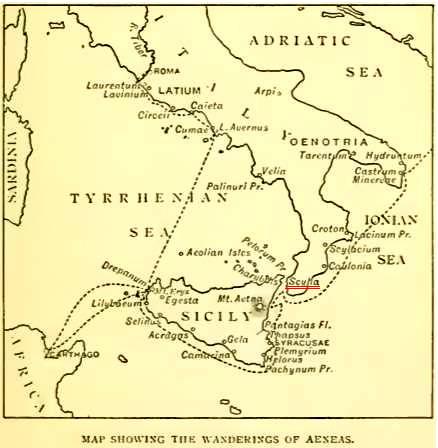
A map of the wanderings of Aeneas, showing the positions of Charybdis and Scylla (underlined in red), from an edition of The Aeneid of Virgil, Book III, edited by Philip Sandford, London: Blackie & Son. 1900


Some of the greatest heroes encountered the terrifying and destructive force of Skylla and Kharybdis on their travels: Odysseus had to pass them twice, and the Argonauts came upon them as well. We will discuss Skylla at a later date, but for now, we will discuss Kharybdis--monster and Goddess--who controls the tide.

The ancient hellenes in the time the Odysseia was written seem to have been largely unaware that the rise and fall of sea levels are caused by the combined effects of the gravitational forces exerted by the Moon and the Sun and the rotation of the Earth. Instead, they held a single entity responsible: a monster or a Goddess controlling a whirlpool, as described by Hómēros:

"Odysseus, you will notice the other cliff is lower, only a bow-shot away, and a great fig-tree with dense leaves grows there. Under it divine Charybdis swallows the black waters. Three times a day, she spews them out, and three times darkly sucks them back again. No one, not even Poseidon, could save you from destruction if you are there when she swallows." [Bk XII:36-110]

For those of you who grew up with huge differences between high and low tides, it might be hard to grasp how the ancient Hellenes attributed such a difference to a single whirlpool entity. Well, they didn't; Even modern Hellas hardly has a difference between high and low tide; a foot or two at max. As such, it becomes a lot more feasable for that amount of water to be swallowed and regurgitated.

The development of tidal science began in antiquity with the cosmology of Aristotle (384 BC – 322 BC), a Hellenic philosopher and polymath, a student of Plato and teacher of Alexander the Great. In researching this subject, I keep happening upon a quote by him that I can't place in any of his works, but would love to have someone source for me. It goes:

"It is even said that many ebbings and risings of the sea always come round with the Moon and upon certain fixed times."

The closest I have gotten is from the 'Meteorology':

"Again, most earthquakes and the severest occur at night or, if by day, about noon, that being generally the calmest part of the day. For when the sun exerts its full power (as it does about noon) it shuts the evaporation into the earth. Night, too, is calmer than day. The absence of the sun makes the evaporation return into the earth like a sort of ebb tide, corresponding to the outward flow; especially towards dawn, for the winds, as a rule, begin to blow then, and if their source changes about like the Euripus and flows inwards the quantity of wind in the earth is greater and a more violent earthquake
results." [Bk 2, Pt 8]
And:

"Every one admits this, that if the whole world originated the sea did too; for they make them come into being at the same time. It follows that if the universe is eternal the same must be true of the sea. Any one who thinks like Democritus that the sea is diminishing and will disappear in the end reminds us of Aesop's tales. His story was that Charybdis had twice sucked in the sea: the first time she made the mountains visible; the second time the islands; and when she sucks it in for the last time she will dry it up entirely. Such a tale is appropriate enough to Aesop in a rage with the ferryman, but not to serious inquirers. Whatever made the sea remain at first, whether it was its weight, as some even of those who hold these views say (for it is easy to see the cause here), or some other reason-clearly the same thing must make it persist for ever. They must either deny that the water raised by the sun will return at all, or, if it does, they must admit that the sea persists for ever or as long as this process goes on, and again, that for the same period of time that sweet water must have been carried up beforehand. So the sea will never dry up: for before that can happen the water that has gone up beforehand will return to it: for if you say that this happens once you must admit its recurrence. If you stop the sun's course there is no drying agency. If you let it go on it will draw up the sweet water as we have said whenever it approaches, and let it descend again when it recedes. This notion about the sea is derived from the fact that many places are found to be drier now than they once were. Why this is so we have explained. The phenomenon is due to temporary excess of rain and not to any process of becoming in which the universe or its parts are involved. Some day the opposite will take place and after that the earth will grow dry once again. We must recognize that this process always goes on thus in a cycle, for that is more satisfactory than to suppose a change in the whole world in order to explain these facts. But we have dwelt longer on this point than it deserves." [Bk 2, Pt 3]

In general, I would say the ancient Hellenes were aware of the connection between the Moon (and Sun) and the tides, but neglected to make a causal connection. For a long time Kharybdis was the most logical of options. Another name of hers is 'Trienos' (Τριενος), 'Three Times a Day', alluding to the earlier stated behavior of the whirlpool. Suidas, by the tenth century AD, had placed the actual whirlpool with accuracy. This location is portrayed on the map above:

"Kharybdis (Charybdis): It sucks up the sea around Gadeira and furiously spirals around again. It is said that it all leads down to chaos and destruction. Priskos (Priscus) says about Kharybdis: ‘They sail by Sikelia (Sicily) in front of Messene and by the strait of Italy where Kharybdis [is], taking in stormy winds, and sucking those men in. Kharybdis and Skylla (Scylla), lying in a narrow place, are subject to the currents of the oceans and sink those sailing past. There Odysseus lost all his companions with the ships; he himself was carried away hanging on to a board in the currents of the sea.’"
It is easy to link our modern understanding of tidal physics to the minds of the ancient Hellenes, but I am in no way certain they actually linked the tides to the Moon and Sun. As such, neither Selene, nor Artemis, nor even the Oceanic Gods like Poseidon would have had any influence on the tides: they were in the domain of either another divinity, or a monster, and both were out of reach.
Do you remember when I had that terrible dream about being chaced through the woods by some horrible creature? I quite liked doing that post, but becase the setting was clearly on land, I had to leave out some of the terrifying aquatic mythological creatures that Hellenic mythology boasts. Today, I wanted to rectify not having a source list of sea or lake based creatures from Hellenic mythology on my blog.

Drakaena
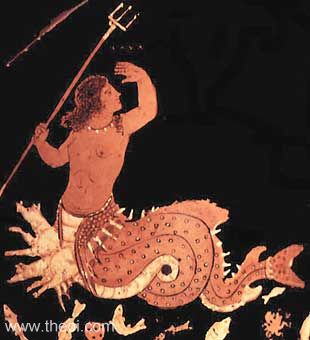
The Drakaena were hybrids, usually with the upper body of a beautiful nymph, and the lower body of a drakon or sea-monster. Famous examples include the Goddess Keto, who spawned the Hesperian Drakon, Ekhidna, who was married to the serpent-giant Typhôeus and spawned most of the dragons and monsters of myth, and Skilla (see below).

Hippokampoi
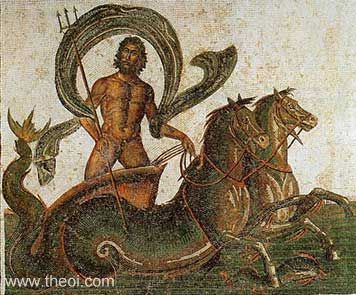
The Hippokampoi were not exactly monsters, btu they make the list because of the idea the ancient Hellenes had about them. Hippokampoi were the horses of the sea. They were depicted as composite creatures with the head and fore-parts of a horse and the tail of a fish. They were often covered with green scales and had fish-fin manes and appendages. The ancients believed they were the adult-form of the fish we call the 'sea-horse'. They were the mounts of Nereid nymphs and sea-gods, and Poseidon drove a chariot drawn by two or four of the beasts.

Karkinos
Karkinos (Καρκινος) was often pictured as a giant crab or crustacean. He features heavily in the mythology of Hēraklēs. On the hero's  second labor, slaying the Lernaean Hydra, Hera send Karkinos to distract Hēraklēs while he fought. Unfortunately for the animal, Hēraklēs wasn't very impressed. He either kicked the animal so hard, that Karkinos flew so far into the sky, he can hardly be seen, or he squashed the crab, and Hera placed him into the sky for trying. She did, however, dim his stars because he had failed at his task. Needless to say, Karkinos is the constellation Cancer.


Ketea
The Ketea are sea-monsters who--like most Drakones resembled snakes. They were destroyers, usually sent by the Gods in punishment. According to the ancient Hellenes, the Ketea had real-life counterparts as well, in the deep Indian oceans, and in the form of the Scolopendra. Kētos (below) was a Ketea.

Kētos
Kētos was the name of the sea monster sent by Poseidon as a favor to the sea God Nereus, who was insulted by the queen of Ethiopia, Cassiopeia, who boasted that either her daughter, or she, or both were equal or even greater in beauty than Nereus' children, the Nereids. Nereus would only be appeased when Cepheus sacrificed his daughter to Cetus. Cepheus had refused, but when the terror continued, Androméda had offered herself up to be sacrificed. Kētos was petrefied by Perseus with Médousa's severed head.

Kharybdis
The ancient hellenes in the time the Odysseia was written seem to have been largely unaware that the rise and fall of sea levels are caused by the combined effects of the gravitational forces exerted by the Moon and the Sun and the rotation of the Earth. Instead, they held a single entity responsible: a monster or a Goddess controlling a whirlpool. If your ship got stuck in the pull of the whirlpool, youw ere as good as dead.


Skylla
During Odysseus' travels to get home, he must run his ship through a narrow passage. One the one side are rocks with a cavern. In this cavern, Skylla, sea monster with six heads, lived, and she would take one of Odysseus' men with each of her heads. On the other side lay Kharybdis, a great whirlpool which would suck in any ship that came too close. It is up to Odysseus to choose one or the other. Eventually, he chooses Skylla, and looses many brave men, his ship, however, is in tact.


Sirens
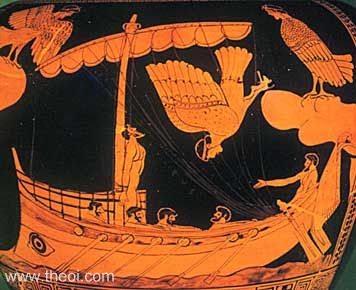
The Sirens (or Seirenes) were three sea nymphs who lured sailors to their death with a bewitching song. They were formerly handmaidens of the goddess Persephone, and were always depicted as birds with either the heads, or the entire upper bodies, of women. In modern tales, they are generally seen as mermaids--part huma woman, part fish, but the ancient Hellenes disagreed.
"The Argonauts sailed on in gloom. The Seirenes  were behind them, but worse perils lay ahead, at a place where two seas met and shipping came to grief. On one side the sheer cliff of Skylla  hove in sight; on the other Kharybdis  seethed and roared incessantly; while beyond, great seas were booming on the Wandering Rocks."
-- Apollonius Rhodius, Argonautica 4. 921

A map of the wanderings of Aeneas, showing the positions of Charybdis and Scylla (underlined in red), from an edition of The Aeneid of Virgil, Book III, edited by Philip Sandford, London: Blackie & Son. 1900


Some of the greatest heroes encountered the terrifying and destructive force of Skylla and Kharybdis on their travels: Odysseus had to pass them twice, and the Argonauts came upon them as well. We will discuss Skylla at a later date, but for now, we will discuss Kharybdis--monster and Goddess--who controls the tide.

The ancient hellenes in the time the Odysseia was written seem to have been largely unaware that the rise and fall of sea levels are caused by the combined effects of the gravitational forces exerted by the Moon and the Sun and the rotation of the Earth. Instead, they held a single entity responsible: a monster or a Goddess controlling a whirlpool, as described by Hómēros:

"Odysseus, you will notice the other cliff is lower, only a bow-shot away, and a great fig-tree with dense leaves grows there. Under it divine Charybdis swallows the black waters. Three times a day, she spews them out, and three times darkly sucks them back again. No one, not even Poseidon, could save you from destruction if you are there when she swallows." [Bk XII:36-110]

For those of you who grew up with huge differences between high and low tides, it might be hard to grasp how the ancient Hellenes attributed such a difference to a single whirlpool entity. Well, they didn't; Even modern Hellas hardly has a difference between high and low tide; a foot or two at max. As such, it becomes a lot more feasable for that amount of water to be swallowed and regurgitated.

The development of tidal science began in antiquity with the cosmology of Aristotle (384 BC – 322 BC), a Hellenic philosopher and polymath, a student of Plato and teacher of Alexander the Great. In researching this subject, I keep happening upon a quote by him that I can't place in any of his works, but would love to have someone source for me. It goes:

"It is even said that many ebbings and risings of the sea always come round with the Moon and upon certain fixed times."

The closest I have gotten is from the 'Meteorology':

"Again, most earthquakes and the severest occur at night or, if by day, about noon, that being generally the calmest part of the day. For when the sun exerts its full power (as it does about noon) it shuts the evaporation into the earth. Night, too, is calmer than day. The absence of the sun makes the evaporation return into the earth like a sort of ebb tide, corresponding to the outward flow; especially towards dawn, for the winds, as a rule, begin to blow then, and if their source changes about like the Euripus and flows inwards the quantity of wind in the earth is greater and a more violent earthquake
results." [Bk 2, Pt 8]
And:

"Every one admits this, that if the whole world originated the sea did too; for they make them come into being at the same time. It follows that if the universe is eternal the same must be true of the sea. Any one who thinks like Democritus that the sea is diminishing and will disappear in the end reminds us of Aesop's tales. His story was that Charybdis had twice sucked in the sea: the first time she made the mountains visible; the second time the islands; and when she sucks it in for the last time she will dry it up entirely. Such a tale is appropriate enough to Aesop in a rage with the ferryman, but not to serious inquirers. Whatever made the sea remain at first, whether it was its weight, as some even of those who hold these views say (for it is easy to see the cause here), or some other reason-clearly the same thing must make it persist for ever. They must either deny that the water raised by the sun will return at all, or, if it does, they must admit that the sea persists for ever or as long as this process goes on, and again, that for the same period of time that sweet water must have been carried up beforehand. So the sea will never dry up: for before that can happen the water that has gone up beforehand will return to it: for if you say that this happens once you must admit its recurrence. If you stop the sun's course there is no drying agency. If you let it go on it will draw up the sweet water as we have said whenever it approaches, and let it descend again when it recedes. This notion about the sea is derived from the fact that many places are found to be drier now than they once were. Why this is so we have explained. The phenomenon is due to temporary excess of rain and not to any process of becoming in which the universe or its parts are involved. Some day the opposite will take place and after that the earth will grow dry once again. We must recognize that this process always goes on thus in a cycle, for that is more satisfactory than to suppose a change in the whole world in order to explain these facts. But we have dwelt longer on this point than it deserves." [Bk 2, Pt 3]

In general, I would say the ancient Hellenes were aware of the connection between the Moon (and Sun) and the tides, but neglected to make a causal connection. For a long time Kharybdis was the most logical of options. Another name of hers is 'Trienos' (Τριενος), 'Three Times a Day', alluding to the earlier stated behavior of the whirlpool. Suidas, by the tenth century AD, had placed the actual whirlpool with accuracy. This location is portrayed on the map above:

"Kharybdis (Charybdis): It sucks up the sea around Gadeira and furiously spirals around again. It is said that it all leads down to chaos and destruction. Priskos (Priscus) says about Kharybdis: ‘They sail by Sikelia (Sicily) in front of Messene and by the strait of Italy where Kharybdis [is], taking in stormy winds, and sucking those men in. Kharybdis and Skylla (Scylla), lying in a narrow place, are subject to the currents of the oceans and sink those sailing past. There Odysseus lost all his companions with the ships; he himself was carried away hanging on to a board in the currents of the sea.’"
 
It is easy to link our modern understanding of tidal physics to the minds of the ancient Hellenes, but I am in no way certain they actually linked the tides to the Moon and Sun. As such, neither Selene, nor Artemis, nor even the Oceanic Gods like Poseidon would have had any influence on the tides: they were in the domain of either another divinity, or a monster, and both were out of reach.