Showing posts with label Theogony. Show all posts

 The beautiful thing about our religion is that not only do we have a clear way to honor the Theoi, and incentive to do so, we also get to live in a world governed completely by the Theoi. Hellenismos is special in that regards because it also largely matches up with science. To me--and many others with me--that is something very comforting. Now, as you are probably all aware, I live in a world full of Gods and Nymphs; for example, I take great strength in greeting Eos each morning as she paves the way for Helios, but there are many Gods who are, or who control, the cycle of day and night, and I would like to write out this cycle, if I may.


For all things geneological, I will always turn to Hesiod first. In his 'Theogony', he speaks of the birth of the Dawn, Sun and Moon:

"And Theia was subject in love to Hyperion and bare great Helios, and clear Selene, and Eos." [177]

Diodorus Siculus, in his 'Library of History' shares this world vieuw and moves a (pseudo-scientific) step beyond it:

"Of Hyperion we are told that he was the first to understand, by diligent attention and observation, the movement of both the sun and the moon and the other stars, and the seasons as well, in that they are caused by these bodies, and to make these facts known to others; and that for this reason he was called the father of these bodies, since he had begotten, so to speak, the speculation about them and their nature." [5.67.1]

Hyperion (Ὑπερίων), meaning 'The High-One', was a Titanes God born from Gaea and Ouranos. Theia and Euryphaessa (as mentioned in, for example, the Homeric Hymns) are generally regarded as the same Deathless woman: 'Theia' is the Hellenic word for 'Goddess', so it was likely 'Theia Euryphaessa' translated to 'Goddess Euryphaessa'. This means that the family tree is as follows:

     Khaos ------------ Gaea
         |         |
   Ouranos --- |
                       Hyperion --- Euryphaessa
                   |
                  Eos - Helios - Selene

The three of them--put into motion by Hyperion--form the basic cycle of these planets associated with specific times of day. Yet, the ancient Hellenes saw Night and Day as quite seperate from the heavenly bodies that are associated with them today. I have spoken before of the Protogenoi, and how They--contrary to the Olympians--are actually of the world; They, together, form the tapistry of earth and life. They literally make up our universe. As such, the further towards the Big Bang you go, the more abstract the Theoi become; They take on large, mostly unformed, chunks of the material that makes up our world and the further away you go from Khaos, the more specialized the Gods become--as well as numerous.

As such, starting this explination with Hyperion is actually incorrect--I should have started with Khaos itself, but if not there, than at least with Nyx, who is the deep Night, and Her daughter Hêmera (Ἡμερα), who is the Protogenos of the Day and the sister-wife of Aither (Light). In Hellenic mythology, Nyx draws a veil of darkness between the shining atmosphere of the aither and the lower air of earth (aer) at set times in the day, bringing night to man. In the morning, Hêmera removes this veil, and exposed the Earth once more to Light. As Hesiod writes in the Theogony:

"[At the ends of the earth, where lie the roots of earth, sea, Tartaros :] There stands the awful home of murky Nyx wrapped in dark clouds. In front of it [Atlas] the son of Iapetos stands immovably upholding the wide heaven upon his head and unwearying hands, where Nyx and Hemera draw near and greet one another as they pass the great threshold of bronze: and while the one is about to go down into the house, the other comes out at the door. And the house never holds them both within; but always one is without the house passing over the earth, while the other stays at home and waits until the time for her journeying come; and the one holds all-seeing light (phaos) for them on earth." [744]

Once we reach AD times, Hêmera is often identified with Eos, but in centuries prior, she was very much Her own Goddess, and Hêmera was as well. Hómēros, for example, in the 'Odysseia' writes: 

"The ship [of Odysseus] in due course left the waters of the river Okeanos and reached the waves of the spacious sea and the island of Aiaia; it is there [Okeanos] that Eos the early-comer (Erigeneia) has her dwelling place and her dancing grounds, and the sun himself has his risings. We came came in; we beached our vessel upon the sands and disembarked upon the sea-shore; there we fell fast asleep, awaiting ethereal Dawn." [12.1]

So, to recapitulate: Nyx and Hêmera continually work to both create and dissolve darkness on Earth; Selene moves with Nyx, and Helios with Hêmera, as heralded by Eos. In this recap, it is quite obvious we are yet missing a speciffic time of the day: dusk, or the evening. This was in the domain of the Nymphs, in this case the Hesperides (Ἑσπεριδες), who--depending of source--are either the daughters of Nyx or Atlas. Diodorus Siculus, in the 1st Century BC., wrote in his 'Library of History': 

"Now Hesperos (Evening) begat a daughter named Hesperis (Evening), who he gave in marriage to his brother [Atlas] and after whom the land was given the name Hesperitis; and Atlas begat by her seven daughters, who were named after their father Atlantides, and after their mother Hesperides." [4. 26. 2]

Yet, older sources agree that the Hesperides were born from Nyx; Hesiod, for example:

"And Nyx (Night) bare hateful Moros (Doom) and black Ker (Violent Death) and Thanatos (Death), and she bare Hypnos (Sleep) and the tribe of Oneiroi (Dreams). And again the goddess murky Nyx, though she lay with none, bare Momos (Blame) and painful Oizys (Misery), and the Hesperides who guard the rich, golden apples and the trees bearing fruit beyond glorious Okeanos."

Of course, there are more Gods--motly Titans--who are in some way connected to the cycle of night and day, but these are the most important ones and it's quite a hand full already. So perhaps next time when you awake, you will think of Hêmera, and rosy Eos, and when the sun is high in the sky, you will think of Him as well, and when you look upon the Moon before going to bed, you will give honors to Selene and Nyx, who holds Her and Gaea in Her embrace. Our Gods are everywhere; you only have to be aware of Them to notice.
The beautiful thing about our religion is that not only do we have a clear way to honor the Theoi, and incentive to do so, we also get to live in a world governed completely by the Theoi. Hellenismos is special in that regards because it also largely matches up with science. To me--and many others with me--that is something very comforting. Now, as you are probably all aware, I live in a world full of Gods and Nymphs; for example, I take great strength in greeting Eos each morning as she paves the way for Helios, but there are many Gods who are, or who control, the cycle of day and night, and I would like to write out this cycle, if I may.

For all things geneological, I will always turn to Hesiod first. In his 'Theogony', he speaks of the birth of the Dawn, Sun and Moon:

"And Theia was subject in love to Hyperion and bare great Helios, and clear Selene, and Eos." [177]

Diodorus Siculus, in his 'Library of History' shares this world vieuw and moves a (pseudo-scientific) step beyond it:

"Of Hyperion we are told that he was the first to understand, by diligent attention and observation, the movement of both the sun and the moon and the other stars, and the seasons as well, in that they are caused by these bodies, and to make these facts known to others; and that for this reason he was called the father of these bodies, since he had begotten, so to speak, the speculation about them and their nature." [5.67.1]

Hyperion (Ὑπερίων), meaning 'The High-One', was a Titanes God born from Gaea and Ouranos. Theia and Euryphaessa (as mentioned in, for example, the Homeric Hymns) are generally regarded as the same Deathless woman: 'Theia' is the Hellenic word for 'Goddess', so it was likely 'Theia Euryphaessa' translated to 'Goddess Euryphaessa'. This means that the family tree is as follows:

     Khaos ------------ Gaea
         |         |
   Ouranos --- |
                       Hyperion --- Euryphaessa
                   |
                  Eos - Helios - Selene

The three of them--put into motion by Hyperion--form the basic cycle of these planets associated with specific times of day. Yet, the ancient Hellenes saw Night and Day as quite seperate from the heavenly bodies that are associated with them today. I have spoken before of the Protogenoi, and how They--contrary to the Olympians--are actually of the world; They, together, form the tapistry of earth and life. They literally make up our universe. As such, the further towards the Big Bang you go, the more abstract the Theoi become; They take on large, mostly unformed, chunks of the material that makes up our world and the further away you go from Khaos, the more specialized the Gods become--as well as numerous.

As such, starting this explination with Hyperion is actually incorrect--I should have started with Khaos itself, but if not there, than at least with Nyx, who is the deep Night, and Her daughter Hêmera (Ἡμερα), who is the Protogenos of the Day and the sister-wife of Aither (Light). In Hellenic mythology, Nyx draws a veil of darkness between the shining atmosphere of the aither and the lower air of earth (aer) at set times in the day, bringing night to man. In the morning, Hêmera removes this veil, and exposed the Earth once more to Light. As Hesiod writes in the Theogony:

"[At the ends of the earth, where lie the roots of earth, sea, Tartaros :] There stands the awful home of murky Nyx wrapped in dark clouds. In front of it [Atlas] the son of Iapetos stands immovably upholding the wide heaven upon his head and unwearying hands, where Nyx and Hemera draw near and greet one another as they pass the great threshold of bronze: and while the one is about to go down into the house, the other comes out at the door. And the house never holds them both within; but always one is without the house passing over the earth, while the other stays at home and waits until the time for her journeying come; and the one holds all-seeing light (phaos) for them on earth." [744]

Once we reach AD times, Hêmera is often identified with Eos, but in centuries prior, she was very much Her own Goddess, and Hêmera was as well. Hómēros, for example, in the 'Odysseia' writes: 

"The ship [of Odysseus] in due course left the waters of the river Okeanos and reached the waves of the spacious sea and the island of Aiaia; it is there [Okeanos] that Eos the early-comer (Erigeneia) has her dwelling place and her dancing grounds, and the sun himself has his risings. We came came in; we beached our vessel upon the sands and disembarked upon the sea-shore; there we fell fast asleep, awaiting ethereal Dawn." [12.1]

So, to recapitulate: Nyx and Hêmera continually work to both create and dissolve darkness on Earth; Selene moves with Nyx, and Helios with Hêmera, as heralded by Eos. In this recap, it is quite obvious we are yet missing a speciffic time of the day: dusk, or the evening. This was in the domain of the Nymphs, in this case the Hesperides (Ἑσπεριδες), who--depending of source--are either the daughters of Nyx or Atlas. Diodorus Siculus, in the 1st Century BC., wrote in his 'Library of History': 

"Now Hesperos (Evening) begat a daughter named Hesperis (Evening), who he gave in marriage to his brother [Atlas] and after whom the land was given the name Hesperitis; and Atlas begat by her seven daughters, who were named after their father Atlantides, and after their mother Hesperides." [4. 26. 2]

Yet, older sources agree that the Hesperides were born from Nyx; Hesiod, for example:

"And Nyx (Night) bare hateful Moros (Doom) and black Ker (Violent Death) and Thanatos (Death), and she bare Hypnos (Sleep) and the tribe of Oneiroi (Dreams). And again the goddess murky Nyx, though she lay with none, bare Momos (Blame) and painful Oizys (Misery), and the Hesperides who guard the rich, golden apples and the trees bearing fruit beyond glorious Okeanos."

Of course, there are more Gods--motly Titans--who are in some way connected to the cycle of night and day, but these are the most important ones and it's quite a hand full already. So perhaps next time when you awake, you will think of Hêmera, and rosy Eos, and when the sun is high in the sky, you will think of Him as well, and when you look upon the Moon before going to bed, you will give honors to Selene and Nyx, who holds Her and Gaea in Her embrace. Our Gods are everywhere; you only have to be aware of Them to notice.
These nine muses were born from Zeus and his aunt and fifth wife, Mnemosyne, who was the personification of memory. The Muses, back then, were simply Deities, in charge of Their own aspects of mortal life. Euterpe was the 'Giver of light', for example. Their function and status as Muses was a later, Roman, addition.

Although most sources say there are nine Muses, the archaic poet Sappho of Lesbos was called the tenth by Plato, a great compliment. It's Sappho's status as 'the tenth Muse' that paved the way to the conventional compliment paid to female poets and those who inspire.

I refer to the muses often; when I'm trying to write but can't find the inspiration, or when I'm trying to sleep but can't because my mind is full of words that want to come out are the most common occurrences. I also thank Them for the inspiration I have gotten to write blog posts or articles.

The muses are well represented in both mythology as Hellenic art. Not only does nearly every hero, poet and even some of the Theoi call out for Them when They're in a bind, but there is even a tragic story in which nine young women get turned into birds for their hubris. In this myth, King Pierus, king of Macedon named his nine beautiful and talented daughters after the muses and went on to boast that the Pierides--his daughters--were equal or even better in their arts than the Muses ever were. Needless to say, neither the Muses, nor the Gods took to this kindly. As punishment for his hubris, Pierus had to watch as his beautiful daughters were transformed into Magpies.

Apollon Mousagetēs, an epithet of Apollon, is said to lead the Muses. His name means 'Apollon Muse-leader'. As such, he can be seen depicted on vases and murals with the Muses.


Here is Apollon to the left, followed by the Muses. If I tell you Calliope carries a writing tablet, Clio carries a scroll and books, Erato is often seen with a lyre and/or a crown of roses, Euterpe carries a flute, Melpomene is often seen with a tragic mask, Polyhymnia is often seen with a pensive expression, Terpsichore is often seen dancing and carrying a lyre, Thaleia is often seen with a comic mask and Urania carries a pair of compasses and the celestial globe, how many can you pick out?

Within Hellenismos, worship, libations and offerings to the Muses is an individual choice. If you feel a need to do so--and poets, musicians, writers and other artists might definitely feel that need--do so. I know I do. As did the ancient writers; there is both an Homeric and an Orphic Hymn to the Muses one can use to honor Them:

Homeric Hymn to the Muses:

I will begin with the Muses and Apollon and Zeus. For it is through the Muses and Apollon that there are singers upon the earth and players upon the lyre; but kings are from Zeus. Happy is he whom the Muses love: sweet flows speech from his lips. Hail, children of Zeus! Give honour to my song! And now I will remember you and another song also.

Orphic Hymn to the Muses:

Daughters of Jove, dire-sounding and divine,
Renown'd Pierian, sweetly speaking Nine;
To those whose breasts your sacred furies fire
Much-form'd, the objects of supreme desire:

Sources of blameless virtue to mankind,
Who form to excellence the youthful mind;
Who nurse the soul, and give her to descry
The paths of right with Reason's steady eye.

Commanding queens who lead to sacred light
The intellect refin'd from Error's night;
And to mankind each holy rite disclose,
For mystic knowledge from your nature flows.

Clio, and Erato, who charms the sight,
With thee Euterpe minist'ring delight:
Thalia flourishing, Polymina fam'd,
Melpomene from skill in music nam'd:

Terpischore, Urania heav'nly bright,
With thee who gav'st me to behold the light.
Come, venerable, various, pow'rs divine,
With fav'ring aspect on your mystics shine;
Bring glorious, ardent, lovely, fam'd desire,
And warm my bosom with your sacred fire.

Yet, I strongly feel one honors the Muses best when being creative and inspired. Write, make art, sing, make music, do whatever you can that invites the inspiration of the Muses. Be aware of your inspiration, allow it to flow freely, and if you feel the need, give honor to the Deities who granted it.
These nine muses were born from Zeus and his aunt and fifth wife, Mnemosyne, who was the personification of memory. The Muses, back then, were simply Deities, in charge of Their own aspects of mortal life. Euterpe was the 'Giver of light', for example. Their function and status as Muses was a later, Roman, addition.

Although most sources say there are nine Muses, the archaic poet Sappho of Lesbos was called the tenth by Plato, a great compliment. It's Sappho's status as 'the tenth Muse' that paved the way to the conventional compliment paid to female poets and those who inspire.

I refer to the muses often; when I'm trying to write but can't find the inspiration, or when I'm trying to sleep but can't because my mind is full of words that want to come out are the most common occurrences. I also thank Them for the inspiration I have gotten to write blog posts or articles.

The muses are well represented in both mythology as Hellenic art. Not only does nearly every hero, poet and even some of the Theoi call out for Them when They're in a bind, but there is even a tragic story in which nine young women get turned into birds for their hubris. In this myth, King Pierus, king of Macedon named his nine beautiful and talented daughters after the muses and went on to boast that the Pierides--his daughters--were equal or even better in their arts than the Muses ever were. Needless to say, neither the Muses, nor the Gods took to this kindly. As punishment for his hubris, Pierus had to watch as his beautiful daughters were transformed into Magpies.

Apollon Mousagetēs, an epithet of Apollon, is said to lead the Muses. His name means 'Apollon Muse-leader'. As such, he can be seen depicted on vases and murals with the Muses.


Here is Apollon to the left, followed by the Muses. If I tell you Calliope carries a writing tablet, Clio carries a scroll and books, Erato is often seen with a lyre and/or a crown of roses, Euterpe carries a flute, Melpomene is often seen with a tragic mask, Polyhymnia is often seen with a pensive expression, Terpsichore is often seen dancing and carrying a lyre, Thaleia is often seen with a comic mask and Urania carries a pair of compasses and the celestial globe, how many can you pick out?

Within Hellenismos, worship, libations and offerings to the Muses is an individual choice. If you feel a need to do so--and poets, musicians, writers and other artists might definitely feel that need--do so. I know I do. As did the ancient writers; there is both an Homeric and an Orphic Hymn to the Muses one can use to honor Them:

Homeric Hymn to the Muses:

I will begin with the Muses and Apollon and Zeus. For it is through the Muses and Apollon that there are singers upon the earth and players upon the lyre; but kings are from Zeus. Happy is he whom the Muses love: sweet flows speech from his lips. Hail, children of Zeus! Give honour to my song! And now I will remember you and another song also.

Orphic Hymn to the Muses:

Daughters of Jove, dire-sounding and divine,
Renown'd Pierian, sweetly speaking Nine;
To those whose breasts your sacred furies fire
Much-form'd, the objects of supreme desire:

Sources of blameless virtue to mankind,
Who form to excellence the youthful mind;
Who nurse the soul, and give her to descry
The paths of right with Reason's steady eye.

Commanding queens who lead to sacred light
The intellect refin'd from Error's night;
And to mankind each holy rite disclose,
For mystic knowledge from your nature flows.

Clio, and Erato, who charms the sight,
With thee Euterpe minist'ring delight:
Thalia flourishing, Polymina fam'd,
Melpomene from skill in music nam'd:

Terpischore, Urania heav'nly bright,
With thee who gav'st me to behold the light.
Come, venerable, various, pow'rs divine,
With fav'ring aspect on your mystics shine;
Bring glorious, ardent, lovely, fam'd desire,
And warm my bosom with your sacred fire.

Yet, I strongly feel one honors the Muses best when being creative and inspired. Write, make art, sing, make music, do whatever you can that invites the inspiration of the Muses. Be aware of your inspiration, allow it to flow freely, and if you feel the need, give honor to the Deities who granted it.
I've been thinking about and researching the myth of Pandora lately. I'm fairly certain most--if not all--of you know the myth of Pandôra. For those who may not, or not know it completely, I will retell it first:

After the Titanomachy ends, Zeus claims His throne as rightful King to the Deathless Ones. Humanity did not yet exist. While most Titans were locked away in Tartarus by Zeus, Prometheus and Epimetheus--who were brothers--had been either neutral or on the side of Zeus during the Titan War and were therefor given a task. Prometheus was given the task of creating man and Epimetheus was ordered go give good qualities to all creatures of earth. So did Prometheus and Epimetheus. Prometheus shaped man out of clay and Athena breathed life into him. Epimetheus spread swiftness, cunning, fur and wings but ran out of gifts when he came to man. Prometheus remedied the situation by allowing men to walk upright and gave them fire.

It soon became apparent that Prometheus loved man more than the Olympians. When Zeus decreed that man must give sacrifice to the Deathless Ones, Prometheus stood ready to aid humanity. He butchered an animal and divided it in to piles; the bones and fat formed one of them, the good meat wrapped in the hide of the animal, the other. Zeus vowed that he would abide by the choice He made now, and picked the tasty looking pile of bones. Zeus was angered but could not take back his vow. What he could take back, was the gift of fire, and this he did.

Mankind suffered greatly without fire and Prometheus traveled either to the sun or Olympus to reclaim fire for his beloved mankind. This, of course, angered Zeus even further and so he devised a plan. First, he imprisoned Prometheus. He ordered Hermes to tie Prometheus to a mountain and had a giant Eagle come every day to eat his liver. As an immortal, Prometheus' liver grew back over night so his torment was endless. Before Prometheus had been taken prisoner, however, he had told his brother Epimetheus never to accept a gift from Zeus, as Zeus' wrath would undoubtedly also extend to the mortal race He had created. 

And Zeus, indeed, was not done with His punishment. After imprisoning Prometheus, Zeus assembled the Theoi. He told Hēphaistos to fashion a woman out of water and clay. Hēphaistos did and brought the statue before Zeus. Zeus then asked Aphrodite to bless the woman with a beauteous face and feminine whiles. He asked Athena to dress her modestly and give her the ability to weave and craft, Demeter taught her to tend the garden. From Apollon, she received the ability to make music and sing. All Gods gave her treacherous gifts, including Hera, who made her curious, and Hermes, who made her cunning and quick of the tongue. Then, Zeus named her Pandôra (Πανδωρα), All-Giving, and breathed life into her. He then bade Hermes to deliver her to Epimetheus, along with a vase (pithos) Pandôra was never allowed to open.

Epimetheus had been warned by Prometheus never to open or accept a gift from Zeus, but he laid eyes on Pandôra's beauty and fell in love too deeply to reject her. He took her into his home amongst men and wedded her right away. And Pandôra loved Epimetheus, because he was a good man and good husband. She worked tirelessly to please him and helped him keep the home. Yet, she found herself drawn to the pithos she was told never to open. Her eyes would wander to it constantly and Hera's gift eventually prevented her from holding to her promise. 

On a day when Epimetheus was away from the home, Pandôra decided to risk a sneak peak at the contents she had fantasized about so often. She pulled the lid off of the pithos and out flew dark spirits of disease, death and the destruction of humanity. Pandôra hastened to seal the jar but managed to trap only Hope (Elpis)--by Zeus' decree or by mere accident.

Mankind was now plagued with illness, with failing crops, with all that make life hard. But they had Hope and soon, Pyrrha (Fire) was born to Epimetheus and Pandôra. Years later, when Zeus would flood the earth, Pyrrha and her husband Deukalion would survive and re-create the human race by throwing pebbles behind themselves as they walked; Deukalion would create the men and Pyrrha the women.

There are countless versions of this tale. It's featured heavily in Hesiod's Theogony and Works & Days but there seem to be older versions of the myth in which Pandôra was not made by Zeus but was an epithet of Demeter or Gaea who became a separate Deity. As such, Pandôra was a harvest Goddess, a Goddess risen from the earth to bestow gifts upon humanity. This would certainly seem closer to the meaning of her name; All-Giving.

The problem with the 'Pandôra's Box' myth as written above is in the inconsistencies. If Zeus wanted to punish mankind, why give them a beautiful woman? Why not drop the jar in front of some poor farmer and have him open it? Was there no curiosity in men at all? Why give Pandôra the ability to craft, sing and work diligently when she's there solely to punish mankind? If the pithos was a prison for the evils of the world, why was Hope locked in there as well? And if the pithos was, indeed, a prison, shouldn't we be without hope now? The same is true for a scenario in which there were actual gifts in the jar; why was Hope kept from humanity?

Scholars have tried valiantly to answer these questions but it doesn't become much clearer. There is a very old reference to pithos and Zeus in Hómēros' Illiad:

"There are two urns (pithoi) that stand on the door-sill of Zeus. They are unlike for the gifts they bestow: an urn of evils (kakoi), an urn of blessings (dôroi). If Zeus who delights in thunder mingles these and bestows them on man, he shifts, and moves now in evil, again in good fortune. But when Zeus bestows from the urn of sorrows, he makes a failure of man, and the evil hunger drives him over the shining earth, and he wanders resepected neither of gods nor mortals."

Could one of these have been given to Pandôra? And if so, which one? Was it the pithos holding the kakoi or the pithos holding the dôroi? Her name seems to indicate the latter, the myth the former. If it's the pithos holding the kakoi, why was hope in that jar? Shouldn't hope have been in the other jar? If it was the pithos holding the dôroi, why was it a good thing hope stayed behind? Don't we need hope? And if hope is a bad thing, why was it in the jar of blessings? Another possibility is that, when opening the jar, the blessings--because this theory works only if the pithos that was given to Pandora was a pithos of blessings--Pandôra caused mankind to lose the blessings Prometheus had bestowed upon them. All that was left, was hope.

Aeschylus, writer of a Hellenic tragedy dating back to C5th B.C. indicated that it was not Zeus, but Prometheus, who saved Hope from leaving the jar and, as Aeschylus explains it, our hearths:

Prometheus: Yes, I caused mortals to cease foreseeing their doom.
Chorus: Of what sort was the cure that you found for this affliction? 
Prometheus: I caused blind hopes to dwell within their breasts.
Chorus: A great benefit was this you gave to mortals.

If this was the case, the jar would have, indeed, contained blessings which were lost upon opening of the jar. Prometheus kept hope alive for humanity, allowing us to weather the evils already in the world even now we had lost most of our ability to withstand it. 

This idea is not as weird as it may sound; I spoke earlier of the Ages of Man. Every new age, we lost more gifts from the Gods because our gifts gave us hubris. Because this myth is set before the flood of Deukalion, it's set in the Bronze Age. Hesiod had this to say about the Bronze Age:

Zeus the Father made a third generation of mortal men, a brazen race, sprung from ash-trees, and it was in no way equal to the silver age, but was terrible and strong. They loved the lamentable works of Ares and deeds of violence; they ate no bread, but were hard of heart like adamant, fearful men. Great was their strength and unconquerable the arms which grew from their shoulders on their strong limbs. Their armour was of bronze, and their houses of bronze, and of bronze were their implements: there was no black iron. These were destroyed by their own hands and passed to the dank house of chill Hades, and left no name: terrible though they were, black Death seized them, and they left the bright light of the sun.

Parts of it come close to a world void of hope, full of evils and/or void of all goodness but hope. It was a bad age and the people who lived in it, destroyed themselves--perhaps due to whatever was in that pithos?--and remained forever nameless spirits. Of course, the creation myth part of this age doesn't fit the myth at all.

Perhaps, Pandôra was an invention of her time, following a shift in culture towards a patriarchal society. Perhaps, her myth got mangled when it came in contact with the story of Adam and Eve, which it resembles. It is said that the Theoi cannot impede on humanity's free will and so they created a creature with the will to do as they pleased. Quite a nice loop in that clause, hm? Whatever happened, I don't think Pandôra meant any harm. She was made to be a certain way, to reach a certain goal, and she did. 
In my introduction series, I try to put a spotlight on Gods and Goddesses who may be easy to overlook, but who hold posts very important to our lives. Recently I was asked to write a little about Eirênê (Ειρηνη), Goddess of Peace, and representative of the season of spring.

"I've been searching for prayers/rituals to Eirene, but I haven't been able to find much, besides new-age/wicca stuff which is not what I'm interested in. If you have anything on Eirene, would you post something about her on your blog?"

The ancient Hellenes were aware of only three seasons: Spring, Summer and Winter, and only these had deities presiding over them--the Hôrai: Eunomia (Good Order, Good Pasture), Eirene (Peace, Spring), and Dike (Justice). They were originally the personifications of nature in its different seasonal aspects, but in later times they were regarded as Goddesses of order in general and natural justice, because these were required for farming prosperity. The association of agriculture with law and order can also be found in the divinities of Zeus and Demeter, for example. She had three more sisters: the Moirai, the Goddesses of fate. Their names are Kloto (Κλωθώ, spinner), Atropos (Ἄτροπος, unturnable), and Lakhesis (Λάχεσις, Alotter).

Eirênê and Her sisters are old Goddesses, being born of Themis and Zeus. Themis is the Titan goddess of divine law and order--the traditional rules of conduct first established by the Gods. She was an early bride of Zeus and his first counsellor and was often represented seated beside His throne advising Him on the precepts of divine law and the rules of fate. Zeus hardly requires an introduction, does he? According to Hesiod in his 'Theogony':

"Next he married bright Themis who bare the Horae (Hours), and Eunomia (Order), Dike (Justice), and blooming Eirene (Peace), who mind the works of mortal men, and the Moerae (Fates) to whom wise Zeus gave the greatest honour, Clotho, and Lachesis, and Atropos who give mortal men evil and good to have." [ll. 901-906]

The Horai, Eirênê, Eunomia, and Dikē

Eirênê was born to Zeus and Themis in a coupling before He took Hera as his wife and queen. Her family tree would look as follows:
  Chaos ------------ Gaea
             |                |
      Ouranos   ---   |
              Themis -- Kronos --- Rhea 
                 |              |
                      |            Zeus
                  |     ---     |
                  | 
                  Eirênê

Eirênê was particularly well regarded by the citizens of Athens. After a naval victory over Sparta in 375 BC, the Athenians established a cult, erecting altars to her. They held an annual state sacrifice to her after 371 BC to commemorate the Common Peace of that year and set up a votive statue in her honour in the Agora of Athens.

As for prayers to her; there are actually hymns to her, and a few beautiful prayers that have survived to now. The Orphic Hymn to her is well known and prescribes fumigation from Aromatics.

"Daughters of Jove [Zeus] and Themis, seasons bright, Justice [Dike], and blessed Peace [Eirene], and lawful Right [Eunomia], Vernal and grassy, vivid, holy pow'rs, whose balmy breath exhales in lovely flow'rs. All-colour'd seasons, rich increase your care, circling, for ever flourishing and fair: Invested with a veil of shining dew, a flow'ry veil delightful to the view: Attending Proserpine [Persephone], when back from night, the Fates [Moirai] and Graces [Kharites] lead her up to light; When in a band-harmonious they advance, and joyful round her, form the solemn dance: With Ceres [Meter] triumphing, and Jove [Zeus] divine; propitious come, and on our incense shine; Give earth a blameless store of fruits to bear, and make a novel mystic's life your care."

Another one of my favourites is from Euripides, from his play 'The Suppliant Women' (or 'The Suppliants'):

"How far peace outweighs war in benefits to man; Eirene, the chief friend and cherisher of the Mousai; Eirene, the enemy of revenge, lover of families and children, patroness of wealth. Yet these blessings we viciously neglect, embrace wars; man with man, city with city fights, the strong enslaves the weak." [484]

In Hómēros' Epigrams we find another line which always moves me:

"Open of yourselves, you doors, for mightly Ploutos (Plutus, Wealth) will enter in, and with Ploutos comes jolly Euphrosyne (Mirth) and gentle Eirene (Irene, Peace). May all the corn-bins be full and the mass of dough always overflow the kneading-trough." [XV]

The link between Eirênê and Ploutos (Πλουτος, 'Wealth') was well-established, and the image to the side depicts both. Ploutos is a son of Demeter, the Goddess of agriculture, who bore him after lying with the hero Iasion in a thrice-ploughed field. He was blinded by Zeus so he would distribute wealth indiscriminately and without favour towards the good or the virtuous. He was almost always depicted as a boy or baby, and was often carried by either Eirênê or Tykhe, the Goddess of fortune. Ploutos was identified with Plouton, the God Haides (Hades) in His role as the deity of the earth's hidden stores of wealth.
In art, She was depicted as a beautiful young woman carrying a cornucopia, the staff of Hermes and a torch or rhyton--a container from which fluids were intended to be drunk or to be poured in some ceremony such as libation.

I hope this is enough to satisfy your curiosity about Her, dear reader, and give you a good start to Her worship.
I was asked to recount the story of Eos and Astraios so it's brought to the attention of a wider audience. Of course, I can do that. No problem. Let's tart with a few basics, though: Eos and Astraios. Eos (Ηως) is the Titanes Goddess of the Dawn, and along with her brother Helios and her sister Selene, She is mainly responsible for the cycles of day and night. For all things geneological, I will always turn to Hesiod first. In his 'Theogony', he speaks of the birth of the Dawn, Sun and Moon:

"And Theia was subject in love to Hyperion and bare great Helios, and clear Selene, and Eos." [177]
 
Hyperion (Ὑπερίων), meaning 'The High-One', was a Titanes God born from Gaea and Ouranos. Theia and Euryphaessa (as mentioned in, for example, the Homeric Hymns) are generally regarded as the same Deathless woman: 'Theia' is the Hellenic word for 'Goddess', so it was likely 'Theia Euryphaessa' translated to 'Goddess Euryphaessa'. This means that the family tree is as follows:

     Khaos ------------ Gaea
         |         |
Ouranos --- |
                       Hyperion --- Euryphaessa
                   |
                  Eos - Helios - Selene

Astraios (Αστραιος) is the Titanes God of the stars and planets, and the art of astrology. He was the son of son of Krios and Eurybia, making His family tree as follows:

                                                 Khaos ---------- Gaea
    |         |       |
   Ouranos --- | --- Pontus
                     | 
            | 
                       Krios --- Eurybia
                   |
                  Astraios

Together, Eos and Astraios are the parents of the seasonal Winds and the Stars. Hesiod, in his 'Theogony' reveals this birth. There is one cardinal direction missing: East, represented by Euros (Ευρος). This is because the ancient Hellenes at the time of Hesiod were aware of only three seasons: Spring, Summer and Winter, and only these had deities presiding over them--in this case Zephyros, Notos and Boreas, respectively.

"And Eos bare to Astraeus [Astraios] the strong-hearted winds, brightening Zephyrus, and Boreas,
headlong in his course, and Notus, -- a goddess mating in love with a god. And after these Erigenia bare the star Heosphorus (Dawn-bringer), and the gleaming Astra (Stars) with which Heaven (Ouranos) is crowned." [ll. 378-382]
 
As with many of the Titans, their love story is simply assumed as truth; connections made to form the universe. They made up important parts of it, however, and had strong children, who--in turn--fathered and birthed strong children as well.
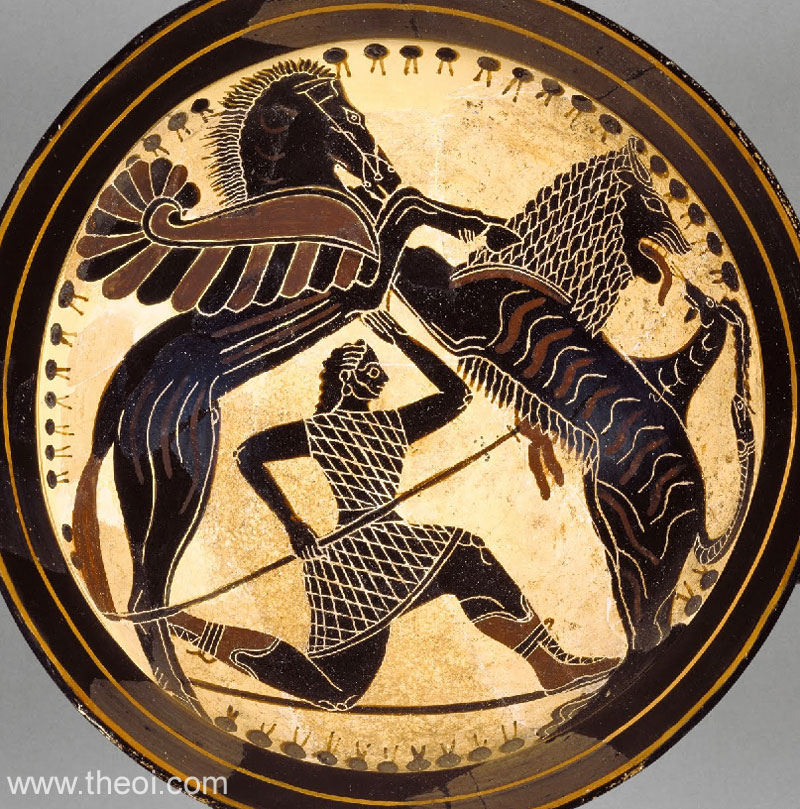
Hellenic mythology has its fair share of mythological creatures. In general, they are considered challenges for the hero to overcome, and the Chimera (Khimaira, Χιμαιρα) is one of them. It features heavily in the story of Bellerophon.


In general, monsters beget monsters. In the case of the Chimera, it was mothered by Erchidna, half Nymph, half snake. The Chimera itself is described as a composite creature, with the body and maned head of a lion, a goat's head rising from its back, a set of goat-udders, and a serpentine tail. From Hesiod's Theogony:

"And there she has a cave deep down under a hollow rock far from the deathless gods and mortal men. There, then, did the gods appoint her a glorious house to dwell in: and she keeps guard in Arima beneath the earth, grim Echidna, a nymph who dies not nor grows old all her days.

Men say that Typhaon the terrible, outrageous and lawless, was joined in love to her, the maid with glancing eyes. So she conceived and brought forth fierce offspring; first she bare Orthus the hound of Geryones, and then again she bare a second, a monster not to be overcome and that may not be described, Cerberus who eats raw flesh, the brazen-voiced hound of Hades, fifty-headed, relentless and strong. And again she bore a third, the evil-minded Hydra of Lerna, whom the goddess, white-armed Hera nourished, being angry beyond measure with the mighty Heracles. And her Heracles, the son of Zeus, of the house of Amphitryon, together with warlike Iolaus, destroyed with the unpitying sword through the plans of Athene the spoil-driver. She was the mother of Chimaera who breathed raging fire, a creature fearful, great, swift-footed and strong, who had three heads, one of a grim-eyed lion; in her hinderpart, a dragon; and in her middle, a goat, breathing forth a fearful blast of blazing fire. Her did Pegasus and noble Bellerophon slay; but Echidna was subject in love to Orthus and brought forth the deadly Sphinx which destroyed the Cadmeans, and the Nemean lion, which Hera, the good wife of Zeus, brought up and made to haunt the hills of Nemea, a plague to men." [295-332]

As said before, the Chimera's main accomplishment if being felled by Bellerophon (Βελλεροφων), a mighty hero who was a son of the Corinthian king, Glaucus and Eurymede, and a grandson of Sisyphus. Alternatively, he was a son of Poseidon and Eurymede. In punishment, Bellerophon was told to slay the Chimera. What crime he committed differs along stories; in some, he is punished for committing murders and this quest is his purification, in others, he is being set up to die, and in a others again, he is falsely accused of trying to seduce or assaulting a married woman.

Hyginus in his 'Astronomica' speaks of the latter of events that led up to the dead of the Chimera:

"Others say that at the time Bellerophon came to visit Proetus, son of Abas and king of the Argives, Antia, the king’s wife, smitten with love for the guest, begged to visit him, promising him her husband’s kingdom. When she couldn’t obtain this request, out of fear that he would accuse her to the king, she anticipated him by telling Proetus that he had offered violence to her. Proetus, who had been fond of Bellerophon, was reluctant to inflict punishment himself, but knowing that he had the horse Pegasus, sent him to the father of Antia (some call her Sthenoboea), for him to defend his daughter’s chastity and send the youth against the Chimera, which at that time was laying waste with flames the country of the Lycians." [II.18]
 
As theoi.com wisely notes:

"The Khimaira (Chimera) may have symbolised the cold of winter: her fire-breathing lion-head representing frost, her goat-head the storms of winter (aigis in Greek means both goatish and storm), and her serpentine-head winter sickness. Khimaira's name was perhaps derived from the Greek words kheima (cold, frost, winter) and aera (air). The father of Khimaira was Typhoeus the daemon of deadly, winter-storms and her mother was Ekhidna a daemon of illness and disease."