Showing posts with label Hermes Psychopompos. Show all posts
My girlfriend's grandmother has passed away. It was an emotional affair and the days have been rough but filled with love. I need some rest, and I need to give praise to Hermes Psychopompos. Psychopompos (ψυχοπομπός) literally means the "guide of souls". Psycholompoi escort newly deceased souls from Earth to the afterlife. Their role is not to judge the deceased, but simply to provide safe passage. In Hellenic mythology, Hermes and Hekate are both Psycholompoi.


"Hermes Kyllenios (of Mt Kyllene) began to summon the suitors' ghosts [at dawn's first light]; he held in his hand the golden rod that he uses to lull men's eyes asleep when he so wills, or again to wake others from their slumber; with this he roused them and led them on, and they followed him, thinly gibbering. As in a recess of some eerie cave a chain of bats may be hanging downwards from the rock, but one of them drops from the clinging cluster and then all the rest flit squeaking round, so did these ghosts travel on together squeaking, while easeful Hermes led them down through the ways of dankness. They passed the streams of Okeanos, the White Rock (leukas petre), the Gates of the Sun (pylai helion) and the Land of Dreams (demos oneiron), and soon they came to the Field of Asphodel (leimon asphodelon) where the souls (psykhai), the phantoms of the dead (eidola) have their habitation . . .

Hermes the Radiant One (Argeiphontes) drew near [to the gathering of the ghosts of heroes], leading down the souls of the suitors who had fallen by Odysseus' hand. Amazed to see this, the two heroes [Akhilleus and Agamemnon] moved straight towards them [and queried the newly arrived shades]."
-- Homeros, Odysseia 24. 1 & 99

"Zeus himself . . . commanded that glorious Hermes . . . only should be the appointed messenger to Haides, who, though he takes no gift, shall give him no mean prize [perhaps meaning that, in return, Haides and Persephone send grass up from the earth for the grazing of herds]."
-- Homeric Hymn 4 to Hermes

"It is said that after death, the tutelary genius (daimon) of each person, to whom he had been allotted in life, leads him to a place where the dead are gathered together [i.e. the daimon guide is Plato's equivalent of Hermes, Guide of the Dead]; then they are judged [i.e. by the Judges of the Dead] and depart to the other world with the guide whose task it is to conduct thither those who come from this world [i.e. the spirit Iakkhos]; and when they have there received their due and remained through the time appointed, another guide [probably Dionysos] brings them back after many long periods of time [i.e. they are reincarnated].

And the journey is not as Telephos says in the play of Aiskhylos; for he says a simple path leads to Haides (the lower world), but I think the path is neither simple nor single, for if it were, there would be no need of guides, since no one could miss the way to any place if there were only one road. But really there seem to be many forks of the road and many windings; this I infer from the rites and ceremonies practiced here on earth [i.e. the Mystery cults]. Now the orderly and wise soul follows its guide and understands its circumstances; but the soul that is desirous of the body, as I said before, flits about it, and in the visible world for a long time [i.e. as a haunting ghost], and after much resistance and many sufferings is led away with violence and with difficulty by its appointed genius (daimon)." [N.B. "led away with violence" cf. the story of the runaway ghost Sisyphos and Hermes.]
-- Plato, Phaedo 107c

"Now when the dead have come to the place where each is led by his genius (daimon) [i.e. by Plato's equivalent of Hermes, Guide of the Dead], first they are judged and sentenced [i.e. by the Judges of the Dead], as they have lived well and piously, or not. And those who are found to have lived neither well nor ill, go to the Akheron and, embarking upon vessels provided for them [i.e. the equivalent of Kharon's skiff], arrive in them at the lake; there they dwell and are purified [i.e. by the equivalent of the Erinyes], and if they have done any wrong they are absolved by paying the penalty for their wrong doings, and for their good deeds they receive rewards, each according to his merits."
-- Plato, Phaedo 112e

"Hermes, I call, whom fate decrees to dwell near to Kokytos, the famed stream of Haides, and in necessity's (ananke) dread path, whose bourn to none that reach it ever permits return. O Bakkheios Hermes, progeny divine of Dionysos, parent of the vine, and of celestial Aphrodite, Paphian queen, dark-eyelashed Goddess, of a lovely mien: who constant wanderest through the sacred seats where Haides' dread empress, Persephone, retreats; to wretched souls the leader of the way, when fate decrees, to regions void of day. Thine is the wand which causes sleep to fly, or lulls to slumberous rest the weary eye; for Persephone, through Tartaros dark and wide, gave thee for ever flowing souls to guide. Come, blessed power, the sacrifice attend, and grant thy mystics' works a happy end."
-- Orphic Hymn 57 to Khthonian Hermes
Many people--myself included--sometimes forget how extensive the ancient Hellenic empire was. It wasn't just what is now modern Greece. It extended all the way down to, for example, Russia, Italy, Spain and the Ukraine. But, of course, there were ancient Hellenic cities in modern day Greece too that no longer exist today. One of these is Mieza.

[Can't find it? Little left and below of center,
under "Bottia"]

At the foot of mount Vermio in Central Macedonia, Greece, excavations brought to light and continue to reveal the remains of an ancient city, which is identified with Mieza, one of the major cities of the Macedonian kingdom the period of its prosperity (4th to 2nd century BC). There are numerous references for Mieza at ancient literary sources, most notably Plutarch's information that near the ancient city lay Nymphaion, in the shady paths of which Aristotle taught the young Alexander the Great.

[Excavations of the "Aristotle School" near Naousa]

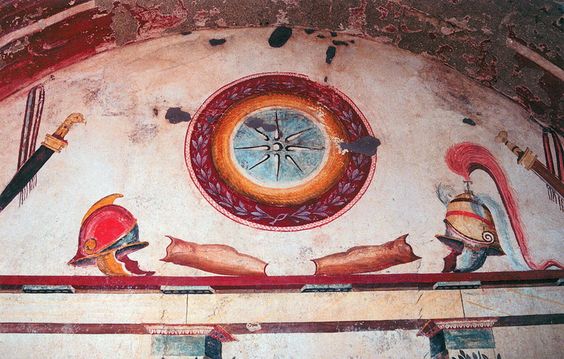
Mieza was a rural community that transformed into an urban center, then into a prosperous and wealthy city of the Hellenistic period. The most valuable archaeological evidence derives from the cemeteries and burial monuments of the area, which preserved the second most significant complex of Macedonian tombs after the royal tombs of Vergina. A total of six Macedonian tombs were found along the course of the road that in antiquity led from Pella to Mieza. They bear all the typical features of the monumental Macedonian tombs, they namely are subterranean vaulted structures with a temple-like façade and one or two burial chambers. Most often the internal surfaces, as well as the façade bear painted decoration and it is noteworthy that the murals of the Macedonian tombs are so far the only preserved examples of the large-scale ancient Greek painting. The tombs used to be covered with soil to form a hill and formed the resting places of the royal dynasty.

[Facade of the "Tomb of Judgment"]

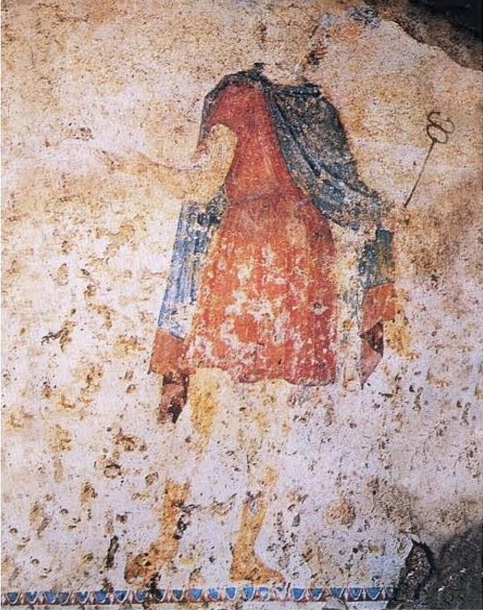
Perhaps the most important amongst all known Macedonian tombs is the Tomb of Judgement (late 4th - early 3rd century BC), one of the largest and most imposing monuments of its kind. Unique is the exterior of the tomb articulated by a two-storey façade which combines the Doric order in the lower half and the Ionic in the upper half respectively. Among the Doric half-columns flanking the door of the tomb are four paintings, depicting Hermes Psychopompos leading the dead to the Judges of the Underworld. The Doric metopes depict scenes of the Kentauromakhy while the war scene of the Ionic frieze with its relief figures represents one of the historic battles of Greeks and Persians.

[Fresco from the Tomb of Judgment showing Hermes Psychopompos]

Outside the perimeter of the ancient city, along the contemporary rural road that leads from Kopanos to Naoussa, lies the idyllic site of Isvoria. The lush landscape with the plenty waters and natural caves on the rocks was an ideal place for worshipping the Nymphs in antiquity. The scattered architectural parts of a rock-hewn Ionic stoa, dated after the mid-4rth century BC, were associated with the ancient descriptions and led to the identification of a significant site: the very school of Aristotles, where the young prince Alexander studied under the great philosopher.

[Painting from the Tomb of Lyson and Kallikles (2nd BC)]

The ancient city itself consists of disperse building complexes, though its boundaries cannot yet be delineated with precision. The architectural remains belong mainly to buildings of a public character and it’s most likely that the nucleus of the ancient city, namely its agora, lay at the present rural site of Belovina at Kopanos, where the theatre also came to light. The theatre dates to the Late Hellenistic period, though the form in which it is preserved today belongs to the Roman times. It was built on a hillside with a panoramic view over the valley and its capacity is estimated at 1500 spectators. The prosperity of Mieza is also reflected in the luxurious villas of the Hellenistic and Roman times. Among the best preserved examples are the two Roman villas at Tsifliki of Lefkadia and Baltaneto of Naoussa respectively, with splendid mosaic floors dated to the 2nd century AD.
On May 7, the body of an unidentified male is found a little less than twelve kilometers from my home. Early morning walkers come upon the body and notify the police. To the police, it soon becomes clear that this is a case of suicide, and they work to identify the male, intending, undoubtedly, to inform the next of kin. It turns out to be Jeroen Denis, a 38 year old physical therapist who works in my town. He has hung himself. When the family is informed--including his ex-wife Iris van de Schuit--the police is informed that Denis is a father of two, Ruben and Julian, who were supposed to be with their father for the weekend. The kids are not at home, nor with family, and it soon becomes very clear that the boys--who are nine and seven years old--are missing, and if they are still alive, they need to be found--fast.


What follows are days of searches in the areas where Jeroen and the kids have been seen on the night of May 6. Their whereabouts are tracked by way of surveillance camera and eye-witness reports. Everyone, from volunteers to the army helps search for the boys, but to no avail. Fragmented reports come in: Denis at a gas station with his kids in the back of the car, a purchase receipt for tie down straps, reports of the nature of the divorce, and threats against his own life and that of his kids that Denis has allegedly made as the divorce went final and he lost most of his custodial rights.


On May 19th, Sunday, a passer-by notices something strange in a drainage tube--the little black hole on the bottom left of the picture above. He notifies the police, and police divers pull out two little bodies. They have been in the water for a long time, and it's impossible to identify them on sight, yet, their heights seem to match Ruben and Julian, and that evening, the police issue a press statement that the boys have been found. That drainage tube is bout 15 kilometers from my home.

Identification of the bodies is still underway, but the forensic investigation into the crime scene has been completed. Two little boys are dead, most likely murdered by their own father after a night of cross-country driving. Two boys--who went to school 900 meters from where I live--were strapped together and weighted down, then stuffed into a dark tube. I can only pray that their death came fast--the cause of death has not been released yet.

The boys leave behind an inconsolable mother, grieving family, friends, and acquaintances, and most of all, questions. What happened? Why did it happen? Could it have been prevented after the accusations Denis made? As it turns out, several governmental organizations were already assigned to the family to mediate and watch over the boys. In the coming days, the case will be looked into thoroughly, but for now, the focus is on identification and community. Later today, the results of several tests to determine the identity of the boys will come in, and we will know for sure if Ruben and Julian have been found, but there is very little doubt left. People here are coming together in churches, they lay flowers at the school, meeting are held for all involved, and there might be a vigil later on, after the identification. I'm not sure about that last one yet.

There is nothing Hellenistic about this post, and I won't make it so. I just needed to write about this, about something that has been occupying my mind for nearly two weeks. The senselessness of the act, and the shock that a father would do something so horrible to his own sons are my primary reactions, next to grief for two--three--lives that never touched mine, but should not have ended when and how hey did. May Hermes Psychopompos have carried their souls swiftly into the Underworld, and may the Theoi prevent something like hi to ever happen again. This is a true tragedy, and it hits very close to home.

If that vigil is organized, I will attend. I want to stand with others in grief, in solidarity, in hope that this tragedy will prevent others from taking place. My thoughts go out to the mother of the boys, who must be going through hell. I wish so many things to change in this tragedy, but most of all, I wish for the Gods to lift the burden of grief from her.
I should have posted this yesterday, but yesterday, I couldn't find the words. I also didn't know if it was my place to comment. I don't know anyone from or in Boston, and I live way across the pond, so in all fairness, there is nothing that binds me to the events that unfolded there, and to the victims. Nothing but common decency and human empathy. As such, I will still comment--like every blogger--because I want to be a voice that speaks out against the crazy, the destructive, and the cowardly. I will not be silent in the face of fear mongering and murder. As such, I offer a prayer today, to the Theoi, with my wishes for Their involvement in the resolution of this terrible event.

"May Hermes Psychopompos carry the souls of the dead safely cross the river Styx.
May Hades accept them favorably, and may the judges judge them fairly.
May Asklēpiós tend to the wounds of the injured
May Ares instill in them the passion of life, and the strength of a thousand warriors.
May Hypnos sooth their weary minds, and cloud them in sleep
May Dionysos calm their terror.
May They offer the same to emergency personnel and passers-by who were witnesses.
May Dikē who weeps at the injustice done upon all touched by this tragedy, clutch the strong thigh of Zeus the All-wise, and beg of Him the severest of punishment.
May All-Mighty Zeus send winged Nemesis to administer swift judgement.
May Her judgement take from the guilty parties an equal or greater price than their victims have had to pay.
May Hēlios the All-seeing whisper truths to law enforcement, and guide the investigation swiftly towards those who conceived and executed this terrible crime.
May Athena led Her aid to them.
May Zeus the All-mighty bless those who ran not from the area, but towards it, in an attempt to offer aid to those wounded or dead.
May he look favorably upon those who ran away as well, as the will to live is at the core of every mortal's life.
To all Theoi: a last plea. To protect those whom the media will persecute, but are innocent of the crime.
To protect the innocent scapegoat from the actions of a species in the grips of fear and revenge."

This is my prayer, may it echo in your.
People who empty a (semi?-)automatic rifle into a group of elementary school children should  be eternally punished in the deepest depts of Tartaros. Likewise if you take a knife to children in an elementary school. I can't wrap my mind around what happened. Any shooting is terrible, but this? Twenty-something dead? Everyone who survive scarred for life? Twenty-two school children injured in a school stabbing? What goes through your head when you prepare for something like this? Is this our world? Modern society? I can't even form proper sentences about this.

Twenty-eight people--twenty children, eight adults--died in the mass shooting in Sandy Hook village, Newtown, Connecticut. Eighteen children and seven adults were killed at the school itself, gunman included, while two other kids died of their injuries at the hospital. Another adult was found dead in the shooter's home shortly afterwards. Only the Virginia Tech shooting had a higher body count.

In Chengping, China, a man tore through a group of elementary school children with a knife, after first attacking an elderly woman. He was tackled by security before anyone was killed; security that was there due to a wave of stabbing incident at schools.

I will never, ever name these attackers, because they do not deserve to be remembered. A large part of Hellenic rituals of the dead speak of honoring the dead by name, so their names will never be forgotten, their honor never lost.

How does this happen? Why does this happen? And why is America not discussing gun policies yet? A knife is horrible, but at least these kids had a fighting chance.

I'm sure there was a reason these men got in a headspace where this rampage was a logical next step. I'm sure the Sandy Hook shooter had issues, most likely with his mother, who was a teacher at the school, and one of the firsts to die. I'm sure there was a lot of crap in both these people's lives that they couldn't work though any other way, but it's no excuse. It doesn't lift the pain, the shock, or the burden of this crime.

It's been a bad week all around. On the eleventh, a fifteen year old girl jumped in front of a train with some of her friends watching. The reason? Bullying in school. She couldn't take it anymore. In November, a twenty year old boy committed suicide for the same reason. Gods know what else happened that I'm not even aware of. These deaths--all these deaths--could have been avoided. And I'm not even talking gun control or a 'love and light' attitude.

We've become so estranged that we hardly know who our neighbors are, let alone the rest of the people on the city block. Behind closed doors, horrors are inflicted every day. We've lost the means of detecting the warning signs; we don't know how someone normally acts, so how could we notice when their lives spin out of control. Who can we go to when we are in need of help? Who do we turn to when we need something? When we are scared?

Times of crisis bring out the best and worst in people. On the one hand, people ban together. The person next to you suddenly becomes a lifeline to life, a way of connecting with the world of the living, a way to prove we are still alive. Even during a minor crisis like an endless rainy day, people band together. We speak to each other, offer a tissue to dry a face, buy some poor soul a cup of coffee because they are completely drenched and freezing.

On the other hand, people choose sides. We bicker over the details without ever addressing the real issues. A crisis as large and terrible as a school shooting rarely changes anything, although we all call for action. Words become weapons, because the emotions are too raw. There is only fear and pain. And to my friend, who told me that even fifty years or so ago, there were guns aplenty, and nothing happened? Even more reason to finally put restrictions on the possession of guns: people have changed, and a good few of them are incapable of carrying ethically.

Last night, I prayed to Hekate and Hermes Psychopompos, to guide the souls of the dead to the place they are meant to be. I offered coins and dark red wine, and cried for the lives lost in this tragic and meaningless act of violence.

My thoughts go out to the families of those who have died, as well as anyone touched by this tragedy. Tomorrow, regular blogging will return, but today, the first day of the month, is--ironically enough--reserved for the dead.
"Death came suddenly and it was mercilessly painful. You are aware you have passed: you can hear the keening of the women in your family, taste the metal of the oboloi in your mouth. You are no longer cold, or hot, and there is no pain. Sensation is for the living, and your memories start to fade already. You are no longer part of the living. You are dead, and your guide is waiting for you. 

Hermes Psychopompos, the winged guide of the newly dead, descends and takes your hand. Below you is the ocean: Oceanos' divine body. You used to watch it glisten in Helios' bright rays, but today, everything is dull and lifeless. You are speeding west, guided by the blessed Immortal. Below you, you can see land again and a mighty river. The land draws you down, and you stand on the ground without feeling it. It is here that Hermes Psychopompos leaves you, in the capable hands of Kharon, on the bank of the river Acheron. 

The ferryman looks old and ageless at the same time. He holds out his hand, but you can't understand what he wants from you. Then, his hand closes around a coin, and he steps aside to let you into his boat. Without moving, you are suddenly on the boat, looking to the shore where shadowy figures of the dead gather, longing to make the journey with you. But they have no coin to hand over, and are forced to wander the bank of the Kokytos river year after year, until the ferryman takes pity on them. Today is not their day.

The river fades into the darkness of a cave. The river of woe joins with the river of hate; the river Styx that seems to have no end. Kharon moves the boat forward in a steady rhythm. You reach the dock sooner than you expected to. Kharon waits silently for you to get off of his boat. You dare not move. Beyond is a field of grey, a sunless cavern filled with the shadows of the dead. The fields of Asphodel; the dreary resting place of the common Hellen. Before the fields stand a huge gate, and an equally huge dog, with three growling heads, foaming at each mouth. Kharon waits, and then you are in the field. The gate stands behind you, Kerberos a constant reminder you can never go back.

You wander, still remembering much of your life. The fall you took as a child that gave you a weak knee, the smile of your spouse on your wedding day. You remember your child being born. It makes being here impossible to bear. The memories will not fade, because before your judgement, you are not allowed to forget. You hold on to them as long as you can, but then you walk through the field, to the compound in the distance. Hades' compound, where the Dread Lord and His beautiful wife live. You walk to forget. Thus, you come upon the judges. 

Rhadamanthys, Minos and Aiakos wait for you at the trivium in the courtyard of the compound; the trivium, Hekate's sacred crossroads. If you still had a heart, you would feel it beating in your throat now. But you do not. Any decision the judges make is alright. The memories hurt. You are cut off from your loved ones, from Helios' powerful rays. Tartaros is not your place, you know that much. You have honored the Theoi, you have done right by your family. You do not fear judgement. You wish to go back to the Asphodel meadows and drink from the river Lethe; you wish to forget. More, you wish to reach Elysium, the island of the blessed. In the distance, the Lord of the Dead and his Queen Persephone must be.

Your life is judged, you are judged. You wait, and look to each side. Left for Tartaros, where the river Phlegethon burns, but leaves everything it touches intact. Right for Elysium, where the ghosts of the blessed reside amongst the blameless heroes. Or back the way you came for the meadows where Lethe flows free, where the dead flutter around like bats, and those initiated into the Mysteries drink from Mnemosyne, so they will not forget their previous life when they reincarnate. You wait, and are judged."

For the ancient Hellens, this is what dying would look like. This is how I see my 'life' after death. When I pass, I will walk to my judgement. Sadly, life after death may be the closes I will ever get to the ancient Hellens, and the Theoi, so because of that, I have a great bit of interest in the Hellenic Underworld. So lets look at the short story I wrote--I won't call it a meditation, because traveling to the Underworld is something one should not attempt in any way, shape or form--to learn a bit more about the last resting place of the ancient Hellens and modern Hellenists.

The Underworld is described as lying in the west in the Odysseia, and there is an entrance that can be reached overseas. Yet, the dead enter the Underworld through one of five rivers surrounding the Underworld.

Acheron (Αχέρων) - The river of woe. This is the river that Kharon ferries the dead across, from the land of the living, to the realm of Hades.
Kocytus (Κωκυτός) - The river of lamentation. Those who could not pay Kharon, were destined to walk the banks of this river--a side river to the river Acheron--for one hundred years.
Phlegethon (Φλεγέθων) - The river of fire in the Underworld. It's a side river of the river Styx and is said to be permanently on fire, yet never burn anything it touches. It's located in Tartaros.
Lethe (Λήθη) - The river of forgetfulness. It runs through the Asphodel meadows, and the dead have to drink from it to completely forget about their lives on Earth. Those who were initiated in the Eleusinian Mysteries--linked to Demeter and Persephone--were allowed to drink from Mnemosyne and are allowed to remember.
Styx (Στύξ) - The river of hate. The Acheron joins with the Styx at the moment the land of the living makes way for the Underword, and as such, She is a portal, and the most famous of the five rivers. It is said to wrap around the Underworld nine times. Styx was also the river upon which the Theoi, and mankind, swore oaths which could not be broken, an arrangement agreed upon by Zeus and the Goddes Styx in return for her aid in the Titan Wars. If a Theos or Theia did break an oath made upon the river Styx, they were forced by Zeus to drink from the river, upon which They fell into a deep coma for a year, and were then cut off from Their worshippers for nine more. For mortals, breaking an oath on the river Styx was something you simply did not do, and it's the gravest vow to make, one that is not made lightly.

The Underworld has various areas where the dead are housed, but also where the various Gods and Goddesses of the Underworld--called 'Theoi Khthonioi'--reside. Several of the Gods and Goddesses have already been discussed; all the rivers are Gods or Goddesses who have their home in the Underworld, and there are Kharon, Kerberos, and the judges: Rhadamanthys, Minos and Aiakos. Yet, there are a lot more. The most well known are Hades and His consort, Persephone.

Hades, brother of Zeus, son of Kronos, is the Lord of the Dead. The Underworld is His domain. He rules it with his beautiful wife--and niece--Persephone, whom He stole away. She resides with Him in their home, a large mansion at the crossroads between the Asphodel meadows, Tartaros and Elysium. This crossroads is sacred to Hekate, and located in the courtyard of the mansion. The maiden Goddess Hekate is a companion of Persephone, whom she led out of the Underworld after Zeus decreed it to be so. She vowed to Demeter to stay with Persephone in the months She spent under the earth, and takes this vow very seriously.

Kronos is an Underworld deity as well: Zeus eventually released His father and made Him king of the Elysian Islands. Other Gods, like Hypnos, Erebos, Nyx, Makaria (daughter of Hades and Persephone, who watched over the blessed dead, who had been initiated into the Mysteries), and the Erinyes (three Goddesses of vengeance and retribution) also make their home in (a part of) the Underworld. The Moirai, the three Goddesses of fate, have their own space in the Underworld as well. Other Immortals who share the Underworld are deamons and nymphs.

In the daímōn-section, we have the the Arai (daímōnes of curses), Askalaphos (who tended to the orchards of Hades and was transformed into a screech owl by Demeter for bringing Her bad news about Her daughter), Kakodaimones (Deamones which cause all kinds of harm), Empousa (a daímōn with flaming hair, the leg of a goat and a leg of bronze, who parents vowed would come after their children if they didn't behave), the Oneiri (dream spirits) and Epiales (the daímōn of nightmares). Other daímōnes include: Eurynomos (who stripped the flesh off of the corpses of the dead), the Lamiai and Mormolykeia (vampiric, succubus-like, daímōnes in the following of Hekate), Melinoe (who led the souls of the dead back to earth to haunt the living). Menoites, furthermore, herds the black-skinned cattle of Hades, and Thanatos, the winged daímōn of death, is Hades' minister.

There are also a few Underworld nymphs: Daeira (a companion of Persephone), the Lampades (torch bearing nymphs in Hekate's following who may have looked over the blessed dead on their way to Elysium), Leuke (a nymph abducted by Hades and transformed into a white poplar which stands in the Elysian fields), Mynthe (a beowed nymph of Hades, who Persephone turned to dust and Hades turned into the mint plant), and Orphne (wife of Acheron).

As for the dead, they had three places to go in the Underworld: Tartaros, where those who were punished for all eternity remained, the Asphodel meadows, where everyone who had lived a good life wandered about endlessly, and the Elysian fields, where the children of Gods, the blessed dead and those who had lead extraordinarily honorable, brave or otherwise well-respected lives resided.

The ancient Hellens believed the Underworld was a neutral place. One did not desire to go there in the least, but it was part of life, and as far as the afterlife went, it was dull and sunless but nothing like the hell of Christianity. The worst part about it is being without the touch of loved ones, and forgetting who you were. In the Odysseia, Odysseus meets his mother's spirit at one of the entrance points to the Underworld. She tells him:

"Oh, my child, most unfortunate of men, Persephone, Zeus’ daughter, does not deceive you: this is the way it is with mortals after death. The sinews no longer bind flesh and bone, the fierce heat of the blazing pyre consumes them, and the spirit flees from our white bones, a ghost that flutters and goes like a dream."

Nobody wants to think about dying and the dead for too long, so I will end this post here. May it have given you some insight into the workings of the Underworld.