Showing posts with label Prometheus. Show all posts

 I've always been a little intrigued with the two-time creation of humanity in Hellenic mythology. While Christianity's end of humanity by way of deluge is much more well-known, and everyone knows about Noah and his ark, humanity in Hellenic mythology also ended and was revived. Story time:


After the Titanomachy--the war in which the Olympic Gods took control from the elder generation of Gods, the Titans--ended, Zeus claimed His throne as rightful King to the Deathless Ones. Humanity did not yet exist. While most Titans were locked away in Tartarus by Zeus, the Titans Prometheus and Epimetheus--who were brothers--had been either neutral or on the side of Zeus during the Titan War and were therefor given a task. Prometheus was given the task of creating man and Epimetheus was ordered to give good qualities to all creatures of earth. So did Prometheus and Epimetheus. Prometheus shaped man out of clay and Athena breathed life into him. Epimetheus spread swiftness, cunning, fur and wings but ran out of gifts when he came to man. Prometheus remedied the situation by allowing men to walk upright and gave them fire.

It soon became apparent that Prometheus loved man more than the Olympians. When Zeus decreed that man must give sacrifice to the Deathless Ones, Prometheus stood ready to aid humanity. He butchered an animal and divided it into piles; the bones and fat formed one of them, the good meat wrapped in the hide of the animal, the other. Zeus vowed that he would abide by the choice of sacrifice He made now, and picked the tasty looking pile of bones. Zeus was angered but could not take back his vow: from that point on, the Gods would get the fat and the bones from a sacrificed animal. The humans were entitled to the meat and the hide. What He could take back was the gift of fire, and this He did.

Mankind suffered greatly without fire and Prometheus traveled either to the sun or Olympus to reclaim fire for his beloved mankind. This, of course, angered Zeus even further and so He devised a plan. First, He imprisoned Prometheus. He ordered Hermes to tie Prometheus to a mountain and had a giant eagle come every day to eat his liver. As an immortal, Prometheus' liver grew back over night so his torment was endless. Before Prometheus had been taken prisoner, however, he had told his brother Epimetheus never to accept a gift from Zeus, as Zeus' wrath would undoubtedly also extend to the mortal race He had created.

And Zeus, indeed, was not done with His punishment. After imprisoning Prometheus, Zeus assembled the Theoi. He told Hēphaistos to fashion a woman out of water and clay. Hēphaistos did and brought the statue before Zeus. Zeus then asked Aphrodite to bless the woman with a beauteous face and feminine whiles. He asked Athena to dress her modestly and give her the ability to weave and craft, Demeter taught her to tend the garden. From Apollon, she received the ability to make music and sing. All Gods gave her treacherous gifts, including Hera, who made her curious, and Hermes, who made her cunning and quick of the tongue. Then, Zeus named her Pandôra (Πανδωρα), All-Giving, and breathed life into her. He then bade Hermes to deliver her to Epimetheus, along with a vase (pithos) Pandôra was never allowed to open.

Epimetheus had been warned by Prometheus never to open or accept a gift from Zeus, but he laid eyes on Pandôra's beauty and fell in love too deeply to reject her. He took her into his home amongst men and wedded her right away. Pandôra loved Epimetheus, because he was a good man and good husband. She worked tirelessly to please him and helped him keep the home. Yet, she found herself drawn to the pithos she was told never to open. Her eyes would wander to it constantly and Hera's gift eventually prevented her from holding to her promise.

On a day when Epimetheus was away from the home, Pandôra decided to risk a sneak peak at the contents she had fantasized about so often. She pulled the lid off of the pithos and out flew dark spirits of disease, death and the destruction of humanity. Pandôra hastened to seal the jar but managed to trap only Hope (Elpis)--by Zeus' decree or by mere accident.

Mankind was now plagued with illness, with failing crops, with all that makes life hard. But they had Hope and soon, Pyrrha (Fire) was born to Epimetheus and Pandôra. Prometheus had a son, Deukalion, with Pronoia, an Okeanid nymph of Mount Parnassos in Phokis. They lived in the time of the Bronze Race of Man, a corrupt age in which the Gods were rarely worshipped. Zeus was angered by their hubris and decided to end this race of man. He sent a great deluge, killing everyone but Deukalion and Pyrrha, who were warned of the flood by Prometheus. They did not build a boat, but clung to a chest, eventually sailing to the mountain peaks of Parnassos. 

Once Zeus caused the water to recede, Deukalion and Pyrrha travelled to the oracle of Delphi and begged to learn how they could bring back mankind. They were told that they needed to cast the bones of their mother over their shoulders, and they understood that they needed to pick up stoned and toss them, because Gaia, the earth, is everyone's mother. Where the pebbles landed, humans rose from the earth. Deukalion created the men and Pyrrha the women, and from their efforts, humankind once more arose to populate the earth.

There are more flood myths in Hellenic mythology--Philemon and Baucis, for example--but none as all-consuming as this one, sent by Zeus. This severe example acts as a warning to mankind: the ultimate display of destructive power by the Gods should mankind disobey Them. In this case, human kind was unethical, did not give to the Gods, and overstepped their bounds. Autochthonous births (αὐτός χθών, 'earth-born') are also well-known in Hellenic mythology. Many ancient Hellenic kings traced their line back to Gaia in this way. These two themes give us an ethical standard to live up to, explain our place in the universe, and connect us to the divine in a beautiful and enlightening way. These are the major reasons why I enjoy this myth so much.

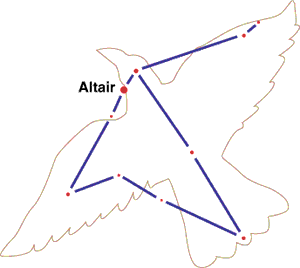
It's time for part three of the constellation series, and this time I'm tackling a constellation I had never heard of before: Aquila. It's one of the medium sized constellations, located a little 'above' Sagittarius.


Aquila is aptly named 'the eagle'. The shape it was given, as well as the mythology attached to it all relate to the bird. Aquila is the Latin for 'eagle', and from mythology, we are well aware that Zeus's favorite animal is this very bird.

This constellation is heavily linked to the constellation of Aquarius: the water carrier. This constellation is often said to represent Ganymēdēs, who was carried to Olympus by an eagle; this very eagle, in fact. It is also said that Zeus's thunderbolts are carried down by the eagle. In the Odysseia, Odysseus' son Telemachos receives oracular message from Zeus by way of the eagle:

"So Telemachus spoke, and Far-Seeing Zeus sent out two eagles from a high mountain peak. They flew for a while with outspread wings, side by side in the currents of air, but when they were above the voice-filled assembly they swiftly slanted their wings, circling round, gazing down on the heads below, and death was in their gaze. Then they clawed at each other’s head and neck with their talons, and soared away eastward over the roofs of the town. The people saw them and wondered, and considered what this might foreshadow. Then the old hero Halitherses, Mastor’s son, spoke out, for he was the wisest man of his day in bird-lore and prophecy. With goodwill in his heart he addressed the assembly:

‘Men of Ithaca, listen to me: and I say these words to the Suitors especially, since disaster approaches them. Odysseus will not be far from his friends much longer, and I believe even now he is near, sowing the seeds of dark death for all these men. Yes, and he will bring trouble to many another of us, who live in clear-skied Ithaca. Let us think in advance how we might prevent all this, or let them prevent it of their own accord, easily their best option. I am not unskilled in prophecy, but have true knowledge. I say that all things for that man will be fulfilled, just as I told him when the Argives sailed for Troy, he among them, resourceful Odysseus. I declared that, suffering many troubles, losing all comrades, he would return in the twentieth year, unknown to all: and now it is coming to pass.’"

Another prominent myth in which the eagle of Zeus features is the myth of Prometheus, who stole fire from the Gods and gave it to humanity. For his efforts, he was tied to a rock by Hermes who was under orders from Zeus. Zeus then tormented him every day for the longest time, by sending an eagle to peck out his liver again and again, because as an immortal, Prometheus' liver grew back every night. In some stories, Prometheus is eventually freed by the hero Hēraklēs, after Zeus takes mercy on him.  

For all his hard work, the eagle was placed into the sky by Zeus, so it could soar through the skies for eternity. The constellation Aguila is visible at latitudes between +90° and −75°. It is best visible at 21:00 (9 p.m.) during the month of August.

Welcome to part two of the constellation series reposts. The second sign we'll be looking at is Aquarius.


Aquarius is the eleventh sign of of the zodiac and is therefor pretty well know. In fact, it is amongst the oldest known constellations. The constellation is said to represent a number of people; for one, it can be Zeus himself, pouring down water onto the Earth. It could also be Ganymēdēs (Γανυμήδης), the beautiful male from Troy, who caught Zeus' eye and served as cup bearer to the Gods. The third explanation would be that the constellation represents Deukalion, son of Prometheus.

The latter two deserve a bit more explanation. Before her marriage to Hēraklēs, Hebe, daughter of Zeus and Hera, acted as cup bearer to the Gods. When she wedded, Zeus cast his eyes about and took a shining to a young boy from Troy: Ganymēdēs. There are various versions of the myth. In one, Zeus transforms himself into an eagle and swoops up the boy, carrying him off to Olympus. In another, he pays Ganymēdēs' father Tros with 'horses beautiful and strong enough to carry the Gods themselves'. In all versions, Ganymēdēs is made immortal and his father is comforted by that knowledge. All Gods were overjoyed to have the young man serve them, except for Hera, who saw a rival for her husband's affection in the boy. It was Zeus who later put Ganymēdēs into the sky as the constellation Aquarius.

The other option is that the constellation represents Deukalion. He and his wife Pyrrha, daughter of Pandôra, recreated humanity by tossing stones behind them as they walked, after Zeus flooded the Earth and killed humanity for its hubris. You can read the full story here, as I have blogged about it before. According to myth, Zeus put Deukalion into the sky to honor his contribution to humanity. Sadly, Pyrrha was not awarded this honor.

Whomever the constellation is supposed to represent, the constellation is very old and--as it's there in every horoscope, ever--very powerful. The Aquarius constellation is visible at latitudes between +65° and −90°. It is best visible at 21:00 (9 p.m.) during the month of October.

 Aeschylus (Aiskhulos, Αἰσχύλος) is of the three Hellenic tragedians whose plays can still be read or performed. He was alive from around 525/524 BC to 456/455 BC, and according to Aristotle, he expanded  the number of characters in plays to allow for conflict amongst them, whereas previously characters had interacted only with the chorus. Aeschylus' most famous works are undoubtedly the Seven against Thebes, the Supplicants and the Orestia. Also usually attributed to him is 'Prometheus Bound'.

Prometheus Bound (Promētheus Desmōtēs, Προμηθεὺς Δεσμώτης) is an Ancient Greek tragedy. The tragedy is based on the myth of Prometheus, a Titan who defies the Gods and gives fire to mankind, acts for which he is subjected to perpetual punishment. Much of the play is performed by the chorus, who are, in this play, the representation of the Oceanids. In Hellenic mythology, the Oceanids (Ὠκεανίδες) are sea nymphs who are the three thousand daughters of the Titans Oceanus and Tethys. Each is the patroness of a particular spring, river, sea, lake, pond, pasture, flower or cloud.

Somewhere a little past the middle, Prometheus still firmly chained to the rock Zeus condemned him to, the chorus speaks to Prometheus through a plea to Zeus. It's this plea to Zeus I'd like to share with you today.


"May Zeus, who apportions everything, 
never set his power in conflict with my will,
nor may I be slow to approach the gods, 
with holy sacrifices of oxen slain, 
by the side of the ceaseless stream 
of Oceanus, my father;
and may I not offend in speech; 
but may this rule abide in my heart 
and never fade away.
Sweet it is to pass all the length of life 
amid confident hopes, 
feeding the heart in glad festivities." [529-544]
Lovely readers, are you fans of classical music? I quite enjoy many classical pieces although I am definitely not well versed. I have found though that the subject matter matters a great deal, so how about some classical pieces with Hellenic influences?

Carl Nielsen - Helios Overture


Carl Nielsen's Helios Overture, Opus 17, was first performed by the Royal Orchestra, conducted by Johan Svendsen, on 8 October 1903 in the large hall of the Odd Fellows Mansion in Copenhagen. In 1902, Nielsen signed a contract with the publisher Wilhelm Hansen, which allowed him to go to Athens, Greece, to join his wife Anne Marie Carl-Nielsen, who was one of the first sculptors allowed to make copies of the bas-reliefs and statues in the Acropolis Museum. Nielsen's stay in Athens gave him the inspiration of a work depicting the sun rising and setting over the Aegean Sea, an overture which he called Helios. He began work on it in March 1903, and finished it on April 23 the same year. The score is written for three flutes, two oboes, two clarinets, two bassoons, four horns, three trumpets, three trombones, tuba, timpani, and strings.

The work begins as the sun ascends over the Aegean Sea, while strings, divided horns and woodwind sound a melody. This rises out of the darkness to a full orchestra, where fanfaring trumpets begin a striding theme, which returns later in the piece. From there woodwinds begin a graceful tune, from which brass sound. Strings begin to play, which draws the orchestra into a reprise of the striding theme and its fanfare. In the final measures, the music subsides as the sun sinks over the horizon of the sea. The average playing time is between ten and twelve minutes.


Gluck - Orpheus and Euridice


Orfeo ed Euridice is an opera composed by Christoph Willibald Gluck based on the myth of Orpheus, set to a libretto by Ranieri de' Calzabigi. The piece was first performed in Vienna on 5 October 1762. The two hour opera is split into three acts. In the first a grieving Orpheus--Orfeo--Amore appears, telling Orfeo that he may go to the Underworld and return with his wife on the condition that he not look at her until they are back on earth. In the second act, Orfeo visits the underworld and is reunited with Euridice, and in the third, they head out and he looses her again when he looks back to check if she is really there.


Karl Goldmark - Prometheus Unbound Overture


 Karl Goldmark, also known originally as Károly Goldmark and later sometimes as Carl Goldmark was a Hungarian composer who lived from May 18, 1830, to January 2, 1915. The Op. 36, the Prometheus Bound Overture, features Prometheus and is concerned with the torments of the Hellenic mythological figure Prometheus who defies the Gods and gives fire to humanity, for which he is subjected to eternal punishment and suffering at the hands of Zeus.


Carl Ditters von Dittersdorf - Symphonies after Ovid’s 'Metamorphoses' No. 6


Carl Ditters von Dittersdorf was an Austrian composer, violinist and silvologist who lived from 2 November 1739 to 24 October 1799. Among his 120-or-so symphonies are twelve programmatic ones based on Ovid's Metamorphoses, although only six have survived (and have also been recorded). They are entitled: 'The Four Ages of the World', 'The Fall of Phaeton', 'The Metamorphosis of Acteon Into a Stag', 'The Rescue of Andromeda by Perseus', 'The Transformation of the Lycian Peasants into Frogs', and a sixth untitled one.
I've always been a little intrigued with the two-time creation of humanity in Hellenic mythology. While Christianity's end of humanity by way of deluge is much more well-known, and everyone knows about Noah and his ark, humanity in Hellenic mythology also ended and was revived. Story time:

After the Titanomachy--the war in which the Olympic Gods took control from the elder generation of Gods, the Titans--ended, Zeus claimed His throne as rightful King to the Deathless Ones. Humanity did not yet exist. While most Titans were locked away in Tartarus by Zeus, the Titans Prometheus and Epimetheus--who were brothers--had been either neutral or on the side of Zeus during the Titan War and were therefor given a task. Prometheus was given the task of creating man and Epimetheus was ordered to give good qualities to all creatures of earth. So did Prometheus and Epimetheus. Prometheus shaped man out of clay and Athena breathed life into him. Epimetheus spread swiftness, cunning, fur and wings but ran out of gifts when he came to man. Prometheus remedied the situation by allowing men to walk upright and gave them fire.

It soon became apparent that Prometheus loved man more than the Olympians. When Zeus decreed that man must give sacrifice to the Deathless Ones, Prometheus stood ready to aid humanity. He butchered an animal and divided it into piles; the bones and fat formed one of them, the good meat wrapped in the hide of the animal, the other. Zeus vowed that he would abide by the choice of sacrifice He made now, and picked the tasty looking pile of bones. Zeus was angered but could not take back his vow: from that point on, the Gods would get the fat and the bones from a sacrificed animal. The humans were entitled to the meat and the hide. What He could take back was the gift of fire, and this He did.

Mankind suffered greatly without fire and Prometheus traveled either to the sun or Olympus to reclaim fire for his beloved mankind. This, of course, angered Zeus even further and so He devised a plan. First, He imprisoned Prometheus. He ordered Hermes to tie Prometheus to a mountain and had a giant eagle come every day to eat his liver. As an immortal, Prometheus' liver grew back over night so his torment was endless. Before Prometheus had been taken prisoner, however, he had told his brother Epimetheus never to accept a gift from Zeus, as Zeus' wrath would undoubtedly also extend to the mortal race He had created.

And Zeus, indeed, was not done with His punishment. After imprisoning Prometheus, Zeus assembled the Theoi. He told Hēphaistos to fashion a woman out of water and clay. Hēphaistos did and brought the statue before Zeus. Zeus then asked Aphrodite to bless the woman with a beauteous face and feminine whiles. He asked Athena to dress her modestly and give her the ability to weave and craft, Demeter taught her to tend the garden. From Apollon, she received the ability to make music and sing. All Gods gave her treacherous gifts, including Hera, who made her curious, and Hermes, who made her cunning and quick of the tongue. Then, Zeus named her Pandôra (Πανδωρα), All-Giving, and breathed life into her. He then bade Hermes to deliver her to Epimetheus, along with a vase (pithos) Pandôra was never allowed to open.

Epimetheus had been warned by Prometheus never to open or accept a gift from Zeus, but he laid eyes on Pandôra's beauty and fell in love too deeply to reject her. He took her into his home amongst men and wedded her right away. Pandôra loved Epimetheus, because he was a good man and good husband. She worked tirelessly to please him and helped him keep the home. Yet, she found herself drawn to the pithos she was told never to open. Her eyes would wander to it constantly and Hera's gift eventually prevented her from holding to her promise.

On a day when Epimetheus was away from the home, Pandôra decided to risk a sneak peak at the contents she had fantasized about so often. She pulled the lid off of the pithos and out flew dark spirits of disease, death and the destruction of humanity. Pandôra hastened to seal the jar but managed to trap only Hope (Elpis)--by Zeus' decree or by mere accident.

Mankind was now plagued with illness, with failing crops, with all that makes life hard. But they had Hope and soon, Pyrrha (Fire) was born to Epimetheus and Pandôra. Prometheus had a son, Deukalion, with Pronoia, an Okeanid nymph of Mount Parnassos in Phokis. They lived in the time of the Bronze Race of Man, a corrupt age in which the Gods were rarely worshipped. Zeus was angered by their hubris and decided to end this race of man. He sent a great deluge, killing everyone but Deukalion and Pyrrha, who were warned of the flood by Prometheus. They did not build a boat, but clung to a chest, eventually sailing to the mountain peaks of Parnassos. 

Once Zeus caused the water to recede, Deukalion and Pyrrha travelled to the oracle of Delphi and begged to learn how they could bring back mankind. They were told that they needed to cast the bones of their mother over their shoulders, and they understood that they needed to pick up stoned and toss them, because Gaia, the earth, is everyone's mother. Where the pebbles landed, humans rose from the earth. Deukalion created the men and Pyrrha the women, and from their efforts, humankind once more arose to populate the earth.

There are more flood myths in Hellenic mythology--Philemon and Baucis, for example--but none as all-consuming as this one, sent by Zeus. This severe example acts as a warning to mankind: the ultimate display of destructive power by the Gods should mankind disobey Them. In this case, human kind was unethical, did not give to the Gods, and overstepped their bounds. Autochthonous births (αὐτός χθών, 'earth-born') are also well-known in Hellenic mythology. Many ancient Hellenic kings traced their line back to Gaia in this way. These two themes give us an ethical standard to live up to, explain our place in the universe, and connect us to the divine in a beautiful and enlightening way. These are the major reasons why I enjoy this myth so much.
Percy Bysshe Shelley (4 August 1792 – 8 July 1822) was one of the major English Romantic poets and is regarded by critics as amongst the finest lyric poets in the English language. A radical in his poetry as well as his political and social views, Shelley did not achieve fame during his lifetime, but recognition for his poetry grew steadily following his death. Shelley was a key member of a close circle of visionary poets and writers that included Lord Byron; Leigh Hunt; Thomas Love Peacock; and his own second wife, Mary Shelley, the author of Frankenstein.

The poetry I'm sharing today is Prometheus Unbound, a four-act lyrical drama first published in 1818. It is concerned with the torments of the Greek mythological figure Prometheus, who defies the gods and gives fire to humanity, for which he is subjected to eternal punishment and suffering at the hands of Zeus. It is inspired by the classical Prometheia, a trilogy of plays attributed to Aeschylus. Shelley's play concerns Prometheus' release from captivity, but unlike Aeschylus' version, there is no reconciliation between Prometheus and Jupiter (Zeus). Instead, Jupiter is abandoned by his supportive elements and falls from power, which allows Prometheus to be released.

Shelley's play is closet drama, meaning it was not intended to be produced on the stage. In the tradition of Romantic poetry, Shelley wrote for the imagination, intending his play's stage to reside in the imaginations of his readers. However, the play is filled with suspense, mystery and other dramatic effects that make it, in theory, performable. This is an excerpt.

SCENE.—A Ravine of Icy Rocks in the Indian Caucasus. Prometheus is discovered bound to the Precipice. Panthea and Ione are seated at his feet. Time, night. During the Scene, morning slowly breaks.

Monarch of Gods and Dæmons, and all Spirits
But One, who throng those bright and rolling worlds
Which Thou and I alone of living things
Behold with sleepless eyes! regard this Earth
Made multitudinous with thy slaves, whom thou
Requitest for knee-worship, prayer, and praise,
And toil, and hecatombs of broken hearts,
With fear and self-contempt and barren hope.
Whilst me, who am thy foe, eyeless in hate,
Hast thou made reign and triumph, to thy scorn,
O'er mine own misery and thy vain revenge.
Three thousand years of sleep-unsheltered hours,
And moments aye divided by keen pangs
Till they seemed years, torture and solitude,
Scorn and despair,—these are mine empire:—
More glorious far than that which thou surveyest
From thine unenvied throne, O Mighty God!
Almighty, had I deigned to share the shame
Of thine ill tyranny, and hung not here
Nailed to this wall of eagle-baffling mountain,
Black, wintry, dead, unmeasured; without herb,
Insect, or beast, or shape or sound of life.
Ah me! alas, pain, pain ever, for ever!

No change, no pause, no hope! Yet I endure.
I ask the Earth, have not the mountains felt?
I ask yon Heaven, the all-beholding Sun,
Has it not seen? The Sea, in storm or calm,
Heaven's ever-changing Shadow, spread below,
Have its deaf waves not heard my agony?
Ah me! alas, pain, pain ever, for ever!

The crawling glaciers pierce me with the spears
Of their moon-freezing crystals, the bright chains
Eat with their burning cold into my bones.
Heaven's wingèd hound, polluting from thy lips
His beak in poison not his own, tears up
My heart; and shapeless sights come wandering by,
The ghastly people of the realm of dream,
Mocking me: and the Earthquake-fiends are charged
To wrench the rivets from my quivering wounds
When the rocks split and close again behind:
While from their loud abysses howling throng
The genii of the storm, urging the rage
Of whirlwind, and afflict me with keen hail.
And yet to me welcome is day and night,
Whether one breaks the hoar frost of the morn,
Or starry, dim, and slow, the other climbs
The leaden-coloured east; for then they lead
The wingless, crawling hours, one among whom
—As some dark Priest hales the reluctant victim—
Shall drag thee, cruel King, to kiss the blood
From these pale feet, which then might trample thee
If they disdained not such a prostrate slave.
Disdain! Ah no! I pity thee. What ruin
Will hunt thee undefended through wide Heaven!
How will thy soul, cloven to its depth with terror,
Gape like a hell within! I speak in grief,
Not exultation, for I hate no more,
As then ere misery made me wise. The curse
Once breathed on thee I would recall. Ye Mountains,
Whose many-voicèd Echoes, through the mist
Of cataracts, flung the thunder of that spell!
Ye icy Springs, stagnant with wrinkling frost,
Which vibrated to hear me, and then crept
Shuddering through India! Thou serenest Air,
Through which the Sun walks burning without beams!
And ye swift Whirlwinds, who on poisèd wings
Hung mute and moveless o'er yon hushed abyss,
As thunder, louder than your own, made rock
The orbèd world! If then my words had power,
Though I am changed so that aught evil wish
Is dead within; although no memory be
Of what is hate, let them not lose it now!
What was that curse? for ye all heard me speak. 
I've always been a little intrigued with the two-time creation of humanity in Hellenic mythology. While Christianity's end of humanity by way of deluge is much more well-known, and everyone knows about Noah and his ark, humanity in Hellenic mythology also ended and was revived. Story time:

After the Titanomachy--the war in which the Olympic Gods took control from the elder generation of Gods, the Titans--ended, Zeus claimed His throne as rightful King to the Deathless Ones. Humanity did not yet exist. While most Titans were locked away in Tartarus by Zeus, the Titans Prometheus and Epimetheus--who were brothers--had been either neutral or on the side of Zeus during the Titan War and were therefor given a task. Prometheus was given the task of creating man and Epimetheus was ordered to give good qualities to all creatures of earth. So did Prometheus and Epimetheus. Prometheus shaped man out of clay and Athena breathed life into him. Epimetheus spread swiftness, cunning, fur and wings but ran out of gifts when he came to man. Prometheus remedied the situation by allowing men to walk upright and gave them fire.

It soon became apparent that Prometheus loved man more than the Olympians. When Zeus decreed that man must give sacrifice to the Deathless Ones, Prometheus stood ready to aid humanity. He butchered an animal and divided it into piles; the bones and fat formed one of them, the good meat wrapped in the hide of the animal, the other. Zeus vowed that he would abide by the choice of sacrifice He made now, and picked the tasty looking pile of bones. Zeus was angered but could not take back his vow: from that point on, the Gods would get the fat and the bones from a sacrificed animal. The humans were entitled to the meat and the hide. What He could take back was the gift of fire, and this He did.

Mankind suffered greatly without fire and Prometheus traveled either to the sun or Olympus to reclaim fire for his beloved mankind. This, of course, angered Zeus even further and so He devised a plan. First, He imprisoned Prometheus. He ordered Hermes to tie Prometheus to a mountain and had a giant eagle come every day to eat his liver. As an immortal, Prometheus' liver grew back over night so his torment was endless. Before Prometheus had been taken prisoner, however, he had told his brother Epimetheus never to accept a gift from Zeus, as Zeus' wrath would undoubtedly also extend to the mortal race He had created.

And Zeus, indeed, was not done with His punishment. After imprisoning Prometheus, Zeus assembled the Theoi. He told Hēphaistos to fashion a woman out of water and clay. Hēphaistos did and brought the statue before Zeus. Zeus then asked Aphrodite to bless the woman with a beauteous face and feminine whiles. He asked Athena to dress her modestly and give her the ability to weave and craft, Demeter taught her to tend the garden. From Apollon, she received the ability to make music and sing. All Gods gave her treacherous gifts, including Hera, who made her curious, and Hermes, who made her cunning and quick of the tongue. Then, Zeus named her Pandôra (Πανδωρα), All-Giving, and breathed life into her. He then bade Hermes to deliver her to Epimetheus, along with a vase (pithos) Pandôra was never allowed to open.

Epimetheus had been warned by Prometheus never to open or accept a gift from Zeus, but he laid eyes on Pandôra's beauty and fell in love too deeply to reject her. He took her into his home amongst men and wedded her right away. Pandôra loved Epimetheus, because he was a good man and good husband. She worked tirelessly to please him and helped him keep the home. Yet, she found herself drawn to the pithos she was told never to open. Her eyes would wander to it constantly and Hera's gift eventually prevented her from holding to her promise.

On a day when Epimetheus was away from the home, Pandôra decided to risk a sneak peak at the contents she had fantasized about so often. She pulled the lid off of the pithos and out flew dark spirits of disease, death and the destruction of humanity. Pandôra hastened to seal the jar but managed to trap only Hope (Elpis)--by Zeus' decree or by mere accident.

Mankind was now plagued with illness, with failing crops, with all that makes life hard. But they had Hope and soon, Pyrrha (Fire) was born to Epimetheus and Pandôra. Prometheus had a son, Deukalion, with Pronoia, an Okeanid nymph of Mount Parnassos in Phokis. They lived in the time of the Bronze Race of Man, a corrupt age in which the Gods were rarely worshipped. Zeus was angered by their hubris and decided to end this race of man. He sent a great deluge, killing everyone but Deukalion and Pyrrha, who were warned of the flood by Prometheus. They did not build a boat, but clung to a chest, eventually sailing to the mountain peaks of Parnassos. 

Once Zeus caused the water to recede, Deukalion and Pyrrha travelled to the oracle of Delphi and begged to learn how they could bring back mankind. They were told that they needed to cast the bones of their mother over their shoulders, and they understood that they needed to pick up stoned and toss them, because Gaia, the earth, is everyone's mother. Where the pebbles landed, humans rose from the earth. Deukalion created the men and Pyrrha the women, and from their efforts, humankind once more arose to populate the earth.

There are more flood myths in Hellenic mythology--Philemon and Baucis, for example--but none as all-consuming as this one, sent by Zeus. This severe example acts as a warning to mankind: the ultimate display of destructive power by the Gods should mankind disobey Them. In this case, human kind was unethical, did not give to the Gods, and overstepped their bounds. Autochthonous births (αὐτός χθών, 'earth-born') are also well-known in Hellenic mythology. Many ancient Hellenic kings traced their line back to Gaia in this way. These two themes give us an ethical standard to live up to, explain our place in the universe, and connect us to the divine in a beautiful and enlightening way. These are the major reasons why I enjoy this myth so much.
I've been thinking about and researching the myth of Pandora lately. I'm fairly certain most--if not all--of you know the myth of Pandôra. For those who may not, or not know it completely, I will retell it first:

After the Titanomachy ends, Zeus claims His throne as rightful King to the Deathless Ones. Humanity did not yet exist. While most Titans were locked away in Tartarus by Zeus, Prometheus and Epimetheus--who were brothers--had been either neutral or on the side of Zeus during the Titan War and were therefor given a task. Prometheus was given the task of creating man and Epimetheus was ordered go give good qualities to all creatures of earth. So did Prometheus and Epimetheus. Prometheus shaped man out of clay and Athena breathed life into him. Epimetheus spread swiftness, cunning, fur and wings but ran out of gifts when he came to man. Prometheus remedied the situation by allowing men to walk upright and gave them fire.

It soon became apparent that Prometheus loved man more than the Olympians. When Zeus decreed that man must give sacrifice to the Deathless Ones, Prometheus stood ready to aid humanity. He butchered an animal and divided it in to piles; the bones and fat formed one of them, the good meat wrapped in the hide of the animal, the other. Zeus vowed that he would abide by the choice He made now, and picked the tasty looking pile of bones. Zeus was angered but could not take back his vow. What he could take back, was the gift of fire, and this he did.

Mankind suffered greatly without fire and Prometheus traveled either to the sun or Olympus to reclaim fire for his beloved mankind. This, of course, angered Zeus even further and so he devised a plan. First, he imprisoned Prometheus. He ordered Hermes to tie Prometheus to a mountain and had a giant Eagle come every day to eat his liver. As an immortal, Prometheus' liver grew back over night so his torment was endless. Before Prometheus had been taken prisoner, however, he had told his brother Epimetheus never to accept a gift from Zeus, as Zeus' wrath would undoubtedly also extend to the mortal race He had created. 

And Zeus, indeed, was not done with His punishment. After imprisoning Prometheus, Zeus assembled the Theoi. He told Hēphaistos to fashion a woman out of water and clay. Hēphaistos did and brought the statue before Zeus. Zeus then asked Aphrodite to bless the woman with a beauteous face and feminine whiles. He asked Athena to dress her modestly and give her the ability to weave and craft, Demeter taught her to tend the garden. From Apollon, she received the ability to make music and sing. All Gods gave her treacherous gifts, including Hera, who made her curious, and Hermes, who made her cunning and quick of the tongue. Then, Zeus named her Pandôra (Πανδωρα), All-Giving, and breathed life into her. He then bade Hermes to deliver her to Epimetheus, along with a vase (pithos) Pandôra was never allowed to open.

Epimetheus had been warned by Prometheus never to open or accept a gift from Zeus, but he laid eyes on Pandôra's beauty and fell in love too deeply to reject her. He took her into his home amongst men and wedded her right away. And Pandôra loved Epimetheus, because he was a good man and good husband. She worked tirelessly to please him and helped him keep the home. Yet, she found herself drawn to the pithos she was told never to open. Her eyes would wander to it constantly and Hera's gift eventually prevented her from holding to her promise. 

On a day when Epimetheus was away from the home, Pandôra decided to risk a sneak peak at the contents she had fantasized about so often. She pulled the lid off of the pithos and out flew dark spirits of disease, death and the destruction of humanity. Pandôra hastened to seal the jar but managed to trap only Hope (Elpis)--by Zeus' decree or by mere accident.

Mankind was now plagued with illness, with failing crops, with all that make life hard. But they had Hope and soon, Pyrrha (Fire) was born to Epimetheus and Pandôra. Years later, when Zeus would flood the earth, Pyrrha and her husband Deukalion would survive and re-create the human race by throwing pebbles behind themselves as they walked; Deukalion would create the men and Pyrrha the women.

There are countless versions of this tale. It's featured heavily in Hesiod's Theogony and Works & Days but there seem to be older versions of the myth in which Pandôra was not made by Zeus but was an epithet of Demeter or Gaea who became a separate Deity. As such, Pandôra was a harvest Goddess, a Goddess risen from the earth to bestow gifts upon humanity. This would certainly seem closer to the meaning of her name; All-Giving.

The problem with the 'Pandôra's Box' myth as written above is in the inconsistencies. If Zeus wanted to punish mankind, why give them a beautiful woman? Why not drop the jar in front of some poor farmer and have him open it? Was there no curiosity in men at all? Why give Pandôra the ability to craft, sing and work diligently when she's there solely to punish mankind? If the pithos was a prison for the evils of the world, why was Hope locked in there as well? And if the pithos was, indeed, a prison, shouldn't we be without hope now? The same is true for a scenario in which there were actual gifts in the jar; why was Hope kept from humanity?

Scholars have tried valiantly to answer these questions but it doesn't become much clearer. There is a very old reference to pithos and Zeus in Hómēros' Illiad:

"There are two urns (pithoi) that stand on the door-sill of Zeus. They are unlike for the gifts they bestow: an urn of evils (kakoi), an urn of blessings (dôroi). If Zeus who delights in thunder mingles these and bestows them on man, he shifts, and moves now in evil, again in good fortune. But when Zeus bestows from the urn of sorrows, he makes a failure of man, and the evil hunger drives him over the shining earth, and he wanders resepected neither of gods nor mortals."

Could one of these have been given to Pandôra? And if so, which one? Was it the pithos holding the kakoi or the pithos holding the dôroi? Her name seems to indicate the latter, the myth the former. If it's the pithos holding the kakoi, why was hope in that jar? Shouldn't hope have been in the other jar? If it was the pithos holding the dôroi, why was it a good thing hope stayed behind? Don't we need hope? And if hope is a bad thing, why was it in the jar of blessings? Another possibility is that, when opening the jar, the blessings--because this theory works only if the pithos that was given to Pandora was a pithos of blessings--Pandôra caused mankind to lose the blessings Prometheus had bestowed upon them. All that was left, was hope.

Aeschylus, writer of a Hellenic tragedy dating back to C5th B.C. indicated that it was not Zeus, but Prometheus, who saved Hope from leaving the jar and, as Aeschylus explains it, our hearths:

Prometheus: Yes, I caused mortals to cease foreseeing their doom.
Chorus: Of what sort was the cure that you found for this affliction? 
Prometheus: I caused blind hopes to dwell within their breasts.
Chorus: A great benefit was this you gave to mortals.

If this was the case, the jar would have, indeed, contained blessings which were lost upon opening of the jar. Prometheus kept hope alive for humanity, allowing us to weather the evils already in the world even now we had lost most of our ability to withstand it. 

This idea is not as weird as it may sound; I spoke earlier of the Ages of Man. Every new age, we lost more gifts from the Gods because our gifts gave us hubris. Because this myth is set before the flood of Deukalion, it's set in the Bronze Age. Hesiod had this to say about the Bronze Age:

Zeus the Father made a third generation of mortal men, a brazen race, sprung from ash-trees, and it was in no way equal to the silver age, but was terrible and strong. They loved the lamentable works of Ares and deeds of violence; they ate no bread, but were hard of heart like adamant, fearful men. Great was their strength and unconquerable the arms which grew from their shoulders on their strong limbs. Their armour was of bronze, and their houses of bronze, and of bronze were their implements: there was no black iron. These were destroyed by their own hands and passed to the dank house of chill Hades, and left no name: terrible though they were, black Death seized them, and they left the bright light of the sun.

Parts of it come close to a world void of hope, full of evils and/or void of all goodness but hope. It was a bad age and the people who lived in it, destroyed themselves--perhaps due to whatever was in that pithos?--and remained forever nameless spirits. Of course, the creation myth part of this age doesn't fit the myth at all.

Perhaps, Pandôra was an invention of her time, following a shift in culture towards a patriarchal society. Perhaps, her myth got mangled when it came in contact with the story of Adam and Eve, which it resembles. It is said that the Theoi cannot impede on humanity's free will and so they created a creature with the will to do as they pleased. Quite a nice loop in that clause, hm? Whatever happened, I don't think Pandôra meant any harm. She was made to be a certain way, to reach a certain goal, and she did. 
Aeschylus (Aiskhulos, Αἰσχύλος) is of the three Hellenic tragedians whose plays can still be read or performed. He was alive from around 525/524 BC to 456/455 BC, and according to Aristotle, he expanded the number of characters in plays to allow for conflict amongst them, whereas previously characters had interacted only with the chorus. Aeschylus' most famous works are undoubtedly the Seven against Thebes, the Supplicants and the Orestia. Also usually attributed to him is 'Prometheus Bound'.
Prometheus Bound (Promētheus Desmōtēs, Προμηθεὺς Δεσμώτης) is an Ancient Greek tragedy. The tragedy is based on the myth of Prometheus, a Titan who defies the Gods and gives fire to mankind, acts for which he is subjected to perpetual punishment. Much of the play is performed by the chorus, who are, in this play, the representation of the Oceanids. In Hellenic mythology, the Oceanids (Ὠκεανίδες) are sea nymphs who are the three thousand daughters of the Titans Oceanus and Tethys. Each is the patroness of a particular spring, river, sea, lake, pond, pasture, flower or cloud.

Somewhere a little past the middle, Prometheus still firmly chained to the rock Zeus condemned him to, the chorus speaks to Prometheus through a plea to Zeus. It's this plea to Zeus I'd like to share with you today.


"May Zeus, who apportions everything,
never set his power in conflict with my will,
nor may I be slow to approach the gods,
with holy sacrifices of oxen slain,
by the side of the ceaseless stream
of Oceanus, my father;
and may I not offend in speech;
but may this rule abide in my heart
and never fade away.
Sweet it is to pass all the length of life
amid confident hopes,
feeding the heart in glad festivities." [529-544]