Showing posts with label Odysseus. Show all posts


Polyphemus (Πολύφημος Polyphēmos) is the giant son of Poseidon and Thoosa in Hellenic mythology, one of the Cyclopes described in Homeros's Odyssey. His name means "abounding in songs and legends".

In Homeros's epic, Odysseus lands on the island of the Cyclops during his journey home from the Trojan War and, together with some of his men, enters a cave filled with provisions. When the giant Polyphemus returns home with his flocks, he blocks the entrance with a great stone and, scoffing at the usual custom of hospitality, eats two of the men. Next morning, the giant kills and eats two more and leaves the cave to graze his sheep.

After the giant returns in the evening and eats two more of the men, Odysseus offers Polyphemus some strong and undiluted wine given to him earlier on his journey. Drunk and unwary, the giant asks Odysseus his name, promising him a guest-gift if he answers. Odysseus tells him "Οὖτις", which means "nobody" and Polyphemus promises to eat this "Nobody" last of all. With that, he falls into a drunken sleep. Odysseus had meanwhile hardened a wooden stake in the fire and drives it into Polyphemus' eye. When Polyphemus shouts for help from his fellow giants, saying that "Nobody" has hurt him, they think Polyphemus is being afflicted by divine power and recommend prayer as the answer.

In the morning, the blind Cyclops lets the sheep out to graze, feeling their backs to ensure that the men are not escaping. However, Odysseus and his men have tied themselves to the undersides of the animals and so get away. As he sails off with his men, Odysseus boastfully reveals his real name, an act of hubris that was to cause problems for him later. Polyphemus prays to his father, Poseidon, for revenge and casts huge rocks towards the ship, which Odysseus barely escapes.

I came across the above artwork yesterday and it broke my heart to see the gentleness of the giant knowing his fate. So, today's post is in honor of Polyphemus. Your life would have been much better if a certain stray hero hadn't set foot on your island.

“Oh gentle ram, why do you come from the cave behind the rest of the flock? You never before tarried behind the other skeep, but striding far before the others you snatched the mild blossoms, you came first to the banks of the rivers, and you ever desired first to return home in the evening. But now you are last by far. Are you worried about my eye, which that rotten bastard Noone and his awful friends took from me after wrecking my mind with wine – I do not say that he has escaped death. Would that you could be of one mind with me, and could tell me where that man has fled from my wrath. Once slain, his brain would drip through my cave here and there to the ground, and it would ease my heart from those troubles which that worthless bastard Noone gave me.”
(Odyssey 9.446-460)

Post settings Labels Polyphemus,Mythology 101,Odysseia,ancient Hellenic culture,Hómēros,Odysseus, No matching suggestions Published on 21/05/2018 09:00 Permalink Location Options

It's the season of gift-giving! Even while socially distanced, this is possible, and of course encouraged. Who doesn't like gifts? And spreading some joy? Order online and have it delivered, or drop gifts off at the door. Why not buy someone a subscription to a service they might enjoy? Options galore! But where does the practice come from and is it important in Hellenism?

Giving gifts to friends, family members, or even acquaintances and complete strangers is a long standing tradition. It existed long before ancient Hellas, but was, indeed, a vital part of its culture. It was tied to both kharis and xenia. Gifts were exchanged between monarchs of city-states to create good will, and were thus an important part of diplomacy. All votives, thank-offerings, and pinakes were gifts from mortals to Theoi. Athletic competitions always concluded with a price--a gift--awarded to the winner. Gifts were given to the submissive partner in a pederastic relationship, and to favored prostitutes and serfs. Gifts played a much more significant role in ancient Hellenic society as a whole than they do in ours today. The giving of gifts in ancient Hellas was not just a social event, however. There was far more to the practice than one might assume, and today, we will look at the tradition of gift giving in greater detail.
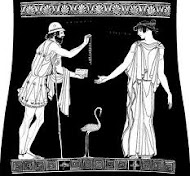

I have spoken of the importance of gifts in xenia before. A gift given as part of ritual hospitality was called a xenion (ξεινήιον). This xenion was expected to be expensive, and was presented to the guest upon departure. Needless to say, this practice was mostly executed by nobility, or at least the elite, and happened mostly when a man of equal social standing from another nation or city-state came to visit. In the Odysseia, Telemachos, son of Odysseus, receives from Menelaus a cup made by Hēphaistos Himself:

"But stay here in the palace, till the eleventh or the twelfth day, and I will send you off with honours, and fine gifts, a shining chariot with a trio of horses, and a glorious cup with which to pour libations to the deathless gods, while remembering me all your days."

The practice of gift giving to someone of another nation whom you might never see again, might seem counter-intuitive, but it's actually quite the opposite. By presenting a foreign equal with a great gift, not only do you establish kharis between the two of you, you also indebt the other person to you: they can not repay your kindness at this time, but they will compensate you for it when you visit, or when you are in need. On top of that, the recieving party will go home with tales of your hospitality, and your wealth, providing a boost in stature to the family and the land. It increases the honor of both, something very important to the ancient Hellenes. Gifts, in this context, functioned as a means of communication, legitimization, and mediation between benefactors and cities.

Beyond the elite, gift-giving was still very important, especially between men. The practice was a feature of the symposion, where it was displayed between men in a pederastic relationship, as well as between men of equal standing. Pederasty was where a mature male would take a young boy as his pupil and lover. The relationship was not about love: it was a social construct that allowed to boy time to get to know influential men, and to work himself up into their ranks. Because of this, there were many ritual acts connected to the practice, amongst which the giving of gifts, from mentor to pupil. Three gifts were traditional: military attire, an ox, and a drinking cup, but the youth most certainly received more expensive gifts.

One of the places the young lover would have been taken was the symposion. By allowing the young boy into the symposion it enabled the adults to prepare them for adult life and war in particular. Once the boys grew up, they became one of the men, taking young boys as lovers themselves, and teaching them the ropes of adult malehood. Gift giving in this context allows for a community to become closer, and for a young boy to prepare for his life as a man. Giving gifts--to their young lovers, as well as to those of equal age and standing--allowed men to teach the importance of equal distribution and redistribution of wealth, which was a founding factor of (mostly Athenian) society. It was also a status symbol: if one had time to visit the symposia, and give expensive gifts, they were not only citizens, but wealthy citizens, a clear mark that they were fit for greater responsibility within the political landscape of the city.

Most of these examples are from wealthy city-states like Athens, but there is evidence of gift-giving in other city-states as well. Sparta, for example, greatly frowned upon the flaunting of wealth, but they, too, gave gifts. These, however, were mostly practical in nature between the citizens themselves--fresh game, honey, perhaps a hunting dog--and were honors bestowed upon the person in the case of big events, or an a-symmetrical relationship. A Spartan winner of important sporting events, for example, would be allowed a place in the royal guard of the King, where Athenian winners would be set up for life, including food, housing, and status.

Another form of gift-giving was from a wealthy citizen to the community. This practice was dubbed 'Euergetism', from the Hellenic 'εὐεργετέω': 'I do good things'. While the money spent this way was, indeed a voluntary action on the part of the citizen, he was socially obligated to participate in the practice. Many roads and public buildings were funded this way, and thus bore the name of the citizen that had donated the funds--something we find archeological evidence for to this day.

Gift giving was of vital importance in the Archaic and Early Classical times, most notably in a social, ethical, economic, and political context. In the Classical period--which witnessed the development of elaborate monetary and law systems--the giving of gifts, and the associated benefits, became less prominent in economic and political contexts, though it did remain central in social and religious systems. Gift-giving and reciprocity did return to the Athenian stage, however, in the Hellenistic age, when much of the previously described took place.

Gift giving was of unparalleled important to the ancient Hellenes, but has lost much of its standing today. For those who reconstruct the ancient Hellenic religion, it might be a good exercise to examine these practices, and implement a symbolic exchange. Lavish gifts would not be necessary, but a parting gift by the host on days then the group comes together might make a nice, ritualistic, reminder that the contributions of the group were welcomed, and the effort to travel to the meeting place recognized--after the pandemic, of course!

This Christmas, we'll do door drop-offs with the family and then we're all meeting on Zoom from the safety of our own homes to unwrap the gifts we've gotten and read the poems we write along with them out loud to one another. You make do in a pandemic! 

Stay safe this season and stay smart. It's just one Christmas, the risks are not worth it.

Image taken from: Sparta Reconsidered

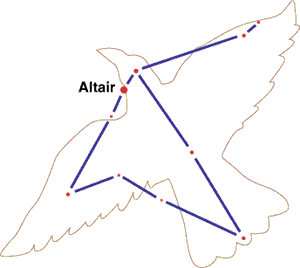
It's time for part three of the constellation series, and this time I'm tackling a constellation I had never heard of before: Aquila. It's one of the medium sized constellations, located a little 'above' Sagittarius.


Aquila is aptly named 'the eagle'. The shape it was given, as well as the mythology attached to it all relate to the bird. Aquila is the Latin for 'eagle', and from mythology, we are well aware that Zeus's favorite animal is this very bird.

This constellation is heavily linked to the constellation of Aquarius: the water carrier. This constellation is often said to represent Ganymēdēs, who was carried to Olympus by an eagle; this very eagle, in fact. It is also said that Zeus's thunderbolts are carried down by the eagle. In the Odysseia, Odysseus' son Telemachos receives oracular message from Zeus by way of the eagle:

"So Telemachus spoke, and Far-Seeing Zeus sent out two eagles from a high mountain peak. They flew for a while with outspread wings, side by side in the currents of air, but when they were above the voice-filled assembly they swiftly slanted their wings, circling round, gazing down on the heads below, and death was in their gaze. Then they clawed at each other’s head and neck with their talons, and soared away eastward over the roofs of the town. The people saw them and wondered, and considered what this might foreshadow. Then the old hero Halitherses, Mastor’s son, spoke out, for he was the wisest man of his day in bird-lore and prophecy. With goodwill in his heart he addressed the assembly:

‘Men of Ithaca, listen to me: and I say these words to the Suitors especially, since disaster approaches them. Odysseus will not be far from his friends much longer, and I believe even now he is near, sowing the seeds of dark death for all these men. Yes, and he will bring trouble to many another of us, who live in clear-skied Ithaca. Let us think in advance how we might prevent all this, or let them prevent it of their own accord, easily their best option. I am not unskilled in prophecy, but have true knowledge. I say that all things for that man will be fulfilled, just as I told him when the Argives sailed for Troy, he among them, resourceful Odysseus. I declared that, suffering many troubles, losing all comrades, he would return in the twentieth year, unknown to all: and now it is coming to pass.’"

Another prominent myth in which the eagle of Zeus features is the myth of Prometheus, who stole fire from the Gods and gave it to humanity. For his efforts, he was tied to a rock by Hermes who was under orders from Zeus. Zeus then tormented him every day for the longest time, by sending an eagle to peck out his liver again and again, because as an immortal, Prometheus' liver grew back every night. In some stories, Prometheus is eventually freed by the hero Hēraklēs, after Zeus takes mercy on him.  

For all his hard work, the eagle was placed into the sky by Zeus, so it could soar through the skies for eternity. The constellation Aguila is visible at latitudes between +90° and −75°. It is best visible at 21:00 (9 p.m.) during the month of August.


Polyphemus (Πολύφημος Polyphēmos) is the giant son of Poseidon and Thoosa in Hellenic mythology, one of the Cyclopes described in Homeros's Odyssey. His name means "abounding in songs and legends". 

In Homeros's epic, Odysseus lands on the island of the Cyclops during his journey home from the Trojan War and, together with some of his men, enters a cave filled with provisions. When the giant Polyphemus returns home with his flocks, he blocks the entrance with a great stone and, scoffing at the usual custom of hospitality, eats two of the men. Next morning, the giant kills and eats two more and leaves the cave to graze his sheep.

After the giant returns in the evening and eats two more of the men, Odysseus offers Polyphemus some strong and undiluted wine given to him earlier on his journey. Drunk and unwary, the giant asks Odysseus his name, promising him a guest-gift if he answers. Odysseus tells him "Οὖτις", which means "nobody" and Polyphemus promises to eat this "Nobody" last of all. With that, he falls into a drunken sleep. Odysseus had meanwhile hardened a wooden stake in the fire and drives it into Polyphemus' eye. When Polyphemus shouts for help from his fellow giants, saying that "Nobody" has hurt him, they think Polyphemus is being afflicted by divine power and recommend prayer as the answer.

In the morning, the blind Cyclops lets the sheep out to graze, feeling their backs to ensure that the men are not escaping. However, Odysseus and his men have tied themselves to the undersides of the animals and so get away. As he sails off with his men, Odysseus boastfully reveals his real name, an act of hubris that was to cause problems for him later. Polyphemus prays to his father, Poseidon, for revenge and casts huge rocks towards the ship, which Odysseus barely escapes.

The above artwork breaks my heart, seeing the gentleness of the giant knowing his fate. So, today's post is in honor of Polyphemus. Your life would have been much better if a certain stray hero hadn't set foot on your island.

“Oh gentle ram, why do you come from the cave behind the rest of the flock? You never before tarried behind the other skeep, but striding far before the others you snatched the mild blossoms, you came first to the banks of the rivers, and you ever desired first to return home in the evening. But now you are last by far. Are you worried about my eye, which that rotten bastard Noone and his awful friends took from me after wrecking my mind with wine – I do not say that he has escaped death. Would that you could be of one mind with me, and could tell me where that man has fled from my wrath. Once slain, his brain would drip through my cave here and there to the ground, and it would ease my heart from those troubles which that worthless bastard Noone gave me.”
(Odyssey 9.446-460)

Today is a busy day so I'm doing a short one, one of the Delphic Maxims; 'do not be discontented by life' (Τω βιω μη αχθου).

We are all told our fate soon after we are born. At night, the Moirae (Μοιραι)--better known as the Fates--enter the room where the newborn lies and they whisper their destiny into their ear. They are the only ones who can do this, as they have spun the threads that make up our fate. Mothers can invite the Moirae by leaving offerings on a table in the nursery. If they wait long enough, the Moirae will appear and, while they enjoy the offerings, will tell the faith of the child. The most well known myth surrounding this event is that of Althaea and Melaeger, who are told that Melaeger will only live as long as the log in the hearth remains unconsumed. Althaea hurries to extinguish the log but eventually kills her son by burning the log.

Fate, although set, is not unbendable. Odysseus was destined to return home to Ithaca, and although the Gods did everything to stop him, he eventually returned home. Myth suggests that, if Zeus really wants someone's faith to change, He can make it so. Yet, overall, our fate does not change. We do what we must, die when we must, live through what we must. We can plead to the Gods to lighten our load when it's too much to bare, but this Maxim reminds us that, if we would ask for anything, it be the strength to bare what we were given, because what we were given, was given to us by the Gods.

To be discontent with life is to question the will of the Gods. It's hubris. Because of this it's dangerous. The Maxim may seem close to 'be grateful', but it's far more severe. It's a warning, not a reminder. So, perhaps, the next time you feel like cursing the Gods or your bad luck, you will remember the Moirae and this Maxim and think twice.
The ancient Hellenes were very keen people, interested in all things nature, science and philosophy. They searched for answers to questions about their life, as well as the Theoi, and they theorized structurally about any discoveries they made, be it in health care, science or paleontology. Especially in the latter department, there are a few discoveries that might have shaped a large part of ancient Hellenic mythology and religion in general. Today, we'll be discussing some of those.

Giants:

Nichoria (Νιχώρια) is a site in Messenia, a regional unit in the southwestern part of the Peloponnese, Greece, on a ridgetop near modern Rizomylos, at the northwestern corner of the Messenian Gulf. It was the home of an Acropolis where many--what we now call--fossils were stored. The Nichoria bone was discovered by the ancient Hellenes roughly around 1000 BC. It is the blackened and petrified thigh bone of an extinct mega mammal--likely a woolly rhinoceros, or a mammoth--that roamed southern Hellas around one million years ago. The rusty-black color of the fossil bone indicates that it was most likely collected from the lignite deposits near the ancient town of Megalopolis, some 55 kilometers (35 miles) away from Nichoria. The Megalopolis basin was known in antiquity as the 'battleground of the Giants', where first the Titanomachy and then the Gigantomachy was believed to have taken place. The dense concentration of large fossil bones found at the basin inspired the belief that entire armies of giants were blasted by Zeus' thunderbolts, and the Nichoria bone--the distal end of a right femur, 15 cm (5-6 inches) wide, about twice the size of a regular human thigh bone--was most likely believed to have belonged to one of these giants. If the myth or the bone came first is unknown.

Cyclopses:
The one-eyed giants might have their origins in the recovered skulls of Deinotherium giganteum, which, loosely translated means 'really huge terrible beast'. Skulls and even tusks have been discovered in temples of the island of Krete, placed their by the ancient inhabitants. The Deinotherium is a distant relative to today's elephants. It stood about four and a half meters (15 feet) tall at the shoulder, and had tusks that extended over a meter (4.5 feet). It roamed Europe, Asia, and Africa during the Miocene (23 to 5 million years ago) and Pliocene (5 to 1.8 million years ago) eras before becoming extinct. As the image to the right shows, the large hole in the front of the skull was the anchor point for the trunk, not the eyes, but the skill of a young Deinotherium combined with the fearsome reputation of the cyclopses, makes it easy to see why the anciente Hellenes might have identified these skulls as belonging to Odysseus' captor.

Griffin's
The grýphōn (γρύφων) is a mythical creature with the body, tail, and back legs of a lion; the head and wings of an eagle; and an eagle's talons as its front feet. They feature in much Hellenic artwork, and Adrienne Mayor, a classical folklorist, proposes that the griffin was an ancient misconception derived from the fossilized remains of the Protoceratops found in gold mines in the Altai mountains of Scythia, in present day southeastern Kazakhstan, or in Mongolia. Looking at the skull of one of these dinosaurs, it really isn't a big leap; Protoceratops is about the size of a sheep or large dog, and they have a powerful jaw, and protruding bird-like beak. As a dinosaur, the rest of the skeleton would also have resembled a densely packed lion, one capable of carrying the weight of a man. The wings could simply have been assumed lost in time, or perhaps small bones found in the area would have indicated that the 'griffin' once took flight.

There are many more examples, and for anyone interested in this topic, Adrienne Mayor's book 'The First Fossil Hunters: Dinosaurs, Mammoths, and Myth in Greek and Roman Times' is an absolute must-read. From a review of the book:

"Above all, in The First Fossil Hunters Mayor proves two basic points: that many of the classic Greek and Roman myths did have a basis in fact, and that the basis for these facts were fossils. Using evidence collected from personal interviews, trips to Greek and Italian museums, and careful studies of classical myths and geology, Mayor continues to prove the two above points throughout her 360-page book. 

[...] Throughout her book Mayor continually proves the two basic points that she originally set out in the introduction: that many Greek and Roman myths had a basis in fact, and that these facts were often fossils. However, she goes beyond this basis thesis, and proves that Greeks and Romans frequently encountered the fossilized remains of mammals and dinosaurs, and that they developed very sophisticated concepts and myths to explain this bewildering and often confusing fossil evidence. Like their modern counterparts, Mayor writes, the ancient fossil hunters collected and measured impressive petrified remains and even displayed them in temples and museums. They attempted to reconstruct the appearance of these creatures through art and sculpture, and went even further in attempting to explain their creation and extinction."


Mammoth bone image source here; Cyclops image source here; Protoceratops skull image source here.
I am swamped, so I am going to repost an old post that new readers most likely have never read as it was published in 2012. I'm going to tackle a good old fashioned ancient Hellenic topic; the peculiar place of beggars in ancient Hellenic society. After all, of all professions there were in ancient Hellas, the profession of beggar is, perhaps, the most difficult to understand.

A beggar, or ptóchos (πτωχός), was both a welcomed and a loathed sight at the gates of ancient Hellenic cities. According to some sources, most notable Hesiod's Works and Days, being a beggar is a profession, equated with potters and minstrels. They performed a public function simply by being who they were and doing what they did. But what did they do?

In Hómēros' Odysseia, Odysseus is dressed as a beggar when he heads home, so his wife's suitors won't kill him on sight. He then runs into Antinous, one of the least noble of all of Penelope's suitors who tells him and his guide Eumaeus:

" ‘Eumaeus, the famous, why on earth did you drag this fellow here? Haven’t we vagrants enough already, beggarly nuisances to ruin our feasts? Isn’t it enough for you that they all crowd in here, swallowing your master’s stores, without you inviting this wretch too?’

Eumaeus, the swineherd, you answered him then: ‘Antinous, noble as you are your words sound ill. Who searches out foreigners himself, and invites them home, unless they are masters of some universal art: a seer, or physician, or architect, or perhaps a divine minstrel who delights men with song? Such men are welcome throughout the boundless earth, but no one would invite a burdensome beggar. You are the harshest Suitor where Odysseus’ servants are concerned, harshest of all to me: but I don’t care as long as loyal Penelope, my lady, and godlike Telemachus live here.’ "

Eumaeus seems to indicate that a beggar is not sought out and brought into a home. That, however, does not mean that being a beggar is not a profession. But what function did beggars fulfill in society? Why would he be welcomed in the house? They take food and drink, smell foul and generally don't keep their mouth shut. Yet, beggars were welcomed into a home. Most were glad to have them. This, of course, ties in heavily with Xenia; ritual hospitality. I wrote before about beggars in relation to Xenia but focussed only on the many occurrences in myth where Gods and Goddesses disguised themselves as beggars to test their hosts. Besides that, any wanderer, beggars included, are protected by Zeus Xenios.

There is a very specific ritual surrounding beggars who come to the home. The Odysseia is very clear about the role of both kurios and beggar and most likely reflects actual practice. Lets look at this ritual, step by step:
  • The beggar comes to the house, wearing the mandatory beggars' outfit (rags, staff and a beggars bag) and sets himself down against the doorpost, rubbing his shoulders against it to indicate discomfort while he waits to be acknowledged.
  • The kurios comes to to the door to offer the beggar a share of his food.
  • If a feast is held, the beggar is then encouraged to go from person to person to beg for more.
  • The beggar thanks the kurios and begs to plead to Zeus Xenios about the kindness bestowed upon him by the kurios and does so, asking for prosperity for the household and kind viewing of the kurios.
  • The beggar then visits the tables, asking for food. He receives his share but continually begs for more, until the guests are angered into striking the beggar or throwing objects at him.
  • The beggar takes this abuse and meanwhile accepts the food gifted to him. When he has made his rounds and his beggars bag is full, he returns to the doorpost and eats, blessing those who have given freely and cursing those who did not, or who abused him. 
  • Those who did not give him enough or who abused him eventually come to the beggar to offer more to him, usually some of the best meats or sweetest treats, if he will perform a task or tell a story. In most cases, this means beating the other beggars who have showed up for the feast.
  • The beggar accepts the challenge and performs it. He then receives his treats and eats them, taking his blessings from the appeased guests.
  • The beggar then leaves or finds a place to sleep on the property where he will not bother the guests, who will hear no more of him after the sharing of food is done.
The custom is an odd one; beating up a beggar who is a willing participant to the abuse and one who may not strike back. This series of exchanges can be boiled down to a single practice; purification. The beggar becomes a scapegoat to load onto the impurities of the kurios and his guests. He comes in to take not only gifts and abuse but, through them, impurity. When he leaves, the impurity leaves as well. This is also why a beggar is not invited to the home, like Antinous says, but is still a welcome sight at it. Inviting a beggar would be to invite the impurities of others into your home.

Those who have read my blog for a while know the importance of katharmos and the cleansing of miasma in ancient Hellas. The beggar's function was thus two-fold; he ridded the giver of his miasma and even went a step further by asking the Gods--and Zeus Xenios, specifically--to bless the giver. All the giver had to do to receive this blessing was put up with the smell and behavior of the beggar long enough for him to be appeased. Once the sharing of food was over, the beggar caused no more fuss. That said, it was the task of the beggar to eat and drink everything offered to him. Nothing could be saved for later or refused; it was part of his role as purifier to consume everything offered to him--and that was usually a lot.

The life of a beggar was not an easy one and many endured injury during this ritual. All dangers of the road were part of his life, but he served a useful role in society. He was a purifier but also a warning of hubris towards the Gods. Often, beggars shared their life's story, how they had ended up on the streets. Others listened and were reminded of the role of Deity in their lives, and that of fate. They gave freely to appease them and minded their step. Many gave out of sympathy for the beggar, as well. Eumaeus says it best when he allows Odysseus, disguised as a beggar, inside his humble home;

"Stranger, it would be wrong for me to turn a guest away, even one in a worse state than you, since every beggar and stranger is from Zeus, and a gift, though small, from such folk as us is welcome."
The lōtophagoi (λωτοφάγοι) are a tribe of people encountered by Odysseus and his crew as they are trying to find their way home after the long Trojan war. In the Odysseia, Odysseus has had quite the adventure already when a strong northern wind has them land on the shores of an island, inhabited by friendly, inviting people. The crew parts with the ship and some partake in the delicacies offered to them by the tribe. The food their receive lulls their mind into forgetfulness, and their bodies into sleep, and when Odysseus sees what is happening to his crew, he drags them away, ties them down to the ship and sets sail. From the Odysseia:

"For nine days I was driven by fierce winds over the teeming sea: but on the tenth we set foot on the shores of the Lotus-eaters, who eat its flowery food. On land we drew water, and my friends ate by the ships. Once we had tasted food and drink, I sent some of the men inland to discover what kind of human beings lived there: selecting two and sending a third as herald. They left at once and came upon the Lotus-eaters, who had no thought of killing my comrades, but gave them lotus to eat. Those who ate the honey-sweet lotus fruit no longer wished to bring back word to us, or sail for home. They wanted to stay with the Lotus-eaters, eating the lotus, forgetting all thoughts of return. I dragged those men back to the shore myself by force, while they wept, and bound them tight in the hollow ships, pushing them under the benches. Then I ordered my men to embark quickly on the fast craft, fearing that others would eat the lotus and forget their homes. They boarded swiftly and took their place on the benches then sitting in their rows struck the grey water with their oars."

Herodotos was sure the lotus-eaters were an actual tribe. In book four of his Histories, he writes:

"In a peninsula which stands out into the sea from the land of these Gindanes dwell the Lotophagoi, who live by eating the fruit of the /lotos/ only. Now the fruit of the lotos is in size like that of the mastich-tree, and in flavour it resembles that of the date-palm. Of this fruit the Lotophagoi even make for themselves wine." [177]

So, what is this lotus? Scholars have pointed to a number of plants which might represent the lotus of the ancient Hellenes, including clovers, fellbloom, water lilies and fenugreek. None of these would have the desired psychoactive effect, however, and personally, I am of the opinion that the lōtophagoi enjoyed the ripe seed pods of the poppy plant, which resemble the pod of an actual lotus. I have no evidence of this, however.

Where the island of the lotus-eaters is located is another mystery entirely. Scholars take the location to be somewhere of the North African shore; quite possibly the island of Djerba, but as we have seen, Herodotos states the lōtophagoi lived in a peninsula, which discredits that theory. All that is certain is that we do not know where the lōtophagoi lived, if they lived at all, although I see no reason why the tribe would not have existed; getting addicted to a hallucinogen is something easily accomplished.
Today's post is a repost of a blog I posted near the start of Baring the Aegis. I do this occasionally when I think the post deserves to be read by more people, like this one. It's about the practice of the washing of feet within the context of xenia. It's something I have been curious about ever since I first read the Odysseia. 


When I first read the Odysseia, I was struck by a two of the later passages, where Odysseus is home, but in disguise, waiting to take his revenge on the suiters of his wife Penelope. During these passages, Penelope offers xenia to Odysseus, disguised as beggar.

"But, come, my maids, wash the strangers’ feet and make his bed, with blankets and bright rugs over the bedstead, so he may rest till golden-throned Dawn in warmth and comfort. In the morning early, bathe and oil him, so he is ready to breakfast in the hall, sitting by Telemachus’ side. And if any man vexes him and pains his spirit, so much the worse for that man’s prospects: he’ll gain nothing here, rage as he might."

A little later on, Odysseus has refused the washing of his feet by anyone but Eurykleia, his nursemaid whom is still alive, and living at the house. Penelope agrees to have the old woman wash Odysseus' feet, which she does while she laments the fate of Odysseus:

"Perhaps the women of some great house mocked at him in a far-off foreign land, just as these shameless hussies here mock you, sir.  You will not let them wash your feet, for fear of their insults, but wise Penelope, Icarius’ daughter, knowing my willingness, has asked me to wash them. So I shall wash your feet for Penelope’s sake and yours, while my heart is stirred with sadness. But listen to one thing I must say. Many a long-suffering traveller have we welcomed here, but never a man resembling another as you resemble Odysseus in looks and voice – even your feet.’

Then resourceful Odysseus answered her, saying: ‘That is what everyone says who has met us both, old woman, that we are very alike, as you remark.’

With this, the old woman, preparing to wash his feet, poured cold water into the shining basin then added hot. Odysseus swiftly sat down by the hearth, and turned towards the shadows, though he had a sudden premonition that as she handled him she would notice his scar and the truth would be out. As she approached and began to wash him, so it was: she immediately knew the scar Odysseus had received from a white-tusked boar, while hunting on Parnassus, when visiting his mother’s father, noble Autolycus, the greatest of all in thievery and oath-making.

[...]

It was this scar the old woman felt as she passed her hands over his leg, and recognising it she let his leg fall. The bronze rang as his foot struck the basin, upsetting it, and spilling the water on the ground. Joy and pain filled her heart at the same moment, her eyes filled with tears and her voice caught in her throat. She touched Odysseus’ face and said: ‘It is Odysseus, it must be. Child, I did not know you, until my hands had touched my master’s limbs."

Ancient evidence suggests there were three major contexts in which foot-washing was important: body hygiene, xenia, and religion. The first is easy to grasp: the ancient Hellenes rarely wore shoes. They tended to travel barefoot, or with light, open sandals. Boots were only for the rich. As roads were unpaved, and often dusty in the dry and hot climate, a traveler's feet tended to get dusty and dirty. Upon arrival at their destination, it was customary--and part of xenia--to offer the traveler a chance to wash their feet. Those with female serfs could offer the service of one of them to have their guest wash the guest's feet for them. In cases where no serfs were present, in case of very special guests--especially those above the host in standing--or between great friends, the host could offer to wash the feet of his guest for them.

Foot-washing was often the chore of female serfs, and was considered lowly work. For the ancient Hellenes, honor was very important. To wash the feet of those below themselves in standing was a breach of societal rules and would most likely be looked upon negatively, or even outright refused. I have found no ancient texts to support this, but I suspect that washing the feet of one of equal standing would be done only between dear friends, perhaps between those who had fought together and saved each other's lives. I suspect that, if this is true, this would extend also to the son(s) of one of the men: the son of the deceased host would extend these honors to the family guest to whom the father was indebted.

At home, washing the feet of elderly family members was considered a form of respect. Aristophanes, in The Wasps (Sphēkes/Σφῆκες ), mentions the pride and joy felt by a rich man when his daughter washes and anoints his feet upon his return from a day of hard work:

"But I am forgetting the most pleasing thing of all. When I return home with my pay, everyone runs to greet me because of my money. First my daughter bathes me, anoints my feet, stoops to kiss me and, while she is calling me "her dearest father," fishes out my triobolus with her tongue; then my little wife comes to wheedle me and brings a nice light cake; she sits beside me and entreats me in a thousand ways, "Do take this now; do have some more." All this delights me hugely." 

Women rarely traveled--if at all--so as far as I can tell, no record of the washing of feet of women, or between women, has survived. I also suspect that this has to do with modesty: in an age where women often went around baring one or two breasts, the ankles and feet were almost always covered up. To bare one's feet--to a man--might have been a sign of seduction. In the rare event of a woman traveling, she would travel with her husband, father, brothers, and/or female serfs. Once arriving at her destination, she would undoubtedly have been allowed and encouraged to wash up and change her clothing. If she had serfs, she would be assisted by them. Else, serfs of the hosting household might have lend a hand, or even the wife of the host. I do wonder if they would ever was the feet of one another.

It seems it was also considered unclean and disrespectful to the Theoi to enter a temple with unwashed feet. Some temples, therefor, offered special basins which a traveler could make use of. It's difficult to find proper information about this, however, because the washing of feet in a religious context is now considered a near-solely Abrahamic thing, and bible quotes are far easier to find than ancient Hellenic texts on the subject. I'm still picking apart Christian and Jewish writings for clues about the Hellenic practice.

I am not sure why this subject interests me so. There is something so very intimate and humbling in the practice; it speaks to me in a way that goes beyond the intellectual. I imagine that having your feet washed upon arrival would make you feel both welcome and respected--as that was what it was, a sign of respect. I would also imagine it would be wonderful to bestow a honor like this to a valued guest. If shared between host and guest--or simply very good friends, or even lovers--it would strengthen the bond between them, and be a wonderful way to practice strong xenia. I think it's a beautiful practice, although not very applicable in modern Hellenismos. Agreements could be made about this, though, like the giving of gifts--another vital part of xenia.
The lōtophagoi (λωτοφάγοι) are a tribe of people encountered by Odysseus and his crew as they are trying to find their way home after the long Trojan war. In the Odysseia, Odysseus has had quite the adventure already when a strong northern wind has them land on the shores of an island, inhabited by friendly, inviting people. The crew parts with the ship and some partake in the delicacies offered to them by the tribe. The food their receive lulls their mind into forgetfulness, and their bodies into sleep, and when Odysseus sees what is happening to his crew, he drags them away, ties them down to the ship and sets sail. From the Odysseia:

"For nine days I was driven by fierce winds over the teeming sea: but on the tenth we set foot on the shores of the Lotus-eaters, who eat its flowery food. On land we drew water, and my friends ate by the ships. Once we had tasted food and drink, I sent some of the men inland to discover what kind of human beings lived there: selecting two and sending a third as herald. They left at once and came upon the Lotus-eaters, who had no thought of killing my comrades, but gave them lotus to eat. Those who ate the honey-sweet lotus fruit no longer wished to bring back word to us, or sail for home. They wanted to stay with the Lotus-eaters, eating the lotus, forgetting all thoughts of return. I dragged those men back to the shore myself by force, while they wept, and bound them tight in the hollow ships, pushing them under the benches. Then I ordered my men to embark quickly on the fast craft, fearing that others would eat the lotus and forget their homes. They boarded swiftly and took their place on the benches then sitting in their rows struck the grey water with their oars."

Herodotos was sure the lotus-eaters were an actual tribe. In book four of his Histories, he writes:

"In a peninsula which stands out into the sea from the land of these Gindanes dwell the Lotophagoi, who live by eating the fruit of the /lotos/ only. Now the fruit of the lotos is in size like that of the mastich-tree, and in flavour it resembles that of the date-palm. Of this fruit the Lotophagoi even make for themselves wine." [177]

So, what is this lotus? Scholars have pointed to a number of plants which might represent the lotus of the ancient Hellenes, including clovers, fellbloom, water lilies and fenugreek. None of these would have the desired psychoactive effect, however, and personally, I am of the opinion that the lōtophagoi enjoyed the ripe seed pods of the poppy plant, which resemble the pod of an actual lotus. I have no evidence of this, however.

Where the island of the lotus-eaters is located is another mystery entirely. Scholars take the location to be somewhere of the North African shore; quite possibly the island of Djerba, but as we have seen, Herodotos states the lōtophagoi lived in a peninsula, which discredits that theory. All that is certain is that we do not know where the lōtophagoi lived, if they lived at all, although I see no reason why the tribe would not have existed; getting addicted to a hallucinogen is something easily accomplished.
Today we will look into the little talked about practice of the washing of feet within the context of xenia. It's something I have been curious about ever since I first read the Odysseia. 


When I first read the Odysseia, I was struck by a two of the later passages, where Odysseus is home, but in disguise, waiting to take his revenge on the suiters of his wife Penelope. During these passages, Penelope offers xenia to Odysseus, disguised as beggar.

"But, come, my maids, wash the strangers’ feet and make his bed, with blankets and bright rugs over the bedstead, so he may rest till golden-throned Dawn in warmth and comfort. In the morning early, bathe and oil him, so he is ready to breakfast in the hall, sitting by Telemachus’ side. And if any man vexes him and pains his spirit, so much the worse for that man’s prospects: he’ll gain nothing here, rage as he might."

A little later on, Odysseus has refused the washing of his feet by anyone but Eurykleia, his nursemaid whom is still alive, and living at the house. Penelope agrees to have the old woman wash Odysseus' feet, which she does while she laments the fate of Odysseus:

"Perhaps the women of some great house mocked at him in a far-off foreign land, just as these shameless hussies here mock you, sir.  You will not let them wash your feet, for fear of their insults, but wise Penelope, Icarius’ daughter, knowing my willingness, has asked me to wash them. So I shall wash your feet for Penelope’s sake and yours, while my heart is stirred with sadness. But listen to one thing I must say. Many a long-suffering traveller have we welcomed here, but never a man resembling another as you resemble Odysseus in looks and voice – even your feet.’

Then resourceful Odysseus answered her, saying: ‘That is what everyone says who has met us both, old woman, that we are very alike, as you remark.’

With this, the old woman, preparing to wash his feet, poured cold water into the shining basin then added hot. Odysseus swiftly sat down by the hearth, and turned towards the shadows, though he had a sudden premonition that as she handled him she would notice his scar and the truth would be out. As she approached and began to wash him, so it was: she immediately knew the scar Odysseus had received from a white-tusked boar, while hunting on Parnassus, when visiting his mother’s father, noble Autolycus, the greatest of all in thievery and oath-making.

[...]

It was this scar the old woman felt as she passed her hands over his leg, and recognising it she let his leg fall. The bronze rang as his foot struck the basin, upsetting it, and spilling the water on the ground. Joy and pain filled her heart at the same moment, her eyes filled with tears and her voice caught in her throat. She touched Odysseus’ face and said: ‘It is Odysseus, it must be. Child, I did not know you, until my hands had touched my master’s limbs."

Acient evidence suggests there were three major contexts in which foot-washing was important: body hygiene, xenia, and religion. The first is easy to grasp: the ancient Hellenes rarely wore shoes. They tended to travel barefoot, or with light, open sandals. Boots were only for the rich. As roads were unpaved, and often dusty in the dry and hot climate, a traveler's feet tended to get dusty and dirty. Upon arrival at their destination, it was customary--and part of xenia--to offer the traveler a chance to wash their feet. Those with female serfs could offer the service of one of them to have their guest wash the guest's feet for them. In cases where no serfs were precent, in case of very special guests--especially those above the host in standing--or between great friends, the host could offer to wash the feet of his guest for them.

Foot-washing was often the chore of female serfs, and was considered lowly work. For the ancient Hellenes, honor was very important. To wash the feet of those below themselves in standing was a breach of societal rules and would most likely be looked upon negatively, or even outright refused. I have found no ancient texts to support this, but I suspect that washing the feet of one of equal standing would be done only between dear friends, perhaps between those who had fought together and saved each other's lives. I suspect that, if this is true, this would extend also to the son(s) of one of the men: the son of the deceased host would extend these honors to the family guest to whom the father was indebted.

At home, washing the feet of elderly family members was considered a form of respect. Aristophanes, in The Wasps (Sphēkes/Σφῆκες ), mentions the pride and joy felt by a rich man when his daughter washes and anoints his feet upon his return from a day of hard work:

"But I am forgetting the most pleasing thing of all. When I return home with my pay, everyone runs to greet me because of my money. First my daughter bathes me, anoints my feet, stoops to kiss me and, while she is calling me "her dearest father," fishes out my triobolus with her tongue; then my little wife comes to wheedle me and brings a nice light cake; she sits beside me and entreats me in a thousand ways, "Do take this now; do have some more." All this delights me hugely." 

Women rarely traveled--if at all--so as far as I can tell, no record of the washing of feet of women, or between women, has survived. I also suspect that this has to do with modesty: in an age where women often went around baring one or two breasts, the ankles and feet were almost always covered up. To bare one's feet--to a man--might have been a sign of seduction. In the rare event of a woman traveling, she would travel with her husband, father, brothers, and/or female serfs. Once arriving at her destination, she would undoubtedly have been allowed and encouraged to wash up and change her clothing. If she had serfs, she would be assisted by them. Else, serfs of the hosting household might have lend a hand, or even the wife of the host. I do wonder if they would ever was the feet of one another.

It seems it was also considered unclean and disrespectful to the Theoi to enter a temple with unwashed feet. Some temples, therefor, offered special basins which a traveler could make use of. It's difficult to find proper information about this, however, because the washing of feet in a religious context is now considered a near-solely Abrahamic thing, and bible quotes are far easier to find than ancient Hellenic texts on the subject. I'm still picking apart Christian and Jewish writings for clues about the Hellenic practice.

I am not sure why this subject interests me so. There is something so very intimate and humbling in the practice; it speaks to me in a way that goes beyond the intellectual. I imagine that having your feet washed upon arrival would make you feel both welcome and respected--as that was what it was, a sign of respect. I would also imagine it would be wonderful to bestow a honor like this to a valued guest. If shared between host and guest--or simply very good friends, or even lovers--it would strengthen the bond between them, and be a wonderful way to practice strong xenia. I think it's a beautiful practice, although not very applicable in modern Hellenismos. Agreements could be made about this, though, like the giving of gifts--another vital part of xenia.