Showing posts with label Pindar. Show all posts

The ancient Hellenes viewed the Earth as a round disk divided into equal parts by the Mediterranean Sea and the (Black) Sea (first called the Inhospitable Sea by Pindar, then the Hospitable Sea once the shores became inhabited). Okeanos, a mystical river, flowed around the entire disk, and mysterious peoples—the Hyperboreans in the north, the Ethiopians in the far south and the Kimmerians in parts unknown—lived outside Okeanos' perimeter. 

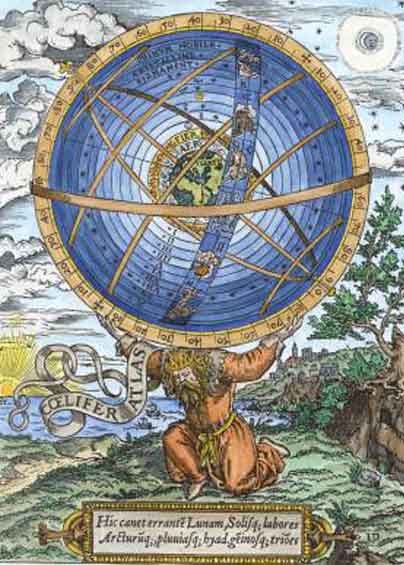
The ancient Hellenes also believed that the heaven was made up of celestial spheres. The celestial spheres, or celestial orbs, were the fundamental entities of the cosmological models developed by great philosophers and astronomers like Plato, Aristotle, and Ptolemy. It was believed that the stars were fixed and did not change their positions relative to one another. As such, it was argued that they must be on the surface of a single starry sphere. The apparent motions of the fixed stars and the planets are accounted for by treating them as embedded in rotating spheres made of an aetherial, transparent fifth element (quintessence).

According to the Homeric hymns, the ancient Hellenes also believed that there are columns that keep apart earth and heaven. It's most likely these columns or pillars were mountains in the centre of the disk, or at the edge of the disk. It were these pillars that Atlas guarded, or he was the actual pillar who held up the spheres--and thus the actual mountain. As Hesiod writes in the Theogony

"[At the ends of the earth, where lie the roots of earth, sea, Tartaros :] There stands the awful home of murky Nyx wrapped in dark clouds. In front of it [Atlas] the son of Iapetos stands immovably upholding the wide heaven upon his head and unwearying hands." [744]

Now we are on the topic, it also depends upon tradition if Atlas held up the celestial orbs as punishment, or if he was chosen to do it as an honour to him. The punishment part is perhaps best described by Hyginus in his Fabulae:

"After Juno [Hera] saw that Epaphus, born of a concubine, ruled such a great kingdom, she saw to it that he should be killed while hunting, and encouraged the Titanes to drive Jove [Zeus] from the kingdom and restore it to Saturn [Kronos]. When they tried to mount to heaven, Jove with the help of Minerva [Athene], Apollo, and Diana [Artemis], cast them headlong into Tartarus. On Atlas, who had been their leader, he put the vault of the sky; even now he is said to hold up the sky on his shoulders." [150]

Hómēros, in his Odysseia, takes an opposite--or at least milder--view, implying the honour in Atlas' position:

"Atlas the baleful; he knows the depths of all the seas, and he, no other, guards the tall pillars that keep the sky and earth apart." [1.52]

It makes sense, in fact, to have holding up the heavens be an honour: if Atlas slacks even a moment, the celestial spheres would crash down onto Earth and destroy it, killing everyone. It's a huge responsibility, and to give that to someone pissed off for losing a war seems foolish. 

Like many of the myths concerning the ancient Titans, there are versions of mythology where Atlas no longer bears the heaven. In this case: Pindar describes it as such in the Pythian Odes:

"Does not even now great [Titan] Atlas struggle to bear up the weight of heaven, far from his fathers’ land and his possessions? But almighty Zeus set free the Titanes, for as time passes and the breeze abates, the sails are set anew." [4]

The Farnese Atlas is a 2nd-century Roman marble copy of a Hellenistic sculpture of Atlas kneeling with the celestial spheres, not a globe, weighing heavily on his shoulders. It is the oldest extant statue of Atlas, as well as the oldest known representation of the celestial sphere. The globe shows a depiction of the night sky as seen from outside the outermost celestial sphere, with low reliefs depicting 41 (some sources say 42) of the 48 classical Hellenic constellations distinguished by Ptolemy. The sphere is made up of solid marble, and contains no actual stars. This may have aided the formation of the common misconception that Atlas was forced to hold the Earth on his shoulders. I hope this post clears up a bit of the confusion.

 The Hellenic religion is a religion of multitudes--of many, many multitudes of Gods, mostly. some are very well known and much hailed and some... well, not so much. Like Hesykhia, daughter of Diké, personification of tranquality and peace. Through Her mother, she is linked to Justice and thus Her tranquality is the tranquality of victory. She is only mentioned once in the surviving Hellenic poetry we have at our disposal and that is in Pindar's Pythian odes.

Pindar is generally considered both Hellas' best poet, and its most difficult to understand. He is most famous for his epinicians, poems celebrating victors at the major Hellenic games. Pindar was paid to write them, which is probably why so many have survived. 

According to ancient scholars, Pythian 8 was performed in 446 BC, shortly before Pindar's death. Pythian 8 is the first Pindaric ode known to have been performed on Aigina since the island lost its freedom to Athens. It opens with invocation of Hesykhia, who is besought to accept the song in honor of Aristomenes, the victor. But peace and justice bring out hatred and pride, as embodied in the giants Porphyrion and Typhon. They were slain by Zeus and Apollon; and Apollon, lord of Pytho, brings completes the circle to bring us back to the victory, the victor, and Aigina. I won't quote the whole poem, but here is the part about Hesykhia for your enjoyment and contemplation. If you would like to read more, you can find it here.


Pindar - Pythian Ode 8
 
"Hesychia, kind goddess of peace, daughter of Justice 
and lady of the greatness of cities: 
you who hold the high keys of wars and of councils, 
accept for Aristomenes this train of Pythian victory.
 
For you understand, in strict measure of season, 
deeds of gentleness and their experience likewise. 
And you, when one fixes anger without pity fast in his heart, 
are stern to encounter the strength of the hateful ones, 
and sink pride in the bilge."
“There is a season when people have the greatest need
For winds and there is a season for water from the sky,
The pouring offspring of clouds.
But if someone should ever find success through toil,
Then honey-sweet hymns form the foundation
For future tales and offer certain promise for great accomplishments.

The praise for Olympic victors is not limited
By envy. My tongue is ready to shepherd
These words. A man similarly prospers through wise thoughts
thanks to divine assistance.
Know this now, son of Arkhestratos,
Hagêsidamos: thanks to your boxing
I will sing a sweet-songed adornment
For your crown of golden olive,
Without neglecting the race of Western Lokrians.

Join us in the revel there—Muses, I pledge
That you will visit no country who rejects a guest
a people who are ignorant of noble things,
But you will find wise spearmen there.
For not even the fire-red fox nor the roaring lions
Could change the nature of their kind.”
[Pindar, Olympian 11: For Hagêsidamos, Winner of Boy’s Boxing, 476BCE]
Mythologically speaking, Pegasos was originally only one winged horse, born from the neck of Médousa when she was beheaded by the hero Perseus. Poseidon, Tamer of Horses, is his father. Hesiod describes in his ‘Theogony’ the curious circumstances of his birth:

"…Medusa who suffered a woeful fate: she was mortal, but the two [of her Gorgon sisters] were undying and grew not old. With her lay the Dark-haired One [Poseidon] in a soft meadow amid spring flowers. And when Perseus cut off her head, there sprang forth great Chrysaor and the horse Pegasus who is so called because he was born near the springs [pegae] of Ocean [Okeanos]; and that other, because he held a golden blade [aor] in his hands. Now Pegasus flew away and left the earth, the mother of flocks, and came to the deathless gods: and he dwells in the house of Zeus and brings to wise Zeus the thunder and lightning." [ll 270-294]

Pegasos was tamed by Bellerophon, a Korinthian hero, who rode him into battle against the fire-breathing Khimaira. Pindar, in his beautiful Olympian Odes describes this cooperation wonderfully:

"Bellerophon, who once suffered greatly when beside the spring he wanted to harness Pegasus, the son of the snake-entwined Gorgon; until the maiden Pallas brought to him a bridle with golden cheek-pieces. The dream suddenly became waking reality, and she spoke: “Are you sleeping, king, son of Aeolus? Come, take this charm for the horse; and, sacrificing a white bull, show it to your ancestor, Poseidon the Horse-Tamer.” The goddess of the dark aegis seemed to say such words to him as he slumbered in the darkness, and he leapt straight up to his feet.

He seized the marvellous thing that lay beside him, and gladly went to the seer of the land,  and he told the son of Coeranus the whole story: how, at the seer’s bidding, he had gone to sleep for the night on the altar of the goddess, and how the daughter herself of Zeus whose spear is the thunderbolt had given him the spirit-subduing gold. The seer told him to obey the dream with all speed; and, when he sacrificed a strong-footed bull to the widely powerful holder of the earth, straightaway to dedicate an altar to Athena, goddess of horses.

The power of the gods accomplishes as a light achievement what is contrary to oaths and expectations. And so mighty Bellerophon eagerly stretched the gentle charmed bridle around its jaws and caught the winged horse. Mounted on its back and armored in bronze, at once he began to play with weapons. And with Pegasus, from the chilly bosom of the lonely air,7 he once attacked the Amazons, the female army of archers, [90] and he killed the fire-breathing Chimaera, and the Solymi. I shall pass over his death in silence; but Pegasus has found his shelter in the ancient stables of Zeus in Olympus." [13. 63]

Pegasos was not worshipped with ritual and sacrifices like the Theoi—the Hellenic Gods—were; only the Theoi were worshipped in that manner, and even then there were huge differences in Ouranic, Khthonic, and hero worship. He/they were featured in art, though, and was/were a beloved part of the Hellenic mythology; especially the Pegasos Bellerophon rode on, as he was featured on many coins throughout the years.
It's been a while since I missed my 9am deadline, but I went way over today because life exploded, so I am going to leave you with some words of beauty today and then head to bed: Pindar's Paean VI, for the Delphians to Pytho. The poem was performed at Delphi for a festival called the 'theoxenia', at which Gods were entertained. More tomorrow!


O golden Pytho, that art famed for thine oracles! I beseech thee, by the Olympian Zeus, with the Graces and Aphrodite, to welcome me at this sacred season as a prophet of the tuneful Pierides. For, beside the water of Castalia, with its outlet of brass, I have no sooner heard a sound of dancing reft of men, than I have come to relieve the need of the townsmen, and of mine own honour.
I have obeyed my dear heart, even as a son obeyeth his kind mother, and have come down to Apollo's grove, the home of garlands and of banquets, where, beside the shadowy centre of the earth, the maidens of Delphi fiill often beat the ground with nimble step, while they sing the son of Leto.
And, whence the strife of the immortals arose, of this the gods are able to prompt sage poets; while, for mortal men, it is impossible to find it.

“There is a season when people have the greatest need
For winds and there is a season for water from the sky,
The pouring offspring of clouds.
But if someone should ever find success through toil,
Then honey-sweet hymns form the foundation
For future tales and offer certain promise for great accomplishments.
The praise for Olympic victors is not limited
By envy. My tongue is ready to shepherd
These words. A man similarly prospers through wise thoughts
thanks to divine assistance.
Know this now, son of Arkhestratos,
Hagêsidamos: thanks to your boxing
I will sing a sweet-songed adornment
For your crown of golden olive,
Without neglecting the race of Western Lokrians.
Join us in the revel there—Muses, I pledge
That you will visit no country who rejects a guest
a people who are ignorant of noble things,
But you will find wise spearmen there.
For not even the fire-red fox nor the roaring lions
Could change the nature of their kind.”

Pindar, Olympian 11: For Hagêsidamos, Winner of Boy’s Boxing, 476 BC

[source]
I have to take the cat to the vet and I'm swamped, so I am going to leave you with some words of beauty today: Pindar's Paean VI, for the Delphians to Pytho. The poem was performed at Delphi for a festival called the 'theoxenia', at which Gods were entertained.


O golden Pytho, that art famed for thine oracles! I beseech thee, by the Olympian Zeus, with the Graces and Aphrodite, to welcome me at this sacred season as a prophet of the tuneful Pierides. For, beside the water of Castalia, with its outlet of brass, I have no sooner heard a sound of dancing reft of men, than I have come to relieve the need of the townsmen, and of mine own honour.
I have obeyed my dear heart, even as a son obeyeth his kind mother, and have come down to Apollo's grove, the home of garlands and of banquets, where, beside the shadowy centre of the earth, the maidens of Delphi fiill often beat the ground with nimble step, while they sing the son of Leto.
And, whence the strife of the immortals arose, of this the gods are able to prompt sage poets; while, for mortal men, it is impossible to find it.

Mythologically speaking, Pegasos was originally only one winged horse, born from the neck of Médousa when she was beheaded by the hero Perseus. Poseidon, Tamer of Horses, is his father. Hesiod describes in his ‘Theogony’ the curious circumstances of his birth:

"…Medusa who suffered a woeful fate: she was mortal, but the two [of her Gorgon sisters] were undying and grew not old. With her lay the Dark-haired One [Poseidon] in a soft meadow amid spring flowers. And when Perseus cut off her head, there sprang forth great Chrysaor and the horse Pegasus who is so called because he was born near the springs [pegae] of Ocean [Okeanos]; and that other, because he held a golden blade [aor] in his hands. Now Pegasus flew away and left the earth, the mother of flocks, and came to the deathless gods: and he dwells in the house of Zeus and brings to wise Zeus the thunder and lightning." [ll 270-294]

Pegasos was tamed by Bellerophon, a Korinthian hero, who rode him into battle against the fire-breathing Khimaira. Pindar, in his beautiful Olympian Odes describes this cooperation wonderfully:

"Bellerophon, who once suffered greatly when beside the spring he wanted to harness Pegasus, the son of the snake-entwined Gorgon; until the maiden Pallas brought to him a bridle with golden cheek-pieces. The dream suddenly became waking reality, and she spoke: “Are you sleeping, king, son of Aeolus? Come, take this charm for the horse; and, sacrificing a white bull, show it to your ancestor, Poseidon the Horse-Tamer.” The goddess of the dark aegis seemed to say such words to him as he slumbered in the darkness, and he leapt straight up to his feet. He seized the marvellous thing that lay beside him, and gladly went to the seer of the land,  and he told the son of Coeranus the whole story: how, at the seer’s bidding, he had gone to sleep for the night on the altar of the goddess, and how the daughter herself of Zeus whose spear is the thunderbolt had given him the spirit-subduing gold. The seer told him to obey the dream with all speed; and, when he sacrificed a strong-footed bull to the widely powerful holder of the earth, straightaway to dedicate an altar to Athena, goddess of horses. The power of the gods accomplishes as a light achievement what is contrary to oaths and expectations. And so mighty Bellerophon eagerly stretched the gentle charmed bridle around its jaws and caught the winged horse. Mounted on its back and armored in bronze, at once he began to play with weapons. And with Pegasus, from the chilly bosom of the lonely air,7 he once attacked the Amazons, the female army of archers, [90] and he killed the fire-breathing Chimaera, and the Solymi. I shall pass over his death in silence; but Pegasus has found his shelter in the ancient stables of Zeus in Olympus." [13. 63]

Pegasos was not worshipped with ritual and sacrifices like the Theoi—the Hellenic Gods—were; only the Theoi were worshipped in that manner, and even then there were huge differences in Ouranic, Khthonic, and hero worship. He/they were featured in art, though, and was/were a beloved part of the Hellenic mythology; especially the Pegasos Bellerophon rode on, as he was featured on many coins throughout the years.
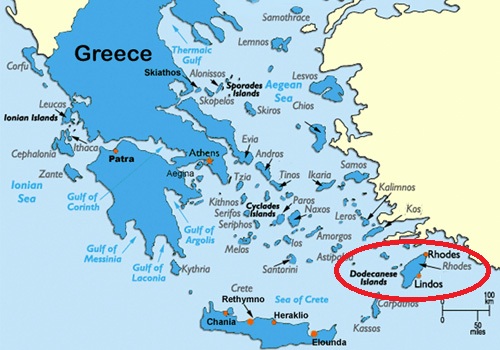
Most of the ancient Hellenic islands have an origin story, recorded in ancient Hellenic writings. One of my favorites is that of Rhodes. Rhodes (Ρόδος, Ródos) is the largest of the Dodecanese islands in terms of land area and also the island group's historical capital. It is located northeast of Crete, southeast of Athens and just off the Anatolian coast of Turkey. In ancient times, it was home to the Colossus of Rhodes, one of the Seven Wonders of the Ancient World.


It's Pindar who recounts the founding myth of the island. He explains how the island was a gift to Helios after the Gods divided the world between Them and there was nothing left for Him. Zeus raised the island from the depths of the ocean and Helios lay with the nymph Rhodos who came into existence with it. From their union came three children, and the cities that were established on Rhodes were named for their three sons. From Pindar's odes:

"Now the ancient story of men saith that when Zeus and the other gods made division of the earth among them, not yet was island Rhodes apparent in the open sea, but in the briny depths lay hid. And for that Helios was otherwhere, none drew a lot for him; so they left him portionless of land, that holy god. And when he spake thereof Zeus would cast lots afresh; but he suffered him not, for that he said that beneath the hoary sea he saw a certain land waxing from its root in earth, that should bring forth food for many men, and rejoice in flocks. And straightway he bade her of the golden fillet, Lachesis ['disposer of lots', one of the Moirai], to stretch her hands on high, nor violate the gods' great oath, but with the son of Kronos promise him that the isle sent up to the light of heaven should be thenceforth a title of himself alone.

And in the end of the matter his speech had fulfilment; there sprang up from the watery main an island, and the father who begetteth the keen rays of day hath the dominion thereof, even the lord of fire-breathing steeds. There sometime having lain with Rhodos he begat seven sons, who had of him minds wiser than any among the men of old; and one begat Kameiros, and Ialysos his eldest, and Lindos: and they held each apart their shares of cities, making threefold division of their father's land, and these men call their dwelling-places. There is a sweet amends for his piteous ill-hap ordained for Tlepolemos leader of the Tirynthians at the beginning, as for a god, even the leading thither of sheep for a savoury burnt-offering, and the award of honour in games." [Pythian Odes VII]

I enjoy this story because it's nothing but fair and filled with respect. Zeus realized Helios--one of the most important Titans in regards to life on earth--had been denied His fair share and so He granted Him one of the grandest islands of the ancient Hellenic world and through the island's guardian nymph strong children. It's soothing and beautiful. Blessed be Rhodes!
The Hellenic religion is a religion of multitudes--of many, many multitudes of Gods, mostly. some are very well known and much hailed and some... well, not so much. Like Hesykhia, daughter of Diké, personification of tranquality and peace. Through Her mother, she is linked to Justice and thus Her tranquality is the tranquality of victory. She is only mentioned once in the surviving Hellenic poetry we have at our disposal and that is in Pindar's Pythian odes.

Pindar is generally considered both Hellas' best poet, and its most difficult to understand. He is most famous for his epinicians, poems celebrating victors at the major Hellenic games. Pindar was paid to write them, which is probably why so many have survived.

According to ancient scholars, Pythian 8 was performed in 446 BC, shortly before Pindar's death. Pythian 8 is the first Pindaric ode known to have been performed on Aigina since the island lost its freedom to Athens. It opens with invocation of Hesykhia, who is besought to accept the song in honor of Aristomenes, the victor. But peace and justice bring out hatred and pride, as embodied in the giants Porphyrion and Typhon. They were slain by Zeus and Apollon; and Apollon, lord of Pytho, brings completes the circle to bring us back to the victory, the victor, and Aigina. I won't quote the whole poem, but here is the part about Hesykhia for your enjoyment and contemplation. If you would like to read more, you can find it here.


Pindar - Pythian Ode 8
 
"Hesychia, kind goddess of peace, daughter of Justice
and lady of the greatness of cities:
you who hold the high keys of wars and of councils,
accept for Aristomenes this train of Pythian victory.
 
For you understand, in strict measure of season,
deeds of gentleness and their experience likewise.
And you, when one fixes anger without pity fast in his heart,
are stern to encounter the strength of the hateful ones,
and sink pride in the bilge."
I was going to do an actual post today, but then life exploded, so I am going to leave you with some words of beauty today: Pindar's Paean VI, for the Delphians to Pytho. The poem was performed at Delphi for a festival called the 'theoxenia', at which gods were entertained.


O golden Pytho, that art famed for thine oracles! I beseech thee, by the Olympian Zeus, with the Graces and Aphrodite, to welcome me at this sacred season as a prophet of the tuneful Pierides. For, beside the water of Castalia, with its outlet of brass, I have no sooner heard a sound of dancing reft of men, than I have come to relieve the need of the townsmen, and of mine own honour.
I have obeyed my dear heart, even as a son obeyeth his kind mother, and have come down to Apollo's grove, the home of garlands and of banquets, where, beside the shadowy centre of the earth, the maidens of Delphi fiill often beat the ground with nimble step, while they sing the son of Leto.
And, whence the strife of the immortals arose, of this the gods are able to prompt sage poets; while, for mortal men, it is impossible to find it.
Okay, guys, I am in for a world of hurt with far too many deadlines coming up, so today, I am taking the day off so I can work for a while longer and hopefully get things done. I quote from Pindar and hope his words will inspire you as his words do me.

Pindar (Pindaros, Πίνδαρος) was alive from around 522 BC to 443 BC and was an Ancient Hellenic lyric poet from Thebes. Of the canonical nine lyric poets of ancient Hellas, his work is the best preserved. He was a very reverent poet, and because of that, I greatly enjoy his work. He was alive in a time of religious reforms, but he clung to the old ways and views--the ways and views I adhere to myself. Pindar wrote many odes to winners of sporting events and battles, and often he included the Gods in his praise. One of these odes today: as a little pick-me-up for myself and anyone who might need it.

The following ode is dedicated to Midas of Akras, who was the winner in the Pythian flute-playing match 494 or 450. It was to be sung, it would seem, at Akragas, and very probably in a procession to the shrine of the tutelar divinity of the city, who seems to be addressed at the start.


I pray thee, lover of splendour, most beautiful among the cities of
men, haunt of Persephone, thou who by the banks of Akragas' stream
that nourisheth thy flocks, inhabitest a citadel builded pleasantly--
O queen, graciously and with goodwill of gods and men welcome this crown
that is come forth from Pytho for Midas' fair renown; and him too
welcome therewithal who hath overcome all Hellas in the art which once
on a time Pallas Athene devised, when she made music of the fierce
Gorgon's death-lament.
That heard she pouring from the maiden heads and heads of serpents
unapproachable amidst the anguish of their pains, when Perseus had
stricken the third sister, and to the isle Seriphos and its folk bare
thence their doom.
Yea also he struck with blindness the wondrous brood of Phorkos,
and to Polydektes' bridal brought a grievous gift, and grievous
eternally he made for that man his mother's slavery and ravished bed:
for this he won the fair-faced Medusa's head, he who was the son of
Danaë, and sprung, they say, from a living stream of gold.
But the Maiden, when that she had delivered her well-beloved from
these toils, contrived the manifold music of the flute, that with such
instrument she might repeat the shrill lament that reached her from
Euryale's ravening jaws.
A goddess was the deviser thereof, but having created it for
a possession of mortal men, she named that air she played the
many-headed air, that speaketh gloriously of folk-stirring games,
as it issueth through the thin-beat bronze and the reeds which grow by
the Graces' city of goodly dancing-ground in the precinct of Kephisos'
nymph, the dancers' faithful witnesses.
But if there be any bliss among mortal men, without labour it is not
made manifest: it may be that God will accomplish it even to-day, yet
the thing ordained is not avoidable: yea, there shall be a time that
shall lay hold on a man unaware, and shall give him one thing beyond
his hope, but another it shall bestow not yet.
Um, guys? When I tell you Atlas holds/held up the heavens and not the earth, none of you is surprised, right? I got into a friendly discussion about the topic with someone who is--admittedly--not a Hellenist and now I just want to make sure all of you understand this little fact from Hellenic mythology. As Hesiod writes in the Theogony:

"[At the ends of the earth, where lie the roots of earth, sea, Tartaros :] There stands the awful home of murky Nyx wrapped in dark clouds. In front of it [Atlas] the son of Iapetos stands immovably upholding the wide heaven upon his head and unwearying hands." [744]

Here is the thing: the ancient Hellenes viewed the Earth as a round disk divided into equal parts by the Mediterranean Sea and the (Black) Sea (first called the Inhospitable Sea by Pindar, then the Hospitable Sea once the shores became inhabited). Okeanos, a mystical river, flowed around the entire disk, and mysterious peoples—the Hyperboreans in the north, the Ethiopians in the far south and the Kimmerians in parts unknown—lived outside Okeanos' perimeter.

The ancient Hellenes also believed that the heaven was made up of celestial spheres. The celestial spheres, or celestial orbs, were the fundamental entities of the cosmological models developed by great philosophers and astronomers like Plato, Aristotle, and Ptolemy. It was believed that the stars were fixed and did not change their positions relative to one another. As such, it was argued that they must be on the surface of a single starry sphere. The apparent motions of the fixed stars and the planets are accounted for by treating them as embedded in rotating spheres made of an aetherial, transparent fifth element (quintessence).

According to the Homeric hymns, the ancient Hellenes also believed that there are columns that keep apart earth and heaven. It's most likely these columns or pillars were mountains in the centre of the disk, or at the edge of the disk. It were these pillars that Atlas guarded, or he was the actual pillar who held up the spheres--and thus the actual mountain.

Now we are on the topic, it also depends upon tradition if Atlas held up the celestial orbs as punishment, or if he was chosen to do it as an honour to him. The punishment part is perhaps best described by Hyginus in his Fabulae:

"After Juno [Hera] saw that Epaphus, born of a concubine, ruled such a great kingdom, she saw to it that he should be killed while hunting, and encouraged the Titanes to drive Jove [Zeus] from the kingdom and restore it to Saturn [Kronos]. When they tried to mount to heaven, Jove with the help of Minerva [Athene], Apollo, and Diana [Artemis], cast them headlong into Tartarus. On Atlas, who had been their leader, he put the vault of the sky; even now he is said to hold up the sky on his shoulders." [150]

Hómēros, in his Odysseia, takes an opposite--or at least milder--view, implying the honour in Atlas' position:

"Atlas the baleful; he knows the depths of all the seas, and he, no other, guards the tall pillars that keep the sky and earth apart." [1.52]

It makes sense, in fact, to have holding up the heavens be an honour: if Atlas slacks even a moment, the celestial spheres would crash down onto Earth and destroy it, killing everyone. It's a huge responsibility, and to give that to someone pissed off for losing a war seems foolish.

Like many of the myths concerning the ancient Titans, there are versions of mythology where Atlas no longer bears the heaven. In this case: Pindar describes it as such in the Pythian Odes:

"Does not even now great [Titan] Atlas struggle to bear up the weight of heaven, far from his fathers’ land and his possessions? But almighty Zeus set free the Titanes, for as time passes and the breeze abates, the sails are set anew." [4]

The Farnese Atlas is a 2nd-century Roman marble copy of a Hellenistic sculpture of Atlas kneeling with the celestial spheres, not a globe, weighing heavily on his shoulders. It is the oldest extant statue of Atlas, as well as the oldest known representation of the celestial sphere. The globe shows a depiction of the night sky as seen from outside the outermost celestial sphere, with low reliefs depicting 41 (some sources say 42) of the 48 classical Hellenic constellations distinguished by Ptolemy. The sphere is made up of solid marble, and contains no actual stars. This may have aided the formation of the common misconception that Atlas was forced to hold the Earth on his shoulders. I hope this post clears up a bit of the confusion.
Oh my, so busy today. This post is going to be short, but I hope it will be interesting none the less. I was asked about Pegasos. They wanted to know if the ancient Hellenes worshipped Pegasos, and how he was seen in ancient times.

Mythologically speaking, Pegasos was originally only one winged horse, born from the neck of Médousa when she was beheaded by the hero Perseus. Poseidon, Tamer of Horses, is his father. Hesiod describes in his ‘Theogony’ the curious circumstances of his birth:

"…Medusa who suffered a woeful fate: she was mortal, but the two [of her Gorgon sisters] were undying and grew not old. With her lay the Dark-haired One [Poseidon] in a soft meadow amid spring flowers. And when Perseus cut off her head, there sprang forth great Chrysaor and the horse Pegasus who is so called because he was born near the springs [pegae] of Ocean [Okeanos]; and that other, because he held a golden blade [aor] in his hands. Now Pegasus flew away and left the earth, the mother of flocks, and came to the deathless gods: and he dwells in the house of Zeus and brings to wise Zeus the thunder and lightning." [ll 270-294]

Pegasos was tamed by Bellerophon, a Korinthian hero, who rode him into battle against the fire-breathing Khimaira. Pindar, in his beautiful Olympian Odes describes this cooperation wonderfully:
 
"Bellerophon, who once suffered greatly when beside the spring he wanted to harness Pegasus, the son of the snake-entwined Gorgon; until the maiden Pallas brought to him a bridle with golden cheek-pieces. The dream suddenly became waking reality, and she spoke: “Are you sleeping, king, son of Aeolus? Come, take this charm for the horse; and, sacrificing a white bull, show it to your ancestor, Poseidon the Horse-Tamer.” The goddess of the dark aegis seemed to say such words to him as he slumbered in the darkness, and he leapt straight up to his feet. He seized the marvellous thing that lay beside him, and gladly went to the seer of the land,  and he told the son of Coeranus the whole story: how, at the seer’s bidding, he had gone to sleep for the night on the altar of the goddess, and how the daughter herself of Zeus whose spear is the thunderbolt had given him the spirit-subduing gold. The seer told him to obey the dream with all speed; and, when he sacrificed a strong-footed bull to the widely powerful holder of the earth, straightaway to dedicate an altar to Athena, goddess of horses. The power of the gods accomplishes as a light achievement what is contrary to oaths and expectations. And so mighty Bellerophon eagerly stretched the gentle charmed bridle around its jaws and caught the winged horse. Mounted on its back and armored in bronze, at once he began to play with weapons. And with Pegasus, from the chilly bosom of the lonely air,7 he once attacked the Amazons, the female army of archers, [90] and he killed the fire-breathing Chimaera, and the Solymi. I shall pass over his death in silence; but Pegasus has found his shelter in the ancient stables of Zeus in Olympus." [13. 63]

Pegasos was not worshipped with ritual and sacrifices like the Theoi—the Hellenic Gods—were; only the Theoi were worshipped in that manner, and even then there were huge differences in Ouranic, Khthonic, and hero worship. He/they were featured in art, though, and was/were a beloved part of the Hellenic mythology; especially the Pegasos Bellerophon rode on, as he was featured on many coins throughout the years.
I'm probably going to regret this by the time the Pagan Blog Project reaches the 'O's, but today, I'll be talking about the navel of the world at the ancient holy site of Delphi. The navel of the world was called the 'omphalos' (ὀμφαλός) and was not so much a hole in the ground but a religious stone artifact. I guess this makes the world an 'outty'.


I might still discuss omphalos stones in general for the 'O's, but today, I want to talk only about the omphalos stone found in Delphi and the mythology that surrounds it.

There are two myths connected to the stone that is said to be the bellybutton of the world: The first is the birth of Zeus, blessed King of the Theoi. It is said that when He as born, His father Kronos intended to swallow Him whole as He had done all His brothers and sisters. Rhea, His mother, fed him a large stone instead, which Kronos regurgitated once Zeus grew up and confronted His father.

A beautiful retelling of this myth can be found in Hesiod's Theogony:
 
"But Rhea was subject in love to Cronos and bare splendid children, Hestia, Demeter, and gold-shod Hera and strong Hades, pitiless in heart, who dwells under the earth, and the loud-crashing Earth-Shaker, and wise Zeus, father of gods and men, by whose thunder the wide earth is shaken. These great Cronos swallowed as each came forth from the womb to his mother's knees with this intent, that no other of the proud sons of Heaven should hold the kingly office amongst the deathless gods. For he learned from Earth and starry Heaven that he was destined to be overcome by his own son, strong though he was, through the contriving of great Zeus. Therefore he kept no blind outlook, but watched and swallowed down his children: and unceasing grief seized Rhea. But when she was about to bear Zeus, the father of gods and men, then she besought her own dear parents, Earth and starry Heaven, to devise some plan with her that the birth of her dear child might be concealed, and that retribution might overtake great, crafty Cronos for his own father and also for the children whom he had swallowed down. And they readily heard and obeyed their dear daughter, and told her all that was destined to happen touching Cronos the king and his stout-hearted son. So they sent her to Lyetus, to the rich land of Crete, when she was ready to bear great Zeus, the youngest of her children. Him did vast Earth receive from Rhea in wide Crete to nourish and to bring up. Thither came Earth carrying him swiftly through the black night to Lyctus first, and took him in her arms and hid him in a remote cave beneath the secret places of the holy earth on thick-wooded Mount Aegeum; but to the mightily ruling son of Heaven, the earlier king of the gods, she gave a great stone wrapped in swaddling clothes. Then he took it in his hands and thrust it down into his belly: wretch! he knew not in his heart that in place of the stone his son was left behind, unconquered and untroubled, and that he was soon to overcome him by force and might and drive him from his honours, himself to reign over the deathless gods." (ll. 453-491)

The 'great stone wrapped in swaddling clothes' swallowed by Kronos obviously became the stone located in Delphi; the place where it was either regurgitated or placed after the events of the next myth, which labels Delphi as the center of the world, and the stone its navel. it is said that Zeus sent out two golden eagles, one from the western edge of the world, and one from the eastern edge. Where the two met, must be the center of the world. The animals met over Delphi, and thus, this became its center. The myth is well-known, but finding the source is ridiculously hard. It is mentioned by Pindar, but retold by Strabo in his 'Geography':

"Now although the greatest share of honor was paid to this temple because of its oracle, since of all oracles in the world it had the repute of being the most truthful, yet the position of the place added something. For it is almost in the center of Greece taken as a whole, between the country inside the Isthmus and that outside it; and it was also believed to be in the center of the inhabited world, and people called it the navel of the earth, in addition fabricating a myth, which is told by Pindar, that the two eagles (some say crows) which had been set free by Zeus met there, one coming from the west and the other from the east. There is also a kind of navel to be seen in the temple; it is draped with fillets, and on it are the two likenesses of the birds of the myth." [9.6.3]

Pausanias in his 'Description of Greece' expands upon this knowledge, and references Pindar as well:
 
"What is called the Omphalus (Navel) by the Delphians is made of white marble, and is said by the Delphians to be the center of all the earth. Pindar in one of his odes supports their view." [10.16.3]

The stone itself has a carving of a knotted net covering its surface, and has a hollow center, which widens towards its base. The stone may have been a copy of the original, even in ancient times, but was still located in the Adyton of the Temple of Apollon, and was viewed only by the priests and priestess who had access to the chamber. It was used as a seat--either literally or figuratively--for the oracle of Delphi. Euripides says this most beautifully in 'Ion':

"I have come to this land of Delphi, where Apollo, sitting on the central navel, chants to mortals, always prophesying the things that are and will be." [5-7]
 
The omphalos from Delphi currently resides in the museum of Delphi.

Image source: omphalos watercolor image
I'm doing a combination post today: I'm combining a Pagan Blog Post, and a constellation series post. As such, I'll be talking about the mythical creatures as well as the constellation named after a few very famous examples of the species. Centaurs (kéntauros, kένταυρος) are depicted as half man, half horse; having the torso of a man extending where the neck of a horse should be. They were said to be wild, savage, and lustful, and in very old Hellenic artwork, they were often depicted as fully human, with a horse's end added to them. This shape for Centaurs remained in art for civilized Centaurs like Kheiron and Phôlus.


There are two stories of the birth of the centaur race: in the first, Ixion (Ἰξίων), king of the Lapiths (Λαπίθαι), and Nephele (Νεφέλη), a cloud nymph Zeus created in the image of Hera to trick Ixion to test his integrity after displaying his lust for Hera during a feast as a guest of Zeus, fathered the Centaurs with the nymph after failing said test. The Lapiths were a mythical, pre-Hellenic tribe whose home was in Thessaly, in the valley of the Peneus and on the mountain Pelion.

Because of the antiquity of the tribe, Ixion's parents are a little hard to determine; sources attest to Ares, Apollon, or Leonteus, or Antion and Perimele. In another version of the myth, Ixion and Nephele had only one son, Centaurus, who was deformed and hunched over. He took to the wilds his father loved, and eventually mated with the mares of a race of horses that lived in Magnesian. From this union came the Centaurs. In all versions of the myth, Ixion was expelled from Olympus and blasted with a thunderbolt for failing his test. Zeus then ordered Hermes to bind Ixion to a winged fiery wheel that was always spinning. Therefore, Ixion is bound to a burning solar wheel for all eternity, at first spinning across the heavens, then into Tartaros. From Pindar's Second Pythian Ode:

"To your benefactor return ever with kind dealing rendered. He learned that lesson well. By favor of the sons of Kronos, he was given a life of delight but could not abide blessedness long; in his delirious heart he loved Hera, dedicated to the high couch of Zeus. That outrage hurled him into conspicuous ruin. He was a man and endured beyond all others distress full merited. Two sins flowered to pain in his life: a hero, he first infected the mortal breed with kindred bloodshed, not with-out treachery; also, in the great secret chambers of Zeus he strove to ravish the Queen. A man should look at himself and learn well his own stature. 

The coupling unnatural brought accumulation of evil on him, even in success; it was a cloud he lay with, and he in his delusion was given the false loveliness. A phantom went in the guise of that highest daughter of Uranian Kronos; a deceit visited upon him by the hands of Zeus, a fair evil thing. Zeus likewise wrought the crucifixion on the wheel, Ixion's bane; and, spinning there, limbs fast to the ineluctable circle, he makes the message a thing that all may know. 

But she, graceless, spawned a child of violence. There was none like her, nor her son; no honor was his portion in the usage of god or man. Nursing him, she named him Kentauros, and he coupled with the Magnesian mares on the spurs of Pelion; and a weird breed was engendered in the favor of either parent: the mare's likeness in the parts below, and the manlike father above. "

The most famous myth concerning the Centaur race is focussed on the tribe of Centaurs, as well as the Lapiths. We call this event the Centauromachy. Scholars say that, like the Titanomancy, the Centauromancy represents a shift from barbarism to civility. The story is as follow, best--and most lengthy--described, I feel, by the Roman poet Ovid, but summarized as follows by Plutarch:

"After this, when Peirithous was about to marry Deidameia, he asked Theseus to come to the wedding, and see the country, and become acquainted with the Iapithae. Now he had invited the Centaurs also to the wedding feast. And when these were flown with insolence and wine, and laid hands upon the women, the Lapithae took vengeance upon them. Some of them they slew upon the spot, the rest they afterwards overcame in war and expelled from the country, Theseus fighting with them at the banquet and in the war. Herodorus, however, says that this was not how it happened, but that the war was already in progress when Theseus came to the aid of the Lapithae and that on his way thither he had his first sight of Heracles, having made it his business to seek him out at Trachis, where the hero was already resting from his wandering and labours; and he says the interview passed with mutual expressions of honor, friendliness, and generous praise."


Note that all Centaurs in the old writings were male. Female Centaurs entered Hellenic writings only as late as (roughly) 190 AD, through the writings of Philostratus of Lemnos. Kentaurides (or Centaurides), the female members of the Kentauroi, were depicted in Hellenic art before that time, though. From Philostratus' Imagine (2.3.):

"You used to think that the race of centaurs sprang from trees and rocks or, by Zeus, just from mares – the mares which, men say, the son of Ixion covered, the man by whom the centaurs though single creatures came to have their double nature. But after all they had, as we see, mothers of the same stock and wives next and colts as their offspring and a most delightful home; for I think you would not grow weary of Pelion and the life there and its wind-nurtured growth of ash which furnishes spear-shafts that are straight and at the same time do not break at the spearhead. And its caves are most beautiful and the springs and the female centaurs beside them, like Naïads if we overlook the horse part of them, or like Amazons if we consider them along with their horse bodies; for the delicacy of their female form gains in strength when the horse is seen in union with it. Of the baby centaurs here some lie wrapped in swaddling clothes, some have discarded their swaddling clothes, some seem to be crying, some are happy and smile as they suck flowing breasts, some gambol beneath their mothers while others embrace them when they kneel down, and one is throwing a stone at his mother, for already he grows wanton. The bodies of the infants have not yet taken on their definite shape, seeing that abundant milk is still their nourishment, but some that already are leaping about show a little shagginess, and have sprouted mane and hoofs, though these are still tender.

How beautiful the female centaurs are, even where they are horses; for some grow out of white mares, others are attached to chestnut mares, and the coat’s of others are dappled, but they glisten like those of horses that are well cared for. There is also a white female centaur that grows out of a black mare, and the very opposition of the colours helps to produce the united beauty of the whole."

It is said that the constellation Centaurus represents Centaurus himself; not because he did something heroic, but because Centaurus was the first person to group stars into constellations and taught others how to read them. The constellation might simply have been Centaurus putting a picture of his children (or, in some versions of the myth--where he is a Centaur--himself) in the sky, possibly to guide the Argonauts on their mission to secure the golden fleece.

There were many famous centaurs in Hellenic mythology, all of whom could be linked to the constellation Centaurus: Kheiron (Chiron, Χείρων), the wise and educated Centaur who taught heroes like Achilles, Theseus, Iásōn, and Hēraklēs, who--although looked like the Centaurs of mount Pelion--was sired much earlier, by KronosPholus, a friend of Hēraklēs, who died of the same poison that led Kheiron to give up his immortality; or Nessus (Νέσσος), the Centaur who carried Hēraklēs' third wife Deïaneira (Δῃάνειρα) over the river Evinos (Εύηνος), and was killed by Hēraklēs for attempting to abduct and rape her. Many of these, however, are linked to the constellation Sagittarius, not Centaurus, and as such, I'll get back to these when I reach this constellation. It seems only Centaurus may rightfully be linked to Centaurus.

The constellation of Centaurus is visible at latitudes between +25° and −90°, and best visible at 21:00 (9 p.m.) during the month of May.