Showing posts with label Echidna. Show all posts
A little over a week ago, I introduced a new series for the blog: a short series about the labours of Hēraklēs. In that post, I described the life of Hēraklēs up until the point where he set out to complete the tasks. Today, I'm taking you through the first of twelve labours: Hēraklēs' challenge to slay the Nemean lion.

The Leon Nemeios (Λεον Νεμειος), or Nemean lion has been described with a large variety of parents. Selene is mentioned by Aelian and Seneca, amongst others, but one of the drakons is also possible, especially Echidna. Diodorus Siculus, in his Library of History describes the lion so: 

"This was a beast of enormous size, which could not be wounded by iron or bronze or stone and required the compulsion of the human hand for his subduing. It passed the larger part of its time between Mycenae and Nemea, in the neighbourhood of a mountain which was called Tretus from a peculiarity which it possessed; for it had a cleft at its base which extended clean through it and in which the beast was accustomed to lurk." [4.11.3]

As the lion was terrorizing the area surrounding the mountain, Eurystheus must have seen in the lion a worthy opponent of  Hēraklēs, whose tales of bravery and brute strength has proceeded him. He ordered the hero to return with its skin. In the words of Apollodorus:

"When Hercules heard that, he went to Tiryns and did as he was bid by Eurystheus. First, Eurystheus ordered him to bring the skin of the Nemean lion; now that was an invulnerable beast begotten by Typhon. On his way to attack the lion he came to Cleonae and lodged at the house of a day-laborer, Molorchus; and when his host would have offered a victim in sacrifice, Hercules told him to wait for thirty days, and then, if he had returned safe from the hunt, to sacrifice to Saviour Zeus, but if he were dead, to sacrifice to him as to a hero." [2.5.1.]

And so, Hēraklēs went to the cave of the lion after picking up a bow and quiver of arrows, because he was unaware he would not be able to harm the creature with mortal weapons. What comes after is undoubtedly best said by Theocretus in the third century BC. In his 'Idylls', he has Hēraklēs explain his victory himself:

"Now this did Eurystheus make my very first task; he charged me to slay that direful beast. So I took with me my supple bow and a good quiverful of arrows, and in the other hand a stout cudgel, made, without peeling or pithing, of a shady wild-olive which myself had found under holy Helicon and torn up whole and complete with all her branching roots; and so forth and made for those parts where the lion was. Whither when I was come, I took and tipped my string, and straightway notched a bearer of pain and grief, and fell a-looking this way and that way after the pestilent monster, if so be I might espy him ere he should espy me. ‘Twas midday now, yet could I nowhere mark his track nor hear his roaring; neither was there any man set over a plough-team and the toil of the seed-furrow that I could see and ask of him, seeing pale wan fear kept every man at the farmstead. Howbeit, I never gave over to search the leafy uplands till I should behold him and put my strength speedily to the test.
 
Now towards evening he came his ways unto his den full fed both of flesh and gore, his tangled mane, his grim visage and all his chest spattered with blood, and his tongue licking his chaps. To waylay him I hid myself quickly in a brake beside the woody path, and when he came near let fly at his left flank. But it availed me not; the barbèd shaft could not pass the flesh, but glanced and fell on the fresh green sward. Astonished, the beast lift suddenly up his gory head, and looked about him and about, opening his mouth and showing his gluttonous teeth; whereupon I sped another shaft from the string (for I took it ill that the fist had left my hand to no purpose), and smote him clean in the middle of the chest where the lungs do lie. But nay; not even so was the hide of him to be pierced by the sore grievous arrow; there it fell vain and frustrate at his feet.
 
At this I waxed exceedingly distempered and made to draw for the third time. But, ere that, the ravening beast rolled around his eyes and beheld me, and lashing all his tail about his hinder parts bethought him quickly of battle. Now was his neck brimming with ire, his tawny tresses an-end for wrath, his chine arched like a bow, as he gathered him up all together unto flank and loin. Then even as, when a wainwright, cunning man, takes the seasoned wild-fig boughs he hath warmed at the fire and bends them into wheels for an axled chariot, the thin-ringed figwood escapes at the bending from his grasp and leaps at one bound afar, even so did that direful lion from a great way off spring upon me, panting to be at my flesh. Then it was that with the one hand I thrust before me the cloak from my shoulders folded about my bunched arrows, and with the other lift my good sound staff above my head and down with it on his crown, and lo! my hard wild-olive was broke clean in twain on the mere shaggy pate of that unvanquishable beast. Yes as for him, or ever he could reach me he was fallen from the midst of his spring, and so stood with trembling feet and wagging head, his two eyes being covered in darkness because the brains were all-to-shaken in the skull of him.
 
Perceiving now that he was all abroad with the pain and grief of it, ere he might recover his wits I cast my bow and my broidered quiver upon the ground and let drive at the nape of that massy neck. Then from the rear, lest he should tear me with his talons, I gat my arm about his throat, and treading his hind-paws hard into the ground for to keep the legs of them from my sides, held on with might and main till at length I could rear him backward by the foreleg, and vasty Hades received his spirit.
That done, I fell a-pondering how I might flay me off the dead beast’s shag-neckèd skin. ‘What a task!’ thought I; for there was no cutting that, neither with wood nor with stone nor yet with iron. At that moment one of the Immortals did mind me I should cut up the lion’s skin with the lion’s talons. So I to it, and had him flayed in a trice, and cast the skin about me for a defense against the havoc of gashing war. Such, good friend, was the slaying of the Lion of Nemea, that had brought so much and sore trouble both upon man and beast.” [204-280]
 
There are other versions, mostly those where Hēraklēs does not fight the lion outside, but instead pursues the beast into his den, having blocked the other end of it so the lion cannot escape. In the dark, he hits the lion over the head, and then proceeds to strangle it. Depending on the author, Hēraklēs looses a finger in the struggle. Polemy Hephaestion, for example, speaks of the finger in his New Histories 2:

"...Heracles, after the Nemean lion had bitten off one of his fingers had only nine and that there exists a tomb erected for this detached finger; other authors say that he lost his finger following a blow by a dart of a stingray and one can see at Sparta a stone lion erected on the tomb of the finger and which is the symbol of the power of the hero.  It is since then that stone lions have likewise been erected on the tombs of other important people; other authors give different explications of the lion statues."

In my introductory post, I spoke of the first lion who was vanquished by Hēraklēs, the lion at Kithairon, whom Hēraklēs is said to have skinned as well, and whose skin he wore as a cloak. Which famous lion skin cloak Hēraklēs wear in most of the art he is depicted on is unclear, but the properties of the hide of the Nemean lion do make it likely he swapped out the cloaks after cutting the pelt off of the lion with the help of Athena. In some versions of the myth, however, he does no skin the beast, but takes it to Eurysteus in one piece. Apollodorus:

"And when the lion took refuge in a cave with two mouths, Hercules built up the one entrance and came in upon the beast through the other, and putting his arm round its neck held it tight till he had choked it; so laying it on his shoulders he carried it to Cleonae. And finding Molorchus on the last of the thirty days about to sacrifice the victim to him as to a dead man, he sacrificed to Saviour Zeus and brought the lion to Mycenae. Amazed at his manhood, Eurystheus forbade him thenceforth to enter the city, but ordered him to exhibit the fruits of his labours before the gates. They say, too, that in his fear he had a bronze jar made for himself to hide in under the earth, and that he sent his commands for the labours through a herald, Copreus, son of Pelops the Elean. This Copreus had killed Iphitus and fled to Mycenae, where he was purified by Eurystheus and took up his abode."  [2.5.1.]

And so, Hēraklēs vanquishes the lion--in one way or another--and completes the first of what he then thinks will be ten labours. Eurystheus warns him, however, that the labours will only become harder as time passes. For his next labour, he will need to keep all of his wits about him, as he is to slay the nine-headed Lernaean Hydra.

Image source: talariaenterprises.com
Yesterday we spoke about the constellation Draco, or Drakon, which was said to represent two on ancient Hellas' dragons. I mentioned in that post that I would speak more of dragons tomorrow, so here we are. The dragons of ancient Hellas had very little--if anything--to do with the fantasy dragons we are so accustomed to now. The ancient Hellenes knew four types of dragon: the Drakones, the Ketea, the Khimaira and the Drakaenae.

The Drakones were named after the Greek 'drakein' and 'derkomai, meaning 'to see clearly' or 'gaze sharply'. These were guardians, usually of wells and springs, groves, Gods, or treasure. As guardians, they were usually equipped with sharp fangs, deadly poison and/or multiple heads. In essence, they were however seen as giant snakes which--and this is wholly a personal observation--makes sense when most protective and purifying Theoi were depicted as snakes.

Some examples of the Drakones are the Drakon Hesperios (Hesperian Drakon), who guarded the golden apples in the grove of the Hesperides; the Hydra, most famous of all mythological drakons, who had nine, regenerating, heads which grew back in pairs when cut off; and the Drakon Ismenios, who guarded the sacred spring of Ares near Thebes and was slain by Kadmos. The ancient Hellenes also believed that remote, unexplored corners of the earth housed a variety of Drakones, which could be found in Aethiopia, the hills and mountains of India, and in central Anatolia.

The second type were the Ketea, sea-monsters. These resembled snakes, again, but did no guard anything. These were destroyers, usually sent by the Gods in punishment. Cetus, the sea monster sent to ravage the coasts of Aethiopia after a prideful boast by Queen Cassiopeia. Cetus could only be appeased by sacrificing Androméda to it. According to the ancient Hellenes, the Ketea had real-life counterparts as well, in the deep Indian oceans, and in the form of the Scolopendra. Aelian, Hellenic natural historian from the second century AD describes them as follows in his 'On Animals':

"Now in the course of examining and investigating these subjects and what bears upon them, to the utmost limit, with all the zeal that I could command, I have ascertained that the Skolopendra is a Ketos (Sea-Monster), and of Sea-Monsters it is the biggest, and if cast up on the shore no one would have the courage to look at it. And those who are expert in marine matters say that they have seen them floating and that they extend the whole of their head above the sea, exposing hairs of immense length protruding from their nostrils, and the tail is flat and resembles that of a crayfish. And at times the rest of their body is to be seen floating on the surface, and its bulk is comparable to a full-sized trireme. And they swim with numerous feet in line on either side as though they were rowing themselves (though the expression is somewhat harsh) with tholepins hung alongside. So those who have experience in these matters say that the surge corresponds with a gentle murmur, and their statement convinces me." [13.23]

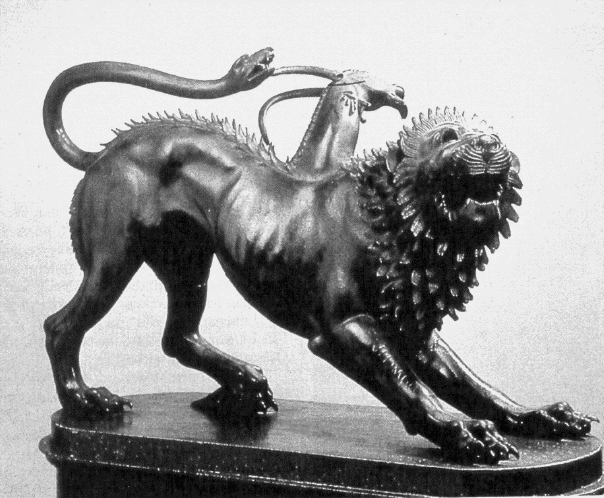
The third type of drakon was the Khimaira, a fire-breathing mythical beast whose form was a hybrid of lion, serpent and goat. Medieval artists used this creature as the template for the Dragon of Saint George, and this form became the link from ancient Hellas to modern D&D creature. The hero Bellerophon was commanded to slay it by King Iobates. He rode into battle against the beast on the back of the winged horse Pegasos and, driving a lead-tipped lance down the Khimaira's flaming throat, suffocated it. From Hómēros' Iliad:

 "On first deciphering the fatal message, he ordered Bellerephon to kill the monstrous Chimaera, spawned by gods and not men, that had a lion’s head, goat’s body and serpent’s tail, and breathed out deadly blasts of scorching fire. But Bellerephon slew her, guided by the gods." [VI:119-211]

The Drakaena were hybrids as well, usually with the upper body of a beautiful nymph, and the lower body of a drakon or sea-monster. Most often, these were parents to the above--a necessary evolutionary step. Famous examples include the Goddess Keto, who spawned the Hesperian Drakon, Ekhidna, who was married to the serpent-giant Typhôeus and spawned most of the dragons and monsters of myth, and Skilla, who did not spawn anyone, but was the she-dragon who haunted the Straits of Messina, snapping up sailors from ships--as Odysseus discovered.

These are the four types of drakones the ancient Hellenes identified, some mythological, some actually living in those days. Hopefully this will clear up the confusion of dragons in ancient Hellas and Hellenic myth once and for all.

Image source: Hydra, Cetus, Khimaira, Skilla.
The legend of Médousa (Μέδουσα) is one of the hardest myths to deal with out of ancient Hellenic mythology. It tells the story of a beautiful woman, who got raped by Poseidon, and gets transformed into a hideous monster who can turn people to stone just by looking at them, by Athena, because of it. She spends the rest of her life trapped on an island, in isolation, while brave warriors try to kill her for her head, which will still turn people to stone once cut off. Perseus eventually does so and gives the head to Athena to place on her shield. The circle is complete and Médousa is dead, after a lifetime of horror which was not her fault to begin with.

It's one of the best known Hellenic myths, and the movies, series, books, comics and other mediums which feature it--or Médousa--are endless. Percy Jackson comes to mind, and Clash of the Titans, but there are many others. What's less well known is that this particular myth doesn't date back to ancient Hellas, but ancient Rome: it was written by the Roman poet Ovid, in 8 B.C., in his Metamorphosis

"...He [Perseus] told of his long journeys, of dangers that were not imaginary ones, what seas and lands he had seen below from his high flight, and what stars he had brushed against with beating wings. He still finished speaking before they wished. Next one of the many princes asked why Medusa, alone among her sisters, had snakes twining in her hair. The guest replied ‘Since what you ask is worth the telling, hear the answer to your question. She was once most beautiful, and the jealous aspiration of many suitors. Of all her beauties none was more admired than her hair: I came across a man who recalled having seen her. They say that Neptune, lord of the seas, violated her in the temple of Minerva. Jupiter’s daughter turned away, and hid her chaste eyes behind her aegis. So that it might not go unpunished, she changed the Gorgon’s hair to foul snakes. And now, to terrify her enemies, numbing them with fear, the goddess wears the snakes, that she created, as a breastplate.’"

Yet, Médousa was a well known figure in ancient Hellas, so well known that the images of her cut off head adorned everything from armors to stoves. Her name meant 'guardian', and her head frightened off enemies as well as little children who would otherwise have burned their hands. The blood from the veins on the left side of Médousa's head was allegedly capable of killing, but Asclepius, a great healer, used the blood from the veins on the right side of the head for saving lives.

In ancient Hellas, Médousa was one of three sisters, Khthonic daímōns called Gorgons. They were named Médousa, Stheno (Σθεννω), and Euryale (Ευρυαλη), and were born to the ancient marine deities Phorkys (Φόρκυς) and Keto (Κητώ), his sister. They were part of the Phorcides (Φόρκιδες), the offspring of Phorkys. Their sisters were Echidna (Ἔχιδνα, half woman, half snake), the Graiai (Γραῖαι, 'old women', sharing one tooth and one eye), and Ladon (Λάδων, the dragon serpent who guarded the golden apples in the garden of the Hesperides). This view comes from Hesiod:

"And to Phorkys, Keto bore the Graiai, with fair faces and gray from birth, and these the gods who are immortal and men who walk on the earth call Graiai, the gray sisters, Pemphredo robed in beauty and Enyo robed in saffron, and the Gorgones who, beyond the famous stream of Okeanos, live in the utmost place toward night, by the singing Hesperides: they are Sthenno, Euryale, and Medousa, whose fate is a sad one, for she was mortal, but the other two immortal and ageless both alike. Poseidon, he of the dark hair, lay with one of these, in a soft meadow and among spring flowers. But when Perseus had cut off the head of Medousa there sprang from her blood great Khrysaor and the horse Pegasos so named from the springs (pegai) of Okeanos, where she was born."

According to Apollodorus, Médousa and her sisters came into the world with snakes on their heads, instead of hair, with yellow wings and brazen hands. Their bodies were also covered with impenetrable scales, and their very looks had the power of killing or turning to stones. Médousa was the only mortal of the three, and in nearly all versions of the myth, has her head cut off by Perseus, who gifts it to Athena. The big difference? In the Hellenic version of the myth, Médousa was never a beautiful maiden who served as a priestess to Athena and was punished for being raped.

There is a third version of the myth, inspired, it seems, by Hesiod, in which Médousa was a very beautiful maiden who lived far to the north where the sun did not reach. She begged Athena to allow her to leave and see the sun, but Athena refused. Médousa got angry and shouted at Athena that she was only disallowing her request because she was jealous at her beauty. Athena, angered, turned her into the monster she is so famous as today. There is a variation of this myth where Médousa tells the sculpture of a statue of Athena that he would have done better making a sculpture of her, because she was far more beautiful. The result is the same; Athena takes her beauty and forces her into isolation as punishment for her hubris. Apollodorus, interestingly enough, also confirms this:

"It is affirmed by some that Medousa was beheaded because of Athene, for they say the Gorgon had been willing to be compared with Athene in beauty."

Archaeologists suspect that Athena, Médousa and Poseidon found their origins in Libya. They came to Hellas through Crete at the dawn of Hellas. In the beginning of Her rein, Athena may have been a snake and fertility Goddess--a trait she shared with her Libyan counterpart, who had Her own cult--and may have either had a priestess who fit the Médousa myth or--and this is more likely--Médousa had her own cult as a snake, fertility and (menstrual) blood Goddess. Especially the latter may be linked to the myths concerning Médousa's blood.

Athena's role as a snake and fertility Goddess is still visible in the myth about the child she had with Hēphaistos;  Erichthonios (Ἐριχθόνιος), who was half man, half snake. It's even posed that in the early days, Athena was married to Hēphaistos and had His child willingly. As Athena was stripped of Her roles as a fertility and snake Goddess, Médousa's myth came into being, where Athena distances Herself from sex and snakes, by punishing an epithet of herself (Athena Tritogeneia, perhaps: 'born of Trito', a lake which was supposedly located in Libya), or the Libyan snake Goddess Médousa, who may have still been attached to Her worship. By placing Médousa's head on Her breastplate or shield, Athena's mythology is continuously linked to Her Libyan heritage, but harmlessly so, to Her new image of a virginal warrior.

Few references remain to Médousa's Libyan cult. There's vague reference to Médousa being a patron of Libya as a whole, or that she was the Goddess most worshipped by the Amazons. She was linked to protection, snakes, menstrual blood, blood, fertility, and femininity in general. If this is true, it's understandable why her worship did not match the Hellenic religion: for one, she's most likely a very powerful female deity. This did not match the hierarchy of the ancient Hellens, and so, Médousa became a monster, and was dealt with accordingly. Blood was one of the fluids that caused serious miasma, and menstrual fluid wasn't even spoken of in ancient Hellas, let alone revered. Not a single Goddess would have it in their portfolio.

I don't like Ovid's version of the Médousa myth. In my view, it's an embellished version of the myth which overshoots its purpose. It also puts both Poseidon and Athena in a very bad light, and takes a lot away from Médousa. As an Hellenist, I am going to pull the Recon card and ignore the heck out of the Ovid myth. I hope that works for you as well. In all honesty, Athena can be a harsh Goddess, but most of her brutal mythology (like Arachne) applies to Minerva, Her Roman counterpart. I'm not saying these two are not linked, but I consider the Roman pantheon as a separate pantheon, with harsher deities. I'll get back to that in another post. For now, I hope this post redeems Médousa a bit, and puts her in a new light for you.