New and highly significant finds came to light during this year’s excavations at the sanctuary of Zeus at Mt. Lykaion, located in the southwestern tip of Arcadia, where Zeus was born, raised and worshipped. This reports the Archaeological News Network.


The 'ash altar', made to host animal sacrifices honouring Zeus, is located on the Mountain’s southernmost peak, at an altitude of almost 1,400 meters above sea-level offering panoramic views across the Peloponnesian mainland, while monumental buildings belonging to the 'lower sanctuary' have been located on a lower plateau, where athletic games called the Lykaia took place in antiquity.

The Greek-American collaborative archaeological research project taking place on the site since 2004, has yielded new important information about the altar. Pottery from within the excavation trenches attests to the fact that human activity on the hill dates back to the Neolithic period and throughout the Early and Middle Bronze Age. During the Mycenaean period the hill emerges as an important sanctuary and was to remain a place of worship well into historical times. The animal sacrifices in honour of Zeus, mainly goats and sheep, indicate continuous religious activity at the altar from at least the 16th century BC through to the Hellenistic period.

In the summer of 2016, a human burial with an East-West orientation was found and excavated in the middle of the altar and next to a platform carved into the rock. The skeleton, in the supine position and in an excellent state of preservation, was deposited in a narrow trench some 1.52 meters in length, created within the embankments of the ash and burnt earth.

The skull of the deceased is missing, although the lower jaw is preserved. The narrow trench was lined with carefully carved stone slabs on the north and south sides, and the deceased’s pelvic area had also been covered with slabs. 

According to the preliminary study, the skeleton is probably that of an adolescent male. Pottery found during the excavation is dated mainly at the end of the Mycenaean period, indicating that the burial probably belongs to the 11th century BC, not long after the collapse of Mycenaean palatial society, during the transitional period from the Late Bronze Age to the Early Iron Age.

From the 4th century BC onwards, written sources mention human sacrifices at the altar of Lykaion Mountain but, till now, no human bones had ever been revealed during excavations in the area. The study of the skeleton is in progress but, despite the fact that it is still too early to draw conclusions as to the cause of death, the burial’s prominent position in the middle of the altar, and its orientation, clearly demonstrate its importance.

Excavations were carried out this year at the lower sanctuary also. Among the most important new findings worth mentioning are a monumental staircase and an impressive apsidal entrance flanking the two ends of a corridor dating to the 4th century BC, where athletes apparently entered the hippodrome and stadium.

In the administrative building - previously identified as a xenonas or guest-house - a large clay sima (ie., the upturned edge of a roof which acts as a gutter) was found. Within a circular natural formation (visible on Google Earth) which is been located West of the stoa and East of a fountain, the excavators brought to light two well-preserved clay water-pipes, one stone basin and traces of a wall, possibly from a sanctuary of Pan which is documented in sources but has yet to be located.

Excavations in the hippodrome continued to expose the embankments that supported the seats, while investigation of the bath-house area also dating to the 4th century BC revealed the remains of earlier phases of construction.

Excavations at the sanctuary will continue until 2020. Go here for more images of the excavation and find.
Death. It's a scary concept for many, I have discovered. I've received a message from a reader of this blog about it while I was away on vacation (I'm back now, yay, and will be catching up with my inbox in the next couple of days. If you've sent me something I ask for a bit more patience. Thank you!). The message reads as follows:

"As I read about the Hellenic understanding of the afterlife, I am left with a feeling of uneasiness and, I'll be blunt, fear.  I grew up in the Orthodox Christian tradition where the afterlife in Heaven is what one was to strive for, and the rewards were supposed to be great.  I love the Theoi, and I love to worship them, and at the same time, I somewhat fear the afterlife that may await me in this tradition.  It seems dreary, empty, monotonous, and devoid of feeling.  As reading, I found that the dead Achilles is to have said to Odysseus, ' Do not try to make light of death to me; I would sooner be bound to the soil in the hire of another man, a man without lot and without much to live on, than ruler over all the perished dead.'  How do I reconcile my faith and practice in life with that which seems to await me in death?"

This question is one I hear more often. It's one I always find hard to answer because I have never been involved in Christianity and find the idea of heaven (or hell) neither comforting nor desirable. In Hellenismos, it all comes down to living life as a mortal, one of the Delphic Maxims, and being judged by that standard, not the divine one of Christianity. The Christian mindset, in fact, would be considered hubristic in Hellenismos: we would ask to be put on the same level as Gods and judged by Them instead of our peers. We are not Gods, we are human and the human standard applies to us.

Christianity is a very dogmatic religion centered on belief: belief in God, belief in Christ and in Mary as mother, and there is the Holy Ghost and all the saints if your Catholic.  If you live a decent life, perhaps not even a good one, and believe in Christ you will go to heaven which has taken on all sorts of grandeur depending on the various branches of Christianity with a promise of eternal life. Our Hellenic religion as practiced by the ancients was not one of dogma nor of belief in the sense of Christianity. It is one of relationship, of accepting the reality of the Gods and Goddesses as part of the world and cosmic order, and honoring that reality in ritual practice and acts of piety. The cultivation of ‘eudaimonia’, happiness, literally the state of the good daimon, was (and is) a major goal of philosophy. Christianity includes judgement before entering heaven and we, long before the Christians, have judgement by the law givers, Rhadamanthys, Aiakos and Minos. In other words, we are judged by a human standard--as we should be.

What seems to be rather universal is a concept of something after life. The Homeric view of death is that we live on in the lives of others which is quite sensible and realistic. where our bodies go after death of secondary importance. This is why--especially in the Homeric view of the Underworld--we lose our memories. We are no longer part of life. Our memories belong with those who do. Thought the mystery cults--especially The Eleusinian Mysteries--we got to keep our memories, meaning we would hold on to our sense of self. Personally, I would not want that. Once my life has ended, who I was is gone. As it should be. I will be laid to rest and perhaps reborn to live again. But it is that time that I am alive that matters. It is there I must strive to do good and live up to the Gods and the maxims They have set out. I must make that time a pleasurable and ethical one for myself. Once I die, I am dead and I will forget. there is nothing to fear.

Now, mythology is a way of understanding the reality of nature and the human condition for both good and bad. It was not meant to be taken literally but used colorful imagery in poetic form (poetic license) to make the oral tradition memorable. Just because the dead Achilles is to have said to Odysseus, 'Do not try to make light of death to me; I would sooner be bound to the soil in the hire of another man, a man without lot and without much to live on, than ruler over all the perished dead' does not make it so. This is Homeros’ view of death and not to be taken as the Christians do their gospel.  Pherekydes visited the underworld and describes a rather gloomy place, but that does not make it so. Likewise, Christians describe heaven as a lovely place as a reward for living a decent life and following their beliefs, a very attractive alternative but that does not make it so. Religions around the world have differing views of the afterlife, but which view is correct? The ancient Hellenic practice always contains the element of unknowability. 

Of course that does not mean the ancient Hellenes did not believe the Underworld to be as described--the idea formed somehow, after all. And throughout Hellenic history this view has changed to include more desirable outcomes once death occurred. Even at its brightest, though, the Underworld was never something to strive for like in Christianity. It was Pherekydes of Syros who was born in 585 BCE who was the first to describe the immortal human soul, which underwent refinement throughout Hellenic philosophy and gave the Christians a base for their future dogmatic views of the afterlife, but even he did not consider that immortal soul's afterlife experiences the goal of life. Our religion is all about living not in a promise of the hereafter.  We all must go through the death experience. That is what it means to be human; to be alive.

Fear of death is inherently human but Christianity has fostered it into a way to control life. Hellenismos is not like that. We govern ourselves through ethics because we value life, not because we want a reward after death. What happens after death in unknowable and unavoidable. It is the time we are alive that we should be ' worried'  about and make the most of. Letting go of the fear of death is, perhaps, the first step towards that goal and I strongly wish thatfor all my readers.
Ohhh my, look at the pretty! Archaeologists working in the western Turkish province of Manisa have discovered a 2,200-year-old dinner set believed to have been buried as part of a ritual in the ancient city of Aigai.

2,200-year-old 'dinner set' found in ancient city of Aigai 

The dinner set was buried in a hollow in the bedrock as part of a ritual after being used on a special occasion. According to scholars’ hypotheses, beliefs required the dinner set to never be used again, thereby requiring its burial.

The dinner set, which has been sent to the Museum of Manisa for display, includes pieces such as cooking pots (khytra and lopas), cups (skyphos) and pitchers (lagynos) for drinking, as well as clay figures depicting gods and goddesses.

The set was found in the Aigai Town Parliament building, which was built around 150 BC and was thought to have been used during sermons dedicated to architecture.

Work in Aigai, located in Manisa’s Yunusemre district, was resumed on July 14 this year with the support of the Culture and Tourism Ministry under the direction of the archaeology departments at Ege University and Celal Bayar University.

Excavations on the site, which are currently being conducted on only a small area due to a lack of sponsorship, will continue until September.
I get a lot of questions from readers, and most of the time, the answers are fairly short. When I feel the question or the reply would be valuable to others as well, I make a post with a collection of them and post them in one go. Today is one of those posts.


"Hi, I'm just discovering Hellenic Polytheism and I can't seem to find a good source that explains the intricacies of the religion, do you have any sites or blog posts to help?"

I do! I have a series on my blog called ’The beginners guide to Hellenismos’ in which I try to explain the fundamentals of Hellenismos. Currently available in the series:

Introduction
What is Hellenismos? Who do we worship? Why do we worship the way we do? What is our history?
Ouranic versus Khthonic
The distinction between Olympic, Earth and Underworld Gods.
Generations of Gods
A more in-depth look into the pantheon.
The daímones
On the lesser spirits of Hellenismos.
Ritual and sacrifice in Hellenismos
On how and why we worship.
Traditional versus Reformed Hellenismos
There are different terms for different levels of reconstructionism a practitioner might apply. This is an overview of those terms.

More posts will be added so keep an eye on that link above or follow my blog.

~~~

"Silly question but is it Hades or Haides? I've always only seen Hades until tumblr."

Well, technically, it’s Ἁιδης. The literal translation from the Greek is ‘Haidês’ and Latinized it’s ‘Hades’. Basically all are correct and refer to the same God. It’s a matter of which translation you wish to uphold. Many Hellenists choose the translation from the Greek (simplified to 'Haides’). I use 'Hades’ on my blog because it’s more familiar to people.

~~~

"I heard someone say that Paganism was more 'valid' than Christianity because 'we were here first'. What's your opinion on that?"

I'm not a big fan of 'who was here first' sort of statements, to be honest. First off, define 'pagan', define 'first'. Are we talking Neanderthals first who--presumably--practiced some form of animism? Are we talking 7500 BC when the Catalhoyuk started building shrines to their spirits or Gods in what is now Asia? Are we talking the Proto-Semetic people who laid the groundwork for the Abrahamic faiths around 3750 BC?

Stonehenge was completed around 1600 BC but had been started in 3100 BC. The oldest pyramid currently known stems from somewhere between 2635 and 2610 BC. Minoan civilization developed around 2200 BC. The Judeochristian/Islamic patriarchal figure Abraham is assumed to have lived somewhere between 2000-1850 BC. Judaism dates back probably about as far as 1500 BC. The Greek Dark Age started in 1200 BC. We all know when Jesus was said to be born.

You know, I understand the sentiment: everything pre-Christian is assumed to be pagan was, thus, there 'first'. But Christianity didn't come to rise in a vaccuum. It was build on Judistic core tennets that predate at least the Greeks. In fact, much predates the Greeks. All of these peoples and all of these religions were intwined and many were related. Christianity took hold because it was a much nicer religion to be a part of than what they previously believed in. Sure, many were forced to follow it, but Christianity is easy and it gives solace much more than the religions that predated it: redemption, heaven, all these nice things.

I see value and validity in every single religion, ancient or otherwise. Wicca is only about forty years old now and it's a beautiful thing. Every God, in my opinion, deserves worship and respect. The question of 'who was here first' is neither logical nor useful in my opinion. Religion is. What form it takes is secondary to that. At which time it came to be is irrelevant.

~~~

"What kind of bowl do you recommend getting to hold the flame for burning your offerings indoors? I was using a small ceramic baking dish, but it cracked and I don't think it's safe to use anymore. I have no clue where to get a dish or what materials to look out for when choosing something that can handle the heat of a fire."

My advice is to make sure to use a cast-iron or at least solid container to burn in. A sacrifice gets hot and if your bowl cracks–like yours did–you will burn the house down. Make sure to test it out a couple of times (outdoors, on stone) and usually if it says ‘oven proof’, you’re good.

~~~

"I recently moved to a dormroom and now I have issues with xenia, hospitality. When am I the host? And when am I a guest? I especially have trouble with deciding for communal areas. Can you help?"

I lived in a house with fourteen others for a fair number of years. We had our own room but the kitchen and bathrooms were communal. My range of hosting in that time was my room: in it I was the host, outside of it was communal (ie the street or a café) and in the room of a housemate, I was the guest. Consider your own threshold the entrance to your home, not the threshold of the front door. A good rule of thumb is the following question: 'am I in complete control of this space?' If the answer is yes, you are the host. If the answer is no, the area is either neutral (so hosting responsibility is shared) or you are the guest. I hope this helps and I wish you a wonderful time in your dorm!
 
As part of the Beginner's guide to Hellenismos, I would like to discuss heroes and hero worship. Heroes and heroines have a special place in Hellenismos, as they had in ancient Hellas. These were humans--most with at least a part divine heritage--who were considered so brave, so skillful, so extraordinary in their lifetime that they became revered. Some were priests or priestesses of a temple, some excelled in battle, others were skilled healers or good rulers. Once they passed to the realm of Hades, their names were remembered at least once a year on a special occasion, because the ancient Hellenes believed that if the name and deeds of a person were remembered, they would live forever and potentially look out for those they had looked out for before.

Hero worship was very specific and it's a concept that translates with more difficulty than straight-up deity worship. In essence, heroes are the bridge between mortals and Gods. They were born mortal (although often with a bloodline to the Gods) but through their deeds, they were rewarded with immortality themselves. They became Gods. Still, the lessons they teach us are all mortal lessons. Heroes were honored more than worshipped, and we do that today as well. So heroes, like Gods, can be called on for counsel and aid, and like the Gods, you can establish kharis--a bond of ritual reciprocity--with them. But they don't judge us, not like the Gods anyway, because they were all just like us once.

Archeological evidence suggests that hero worship was closer to khthonic sacrifice in execution than ouranic ones the further back in time you go; especially in the archaic period, it seems that hero worship consisted of destructive sacrifices--sometimes in the form of a holókaustos where the entire animal was burned, sometimes in a sacrifice where only a part (most often 'a ninth' of the animal) was burned and the rest remained on the altar for the heroes to eat from until gone. The sacrifices were generally burned in an offering pit known as a bothros. The food offered to heroes consisted of meat, blood, and 'food eaten by men' like grains, fruits and other every-day dishes. These were usually offered to the heroes on a table--known as a trapeza--and the heroes were sometimes offered chairs or a bench to sit on. As time went on, the living began to eat part of the meal laid out for the heroes, joining them in celebration.

Although linked, hero worship in ancient Hellas was not the same as ancestral worship; heroes and heroines transcended family bonds. That said, ancestor worship was performed in a khthonic manner during state festivals but as hero worship when at home. This can be explained by surmising that ancestors were considered heroes to the family and they were missed. As such the character of their remembrance was khthonic. It was also possible to honour the family line and it was actually a part of the celebration of Agathós Daímōn, the third day of the month. The goal was not to honour the people in the family line but to express pride in your blood and bring about good fortune as stemming from the family line. This type of worship was closer to hero worship and was performed at a separate shrine or at an offering pit outside. These sarcifices were generally wholly given as well and could either be an animal or, more commenly, unmixed wine.

There were regular state festivals organized for the dead (nekysia) and for the forefathers (genesia) as there were for the heroes. Unlike with rites to the heroes, on such days, graves were adorned, offerings of barley broth, milk, honey, unmixed wine, oil, water and the blood of animal sacrifices were given in the form of khoai--fully poured out libations. Graves often had bottomless amphorae placed on it on hollow columns. The libation was poured into this and seeped down into the dirt to 'feed the dead'. Heroes were not considered to be dead, they were considered to be raised up as Gods. To worship them in a khthonic manner would have been inappropriate.

Heroes and heroines were considered to be raised up to Olympos and as such to have become Gods. They were, however, never revered as Gods. They were considered part of the tapestry of life: ideals to live up to, reminders of hard times in the past, and some were remembered as reminders against hate. Others were remembered for contributions to society, or for a whole scope of other reasons that made their lives important enough to remember.

In a modern Hellenistic context, hero worship translates very well. This applies to both the ancient Heroes like Theseus and Atalanta but also to modern ones like Martin Luther King and Malala Yousafzai. More importantly, perhaps, it also translates to people in your own life and your own community; the founder of the food program for the poor in your neighborhood, the man who stopped a robbery, the woman who saved a child from drowning. These are events that change lives and communities.

There is a lot of pain and suffering in the world; anyone who stands up against that, who goes out and does something extraordinary, needs to be honored and thanked, both when they are alive and after they have passed. There are people who change our lives and communities--we all know them. Remember and honor them every once in a while, for their actions, for what they taught you, and for what they have inspired to bring into the world.
On 12 Metageitnion, two separate rites were held, one in Erkhia and one in Athens. The first was in honour of Demeter, the other in honour of Zeus Polieus, Athena Polias, and Apollon Lykeios. On 15 August, at 10:00 AM EDT, we will combine both rites into a single PAT ritual.


Demeter, we all know, and she is not listed with a specific epithet. Zeus, Athena, and Apollon, however, are. Zeus Polieus and Athena Polias were protectors of the city. That is literally the translation of their epithet: 'of the city'. Apollon Lykeios means 'of the wolves'.

From the Erkhian ritual calendar, we know that the sacrifices to Apollon, Zeus, and Athena were not to be removed from the site and were thus to be eaten on the spot after part of the offering was sacrificed. In all cases, this offering was a white sheep, male for the male Gods, female for the female Gods. Demeter also got a female sheep, but her entry does not have a note to not remove the meat from the location, meaning the meat could potentially be taken away to be eaten later, or sold at shops founded especially for the purpose.

Will you be joining us in honouring these Gods on Thursday 15 August, at 10:00 AM EDT? The ritual can be found here, and you can join our community here.
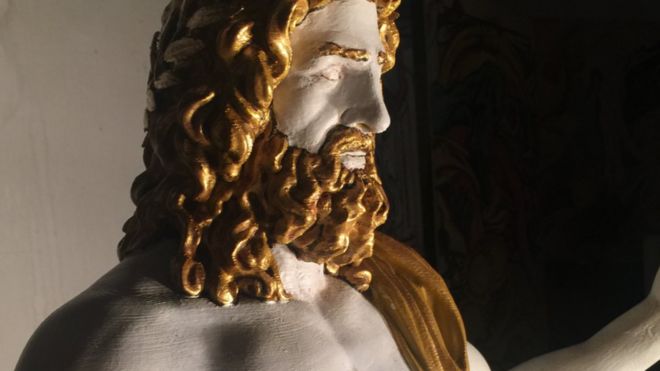
A few days ago, in the spirit of the Olympics, I posted about ancient Olympia. As the site of the ancient Olympics, the site boasted some truly spectacular features, including a seated statue of Zeus that stood inside His temple. The statue has recently been recreated--by way of 3D printing.


3D printing firms Stratasys and 3DPTree made the recreation for the Millennium Gate Museum in the US city of Atlanta. The 3D-printed version stands at a  modest 1.8 meters and was printed in thermoplastics, using a 3D model that approximated the design of the statue.

It took two days to 3D-print Zeus' body and another 20 hours for his legs. After some finishing of the statue's surface, the pieces were shipped to another location for assembly. Jesse Roitenberg at Stratasys stated about the project:

"It's not just for engineers, it's not just for designers - it's for art, it's for archaeologists."

Susanne Turner, curator at the Museum of Classical Archaeology in Cambridge, who was not involved with the project but has followed it closely states:

"Often, studying the ancient world is like trying to put the pieces of a jigsaw puzzle back together - but you've lost the cover with the picture and half the pieces. Anything that allows academics and interested members of the public to be able to visualise and imagine what these lost things may have looked like is an extremely powerful tool. I think [3D technologies] are going to become increasingly important, because it's so terribly distressing that those artefacts were lost."

The seated statue, created by the sculptor Phidias, was thirty-nine feet, or twelve meters, tall. The statue was richly decorated with ivory and gold-plated bronze. The sculpture was wreathed with golden olive shoots and sat on a grand throne of cedarwood, inlaid with ivory, gold, ebony, and precious stones. He held a small statue of crowned Nike, goddess of victory, in his right hand, and in his left hand, a sceptre inlaid with gold, on which an eagle perched.

The statue was eventually destroyed, either in the fire that also destroyed the temple, or before, when it was carried off by Romans who either used the stone and precious metals to create something new, or to repurpose the statue as a representation of one of their own emperors.