Classical Hellenic culture was strongly marked by gender segregation. Generally speaking, the public sphere was associated with men and the domestic sphere with women. It's a well known fact this is true, but it's less known (but much speculated about) why this was the case. One particular interesting angle to consider is the idea that this segregation arises from Hellenic ideas about the human body and the biological differences between males and females.


In the Greek tradition, mortal men and mortal women were created at different times and for different purposes, and indeed are different races of humans. According to Hesiod in his Works & Days, men were created first and lived free of evil, turmoil and the need to work. Then Pandora was created as a weapon in the contest against the Titan Prometheus and the race of women was born (the 'genos gynaikôn'). When she opened the pithos, she created the world we know today: a place where hard work has to be done, where life was hard and humanity became mortal because sexual reproduction began.

The ancient Hellenic medical writers differed in their ideas about male and female bodies. Roughly speaking, there are two 'schools' of thought: the 'two sex model' and the 'one sex model'. The Hippocratic school, as an example, saw men and women as separate species (two sex model), whereas Aristotle, for example, considered women imperfect or defective men, but men none the less (one sex model).

Hippocrates is credited with creating the theory of humoralism. Humoralism is a now discredited theory of the makeup and workings of the human body, positing that an excess or deficiency of any of four distinct bodily fluids in a person directly influences their temperament and health. The four humors of Hippocratic medicine are black bile (melan chole), yellow bile (chole), phlegm (phlegma), and blood (haima), and each corresponds to one of the traditional four elements. A person suffering from fever and sweats, for example, was diagnosed with an excess of blood, and was treated with instruments that were considered dry and cold.


Somewhat in line with this theory, men’s bodies were considered hot, dry, and compact where women’s bodies were cool, moist, and spongy. Women’s bodies were considered to be more open to outside influences (because of their spongy nature) and women thus lacked the firm control of bodily boundaries that men had. Because women's bodies changed during pregnancy and because they leaked (blood during their periods and tears when they got emotional), ancient Hellenic men figured that women ritually polluted (in the form of miasma) the world around them.

While women worshipped both male and female divinities and acted as priestesses in cult like as men acted as priests, performing many of the same activities, women’s bodies and voices were strictly controlled or semi-secluded in most areas of ancient Hellenic public life partly because of this potential to pollute. These were biological factors, created by the Gods and women were not faulted or blamed for them. The men simply acted according to this understanding of the female body and its properties.

The male body (and mind) and the female body (and mind) made them especially capable of maintaining relationships with the divine in different areas of life. War, athletics and politics were considered hard, dry subjects and thus men were best suited to undertake them, both in execution and in honouring the Gods connected to these subjects. Life-cycle rituals and especially rituals of reproduction and family were spongy and wet, far better suited for women.

Even in joined rites, men and women had different tasks, tabboos and specialties. One example: the ololygē, the ritual scream, that only women could perform during sacrifice. We are supposed to feel friction with our emotions when we take a life, animal or otherwise. Our instinct to preserve life is one of the strongest we have. As such, the moment within ancient Hellenic ritual when the animal's life was actually taken was marked with a scream. It was a joyous scream, one that marked the moment of giving to the Gods, the moment of closest connection and highest tension. After that the tension would wane and the sacrifice turned festive.

Only women could scream. Why? The ancient Hellenes had a masculine virtue called 'sophrosyne', which roughly translates to 'prudence (or soundness) of mind'. Men were expected to control their speech and utterances. Women lacked sophrosyne by nature and were especially suited to voice emotional cries Euripides writes in 'Andromache':

"There is in women is an inborn pleasure in having their present misfortunes always on their tongues." [94-95]

So, while women in public were ideally silent (much safer for everyone!), women’s voices played an important part in Hellenic ritual--critical, even. The same held true in other (but all connected to life and death, like the ololygē) areas of life. Women were actively involved in burials while men stayed away, fearing pollution. Women expressed their grieve loudly and lamented. Thought their cries and stories everyone could hear and remember the person who had passed--which was the way through which the ancient Hellenes claimed some sort of immortality: if their lives were forever remembered, they would never truly die.

The ancient Hellenes concluded that Hellenic men and women related differently to the Gods. Women had a more direct relationship with Them because they were more open (spongy) to Their influence and were thus expected to intercede with the Gods on behalf of their families and their city-states. Women’s behavior in ritual and situations related to life and death reflected these ideas.

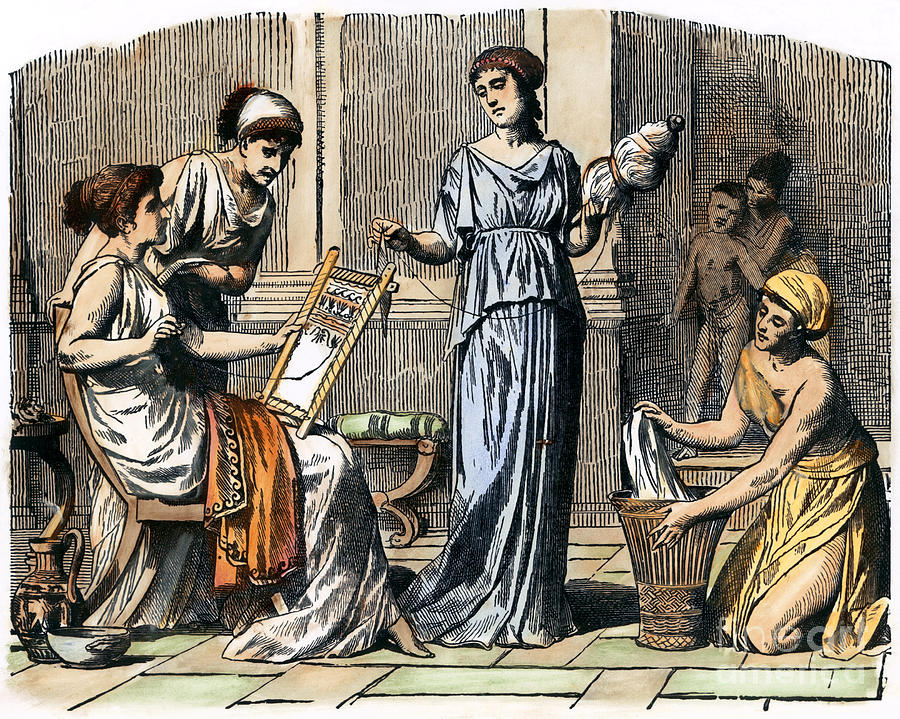
The perceived polluting qualities of women’s bodies meant that they had to be tightly controlled, ideally even contained within the domestic sphere and veiled when they emerged into the public sphere. The perceptions of women allowed them special prominence in ritual even as it justified their marginalized status in society as a whole.
Many people--myself included--sometimes forget how extensive the ancient Hellenic empire was. It wasn't just what is now modern Greece. It extended all the way down to, for example, Russia, Italy, Spain and the Ukraine. But, of course, there were ancient Hellenic cities in modern day Greece too that no longer exist today. One of these is Rhamnous.


Rhamnous (Ραμνούς), also Ramnous or Rhamnus or Rhamnounda, was a remote Attic deme center on a small sheltered bay along the rocky north-eastern Attic coast. It was named for the local prickly bush called ramnos and was the most important sanctuary of Nemesis in ancient Hellas.

Rhamnous was strategically important because it overlooked a narrow stretch of the Euboean channel. After Athens lost the city of Dekelia in 412 B.C., it also became important as the main harbor for import of food supplies from Euboea. The deme center at Rhamnous was fortified in the 5th or 4th century B.C. and probably received a permanent garrison because of its strategic position.

The temple of Nemesis in Rhamnous was renowned even before the fortified settlement acquired importance in the 5th century BC. Rhamnous also had a cult of Themis. A temple smaller and earlier than the temple of Nemesis, build around 480 BC may have been dedicated to both Gods. The later temple (ca. 420 BC) was dedicated to Nemesis alone, but was left unfinished. The worship of Nemesis ended in 382 BC when the Byzantine emperor Arcadius ordered that all pagan temples be destroyed.

The hamlet at Rhamnous also had a gymnasium and a small theater which may have served for civic assemblies as well as performances. Within the town's fortifications a hill top was enclosed in a second circuit of walls and may have held a permanent Athenian garrison. A route led from the town, through the necropolis and up to the Sanctuary of Nemesis and Themis situated on an artificial terrace facing the sea. The temenos was entered from the south-east and contained two small, closely adjacent temples and a number of sculptures and dedications.


For images and artist's impressions of the city, temples and sites, please go here.
When I find myself in troubled times, I turn to the ancient writers for the comfort of their now familiar words. Yesterday I picked up Hesiod's Works and Days. Works and Days is a very soothing piece of writing for me. It describes the day to day; it looks in, not out. While the world burns, it gives reprieve.

Works and Days (Erga kaí Hemérai, Ἔργα καὶ Ἡμέραι) is a didactic poem written by the very early ancient Hellenic poet Hesiod. It was probably written around 700 BCE or earlier and is the first example we have of Hellenic didactic poetry (poetry that emphasizes instructional and informative qualities). It embodies the experiences of his daily life and work, forming a sort of shepherd's calendar, interwoven with episodes of myth, allegory, advice and personal history. It may have been written against a background of an agrarian crisis in mainland Hellas, which inspired a wave of documented colonization in search of new land. It was written for his son Peres, as advice to him.

While I was reading last night, I recognized that turmoil in the pages and I found his words even more sound and soothing. They reminded me that I can only control my own actions and through them inspire others to take good and just action. As much as I would like to do more, I cannot shoulder that burden, nor can any individual. So, listen to Hesiod today and remember his still very timely advice.

Hesiod - Works and Days
"...And there is virgin Justice, the daughter of Zeus, who is honoured and reverenced among the gods who dwell on Olympus, and whenever anyone hurts her with lying slander, she sits beside her father, Zeus the son of Cronos, and tells him of men's wicked heart, until the people pay for the mad folly of their princes who, evilly minded, pervert judgement and give sentence crookedly. Keep watch against this, you princes, and make straight your judgements, you who devour bribes; put crooked judgements altogether from your thoughts.

He does mischief to himself who does mischief to another, and evil planned harms the plotter most. 

The eye of Zeus, seeing all and understanding all, beholds these things too, if so he will, and fails not to mark what sort of justice is this that the city keeps within it. Now, therefore, may neither I myself be righteous among men, nor my son -- for then it is a bad thing to be righteous -- if indeed the unrighteous shall have the greater right. But I think that all-wise Zeus will not yet bring that to pass.

But you, Perses, lay up these things within you heart and listen now to right, ceasing altogether to think of violence. For the son of Cronos has ordained this law for men, that fishes and beasts and winged fowls should devour one another, for right is not in them; but to mankind he gave right which proves far the best. For whoever knows the right and is ready to speak it, far-seeing Zeus gives him prosperity; but whoever deliberately lies in his witness and forswears himself, and so hurts Justice and sins beyond repair, that man's generation is left obscure thereafter. But the generation of the man who swears truly is better thenceforward.

To you, foolish Perses, I will speak good sense. Badness can be got easily and in shoals: the road to her is smooth, and she lives very near us. But between us and Goodness the gods have placed the sweat of our brows: long and steep is the path that leads to her, and it is rough at the first; but when a man has reached the top, then is she easy to reach, though before that she was hard."
[250-292]
The lost city of Atlantis has been found, and it’s straight out of the Bible – at least according to a stunning new National Geographic documentary which follows a high-tech, wide-ranging search for the mythical city with incredible results. The documentary, Atlantis Rising, released last Sunday, features Oscar-winning Titanic director James Cameron and Emmy-winning journalist Simcha Jacobovici following ancient clues through Greece, the Mediterranean, and the Atlantic on a search for Atlantis, a mythical city that allegedly sunk into the sea thousands of years ago. Along the way, they discover Biblical connections to Atlantis, including a 3,000 year old carving that ties the mythical city to the Jewish Temple.

[Scholars have begun to favor a location in southern Spain and Portugal,
just past the Strait of Gibraltar, as the location of Atlantis]

Jacobovici, who describes his recent projects as 'investigative archaeology', admitted that sources are scarce. The only ancient source for Atlantis was the Greek philosopher Plato in the 4th century BCE. In his dialogues, Plato wrote about a traveler, Solon, who learned about a highly advanced, wealthy civilization, described in depth. It was a port city located past the 'Pillars of Hercules', which Jacobovici explained is known today as the Straits of Gibraltar. In Plato’s account, Solon describes the destruction of Atlantis by a natural disaster which covered the coastal city with mud and water. According to the story, the city sank into the ground and disappeared. Jacobovici equated this to a tsunami.

"So often, when you tell people you are looking for Atlantis, they think it is a crazy project because they think it is a thing that was made up by Disney or Hollywood, a city full of mermaids. Many people may think this is a fictitious account, but Plato went into a lot of detail. More problematic is that no other historical or archaeological source discusses a city named Atlantis."

The team set out to find a city that fit the description of Atlantis. The search eventually led them to the Iberian Peninsula, where they began to make a connection between Atlantis and an ancient city known as Tartessos – which appears in the Bible. The research led Jacobovici to believe there is a link between Plato’s fabled city of Atlantis, which he believes is Tartessos, and the oft-mentioned Biblical city of Tarshish, citing an unmistakably Atlantis-like reference in Psalms.

"There are many artifacts and ancient writings that show that 3,000 years ago there was a great city of Tartessos, very wealthy and with a powerful navy. Though we don’t know exactly where it was, it was purported to be somewhere in Southern Iberia, Spain or Portugal, precisely the area that Plato gives for Atlantis."

Perhaps the most shocking revelation came when Jacobovici interviewed Spanish researcher Georgeos Diaz Montexano:

"He showed me Bronze Age symbols, 3,500 years old, carved into ancient shrines. Montexano believes that after the tsunami destroyed Atlantis, or Tarshish, the refugees made these shrines to commemorate the destruction of their city and to pray to their gods that Atlantis should rise again. The symbols carved into the walls had distinct design resembling a bull’s eye standing on a stick with three legs. The ancient stone carvings in the Spanish shrines are strongly reminiscent of Plato’s description of the port of Atlantis: three concentric circular docks with a central rectangular temple to Poseidon, with a canal connecting out to the sea. The symbol carved into the walls in Spain was an aerial view of the port Plato described, but with the canal depicted as Poseidon’s three-pronged trident. In one of these of these shrines in Spain, the 3,000 year old carving is missing the top half of the bull’s eye. Montexano theorized that this symbolizes the refugees were praying for a restored Atlantis. But that symbol, as everyone knows, is the Menorah in the Jewish Temple."

Jacobovici relates Montexano’s theory for the remarkable similarity between the ancient symbol found in Spain and the Jewish Temple.

"Montexan believes that when God told the Jews to make the Menorah, he gave them a symbol they already understood, already recognized from the Atlanteans."


In Greek, the term 'Atlantis' means 'island of Atlas' (Ἀτλαντὶς νῆσος), and it may very well have applied to the island of Santorini. It was Plato who brought life--and myth--to Atlantis. According to him, Poseidon fell in love with Cleito, the daughter of Evenor and Leucippe, who bore him five pairs of male twins. The eldest of these, Atlas, was made rightful king of the entire island and the ocean--called the Atlantic Ocean in his honor--and was given the mountain of his birth and the surrounding area to rule over. It was also Plato who wrote that Poseidon made Atlantis--a huge island with a volcano at its center--His home after Zeus, Hades and He divided the world.

The theory--because that is undoubtedly what it is--is interesting and the documentary does a good job of tying all the ends together, but is it true? By far the majority of previous theories point to modern dat Santorini. Santorini (Σαντορίνη), classically named 'Thera' and officially Thira (Θήρα), is an island in the southern Aegean Sea, about 200 km (120 mi) southeast of Greece's mainland. Santorini is essentially what remains after an enormous volcanic eruption that destroyed the earliest settlements on a formerly single island and created the current geological caldera.

Plato's description of Atlantis would have fit the ancient Hellenic version of Santorini well. It was a large, mountainous island, with an active volcano at its center. The large settlement on the island was build around said volcano. Poseidon's influence on the island isn't a stretch of the imagination at all; there was sea and ocean all around and from time to time, the entire island would tremble due to the volcano. The volcano eruption decimated the settlement, but from what archeologists and scholars have been able to piece together, the settlement was a sight to behold while it stood. It had walls eight meters tall, three story houses, beautiful frescos and a rich economic climate.

We most likely will never know for sure where--if anywhere--the ancient city of Atlantis was, but it's good new research and new theories continue to be posited.
One of Hellenismos' most important festivals is the Anthesteria. It is held in honour of Dionysos Limnaios; of wine, and the dead. Elaion will hold a PAT ritual for the festival on 8 February, 9 February and 10 February, 2017, at 10 am EST. Will you join us?


The Anthesteria was held annually for three days, the eleventh to thirteenth of the month of Anthesterion. It is an ancestral festival, the oldest of the festivals for Dionysos in Athens, a time of reflection and trust in the new growing season to come, a time to celebrate with the spirits of the departed the indefatigable resurgence of life. The festival centered around the celebration of the maturing of the wine stored at the previous vintage, whose pithoi were now ceremoniously opened, and the beginning of spring. The three days of the feast were called Pithoigia (after πίθοι 'storage jars'), Khoes (χοαί 'libations') and Khytroi (χύτροι 'pots').

On the first day, the pithoi were brought to the city of Athens and opened in the temple of Dionysos. Everyone from age three and up wore garlands of new flowers, and many were present when the pithoi of new wine were opened, and a libations was offered to Dionysos before drinking of it. It was a truly celebratory day.

On the second day, all temples were closed, except the temple of Dionysos. Social order broke down on this day--as slaves were permitted to celebrate alongside everyone else--and there was a drinking contest in the afternoon where three liters of wine were drunk in complete silence, from khoes. Whomever finished first, won. At the end of the day, the garlands that had been worn were wound around their khoes which they then took to the priestess in charge of the sanctuary at the Limnaios (the marsh) to be dedicated. The wife of the Archōn Basileus--the Archon in charge of religious and artistic festivals--the Basilinna might have taken part in a sacred marriage with Dionysos, either with her husband acting as a conduit for Dionysos, or one of His priests. Geriai, priestesses or followers of Dionysos, might have assisted in this ritual, or would have held their own cult rituals on this day. Young women swung in trees and decorated them to commemorate the death of Erigone, as chronicled below.

On day three, everyone joined in a procession to the temple of Dionysos. It was a somber day consisting of the preparation of a mixture of a panspermia, grains and beans boiled together (a good recipe can be found here), along with honey which was offered to Hermes Khthonios on behalf of the spirits of the dead, especially those who died in Deukalion’s flood. The slaves, as well as the dead, were then told to go home, as 'the Anthesteria had ended'.

The origins of the Anthesteria are based in myth. After the battle of Troy, King Agamemnon returns home to his wife Klytaemnestra (Κλυταιμνήστρα). When Agamemnon returns, playwright Aeschylus in his Oresteia, writes Klytaemnestra as not having been faithful to her husband. She has taken as her new lover and husband Aegisthos (Αἴγισθος), cousin of Agamemnon, and when Agamemnon and his young slave come home, Klytaemnestra kills them both. Orestes (Ὀρέστης), son of Agamemnon and Klytaemnestra ends up killing Aegisthos, as well as his mother for her crime, under orders of Apollon. Yet, the matricide is a terrible offense in the eyes of the Theoi, and the Erinyes--Khthonic deities of vengeance--are sent to kill Orestes. They chased him relentlessly and upon reaching Delphi he is told by Apollon that he should go to Athens to seek Athena's aid.

Phanodemus (Athenaeus 10.437c-d) describes what happens to Orestes next, as it is this practice that was reenacted again and again, during the second day of the Anthesteria:

“When Orestes arrived at Athens after killing his mother, Demophon [king of Athens] wanted to receive him, but was not willing to let him approach the sacred rites [to Dionysos] nor share the libations, since he had not yet been put on trial [and had not yet been cleansed of miasma]. So he ordered the sacred things to be locked up and a separate pitcher of wine to be set beside each person [instead of sharing a drinking vessel as usual], saying that a flat cake would be given as a prize to the one who drained his first. He also ordered them, when they had stopped drinking, not to put the wreathes with which they were crowned on the sacred objects, because they had been under the same roof with Orestes. Rather each one was to twine them around his own pitcher and take the wreathes to the priestess at the precinct in Limnai, and then to perform the rest of the sacrifices in the sanctuary.”

As mentioned, Orestes arrives at Athens during an existing festival to Dionysos. It is posed that this festival was the Aiora, a festival instituted to commemorate the death of Erigone, her father, and their dog Maera. The story goes that Ikários (Ἰκάριος) was such a fine winemaker that he could produce wine so strong, those who drank it appeared to be poisoned. His skill turned out to be his undoing; Íkaros was killed by those who drank his wine, thinking the wine maker was out to kill them. His daughter Erigone was taken to his body by the family hound, Maera, whereupon both she and the dog committed suicide by hanging. It may have been that Dionysos was so angry over the murder and the following suicides, He punished Athens by making all of the city's maidens (or only the daughters of those who had killed Ikários) commit suicide in the same way. The citizens of Athens turned to the oracle of Delphi to stop these suicides, and the oracle told them to burry the three with honors, and appease their spirits. The Athenians buried the bodies with full honors, and a festival was founded where young Athenian women swung in swings, and hung ribbons, cups, and dolls in trees.

The Anthesteria might sound like a confusing festival, and it was, in a way. The three days were almost completely separate events, but have a few things in common. It's a fertility festival, but birth is linked to death. All life is linked to death, after all, and both birth and death were miasmic events. After the rough winter, everything was dead: the soil, the remaining food stores, people... miasma tainted everything. So, as new life began from the ashes of the old, Dionysos was invoked and sacrificed to, to cleanse the old, to remove the miasma resting upon the earth and the people. It is not odd to find mythology connected to this festival which is so strongly linked to miasma, birth and death.

How does a modern Hellenist celebrate the Anthesteria? The first day should focus upon the fertility aspects of the festival: the coming abundance of flowers, wine, and fruit now the spring is almost upon us. Day two began at night, and was filled with... well... sex. People were intoxicated, enthusiastic about the upcoming spring and the end of winter, and they tended to find each other in the dark of night. I would suggest starting there for day two, if you have the option.

On this second day, I cover all other shrines I have in the house but the one on which I will honor Dionysos, to prevent them from becoming tainted with miasma. This is optional, of course. Do think about Orestes, and what he was forced to do--fail either his father by not punishing his killer, or fail his mother by killing her, and dooming himself, regardless--and think about hard decisions you have had to make, and ask forgiveness for them. If you are of legal age and have the opportunity to do so, empty a glass of wine, and feel it swirl in your stomach, as restless as the spirits of the mythic dead who will come up from the Underworld tomorrow. Swing on a swing, as high as you can, and revel in the feeling. Decorate trees with knick-knacks. If you made yourself a garland, take it outside, preferably somewhere wet, and beg that Dionysos accept it and cleanse you of the pollution you carry within you. Again, this night is perfect for making love, especially in honor of Dionysos.
Keep your shrines covered for the third day if you chose to do this, as miasma has not yet been lifted, and the dead roam the earth freely. Give honors to family members and others who were close to you, who have died. Speak with them and try to find closure. Make them a meal; a panspermia is best, but eggs, leeks and garlic also work well. There are different stories surrounding the eating of the panspermia yourself. Some say no one was to eat from it, but Walter Burkert in 'Greek Religion' notes:

"On the 13th Anthesterion, the day of the Pots, grains of all kinds are boiled together in a pot along with honey. This is the most primitive cereal dish of the early farmers, older than the discovery of flour-milling and bread-baking; in funeral customs it has survived down to the present day. But the idea of food for the dead, conjoined to an abridged version of an ancient source, has lead to the mistaken view that the living were actually prohibited from eating from the Pots. According to the full text, it is only the priests who are barred from eating this food, in accordance with the fact that all sanctuaries are closed on the Choes day. The meal of pottage is linked to the myth of the flood: once the water had subsided, the survivors threw everything they could find into a pot and cooked it as their first meal after the cataclysm, an occasion for summoning up new courage and yet in memory of the dead. One sacrifices to the chthonic Hermes for the sake of the dead and eats from the Pots in the certainty of life regained. The day of defilement is over, the masks and the dead lose their rights: 'Out you Keres, the Anthesteria are over' became a proverbial saying."

Yet, Harrison in 'Themis: A Study of the Social Origins of Greek Religion' has the following to say:
"The panspermia has not, I think, been rightly understood. In commenting on it before, misled by the gift-theory of sacrifice, I took it to be merely a 'supper for the souls.' No doubt as such it was in later days regarded when primitive magical rites had to be explained on Olympian principles. But it was, to begin with, much more. The ghosts had other work to do than to eat their supper and go. They took that 'supper', that panspermia, with them down to the world below and brought it back in the autumn a pankarpia. The dead are Chthonioi, 'earth people', Demetreioi, 'Demeter's people,' and they do Demeter's work, her work and that of Kore the Maiden, with her Kathodos and Anodos."

Where you stand, you must decide for yourself. Personally, I will not taste of the panspermia. Like with the Deipnon, however, setting outside the meal will lift the miasma from your person and the house, so afterwards, you can uncover your shrines again if you covered them in the first place.

The Anthesteria is a festival of deep, emotional, involvement, and it is best celebrated by emerging yourself as completely as you can. As with any rites to Dionysos, transformation within yourself is almost always a consequence. The Anthesteria is a heavy festival, but filled with joy, regardless, because you are working towards spring. Burdens will be lifted from you. Rejoice with with us and you will get through these festivals just fine. You can find the rituals here and join the community here. Enjoy!
Do you ever wonder why the ancient Hellenes depicted the Gods as they did? As peak examples of human beings; strong, muscular, handsome and broad for the men, either aged and wise or young and beautiful; or young, curved and stunningly beautiful for the women? The ancients questioned it too, actually, especially Xenophanes.

Xenophanes of Colophon (Ξενοφάνης ὁ Κολοφώνιος) was a Hellenic philosopher, theologian, poet, and social and religious critic. He lived from around 570 to 475 BC and is, perhaps, the first monotheist. His work survives solely in fragments but in those fragments it becomes apparent he considers many achievements of humans to be falsely contributed to Gods. Discoveries in science were ours to make, not of the Gods. Greed, jealousy, wrath and other negative emotions cannot and should not be waylaid to deities but should be accounted for by humans themselves. He saw divinity not as many Gods but as one supreme God. This God is one eternal being, spherical in form, comprehending all things within himself, is the absolute mind and thought, therefore is intelligent, and moves all things, but bears no resemblance to human nature either in body or mind.

Xenophanes was especially critical of anthromorphing the Gods. In religion and mythology, anthropomorphism refers to the perception of a divine being or beings in human form, or the recognition of human qualities in these beings. In Christian writer Clement of Alexandria's 'Stromata', Xenophanes is quoted as follows:

"Now, as the Greeks represent the gods as possessing human forms, so also do they as possessing human passions. And as each of them depict their forms similar to themselves, as Xenophanes says, 'Ethiopians as black and apes, the Thracians ruddy and tawny;' so also they assimilate their souls to those who form them: the Barbarians, for instance, who make them savage and wild; and the Greeks, who make them more civilized, yet subject to passion." [Book 7, Chapter 4]

And elsewhere in the same document:

"But men have the idea that gods are born,
And wear their clothes, and have both voice and shape.
[...]
But had the oxen or the lions hands,
Or could with hands depict a work like men,
Were beasts to draw the semblance of the gods,
The horses would them like to horses sketch,
To oxen, oxen, and their bodies make
Of such a shape as to themselves belongs."
[Book 5, chapter 14]

Interesting point to make: Clement quotes Xenophanes for quite a different purpose than Xenophanes intended his words. For Clement, this is all proof that the Gods are false, for Xenophanes proof there is only one God.

As long term readers of this blog might know, I have--what I have come to label as--a multiperspectivalistic view of religion and life as a whole. Multispectivalism, in short, is an approach to knowledge that suggests that reality is made up of multiple perspectives, none of which can grasp reality-as-is on its own. As such, the more perspectives one takes into account--biological, scientific, psychological, theological--the better the understanding one might have of reality. Multispectivalism in relation to religion thus implies that all reality can never be summed up under any one religion, concept, or perspective but is, in essence, a combination of all.

Unlike Xenophanes, I do not believe there is only one God. Paradoxically, my believes place me both at the opposite of the spectrum of Xenophanes as outside of it; above it, perhaps. I do agree with Xenophanes that the Gods express our best qualities, but unlike Xenophanes, I do not believe this is proof there is only one God. I consider it a single perspective that there is but one God, falsely divided into parts by ignorant humans. Another perspective would be that the Gods are most certainly distinct. That They looked upon the species of animal to worship Them (us humans) and made Themselves the pinnacles of this species. Perhaps the ox and lion worship pantheons of ox and lion-shaped deities who are either the same or different still from our Gods. Perhaps both, in different perspectives.

I have gone off into quantum mechanics, I fear. Let me take a step back. We do not know the true nature of the Gods. It is my firm belief They exist. I am also cognizant of the fact They might not exist. Consider multispectivalism as a box with the very essence of an issue inside, in this case the nature of Divinity. Now picture every side of the box a window with a different lens. One might be anthromorphism, one monotheism, one atheism, one a more scientific concept like particle science, hunting down the God Particle, and so on. When you look at the issue in the box from all different angles--perspectives--you learn something a little bit different every time.

Now, a box usually has six sides, which is limiting. You will only gleam a limited amount of information this way. True reality can only be observed when you've looked at the issue through every possible lens, every possible side. So our box does not have six sides but a hundred, or a thousand. Currently, we have not discovered all the required lenses to truly understand divinity and we cannot solve the issue of the nature of the Gods. But we keep creating lenses through religious interpretation, through scientific discovery, through philosophical and psychological understanding. As we evolve as humans, we become more capable of reasoning and understanding.

Here is a thought: what if we can only grasp the true nature of the Gods when we evolve into Gods? Is divinity itself the final lens through which to observe divinity and understand it? If so, is it hubris to consider the pursuit of that knowledge, or is it heroism? Herakles trained his body and mind in imitation of the Gods and eventually became one. There is mythological precedence.

I believe study is important to Hellenismos. The ancient Hellenes struggled with these questions just as we do. Xenophanes, Socrates, Plato. Philosophical, theological and scientific pursuits are at the very core of what makes us human and it's a path we were in part put on by the ancient Hellenes. To look for divinity in mathematical equations is as much a worthy pursuit to me as the practice of sacrifice or the study of mythology. Only by combining views can we hope to understand. Personally, I can't think of a worthier pursuit in life than the pursuit of true and all-encompassing understanding.
On November 10, 2012, Emory University students under the direction of Bonna Wescoat, Professor of Greek Art and Architecture, address the longstanding question of why an ornate frieze was located in a seemingly obscure position high on the outside wall of the Parthenon. The students erected a replica of panels of the frieze at the Nashville, Tennessee Parthenon. Then they asked bystanders what they could see. For her success, Wescoat has been honored as the 2017 recipient of the Archaeological Institute of America’s Excellence in Undergraduate Teaching Award. She recently received the award at the organization’s annual conference in Toronto.


The national award recognizes individuals who, among other things, have developed innovative teaching methods or interdisciplinary curricula and are actively teaching. In accepting the award, Wescoat praised the ingenuity of her students and thanked Emory for:

“[...]saying yes rather than no, for supporting archaeology, art history and classics without question, and for providing an environment in which they can thrive. We [art historians and archeologists] are the ultimate doers. Antiquities seem remote, but not always. Certainly not when you put yourself in its environment.”

Wescoat has long put herself into the environments in question. Since 1977, she has traveled to the Greek island of Samothrace for excavations meant to uncover the history and legacy of the Sanctuary of the Great Gods. She was named to the directorship of excavations in 2012, overseeing work at one of the most significant sanctuaries in Greece. That work informs her seminars based specifically on the research, as well as her first-year seminar “Myth and Legend in Ancient Greek Art,” and 200- and 300-level classes on art and architecture in ancient Greece and Rome. In all of Wescoat's courses, including those in the architectural studies minor that she played a critical role in devising, she makes the ancient come alive with hands-on engagement.

The 2012 project with the Emory students was a prime example of this. She and her students tackled the question of a seemingly overlooked part of the Parthenon in Athens by installing test panels in a replica in Nashville. At issue was why the iconic frieze, depicting a ceremonial procession, was placed high on the outside wall of the Parthenon’s central chamber and partially obscured by the surrounding colonnade. Some scholars suggested the detail of the work would have been lost in the shadows, even guessing the frieze was added as an afterthought to the original building.

The video above documents the extensive work students put into the optical experiment testing the visibility based on the precise Nashville replica. The conclusion: The view is optimal to tell a narrative to guests as they walk up to the structure. According to Wescoat:

“For whatever reason, today we feel there is some disjunction between meeting practical needs and aesthetics. My goal is to show how those two connect, to put back together how art is an integral part of the environment. One of my overarching goals is for my students to feel comfortable in the presence of art and architecture, and be able to engage and enjoy what they’re seeing and how it connects to the environment. I have fun doing this with my students.”

Can I just say that I want a teacher like this?