
For the second year Elaion will be hosting the celebration of the Lesser Eleusinian Greater Mysteries. As a basic viewpoint, Elaion believes that the Mysteries need not be pursued; they are not a spiritual ‘formula’ that experimentation will eventually rediscover. That said, we also acknowledge that it's a festival many have been drawn to--both then and now--and we want to give our members a chance to celebrate it in a way that is as Recon as possible once you accept that we know far too little about it to ever accurately be so. Since the proceedings of the Eleusinian Mysteries were kept secret in fear of the punishment of death, we will never be able to restore these rites. But we do know a few basics and we have formulated our celebration accordingly. Please read through all information as well as the rituals before deciding to join.

The Eleusinian Mysteries (Ἐλευσίνια Μυστήρια) had festivals throughout the year, which were tied to agriculture through Demeter's refusal to perform her duties as an agricultural Goddess while her daughter Persephone is with Hades, and to the afterlife and Underworld through Persephone's return to the surface of the earth after Her mandatory stay with Hades has ended. Initiation ceremonies were held every year at Eleusis. Of all the mysteries celebrated in ancient times, the mysteries at Eleusis were assumed to be of great importance to a large portion of the ancient Hellenes. The cult itself likely had origins dating back to the Mycenean period of around 1600 to 1100 BC, and it is believed that the cult of Demeter Herself was established in 1500 BC.
The Eleusinian Mysteries consist mostly of two festivals, but the worship of Demeter and Persephone consist of a cycle of seven festivals: the Greater Mysteries (13-23 Boedromion), the Proerosia (6 Pyanepsion), the Stenia (9 Pyanepsion), the Thesmophoria (11-13 Pyanepsion), the Haloa (26 Poseideon), the Lesser Mysteries (20-26 Anthesterion), and the Skiraphoria (12 Skirophorion). These are placed in sequence of the Athenian year.
Mythologically, the foundations of the Eleusinian Mysteries can be found in the Homeric Hymn to Demeter. Within the hymn, Demeter travels the globe in her grief over losing Her daughter. She eventually settles at the home of Keleus. Demeter plans to make one of his sons immortal in return for his hospitality but She is interrupted. Instead, she tells Keleus to build Her a temple and altar so she can teach human beings the knowledge they need to have a good life.
The Mysteries were obviously celebrated to honor Demeter--Demeter Eleusinia, specifically. Through the honoring of Demeter, the ancient Hellenes prayed for a good harvest, and through the worship of Persephone--Kore--those who were initiated in the Mysteries assured they would be looked upon favorably in the Afterlife.
The Lesser Mysteries were not always a part of the mysteries; around the middle of the fifth century BC, Eleusinian officials decreed that the Lesser Mysteries could serve as a necessary prerequisite to the Greater Mysteries. From that point on, they took place at a shrine located near the Ilissos river, from 20 to 26 Anthesterion, while they had most likely taken place at a special building at Eleusis, the Telesterion, before that. The river is located between Athens and Eleusis, and served as a meeting point when Athenian and Eleusinian worshippers came together. The location is also important for another reason: it was said to be the place where the first Lesser Mysteries were held; the place where Hēraklēs underwent purification before his initiation, so he could travel to the Underworld and not forget who he was, and through that, make sure he could get back to the surface world.
Hēraklēs, son of Zeus and the mortal Alcmene (Ἀλκμήνη)--who was a bane in Hera's life, simply for being born--was stricken mad by the Queen of the Gods and killed his five sons by his wife Megara (Μεγάρα), oldest daughter of Kreōn (Κρέων) of Thebes. When he was released from his madness by a hellebore potion--provided by Antikyreus--and realized what he had done, he cried out in anguish, and went on a long journey to cleanse himself of the miasma caused by these killings.
First, he visited the oracle at Delphi, who, unbeknownst to him, was whispered to by Hera. The Oracle told Hēraklēs to serve the king of Tiryns (Τίρυνς), Eurystheus (Εὐρυσθεύς), for ten years and do everything Eurystheus told him to do. Eurystheus gladly provided Hēraklēs with these labors--ten of them, one for each year--and eventually ended up adding two more, resulting in the Twelve Labors of Hēraklēs. Hēraklēs was told to: slay the Nemean Lion, slay the nine-headed Lernaean Hydra, capture the Golden Hind of Artemis, capture the Erymanthian Boar, clean the Augean stables in a single day, slay the Stymphalian Birds, capture the Cretan Bull, steal the Mares of Diomedes, obtain the girdle of Hippolyta, Queen of the Amazons, obtain the cattle of the monster Geryon, steal the apples of the Hesperides, and to capture and bring back Kerberos.
This twelfth labor caused a problem for Hēraklēs, because he had to enter the Underworld to capture Kerbaros, and come back up, something that the Underworld was not intended for. Yesterday I explained how the river Lethe, the river of forgetfulness, runs through the Underworld, and all who come to the afterworld are eventually forced to drink from it in order to forget their old lives. Those who were initiated in the Eleusinian Mysteries, however, could drink from the fountain (or well) of Mnemosyne (memory) and were allowed to remember. Hēraklēs had to go through the mysteries, but initiation into the Eleusinian Mysteries excluded those who were guilty of murder, and of course Hēraklēs was quite guilty of that. He was tainted not only with the miasma of killing his family, but also for killing the kentaur Nessus (Νέσσος), the kentaur who carried Hēraklēs' third wife Deïaneira (Δῃάνειρα) over the river Evinos (Εύηνος), and was killed by Hēraklēs for attempting to abduct and rape her.
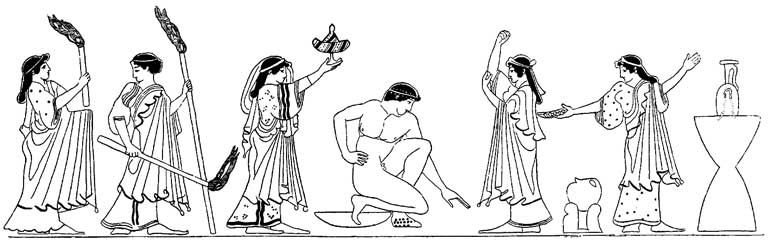
In ancient texts, the rituals of the Lesser Mysteries were often referred to as 'myesis', as opposed to the rites of the Greater, which were referred to as 'epopteia'. The word myesis means 'to teach', as well as 'to initiate', while epopteia has a similar meaning, but with an important difference; it means 'to witness', as well as 'to be initiated'. This difference equates the major difference between the two rites: in the Lesser Mysteries, candidates underwent a teaching course. They were educated on the gifts of Demeter, on the mythology surrounding Her and Her daughter, and on the mysteries. They went through a rite of purification--possibly in the river. Upon completion of the Lesser Mysteries, participants were deemed mystai ('initiates') worthy of witnessing the Greater Mysteries.
While what exactly happens on which day, is completely unknown due to the vow of silence--which was most likely placed upon the seekers the first day. What we do know from artwork is that a pig was sacrificed on a eschára, a low-lying altar to the khthonic deities--most likely Persephone. Also sacrificed by the seeker was a stack of flat cakes called 'pelanoi', although the actual sacrifice is not depicted. A priest gave a libation, and may also have burned poppies, a plant linked to both Demeter and Persephone, as Demeter might have used it to relief the burden of Her grief over losing Her daughter. Other options for offerings include pomegranates, the seeds of the pomegranate, cakes, or cheese.
The seeker was--assumable after this sacrifice--told of Demeter and Persephone, and he or she might have been seated on a chair, coated by a ram's fleece, while these stories were told to them. Again, we know this from artwork, but we do not know why they were seated as such, save that Demeter also sat on a chair with a ram's fleece on it as she grieves over Persephone's abduction. A ram appears to have been a favored sacrificial animal for Persephone, so it might be that the ram--minus its fleece--was sacrificed as well.
Next--and I use this term loosely, because we have no idea about the order of things--the seeker was blindfolded and led on a journey--either physically, or as a meditative exercise. As a journey into the Underworld is also a journey into the darkness, one can assume this was the main goal of the exercise; for the seeker to feel he or she was being led deeper into the mysteries of the Underworld, deeper into a sense of sacredness and trust in the Theoi and priests who overlooked the mysteries, and deeper into him or herself, possibly to face their own crimes and impure actions. Anyone who has ever walked to an initiation in a blindfold knows the power of the act. It brings a finality, a true sense of entering a new world, and a leaving behind of the old. It may be that especially the latter was the goal of this exercise; a continuation of the purification that started with sacrifices.
During the blindfold exercise, a winnowing fan, a 'liknon', which was used to separate wheat from the chaff was held over the head of the seeker. It's a common symbol of Dionysos, and withing the mysteries, it may have signified the separation of the soul from the body--a start of the preparation for the demise of the seeker at the end of life, and the control they would have not to drink from Lethe.
After this ritual, the seeker was purified, and 'brought before Demeter'. This was most likely a priestess representing the Theia for the rite. She was seated on the kiste--a basket which held the ritual items used in the Greater Mysteries--and on her lap (or somewhere close) would be a snake. The seeker had to reach out and touch the snake, to show they had no fear of death, nor dying. It appears this was the final step in completing the Lesser Mysteries, and becoming a mystes, but there may have been be a dozen more rites the seeker would have had to go through that were lost in time.
Because so much is lost of the mysteries, celebrating the Lesser Mysteries as a modern Hellenist is virtually impossible. We'll give it a try, though, while being fully aware that it's a mere shadow of itat best. For those who wish to join us, the Lesser Eleusinian Mysteries will be a seven day event, starting on February 17th and ending on February 23th. Many of the days will be study days with meditations of smaller rituals in order to understand the mythology and reasoning behind the Mystries. In this regard, the Lesser Mysteries differ from the Greater Eleusinian Mysteries.
To make things easier, we have laid out a time table:
February 17: Opening rite (daytime)
February 18: Study day: Demeter (daytime)
February 19: Purification rite (daytime)
February 20: Study day: the Underworld (nighttime)
February 21: Study Day: Iakkhos (daytime)
February 22: Initiatory rite (nighttime)
February 23: Closing rite (daytime)
We truly hope you will join us for this event. You can share your experience with the community here and the rituals can be found here. Note, these are ALL rituals, seven of them in total, one for every day. It is highly encouraged you read through them before the Mysteries start.
We are very excited about the opportunity of offering this experience to you and we hope you will find a glimmer of what the ancient Hellenes might have experienced during the some of the most anticipated days of the year.
The Eleusinian Mysteries (Ἐλευσίνια Μυστήρια) had festivals throughout the year, which were tied to agriculture through Demeter's refusal to perform her duties as an agricultural Goddess while her daughter Persephone is with Hades, and to the afterlife and Underworld through Persephone's return to the surface of the earth after Her mandatory stay with Hades has ended. Initiation ceremonies were held every year at Eleusis. Of all the mysteries celebrated in ancient times, the mysteries at Eleusis were assumed to be of great importance to a large portion of the ancient Hellenes. The cult itself likely had origins dating back to the Mycenean period of around 1600 to 1100 BC, and it is believed that the cult of Demeter Herself was established in 1500 BC.
The Eleusinian Mysteries consist mostly of two festivals, but the worship of Demeter and Persephone consist of a cycle of seven festivals: the Greater Mysteries (13-23 Boedromion), the Proerosia (6 Pyanepsion), the Stenia (9 Pyanepsion), the Thesmophoria (11-13 Pyanepsion), the Haloa (26 Poseideon), the Lesser Mysteries (20-26 Anthesterion), and the Skiraphoria (12 Skirophorion). These are placed in sequence of the Athenian year.
Mythologically, the foundations of the Eleusinian Mysteries can be found in the Homeric Hymn to Demeter. Within the hymn, Demeter travels the globe in her grief over losing Her daughter. She eventually settles at the home of Keleus. Demeter plans to make one of his sons immortal in return for his hospitality but She is interrupted. Instead, she tells Keleus to build Her a temple and altar so she can teach human beings the knowledge they need to have a good life.
The Mysteries were obviously celebrated to honor Demeter--Demeter Eleusinia, specifically. Through the honoring of Demeter, the ancient Hellenes prayed for a good harvest, and through the worship of Persephone--Kore--those who were initiated in the Mysteries assured they would be looked upon favorably in the Afterlife.
The Lesser Mysteries were not always a part of the mysteries; around the middle of the fifth century BC, Eleusinian officials decreed that the Lesser Mysteries could serve as a necessary prerequisite to the Greater Mysteries. From that point on, they took place at a shrine located near the Ilissos river, from 20 to 26 Anthesterion, while they had most likely taken place at a special building at Eleusis, the Telesterion, before that. The river is located between Athens and Eleusis, and served as a meeting point when Athenian and Eleusinian worshippers came together. The location is also important for another reason: it was said to be the place where the first Lesser Mysteries were held; the place where Hēraklēs underwent purification before his initiation, so he could travel to the Underworld and not forget who he was, and through that, make sure he could get back to the surface world.
Hēraklēs, son of Zeus and the mortal Alcmene (Ἀλκμήνη)--who was a bane in Hera's life, simply for being born--was stricken mad by the Queen of the Gods and killed his five sons by his wife Megara (Μεγάρα), oldest daughter of Kreōn (Κρέων) of Thebes. When he was released from his madness by a hellebore potion--provided by Antikyreus--and realized what he had done, he cried out in anguish, and went on a long journey to cleanse himself of the miasma caused by these killings.
First, he visited the oracle at Delphi, who, unbeknownst to him, was whispered to by Hera. The Oracle told Hēraklēs to serve the king of Tiryns (Τίρυνς), Eurystheus (Εὐρυσθεύς), for ten years and do everything Eurystheus told him to do. Eurystheus gladly provided Hēraklēs with these labors--ten of them, one for each year--and eventually ended up adding two more, resulting in the Twelve Labors of Hēraklēs. Hēraklēs was told to: slay the Nemean Lion, slay the nine-headed Lernaean Hydra, capture the Golden Hind of Artemis, capture the Erymanthian Boar, clean the Augean stables in a single day, slay the Stymphalian Birds, capture the Cretan Bull, steal the Mares of Diomedes, obtain the girdle of Hippolyta, Queen of the Amazons, obtain the cattle of the monster Geryon, steal the apples of the Hesperides, and to capture and bring back Kerberos.
This twelfth labor caused a problem for Hēraklēs, because he had to enter the Underworld to capture Kerbaros, and come back up, something that the Underworld was not intended for. Yesterday I explained how the river Lethe, the river of forgetfulness, runs through the Underworld, and all who come to the afterworld are eventually forced to drink from it in order to forget their old lives. Those who were initiated in the Eleusinian Mysteries, however, could drink from the fountain (or well) of Mnemosyne (memory) and were allowed to remember. Hēraklēs had to go through the mysteries, but initiation into the Eleusinian Mysteries excluded those who were guilty of murder, and of course Hēraklēs was quite guilty of that. He was tainted not only with the miasma of killing his family, but also for killing the kentaur Nessus (Νέσσος), the kentaur who carried Hēraklēs' third wife Deïaneira (Δῃάνειρα) over the river Evinos (Εύηνος), and was killed by Hēraklēs for attempting to abduct and rape her.
Hēraklēs traveled to Eleusis in search for a way into the mysteries. Eventually, the officials of the mysteries decided that, in order for Hēraklēs to take part, he would have to be cleansed of the blood of his crimes first. As such, he was put through a rite, most likely at the shrine at the Ilissos river. Hēraklēs was cleansed, and eventually, he was initiated into the mysteries. He traveled to the Underworld--aided by a lot of Theoi--and eventually, he returned successful in his quest. For the ancient regular mortal, returning from the Underworld was not the goal. They did, however, want to be initiated. In order to qualify for initiation, participants would sacrifice a piglet to Demeter and Persephone.
In ancient texts, the rituals of the Lesser Mysteries were often referred to as 'myesis', as opposed to the rites of the Greater, which were referred to as 'epopteia'. The word myesis means 'to teach', as well as 'to initiate', while epopteia has a similar meaning, but with an important difference; it means 'to witness', as well as 'to be initiated'. This difference equates the major difference between the two rites: in the Lesser Mysteries, candidates underwent a teaching course. They were educated on the gifts of Demeter, on the mythology surrounding Her and Her daughter, and on the mysteries. They went through a rite of purification--possibly in the river. Upon completion of the Lesser Mysteries, participants were deemed mystai ('initiates') worthy of witnessing the Greater Mysteries.
While what exactly happens on which day, is completely unknown due to the vow of silence--which was most likely placed upon the seekers the first day. What we do know from artwork is that a pig was sacrificed on a eschára, a low-lying altar to the khthonic deities--most likely Persephone. Also sacrificed by the seeker was a stack of flat cakes called 'pelanoi', although the actual sacrifice is not depicted. A priest gave a libation, and may also have burned poppies, a plant linked to both Demeter and Persephone, as Demeter might have used it to relief the burden of Her grief over losing Her daughter. Other options for offerings include pomegranates, the seeds of the pomegranate, cakes, or cheese.
The seeker was--assumable after this sacrifice--told of Demeter and Persephone, and he or she might have been seated on a chair, coated by a ram's fleece, while these stories were told to them. Again, we know this from artwork, but we do not know why they were seated as such, save that Demeter also sat on a chair with a ram's fleece on it as she grieves over Persephone's abduction. A ram appears to have been a favored sacrificial animal for Persephone, so it might be that the ram--minus its fleece--was sacrificed as well.
Next--and I use this term loosely, because we have no idea about the order of things--the seeker was blindfolded and led on a journey--either physically, or as a meditative exercise. As a journey into the Underworld is also a journey into the darkness, one can assume this was the main goal of the exercise; for the seeker to feel he or she was being led deeper into the mysteries of the Underworld, deeper into a sense of sacredness and trust in the Theoi and priests who overlooked the mysteries, and deeper into him or herself, possibly to face their own crimes and impure actions. Anyone who has ever walked to an initiation in a blindfold knows the power of the act. It brings a finality, a true sense of entering a new world, and a leaving behind of the old. It may be that especially the latter was the goal of this exercise; a continuation of the purification that started with sacrifices.
During the blindfold exercise, a winnowing fan, a 'liknon', which was used to separate wheat from the chaff was held over the head of the seeker. It's a common symbol of Dionysos, and withing the mysteries, it may have signified the separation of the soul from the body--a start of the preparation for the demise of the seeker at the end of life, and the control they would have not to drink from Lethe.
After this ritual, the seeker was purified, and 'brought before Demeter'. This was most likely a priestess representing the Theia for the rite. She was seated on the kiste--a basket which held the ritual items used in the Greater Mysteries--and on her lap (or somewhere close) would be a snake. The seeker had to reach out and touch the snake, to show they had no fear of death, nor dying. It appears this was the final step in completing the Lesser Mysteries, and becoming a mystes, but there may have been be a dozen more rites the seeker would have had to go through that were lost in time.
Because so much is lost of the mysteries, celebrating the Lesser Mysteries as a modern Hellenist is virtually impossible. We'll give it a try, though, while being fully aware that it's a mere shadow of itat best. For those who wish to join us, the Lesser Eleusinian Mysteries will be a seven day event, starting on February 17th and ending on February 23th. Many of the days will be study days with meditations of smaller rituals in order to understand the mythology and reasoning behind the Mystries. In this regard, the Lesser Mysteries differ from the Greater Eleusinian Mysteries.
To make things easier, we have laid out a time table:
We truly hope you will join us for this event. You can share your experience with the community here and the rituals can be found here. Note, these are ALL rituals, seven of them in total, one for every day. It is highly encouraged you read through them before the Mysteries start.
We are very excited about the opportunity of offering this experience to you and we hope you will find a glimmer of what the ancient Hellenes might have experienced during the some of the most anticipated days of the year.
-
Tuesday, February 14, 2017
current affairs Demeter Elaion Eleusinian mysteries Hellenic Reconstruction Hellenismos 101 Hēraklēs Iakkhos Mythology 101 PAT


