Today is the cremation of my girlfriend's grandmother, who in life was so kind as to adopt me as a grandchild in my own right. I loved her very much and she will be greatly missed. It's a sad day, and I am fortunate I get to spend it in the company of family.

I don't usually put the words of a Roman on this blog, but I wanted to today, because it's a passage I love and which has been on my mind a lot throughout this process.

Titus Lucretius Carus (99 BC – 55 BC) was a Roman poet and philosopher. His only known work is the didactic philosophical poem "De rerum natura" about the tenets and philosophy of Epicureanism, and which is usually translated into English as On the Nature of Things.

Epicureanism is a system of philosophy based upon the teachings of the ancient Greek philosopher Epicurus, founded around 307 BC. Epicurus was an atomic materialist, following in the steps of Democritus. His materialism led him to a general attack on superstition and divine intervention. Following Aristippus—about whom very little is known—Epicurus believed that what he called "pleasure" was the greatest good, but that the way to attain such pleasure was to live modestly, to gain knowledge of the workings of the world, and to limit one's desires. From "De rerum natura":

Finally, what great and vile desire for life compels us
To quake so much amidst doubts and dangers?
Mortals have an absolute end to our lives:
Death cannot be evaded—we must leave.
Nevertheless, we move again and still persist—
No new pleasure is procured by living;
But while what we desire is absent, that seems to overcome
All other things; but later, when we have gained it, we want something else—
An endless thirst for life grips us as we gasp for it.
It remains unclear what fortune life will offer,
What chance may bring us and what end awaits.
But by extending life we do not subtract a moment
Of time from death nor can we shorten it
So that we may somehow have less time after our ends.
Therefore, you may continue as living as many generations as you want,
But that everlasting death will wait for you still,
And he will be there for no less a long time, the man who
Has found the end of life with today’s light, than the man who died
Many months and many years before.
[3.1076-1094]
A vast collection of ancient coins from far-flung locations across the globe, including Syria and China, has been discovered tucked away in a drawer at a castle in Britain. The unique set, comprising 186 coins in total, spans twenty-five centuries of history, the National Trust (NT), custodians of Scotney Castle said Saturday as the collection went on show to the public for the first time.


The coin collection reaches as far back as Archaic Hellas, with a seventh century B.C. piece. This silver token is one of the earliest struck in Europe, and comes from the tiny island of Aegina. It features a clear depiction of a sea turtle, a creature sacred to Aphrodite. National Trust archaeologist Nathalie Cohen said:

"We know that Edward and Edwy Hussey had a great interest in collecting, but this considerable cache of fascinating coins shows just how much their interest grew into a collection of exceptional importance. What is a mystery though is why a collection of this caliber ended up at the back of a drawer."

The bulk of the collection is made up of Roman coins, ranging from the late second century BC to the late fourth century AD. The NT said it was possible that the Husseys, like many collectors, were trying to gather a "complete set" of Roman rulers. Despite the difficulty of this -- Roman succession was complex and many coins of the shorter reigns very rare -- they were close to achieving it. Experts from MOLA (Museum of London Archaeology) have been consulted by the National Trust and consider eighteen of the coins to be "rare" examples. MOLA's Julian Bowsher said:

"It was a delight, as a coins specialist, to examine such a significant and diverse collection. A particular highlight was seeing Roman coins that rarely appear in Britain, such as those of the 3rd century emperors Balbinus, Pupienus and Aemilian, none of whom ruled for more than a year."

The records also give insight into the purchase value of the collection in the nineteenth century. In Edward's diary from 1823, the "Accounts" section lists him purchasing "Coins" priced from 4 shillings to 7 shillings and 6 pence (0.26 U.S. cents to 0.49 U.S. cents respectively)

The NT said the coins were found by volunteers at the castle as they searched for photographs in a study drawer. Research into family diaries in the archive suggests the coins were amassed during the nineteenth century by avid collector Edward Hussey III and his son Edwy, who lived at the castle. Scotney Castle was the Lamberhurst home of the Hussey family for 200 years before it was left to the trust. The NT opened it to the public in 2007.


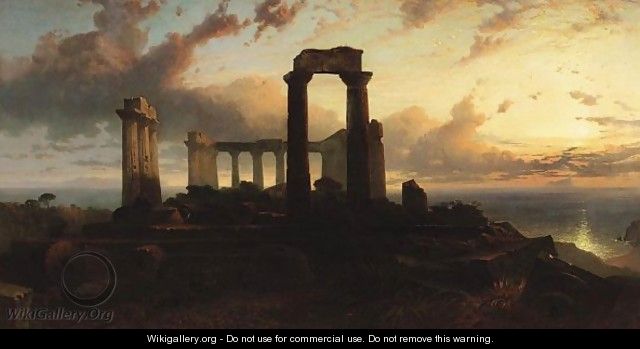
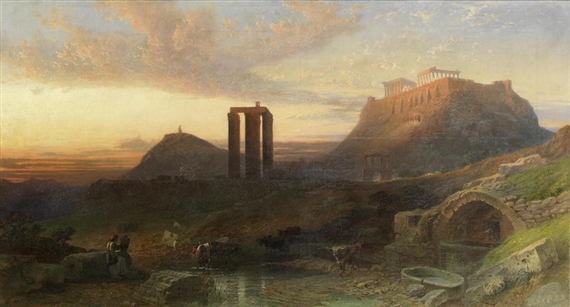
Henry John Johnson (10 April 1826 - 31 December 1884) was an English landscape and water colour painter. Johnson travelled in southern Europe, northern Africa and Asia Minor. He painted oil - and watercolour pictures of the ruins of Sardis, the Acropolis in Athens, and the Temple of Athena in Aegina), which I think are quite stunning, but judge for yourself!


Temple of Aphaea in Aegina, Greece

The Acropolis of Athens

Ruins at Hierapolis

Sounion
I'm sorry everyone, this week is still a very rough week for me due to family circumstances. Yesterday I posted part of a lecture by Elizabeth Vandiver. Let me share the rest of the lecture with you today. This is the full lecture, in parts, on auto play. Enjoy!


In this video, Dr. Elizabeth Vandiver, a Professor of Classics from University of Maryland, College Park, introduces the topic of Classical Mythology and tries to define its the words "classical", "mythology", and "myth", a background of some myths, as well as briefly touching on the broader cultural implications of these myths.
"There is this video on youtube about a woman named Elizabeth Vandiver, who is a professor in mythology and she says, that the gods could care less about us humans, and what they truly want from us is sacrifices. Now, I wanted to know what you thought about this lecture (if you have the time to see it, it's about half an hour long and covers subjects such as Pandora and Prometheus) because I feel like, whenever I pray my prayers goes unheard, and this professor may have a point, even if it's moot. She's really convincing, because she knows her stuff, and that's why I'm pondering whether she's right or if this is just the view of someone outside Hellenismos. So if you have the time to see this, I would love to hear your response because you are a strong believer and you might just convince me otherwise."


In Hellenic mythology, when our pre-human ancestors no longer gave the Gods sacrifice, Zeus wiped them all off the face of the planet with a huge flood and started over. In the myth of Baukis and Philemon, every villager who had turned the disguised Gods Zeus and Hermes away were drowned by another flood. This, however, has to do with respect and the just order of things--which is wholly Zeus's domain.

I agree with Vandiver when she says that humans are useful to the Gods and that's basically the only reason They keep us around, but she doesn't go into the very important concept of kharis. Hellenic animal sacrifice was done for a multitude of reasons. It was an act of devotion, an act to establish hierarchy--the Theoi are higher than mankind, but mankind is higher than animals, who are equal to each other--a social bonding affair, a nutritious necessity and tradition. First and foremost, sacrifice of any kind was given out of piety, out of a desire to please or appease the Theoi. Any sacrifice establishes kharis.

When we, in Hellenismos, petition the Gods for aid, we always do so with an offering. This offering can be incense, a libation, a food offering or anything else. It must be something tangible. Good thoughts and intentions don't count. This offering is given freely, joyfully, with pleasure, out of respect and love for the Gods. We ask what we feel we need--sometimes that's a new job, sometimes just a vague sentiment like honor and prosperity to the household--and never expect to be granted this request. Petitions aren't bribery. We give to the Gods and should They feel inclined to grand us our request, we thank Them by offering to them again, to which the Gods might respond, to which we will sacrifice, and so on. This circular practice of voluntary giving is called kharis. As long as we show respect and establish kharis, we are useful to the Gods. Disrespect the Gods and you become expendable.

We tend to resist this view in modern times. I consider that an especially Christian influence: God should be/is a benevolent entity (Islam and Judaism are less firm on a benevolent God), as well as a sign of the times. The ancient Hellenes, nor any of their contemporaries, believed the Gods to be anything but feared, appeased, and respected. The reason for this is logical: they were hard times to live in. The ancient Hellenes were subject to natural influence much more than we are. When a harvest fails, it doesn't automatically mean famine anymore. When we travel by ship, the odds of dying on it are slim. Not so in ancient Hellas. It were exactly these natural influences that the Gods had (and have) domain over, ergo: the Gods became beings to fear. They still are.

In essence: regular and grandiose worship through sacrifice raises your status with the Gods from an easily squashed nobody to someone who is useful and perhaps worthy of some protection and aid.

Having an almost personal, loving, and safe relationship with the Gods is a modern invention. It came to a rise with the revival of Paganism in the form of Wicca and Witchcraft. It makes absolutely no sense in an Hellenistic context because it goes against the hierarchy: Gods, then humans, then animals. As humans, we tend to reason from ourselves outwards, which basically would make the hierarchy: humans, Gods/animals. That's hubris. That's the opposite of piety. Piety, in large part, is accepting that we, as humans, are not at the top of this chain and that the Gods look at us like we look at animals: cute, but expendable once their purpose is served. It's a hard truth to face, and I get a lot of backlash for putting it out there, but that's the way the ancient Hellenes viewed their Gods, and it's how I view Them as well.
Archaeologists in Greece have uncovered rare jewels, coins and other artefacts while excavating tombs near the ruins of the classical city of Corinth dating to between the fourth and first centuries A.D. The team of experts, working with the Greek Ministry of Culture, made the discoveries in eastern Corinthia, at the site of the ancient village of Tenea, while excavating a burial ground with two distinctive chambers built when Greece was part of the Roman Empire.


The Greek Ministry of Culture said in a statement that the Roman burial monuments appeared to have been built into a preexisting Hellenic substructures from the period between the death of Alexander the Great in 323 B.C. up until the Roman conquest in B.C. 146. Five of the most well-appointed tombs, the experts said, would have belonged to wealthy inhabitants of Roman Greece. Bodies were found alongside elaborate gilded bronze leaves, a golden ring, precious stones and gold and bronze coins from the surrounding region.

Among the other ritualistic items buried with the dead were perfumes, artefacts made of gold, gold foil and elaborately crafted glassware, as well as items of pottery. Also within the dig site the archaeologists recovered items from a series of different burial plots. Fourteen graves, organized in circles, as was Roman convention, yielded a number of gold and silver coins, vases and a series of lamps, the most striking of which bore depictions of the Roman Goddess Venus and two cupids.

Of particular interest to the excavation team, led by Elena Korka, were the older Hellenic parts of the structures. One side of the Roman burial monument was built above an typical rectangular Hellenistic basement made of limestone and then coated in a thick layer of mortar.

In other areas they found evidence of graves from the earlier Hellenic period, pottery including a figurine in the shape of a dove and other ritual items such as perfume. It also appeared some of the lower vaults in the buildings would have been associated with other Greco-Roman rituals.
The period of Roman rule in Hallas began following the destruction of Corinth, when the Roman Empire annexed the Hellenic heartlands and crushed the Peloponnesians, the Hellenic peoples living in the southern part of the country.

The ancient Hellenes were able to maintain relative autonomy from their Roman rulers during the early period of empire with sophisticated Hellenic culture, its philosophy and literature having a profound influence on Rome’s educated elite.
Okay, okay, way too late for this, but it isn't like we celebrate Halloween anyway. Consider it a nudge toward craftiness, all right? The Getty Museum has put out five stencil designs -- three ancient pottery forms (amphora, olpe, and kylix), as well as an ancient Greek athlete and a Cycladic figurine.