Pliny the Younger was born Gaius Caecilius or Gaius Caecilius Cilo. He lived from 61 to 113 AD. Pliny was a lawyer, author, and magistrate of Ancient Rome. His uncle, Pliny the Elder, helped raise and educate him.

Pliny the Younger wrote hundreds of letters, of which 247 survive and are of great historical value. I wanted to share one of those today, even though it's a Roman piece of writing. Based on what we know of ancient Hellenic food habits, what follows could very well be accurate for Hellenic times as well, which is why I enjoy finding (or rediscovering) passages like this.

This letter is directed at a man called Septimius Clarus, who was supposed to show up for dinner but didn't. What follows is a summation of everything that was served during and organized for the banquette.

“Who do you think you are?! You agree to come do dinner…but you don’t come? The judgment is passed: You must pay my cost to a penny, and this is not moderate. All was set out: a lettuce for each, three snails, two eggs, wine with honey chilled with snow—for you should include this too among the highest expense since it dissolves on the plate—and there were olives, beets, pickles, onions and countless other things no less neat.

You would have heard a comedy or a reader or a singer of all of them, given my generosity. But you went where I don’t know, preferring oysters, a sow’s belly, sea-urchins, and Spanish dancers. You will suffer for this, somehow, believe me.

You did something bad to one of us, certainly to me, but perhaps to yourself too. How much we played, laughed, and studied! You might eat better food at many homes, but nowhere will you eat so enjoyably, simply, and freely. In sum: try me: and if later you don’t excuse yourself from another’s meal, you can always lie to me again. Goodbye!”
By 2050, according to a study presented on 8 November at an event organized by MEP Ricardo Serrão Santos (S&D) and the IUCN European Regional Office in Brussels, the oceans will contain more plastic than fish and 99% of seabirds will ingest plastic as well as 52% of sea turtles. In Europe specifically, 100,000 tons of waste are discharged into the seas. The majority of plastic waste is disposable and consists of: 2.5 billion food packages, 580 billion cigarette butts, 16 billion plastic cups, 36.4 billion drinking straws and 46 billion plastic bottles! But there are lessons to take from Ancient Hellas.

greek-800x450

Jacques Yves Cousteau’s son, Pierre Yves, has presented important facts about the state of the oceans today: 70% of the plastic remains at the bottom of the ocean, 15% floats, while the remaining 15% is in the water column between the surface and the bottom. The Guardian, has revealed that 80% of drinking water in Europe contains microplastics.

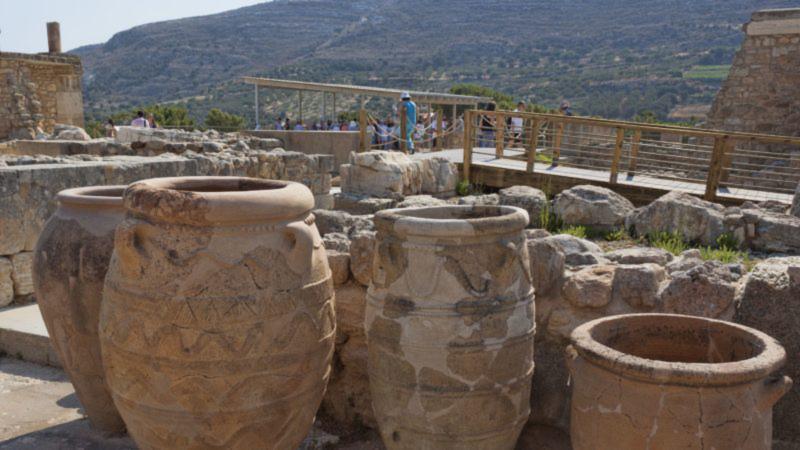
“During my last visit to Santorini, I visited the archaeological site in Akrotiri. I was impressed by the way the Ancient Greeks stored in their jars the olive oil and the wine. I think we can take lessons from this. The problem we are facing today is something that has been the main concern of all the great civilisations in the past: the production, storage and shipping of goods. During the last century, the way we chose to do it was not sustainable.”

The UN’s representative for the environment in Brussels, Ulf Björnholm, proposed the following:

“We need regulations, economic incentives and voluntary action. It is also necessary to promote the circular economy. We should reduce the production of both disposable and non-recycled plastics, for example in cosmetics and cars"

On 6-7 December, the UN is organizing a world conference entitled "Towards a pollution-free planet," while an information campaign has already been launched, inviting governments, companies and civil society to take part in the initiative and take local action.

This is an issue that is near and dear to my heart and outside of contributing to Pandora's Kharis, this is where most of my giving goes to. The ancient Hellenes didn't care about the environment like we care about the environment, but they didn't have to. They hadn't polluted the earth like we have. I'm shoehorning this issue into my blog because this is something I care greatly about and changing perception and behavior matters. We are not killing the planet, we are killing ourselves and millions of animals by living in a society that is build on profit, not sustainability, and there are definitely lessons to take from ancient Hellas in that regard.
Two days ago, we brought home a tiny chap who's already bought us a lot of joy. He's a half Persian, half Norwegian Forest Cat mix who's been severely neglected by his previous owners, so he's very thin and his fur is badly maintained. He is very bright, though, and very, very sweet. Having him in the home has been an absolute joy and he's very much settled in already. So, this post is for Hugo (or Oscar, if my girl has her way).


As you are probably all well aware, the ancient Egyptians were big fans of cats, and one of their main Goddesses, Bastet, Goddess of protection and motherhood, carried the head of one. Alexandria had a temple to Bastet, for example, so the ancient Hellenes would have come in contact with Her. Most likely not everyone, but at least a few of the ancient Hellenes would have equated Bastet with Artemis--especially in Late Antiquity. Bast was a lioness Goddess of the sun throughout most of Ancient Egyptian history, but later she was changed into the cat Goddess Bastet. She also was changed to a Goddess of the moon by Hellenes occupying Ancient Egypt toward the end of its civilization. In Hellenic mythology, Bast also is known as Ailuros. Hyginus, for example, in his 2nd century AD 'Astronomica' writes:

"Egyptian priests and some poets say that once when many gods had assembled in Egypt, suddenly Typhon, an exceedingly fierce monster and deadly enemy of the gods, came to that place. Terrified by him, they changed their shapes into other forms: Mercurius [Hermes] became an ibis [the god Thoth], Apollo [Apollon], the bird that is called Thracian [the god Horus], Diana [Artemis], a cat [the goddess Bastet]. For this reason they say the Egyptians do not permit these creatures to be injured, because they are called representations of gods." [2.28]

You can read more about this bit of mythology here.

Returning to ancient Hellas--and not so much the Roman era--the question of the cat as a pet in ancient Hellas is rather vexing. Modern Athens is home to countless feral cats, however, the status of the cat in ancient Hellas is unclear, as images of cats are fairly rare. This is obviously a sign that even if there is a God or Goddess of cats in the ancient Hellenic pantheon cats are most likely a side-line.

Cats were probably kept by Hellenic households as liminal animals--animals who were free to come and go as they pleased, roaming houses and streets alike. This may account for the fact that few cat bones have been found in domestic situations. Historically, the main reason to keep cats is to get rid of mice, only in ancient Hellas the job of 'mouser' seems to have been handled by weasels and ferrets, many of which were also considered liminal pets. Yet some clear representations of cats do exist, primarily on funeral stele. These show caps on leashes, or being shown off as prized possessions, so we do know that some cats were updated to the status of 'pet'. The comic playwright Aristophanes liked to include cats in his productions and often used the phrase 'the cat did it' for comic effect, as cats were blamed for things breaking in the household.

So there isn't a God or Goddess of cats, but there is a Goddess associated with cats: Hekate. There is one single piece of mythology I have to base this on: the myth of Galinthias, the nurse of Alkmene, transformed by the angry Eileithyia, but received by Hekate as her animal. Again, I have only late sources, second century AD again, although this time recorded by Antoninus Liberalis in his 'Metamorphoses':

"At Thebes Proitos had a daughter Galinthias. This maiden was playmate and companion of Alkmene, daughter of Elektryon. As the birth throes for Herakles were pressing on Alkmene, the Moirai (Fates) and Eileithyia (Birth-Goddess), as a favour to Hera, kept Alkmene in continuous birth pangs. They remained seated, each keeping their arms crossed. Galinthias, fearing that the pains of her labour would drive Alkmene mad, ran to the Moirai and Eleithyia and announced that by desire of Zeus a boy had been born to Alkmene and that their prerogatives had been abolished.

At all this, consternation of course overcame the Moirai and they immediately let go their arms. Alkmene’s pangs ceased at once and Herakles was born. The Moirai were aggrieved at this and took away the womanly parts of Galinthias since, being but a mortal, she had deceived the gods. They turned her into a deceitful weasel (or polecat), making her live in crannies and gave her a grotesque way of mating. She is mounted through the ears and gives birth by bringing forth her young through the throat. Hekate felt sorry for this transformation of her appearance and appointed her a sacred servant of herself." [29]

Whatever the case, our cat is definitely part of our oikos, and I couldn't be happier to welcome him.
A unique bronze helmet discovered in the deep by marine archaeologists off the Sicilian coast, which they have dated to a sea battle of 241 B.C.E. may have been a precursor of the lion-themed helmets used by Rome's Praetorian Guards, the personal bodyguards of the Roman emperors.        


Recovered from the site of the Battle of the Egadi Islands (Aegadian islands), northwest of Sicily, the helmet is a Montefortino, a Celtic style-helmet that had been worn across Europe, also popularly known as a "Roman helmet". These are easily identified: they look like half a watermelon with a knob on top and cheek flaps down the sides that tie at the chin. However, the newly discovered helmet has a unique feature: what appears to be a relief of a lion's skin embracing the central cone adorning its peak. Only one Montefortino helmet is known to have a relief on top, that appears to show a stylized bird.

The helmet's dating is based, among other things, on pottery jars and other debris discovered on the sea floor at the site. It was heavily encrusted after more than 2,000 years under the Mediterranean Sea and is undergoing cleaning and conservation that the archaeologists hope will reveal more details.
Other helmets discovered at the same site bore what appears to be Punic lettering engraved into the crest knob. The helmets could be a Libyan-Phoenician type, or worn by Greek mercenaries in Carthaginian employ, Royal suggests.

The find is the latest in a string of discoveries made this year using unmanned submersibles as well as divers that have changed our understanding of naval tactics during the First Punic War (264-241 B.C.E.) , which knocked out Carthage, and made Rome lords of the sea. Diving at depths as deep as 120 meters, the marine archaeologists are surveying an area of about five square kilometers, littered with the relics of this decisive war.

For much more information about the battle and finds, go here.
I've been thinking about the bonds of family a lot lately. Not surprisingly, considering the circumstances, I suppose. I've found myself inexplicably drawn to Artemis, and I have spent more time sacrificing and praising Her in my daily prayer rituals than I usually would. I suppose I've never truly considered how great an influence She has on my life as a Goddess of women and the patron of the transition from girlhood into womanhood.

I have considered myself a woman for many years. I have made conscious efforts to correct people who would call me a "girl" for just about as many, both out of a sense of feminism and honest belief that I was an adult woman and knew what came with that title. I think I am currently realizing that there is more to adulthood than just moving out of the home of your parents, especially if it's a toxic environment to be in. You carry the roll of "child" with you for a long time and I doubt you ever truly shake it, but I'm coming to find that letting go of some of the ties that bind is a process that takes part in stages. I have reached a new one, and I naturally reach out to Artemis for comfort.

In ancient Hellas, a girl's coming of age ceremony was linked to her wedding day. As soon as she got married, she would move out, into her new husband's oikos, and commit to the task she was born to fulfill: gift her husband legitimate offspring--boys, preferably. It won't come as a surprise that in preparation for this entirely new role in life, a girl's coming of age ceremony was focussed almost entirely on ending her own childhood, and petitioning the Gods for help in her life as an adult. As such, fertility and womanhood were big parts of the rituals.

Young girls rarely had a role to play in household worship. The family only had them with them for thirteen to fifteen years, on average, after that, she joined her rightful place at the oikos of her husband, where she carried more (religious) responsibility. There were religious roles young girls could fulfill outside of the home, however, most notably as 'Arrephoros' (Ἀρρήφορος)--year long handmaidens of Athena Polias (Πολιάς)--in Athens, and as 'Arktos' (αρκτος), bear, a service in the following of Artemis Brauronia (Βραυρωνια) at Brauron (Βραυρών).

During the Arkteia festival, celebrated every four or five years alongside--or as a part of--the Brauronia, named and in honor of the epithet of Artemis. Every Athenian girl, as well as many other girls from all over Attika, had to take part of the festival before they could marry. The girls were brought to Brauron, a temple of Artemis with a rich history in both myth and history. Some versions of the myth of Iphigeneia have her taken from the sacrifice and dropped in Brauronia, where she established a temple to the Goddess in gratitude. Otherwise, an oracle might have told the ancient Hellenes to build a temple to the Goddess at Brauron after a terrible plague or famine plagued the land following the killing of a bear by two hunters.

The symbolism of the bear might refer to the bear which was slain by the hunters, or the clothes Iphigeneia might have left at her 'sacrifice'. It's also possible that the bear reference refers to Kallisto, who was transformed into a bear by the Goddess.

During the festival young girls, and it seems that on occasion young boys, would gather to celebrate Artemis Brauronia with races, and dances. They would don bear masks and dance a dance known as the 'Arkteia', which was made up of slow, solemn steps meant to imitate the movements of a bear and was performed to a tune from a diaulos (double flute). They might have carried baskets of figs. Up until as far back as the 5th century, the girls might have worn actual bear skins, but bears soon became scarce, so they wore yellow dresses called 'krokoton', which they 'shed' instead of the skins to signal their coming adulthood.

The actual reason for the 'bear' ritual has been lost. It's possible that the ritual served to exorcise 'the wildness' out of little girls, but it's more likely that it was simply a way to procure kharis for the young girls who would soon call on Artemis during childbirth. In the same spirit, young women on the threshold of marriage made an offering to Artemis of their childhood toys and other paraphernalia that represented childhood, as with an offering of one drachma (roughly $ 60,-) at the temple of Aphrodite. Most likely, the bride also honored Hera Teleia and Zeus Teleios in some way.

A young woman came of age during her wedding and the subsequent wedding night, but became a woman when she gave birth for the first time. Especially during the latter, they desperately needed the support of the Goddess Artemis. Aphrodite and Hera Teleia would support her through her marriage, and help her make it a success. With the help of the Gods, a girl could become a woman.

I am not a mother. I don't know if I will ever become one either. I am also not married, but I have been with my girlfriend for thirteen years, and we've lived together for eleven. I consider myself married in the eyes of the Gods. I present myself as a woman, but I am in need of a new Arkteia, of a new blessing from Artemis Brauronia in order to break more chains that shackle me to the past. I suppose that is going to be a focal point of my worship for a while.
The cremation on Tuesday was hard to get through but very beautiful and fulfilling. It was as you hope a farewell goes. I won't go into detail, but anyone who had been to a cremation or funeral knows how these things go.

I haven't worshipped since Monday last week, when I first heard about the death of my girlfriend's (and my, really) grandmother. Death, after all, is miasmic. Within Hellenic practice, miasma describes the lingering aura of uncleanliness in regards to a person or space through which contact is made with the Gods. After a lot of research into the workings of miasma, I have come to the conclusion that true, practice stopping, miasma is linked to distraction. Anything that takes your mind off of the Gods during ritual can be considered miasmic. Death, through grief, is therefore especially miasmic.

With the cremation came a conclusion to the source of miasma, so to speak, as it offers closure. Yesterday, I prepared to resume worship.

First, I vacuumed and cleaned the space my altar is in. I opened the windows and let fresh air in. Then I took a long, hot shower and scrubbed every inch of me. After dressing in clean clothes and doing my hair up, I uncovered my altar and shrines. It's a practice I have adapted from ancient Hellas; the ancient Hellenes didn't cover their shrines in the face of miasmic events, but for the final two days of the Anthesteria, all temples were closed besides the one of Dionysos to prevent them from becoming tainted by the underworld influences of the festival. Covering my shrines is the closest I can get to replicating that experience and I do it when someone close to me dies, for example, until I can purify myself. With my shrines uncovered, I cleaned those as well, like I would on Noumenia. With everything shiny and fresh, I was ready to do my morning rites.

I didn't perform a special rite to "re-introduce" myself to the Gods. At the risk of alienating anyone--I don't believe you have to. I also don't believe you have to introduce yourself to the Theoi when you start worshipping Them or say goodbye to Them when you stop. We are below the Gods.
 From that linked post:

Having an almost personal, loving, and safe relationship with the Gods is a modern invention. It came to a rise with the revival of Paganism in the form of Wicca and Witchcraft. It makes absolutely no sense in an Hellenistic context because it goes against the hierarchy: Gods, then humans, then animals. As humans, we tend to reason from ourselves outwards, which basically would make the hierarchy: humans, Gods/animals. That's hubris. That's the opposite of piety. Piety, in large part, is accepting that we, as humans, are not at the top of this chain and that the Gods look at us like we look at animals: cute, but expendable once their purpose is served. It's a hard truth to face, and I get a lot of backlash for putting it out there, but that's the way the ancient Hellenes viewed their Gods, and it's how I view Them as well.

The Gods don't care that I didn't worship Them for a week. I do think They would have minded if I'd half-assed Their worship because I was grieving my grandmother who meant so much to me. They are above me, They deserve proper worship. Today, I was able to give Them that again. I took a lot of comfort from that.

I want to take a moment to thank everyone who has reached out to me in this past week with condolences and support. It has meant a lot in a very trying and difficult time. May the Gods bless you greatly!
In the more than two years since University of Cincinnati researchers unearthed the 3,500-year-old tomb of a Bronze Age warrior in southwest Greece, an incredible trove of riches has emerged, including four gold signet rings that have challenged accepted wisdom among archaeologists about the origins of Greek civilization. But that wasn't the only secret hidden there beneath the hard-baked clay.  It would take another year before the so-called "Griffin Warrior" revealed his most stunning historical offering yet: an intricately carved gem, or sealstone, that UC researchers say is one of the finest works of prehistoric Greek art ever discovered.

Credit: University of Cincinnati


The "Pylos Combat Agate," as the seal has come to be known for the fierce hand-to-hand battle it portrays, promises not only to rewrite the history of ancient Hellenic art, but to help shed light on myth and legend in an era of Western civilization still steeped in mystery.

The seal is the latest and most significant treasure to emerge from the treasure-laden tomb of the Griffin Warrior, which was hailed as the most spectacular archaeological discovery in Greece in more than half a century when it was uncovered in an olive grove near the ancient city of Pylos in 2015.
The remarkably undisturbed and intact grave revealed not only the well-preserved remains of what is believed to have been a powerful Mycenaean warrior or priest buried around 1500 B.C., but also an incredible trove of burial riches that serve as a time capsule into the origins of Greek civilization.
But the tomb didn't readily reveal its secrets. It took conservation experts more than a year to clean the limestone-encrusted seal, say dig leaders Shari Stocker, a senior research associate in UC's Department of Classics, and Jack Davis, the university's Carl W. Blegen professor of Greek archaeology and department head.

As the intricate details of the seal's design emerged, the researchers were shocked to discover they had unearthed no less than a masterpiece.

"Looking at the image for the first time was a very moving experience, and it still is. It's brought some people to tears."

Davis and Stocker say the Pylos Combat Agate's craftsmanship and exquisite detail make it the finest discovered work of glyptic art produced in the Aegean Bronze Age.

"What is fascinating is that the representation of the human body is at a level of detail and musculature that one doesn't find again until the classical period of Greek art 1,000 years later. It's a spectacular find."

Even more extraordinary, the husband-and-wife team point out, is that the meticulously carved combat scene was painstakingly etched on a piece of hard stone measuring just 3.6 centimeters, or just over 1.4 inches, in length. Indeed, many of the seal's details, such as the intricate weaponry ornamentation and jewelry decoration, become clear only when viewed with a powerful camera lens and photomicroscopy.   

"Some of the details on this are only a half-millimeter big. They're incomprehensibly small."

The miniature masterpiece portrays a victorious warrior who, having already vanquished one unfortunate opponent sprawled at his feet, now turns his attention to another much more formidable foe, plunging his sword into the shielded man's exposed neck in what is sure to be a final and fatal blow.

It's a scene that conjures the sweeping and epic battles, larger-than-life heroes and grand adventures of Homer's "The Iliad," the epic Greek poem that immortalized a mythological decade-long war between the Trojan and Mycenaean kingdoms. While the researchers can't say that the image was intended to reflect a Homeric epic, the scene undoubtedly reflects a legend that was well known to Minoans and Mycenaeans, says Stocker.

"It would have been a valuable and prized possession, which certainly is representative of the Griffin Warrior's role in Mycenaean society. I think he would have certainly identified himself with the hero depicted on the seal."

Though the seal and other burial riches found within the tomb suggest the Griffin Warrior held an esteemed position in Mycenaean society, that so many of the artifacts are Minoan-made raises intriguing questions about his culture.

Scholarly consensus has long theorized that mainlander Mycenaeans simply imported or robbed such riches from the affluent Minoan civilization on the large island of Crete, southeast of Pylos. Although the Minoans were culturally dominant to the Hellenic mainlanders, the civilization fell to the Mycenaeans around 1500-1400 B.C. -- roughly the same time period in which the Griffin Warrior died.

In a series of presentations and a paper published last year, Davis and Stocker revealed that the discovery of four gold signet rings bearing highly detailed Minoan iconography, along with other Minoan-made riches found within the tomb, indicates a far greater and complex cultural interchange took place between the Mycenaeans and Minoans.

But the skill and sophistication of the Pylos Combat Agate is unparalleled by anything uncovered before from the Minoan-Mycenaean world, say the researchers. And that raises a bigger question: How does this change our understanding of Hellenic art in the Bronze Age? According to Davis:

"It seems that the Minoans were producing art of the sort that no one ever imagined they were capable of producing. It shows that their ability and interest in representational art, particularly movement and human anatomy, is beyond what it was imagined to be. Combined with the stylized features, that itself is just extraordinary."

The revelation, he and Stocker say, prompts a reconsideration of the evolution and development of Hellenic art.  Stocker:

"This seal should be included in all forthcoming art history texts, and will change the way that prehistoric art is viewed."

Stocker and Davis will present findings from the Pylos Combat Agate in a paper to be published later this month in the journal Hesperia. Meanwhile, work continues in unlocking the full mysteries of the Griffin Warrior's tomb. Davis and Stocker, along with other UC staff specialists and students, have altogether catalogued more than 3,000 burial objects discovered in the grave, some of which are still in the process of being cleaned and preserved. David:

"There will be many more surprises to come, for sure."

For more pictures and a sketch, go here.