Screenrant recently came out with a list of 10 Exciting Films About Ancient Greece. This list focusses on ancient Hellas and the way its legends and histories have been realized through the medium of film. From Disney to Zack Snyder and Franc Miller to Stanley Kubrick, these masterpieces bring to life some epic tales from long ago. Now, no one is going to accuse these movies of being historically accurate, but they're fun! And that is worth something too.

10 - Hercules (1997)
Disney’s Hercules was definitely enjoyable and entertaining, even though it tried being everything under the sun and to appeal to every kid imaginable, whether they liked superheroes, celebrity athletes, “The One” narratives, or ancient myths.

The young son of Zeus and Hera is kidnapped and turned mortal to grow up on earth. Years later, and at last aware of his godly origins, he embarks on a journey to become a true hero and earn his place on Olympus. Meanwhile, his evil uncle, Hades, is planning the demise of all the other Gods and only one man can stand on his way.

9 - Alexander (2004)
Beginning in 283 BC, this epic tale of kingship, conquest, betrayal, and passion follows Alexander, King of Macedonia (Colin Farrell), and the general who conquered Persia. From his childhood to his death, Alexander never wavered in his will, becoming beloved to some and hated by many.

He was undefeated in battle from his 20th year to his untimely death at 32 and his life influenced many peoples and civilizations. The film combines historical evidence with original ideas and certain non-confirmed legends and rumors from the depths of history to create the portrait of a fascinating and tumultuous life.

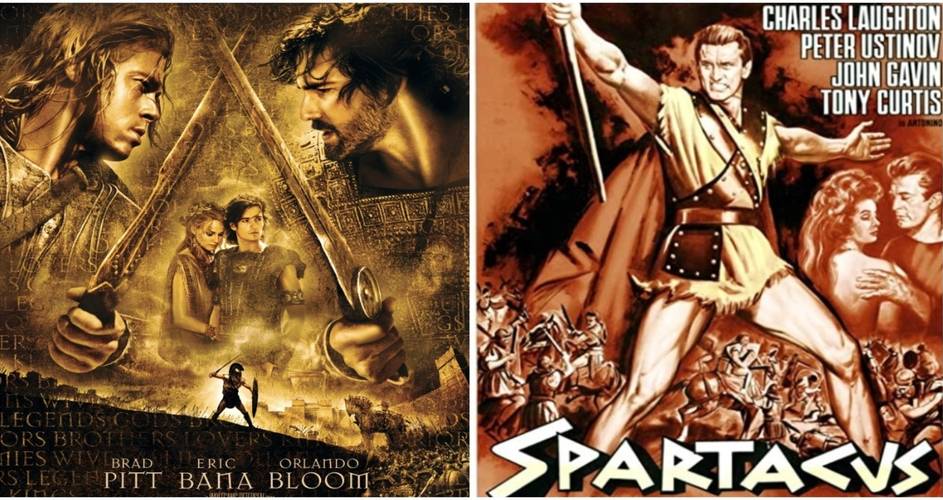
8 - Troy (2004)
Brad Pitt stars as Achilles, the legendary warrior, son of Goddess Thetis and mortal king Peleus, in his toils as the best warrior of the Greeks, but a man knowingly destined to die in battle and achieve eternal fame.

He and his Myrmidon warriors are part of Agamemnon’s expedition to conquer Troy, the City of the Sun. Achilles’s love for Briseis, a Trojan noblewoman, along with his own ego, will clash against his (already frail) loyalty to Agamemnon, in this film where worlds collide.

7 - Agora (2009)
Rachel Weisz stars as Hypatia, the famous female Greek philosopher, mathematician, and prominent member of the Neoplatonic school who teaches in the Platonic Academy in Alexandria during the 4th century AD. She is deeply devoted to science and rejects the advances of many a man that falls for her.

Meanwhile, she finds herself in the middle of civil unrest in the city and the violent clashes between Pagans and Christians, as the old and the new religion collide in moments that will define the rest of history.

6 - 300 (2006)
Based on the gritty graphic novel by Frank Miller, this film, by Zack Snyder, follows Leonidas (Gerard Butler) and his 300 warriors as they march against all odds to fight off the Persian invaders and their King, Xerxes.

Leonidas has to lead his brave warriors in a battle that might as well be lost already in front of the vast numbers of the Persian armies, while back home in Sparta, betrayal and conspiracies are brewing. The film captures the ancient Spartan philosophy of unison and hardness, and their battle-oriented culture, while the noir and gory aesthetic elevate it to a whole new level.

5 - Spartacus (1960)
The legendary actors Kirk Douglas and Lawrence Olivier star in Stanley Kubrick’s epic tale of hardship, enslavement, and rebellion. Spartacus, a Greek (Thracian) slave to the Roman Republic, is sentenced to death due to insubordination, but spared because Lentulus Batiatus buys him, seeing a potential gladiator in him.

Spartacus falls in love with Varinia, a slave woman, and leads a rebellion that takes Rome and its prefectures by storm, freeing people and trying to find a way to lead them all to their homes. Unfortunately, in the midst of panic from the ever-growing army of freed slaves, Rome falls under tyranny and Spartacus’s rebellion is short-lived, however, on a hopeful note, he leaves a son behind: a free boy that will grow to tell his father’s story.

4 - Iphigenia (1977)
This film was part of Michael Cacoyannis’s “Greek Tragedy” trilogy, along with The Trojan Women (next on our list) and Electra. Agamemnon, King of Argos, had gathered a vast Greek expeditionary army on the coasts of Aulis that he intended to take to Troy in order to retrieve his brother's wife, but the opposing winds prevent the ships from sailing for a long time.

Agamemnon lets the restless men slay and eat sheep that belong to Artemis’s temple. In the subsequent havoc, Artemis' sacred deer is unintentionally killed. Calchas, the high priest of Artemis' temple, is enraged by the blasphemy and says that furious Artemis will calm the winds (letting the Greeks sail) on one condition: they must sacrifice the young daughter of Agamemnon, Iphigenia.

3 - The Trojan Women (1971)
Legends of cinema Katharine Hepburn and Vanessa Redgrave star in this film by Cacoyannis that is based on the homonymous ancient Greek tragedy by Euripides.

The film follows the various noblewomen of Troy (Hecuba, Andromache, Cassandra, and Helen) after its sack, each one with her own personal tragedies and fears, all of them collectively worried about their future and the ultimate fate of Troy, as they are surrounded by death and ruins. This was the second in Cacoyannis’s “Greek Tragedy” trilogy.

2 - Jason And The Argonauts (1963)
The fabled Greek hero Jason guides a team of courageous voyagers in a dangerous search for the legendary Golden Fleece. Jason has been foretold to seize back the throne of Thessaly, as he is (unbeknownst to himself) the true heir.

When he keeps Pelias from dying, but does not identify him as the usurper of his father’s throne, Pelias rushes Jason to go to Colchis to find the Golden Fleece. Jason gathers a maritime crew of the best men in Greece (including Hercules) and they depart under the guard of Hera, queen of the Gods, as their expedition abounds with fights against harpies, the bronze giant Talos, a hydra, and many more obstacles.

1 - Ulysses (1954)
This Italian swords-and-sandals epic stars Kirk Douglas and Anthony Quinn and follows the adventures of Ulysses, king of Ithaca and one of the Greek generals at the Trojan War, as he desperately tries to return to his homeland (following the Odyssey quite faithfully).

During the sack of Troy, he and his men desecrated the temple of Poseidon and as punishment, he threw many obstacles on the path of their return. After many a tribulation, Ulysses finds himself an amnesiac on the island of Phaeacia and falls for princess Nausicaa. However, when his memory is stirred, he must find the courage to return home and face a wife and son he hasn’t seen in 20 years.

I love knowing how far Hellenic mythology and the Gods still reach and how they impact our lives without us even being aware of it. Today, I want to present you with a list of the Hellenic influence on the names of chemical elements--either through mythology or simply through language.


Argon (Ar) From the Greek word "argos" which means idle or lazy. Argon is one of the laziest, least reactive elements of all. There are also many mythological figures named "Argos", but those are not whom the element was named after.

Bromine (Br) - From the Greek word "bromos" which means stench. Bromine has an unpleasant smell.

Chlorine (Cl) From the Greek word "chloros" which means green. Chlorine is a green gas.

Helium (He) - Named after the God Helios. In 1868, during an eclipse of the Sun, scientists observed a spectral line caused by an unknown element. They named the element Helium. Twenty seven years later, in 1895, the element was discovered on Earth.

Hydrogen (H) - From the Greek words "hydro" and "genes" which mean water and forming. When hydrogen burns in the air, it forms water.

Iodine (I) - From the Greek word "iodos" which means violet. Iodine is a grey solid at room temperature. It gives off a violet colored vapor when warmed.

Niobium (Nb) - It is a soft, grey, ductile transition metal, which is often found in the pyrochlore mineral, the main commercial source for niobium, and columbite. Its name comes from Niobe, daughter of Tantalus, the namesake of tantalum (see below). The name reflects the great similarity between the two elements in their physical and chemical properties, making them difficult to distinguish.

Oxygen (O) - From the Greek words "oxy" and "genes" meaning acid forming. Most non-metals burn in oxygen to form acids eg. sulphur.

Phosphorous (P) - From the Greek word "phosphorus" which means "light bearing". It was also the ancient name for the planet Venus, usually the brightest "star" in the night sky. Phosphorous glows in the dark and catches fire in the air to give a bright flame.

Tantalum (Ta) - Named after King Tantalos. It was discovered in 1802 and great difficulties were encountered in dissolving its oxide in acid to form salts, which is most likely how it got its name--King Tantalos was imprisoned in Tartaros for serving the son he murdered to the Gods when They came to dinner. Tantalos' punishment for his actions was to stand in a pool of water beneath a fruit tree with low branches. Whenever he reached for the fruit, the branches raised his intended meal from his grasp. Whenever he bent down to get a drink, the water receded before he could get any. 

Titanium (Ti) - Named after Titans, members of the second generation of divine beings, descending from the primordial deities and preceding the Olympian deities. They are giant deities of incredible strength. Titanium is an extremely strong metal which resists attack by acids.

 Acknowledging the current need for their widespread use, The Greek Ministry of Culture is now marketing fabric facemasks inspired by Ancient Greece so that citizens can stay protected from Covid-19 — while promoting Greek history.


According to an announcement by the Ministry of Culture and Sports, 

"The new data imposed by the Covid-19 pandemic, they brought protective masks into our daily lives. No one can say for sure how much longer we will need to move around wearing them. However, it is not necessary for the mask to refer to a clinical picture. In the context of adapting its operation to the new conditions created by the outbreak of the pandemic and taking into account the fact that the use of the protective mask is now a necessity for citizens, as a basic means of individual and collective protection.

The masks, which are of high quality standards and aesthetics, are available from the TAP stores to the public who visit the Archaeological Sites and the Archaeological Museums of the country. The sale price is 5 euros, while from the first days that they started to be available from the TAP stores, the masks are one of the best-selling items."

The fashionable masks come in seven different high-quality fabrics, all inspired by objects found in Greece’s many archaeological museums or sites.


The designs depicted on the masks

Design inspired by animal-shaped figurines-votive offerings 8th-7th century BC. (Archaeological Museum of Olympia).

Design inspired by animal-shaped figurines-votive offerings 8th-7th century BC. (Archaeological Museum of Olympia).

Design inspired by the Disk of Phaistos 1700-1550 BC. (Archaeological Museum of Heraklion).

Design inspired by the Disk of Phaistos 1700-1550 BC. (Archaeological Museum of Heraklion).

Early Byzantine mosaic floor with ducks Early 6th century AD. (Archaeological Museum of Delphi).

Design inspired by Cycladic marble figurines 2700-2300 BC.

"Beehive" Minoan gold jewelry, 18th century BC. (Archaeological Museum of Heraklion).

Sooooo, who can I pay to get me some of these, hm? 

The Epidauria was a festival of Asklepios placed smack in the middle of the Mysteries--exactly six months after the other major festival of Asklepios in Athens: the one during the Greater Dionysia. The day was named after Asklepios' healing centre to the south at Epidauros. It was said that on this day, the cult of Asklepios and Hygeia joined the Eleusinian Mysteries rites in Athens.


What, exactly, happened during the Epidauria is unclear as discussing the rites that took place at Eleusis carried a death sentence, but I think we can safely say that the rites at Eleusis involving Asklepios were most likely similar to the rites to Asklepios that took place at other places--including Epidauros. What we do know is that the evening rites of sacrifices were held at Demeter’s Eleusinion temple in Athens to honor Asklepios, His daughter Hygeia, and Demeter and Persephone, who also were revered as healing deities. Special blessings were invoked for doctors and healers, and perhaps healing practices were offered at Demeter’s Eleusinion temple.

Then started the part that we have to guestimate by way of other practices involving Asklepios. Asklepios' worship almost always included a 'night watch'; a night time period of meditation and contemplation at a temple to Asklepios; the Asklepion. During the Mysteries, the initiates would most likely sit, contemplate, and cleanse themselves of ailments, distress, and anything that might distract them form the proceedings to follow. The temple of Asklepios was built near the enclosure of a sacred spring in a small cave and it included an abaton, a sleeping hall sacred to Asklepios where initiates could sleep while watched over by priests of Asklepios who prayed to Asklepios to visit these initiates in their sleep and give them messages intended to heal and cleanse. The following morning, initiates would tell their dream to a priest of Asklepios or Hygeia, called 'therapeutes'. The initiate would then be encouraged to put the advice he or she had gotten into practice.

The Epidauria took place as a preparatory intermezzo: afterwards, the initiates were cleaned and focused, ready to be drawn further into the Mysteries. As these proceedings took place late at night, a certain lack of sleep might also occur, leaving the initiates more susceptible to the coming proceedings. Whatever the case, the initiates would soon be enveloped in the hectic but highly ritualized proceedings of the Mysteries, and likely feel far more ready--and worthy--to face them.

In Athens, a separate ritual took place. The night of the 18th may have been spent by the very devout in sleeping in the Temple of Aesculapius, southwest of the Acropolis, or in the Iaccheum, also called the Temple of Demeter. It was just where the road from the Piraeus entered Athens. The early morning of that day till about 9 a.m. was devoted to ordinary business, as we find decrees issued bearing that date. After this hour the Epidauria was celebrated in the Temple of Demeter or Iacchus and in the Temple of Aesculapius.

For those who have decided to join the Eleusinian Mysteries, both a night watch and the daytime ritual are included in the rituals provided. For those not participating, a separate ritual will be held on the 18th of Boedromion, which is on the 6th of September this year. You can find this separate ritual here and join the community here.

Monuments at Greece's archaeological site of Mycenae have not been damaged by a wildfire that swept through the area, despite the blackening from smoke on the iconic entrance to the ancient citadel, Greece's culture minister said Monday. Four water-dropping planes and two helicopters helped dozens of firefighters contain the blaze Sunday after it reached the fringes of one of Greece's most important archaeological sites, 120 kilometers (75 miles) southwest of Athens.


The Bronze Age fortified city, whose rulers were key figures in ancient Greek legend, including the Trojan War, flourished centuries before the major Acropolis temples were built in Athens and was a major center of Mediterranean civilization.

Smoke from the flames blackened the 3,250-year-old Lion Gate, named after the monumental relief sculpture of two heraldic lions flanking a pillar that crowns the entrance to the ancient citadel.

"The damage caused by yesterday's fire was the least possible," Culture Minister Lina Mendoni said during a visit to the site Monday, adding that none of the site's monuments or the Mycenae museum had suffered any damage. 

"Smoke blackened some walls. The problem is (only) aesthetic. The Fire Service acted swiftly ... and prevention measures worked: Dry vegetation had all been cleared away. That's what saved the monuments."

A spokesman for Greece's main political opposition, the left-wing Syriza party, questioned the speed of the response by the Fire Service, noting that the fire had entered the site. The party said it was carrying out a separate inspection Monday and called on the minister to apologize for downplaying the damage.

Mycenae has been closed to visitors but the Culture Ministry said it will reopen Tuesday.

The Greater Eleusinian Mysteries are upon us again, so it's time for the Masterpost to come back. Of all the mysteries celebrated in ancient times, the mysteries at Eleusis are assumed to be of great importance to a large portion of the ancient Hellenes. The cult itself likely has origins dating back to the Mycenean period of around 1600 to 1100 BC and it is believed that the cult of Demeter Herself was established in 1500 BC. 

The Eleusinian mysteries (Ἐλευσίνια Μυστήρια) had festivals throughout the year, which were tied to agriculture through Demeter's refusal to perform her duties as an agricultural Theia while her daughter Persephone is with Hades, and to the afterlife and Underworld through Persephone's return to the surface of the earth after Her mandatory stay with Hades has ended. Initiation ceremonies were held every year at Eleusis. The Mysteries were mysteries for a reason and revealing information of these involved rituals carried the punishment of death (or at least, that is what the ancient sources say). We still have been able to piece together quite a bit of information however, and I would like to create a masterpost of sorts.


Mythological connections and sources of the Mysteries:
- The Eleusinian Mysteries 
A short introduction to the Mysteries, which includes the mythological reason for the festival and the rewards for being initiated.
- On Persephone and Spring 
A writer's perspective on the myth of Persephone's abduction. 
- Iakkos 
The personification of the ritual cry of joy called ‘iakhe’ of the procession of the initiates. 
- On 'Kore' versus 'Persephone' 
...and why They are not always the same.


Eleusinian festivals:
A summary of the festivals included in the cycle of the Mysteries. It also includes a description of the way the days of the Mysteries would have been spent--as well as we can gather about a mystery tradition, of course. The cycle consists of: the Greater Mysteries (13-23 Boedromion), Proerosia (6 Pyanepsion), Stenia (9 Pyanepsion), Thesmophoria (11-13 Pyanepsion), Haloa (26 Poseideon), the Lesser Mysteries (20-26 Anthesterion), and the Skiraphoria (12 Skirophorion). These are placed in sequence of the Athenian year. Also linked to the Mysteries because they fall during either the Lesser of Greater Mysteries: the Diasia and the Epidauria.


Periferal points of interest connected to the Mysteries:
- On attending women-only festivals as a male
Some of the eleusinian rites are women-only. Can you attend as a male?
- On attending women-only festivals as non-binary
Some of the eleusinian rites are women-only. Can you attend if you identify as non-binary?
- On maidens, the Stenia and the Thesmophoria 
On attending women-only festivals as an unmarried woman.
- On the binding of hair 
As part of Eleusinian ritual.
- Dadoukhoi: torch bearers 
On the importance of torches and torch bearers in the Eleusinian Mysteries.
- The ancient tradition of Martes 
Martes were pieces of string, worn around the wrist. The innitiates of the Mysteries recieved yellow ones on the way to Eleusis.
- On ending the Mysteries
On why the ending rites of the Mysteries matters.
- On fasting for the Eleusinian Mysteries
Fasting is a part of the Greater Mysteries as well as the Thesmophoria. Here is how to do it safely.
- On the forbidden foods of the Eleusinian Mysteries 
Some things not to eat during these days.
- On the 'hiera' of the Eleusinian Mysteries
The heira are the 'sacred objects'.
- On kykeon 
A barley beverage sacred to Demeter and used to break a sacred fast within the Eleusinian Mysteries as well as in preparatory rites for some of the most sacred--and secret--rites within Eleusis. 
- Pelanoi, the cakes of the Athenians 
Athenian sacrifical cakes that were often used in the Lesser mysteries.
- Snakes, the ancient Hellenes and the Eleusinian Mysteries 
Snakes were used in the Lesser Mystery rites. Why?

 As a basic viewpoint, Elaion believes that the Mysteries need not be pursued; they are not a spiritual ‘formula’ that experimentation will eventually rediscover. That said, we also acknowledge that it's a festival many have been drawn to--both then and now--and we want to give our members a chance to celebrate it in a way that is as Recon as possible once you accept that we know far too little about it to ever accurately be so. Since the proceedings of the Eleusinian Mysteries were kept secret in fear of the punishment of death, we will never be able to restore these rites. But we do know a few basics and we have formulated our celebration accordingly. Please read through all information as well as the rituals before deciding to join.


The Eleusinian Mysteries (Ἐλευσίνια Μυστήρια) had festivals throughout the year, which were tied to agriculture through Demeter's refusal to perform her duties as an agricultural Goddess while her daughter Persephone is with Hades, and to the afterlife and Underworld through Persephone's return to the surface of the earth after Her mandatory stay with Hades has ended. Initiation ceremonies were held every year at Eleusis. Of all the mysteries celebrated in ancient times, the mysteries at Eleusis were assumed to be of great importance to a large portion of the ancient Hellenes. The cult itself likely had origins dating back to the Mycenean period of around 1600 to 1100 BC, and it is believed that the cult of Demeter Herself was established in 1500 BC.

The Eleusinian Mysteries consist mostly of two festivals, but the worship of Demeter and Persephone consist of a cycle of seven festivals: the Greater Mysteries (13-23 Boedromion), the Proerosia (6 Pyanepsion), the Stenia (9 Pyanepsion), the Thesmophoria (11-13 Pyanepsion), the Haloa (26 Poseideon), the Lesser Mysteries (20-26 Anthesterion), and the Skiraphoria (12 Skirophorion). These are placed in sequence of the Athenian year.

Mythologically, the foundations of the Eleusinian Mysteries can be found in the Homeric Hymn to Demeter. Within the hymn, Demeter travels the globe in her grief over losing Her daughter. She eventually settles at the home of Keleus. Demeter plans to make one of his sons immortal in return for his hospitality but She is interrupted. Instead, she tells Keleus to build Her a temple and altar so she can teach human beings the knowledge they need to have a good life.

The Mysteries were obviously celebrated to honor Demeter--Demeter Eleusinia, specifically. Through the honoring of Demeter, the ancient Hellenes prayed for a good harvest, and through the worship of Persephone--Kore--those who were initiated in the Mysteries assured they would be looked upon favorably in the Afterlife.

For those who wish to join us, the Eleusinian Mysteries will be a ten day event, starting on September 3rd with a rite meant to emulate the walk to Eleusis from Athens that all initiates eventually undertook. The procession would have started from the shine of Iakkhos, and Iakkhos was invited to come along to Eleusis by those in the procession. The mystai would sacrifice at all shrines along the way. The mystai would arrive in darkness, or at least guided by torchlight, as Demeter searched for Her daughter with a torch in hand. Upon arrival, sacrifices were made to Demeter. After undertaking this rite, we encourage everyone articipating to put on a króki. Króki were pieces of string (wool), worn around the wrist. The initiates of the Mysteries recieved yellow ones on the way to Eleusis.

For the continuation of the days, you can make daily sacrifices to Demeter and Persephone, as laid out in the rituals provided. All have a different character and different steps to undertake so reading through them ahead of time is quite important. While not mandatory, we also encourage those who join to potentially limit or cut out their intake of pomegranates, apples, eggs, fowls, and fish as the ancient Hellenes would have done for the duration of the Mysteries.

Then, we have prepared a rite for the Epidauria. The Epidauria was a festival of Asklepios placed smack in the middle of the Mysteries--exactly six months after the other major festival of Asklepios in Athens: the one during the Greater Dionysia. The day was named after Asklepios healing centre to the south at Epidauros. It was said that on this day, the cult of Asklepios and Hygeia joined the Eleusinian Mysteries rites in Athens.

What, exactly, happened during the Epidauria is unclear as discussing the rites that took place at Eleusis  carried a death sentence, but I think we can safely say that the rites at Eleusis involving Asklepios were most likely similar to the rites to Asklepios that took place at other places--including Epidauros. What we do know is that the rites of sacrifices were held at Demeter’s Eleusinion temple in Athens to honour Asklepios, His daughter Hygeia, and Demeter and Persephone, who also were revered as healing deities.

Asklepios' worship almost always included a 'night watch'; a night time period of meditation and contemplation at a temple to Asklepios; the Asklepion. the initiates would most likely sit, contemplate, and cleanse themselves of ailments, distress, and anything that might distract them form the proceedings to follow. The temple of Asklepios was built near the enclosure of a sacred spring in a small cave and it included an abaton, a sleeping hall sacred to Asklepios where initiates could sleep while watched over by priests of Asklepios who prayed to Asklepios to visit these initiates in their sleep and give them messages intended to heal and cleanse. The following morning, initiates would tell their dream to a priest of Asklepios or Hygeia, called 'therapeutes'. The initiate would then be encouraged to put the advice he or she had gotten into practice. We ask you to take part in this night time practice and follow it up with sacrifices to Asklepios and His daughter the day after.

The day after the epidauria was the day the initiates would have traveled to Eleusis. We moved this to the start as a way to introduce you to the Mysteries themselves, but for the ancient Hellenes, this was a walk that ended in darkness, with a torch lit procession to the shrine of Demeter and an offering that was not burned but buried. In the case of the ancient Hellenes, this was most likely a pig but we leave it to you what you want to offer to the Goddess.

We can say with a relative degree of certainty, that the day before the actual initiation was a day on which the initiates fasted in preparation of the main initiatory rite that took place in the nighttime hours of the next day. If you wish to join us for that fast, we would encourage you to stop eating at dusk on 6 September and consume nothing but water (or juice, if you need to!) until after the main rite that takes place after dusk on 7 September, once it's completely dark out.

While the Eleusinian Mysteries were held largely out of gratitude for the agricultural knowledge provided to us by Demeter, the ancient Hellenes became initiates for an entirely different reason: to be looked more favourably upon by the Theoi in death. Through the worship of Demeter and Persephone, participants hoped that Persephone would talk to Her Husband and the Judges of the dead. It is this focus that all rituals have: the rites of being initiated into the Mysteries in order to be well taken care of after death.

After the main initiatory right, the festival winded down. It's quite possible the initiated didn't sleep throughout the night of their initiation and the attested sacrifice to Demeter and Persephone the next day, we feel, was most likely done at dusk. Feel free to hold it at the standard PAT ritual time of 10 AM EDT, though. the focus of this sacrifice was the complete tipping out of two jugs of water onto the eath by the initiated, one to Demeter and one to Persephone, most likely in gratitude of the experience and knowledge gleamed the previous night.

The following day, we are unsure of what happened, exactly, but we take it to be a resting day and have prepared a simple rite to the Theoi for it. Day nine is another, general, rite, but we encourage you--as the initiated were--to add prayers and hymns to the Theoi you feel closest to to it with the goal of reestablishing the connection with Them after being so immersed in rites with a Kthonic character.

On the final day, we have prepared a closing rite which thanks the Theoi for guiding you on this journey and has you take off the króki you tied around your wrist on the first day. This will signal the end of the Mysteries.

To make things easier, we have laid out a time table:

  • September 3 / 15 Boedromion: starting ritual 
  • September 4 / 16 Boedromion: purification rite
  • September 5 / 17 & 18 Boedromion: sacrifices to Demeter and Persephone / prayers to Asklepios for prophetic dreams and healing (nighttime)
  • September 6 / 18 Boedromion: Epidauria ritual
  • September 6 / 19 Boedromion: sacrifices to Demeter (nighttime) (fasting day)
  • September 7 / 20 Boedromion: initiation rite (nighttime) 
  • September 8 / 20 Boedromion: tipping out of water jugs to Demeter and Persephone
  • September 9 / 21 Boedromion: sacrifices to Demeter and Persephone 
  • September 10 / 22 Boedromion: sacrifices to Demeter and Persephone + personal sacrifices
  • September 11 / 23 Boedromion: closing rite

  • We truly hope you will join us for this event. You can share your experience with the community here and all rituals can be found here. Note, these are ALL rituals, eleven of them in total. One for every day, plus one extra. Read the explanation above and see the schedule for clarification. It is highly encouraged you read through them all before the Mysteries start! We are very excited about the opportunity of offering this experience to you and we hope you will find a glimmer of what the ancient Hellenes might have experienced during the most anticipated days of the year.