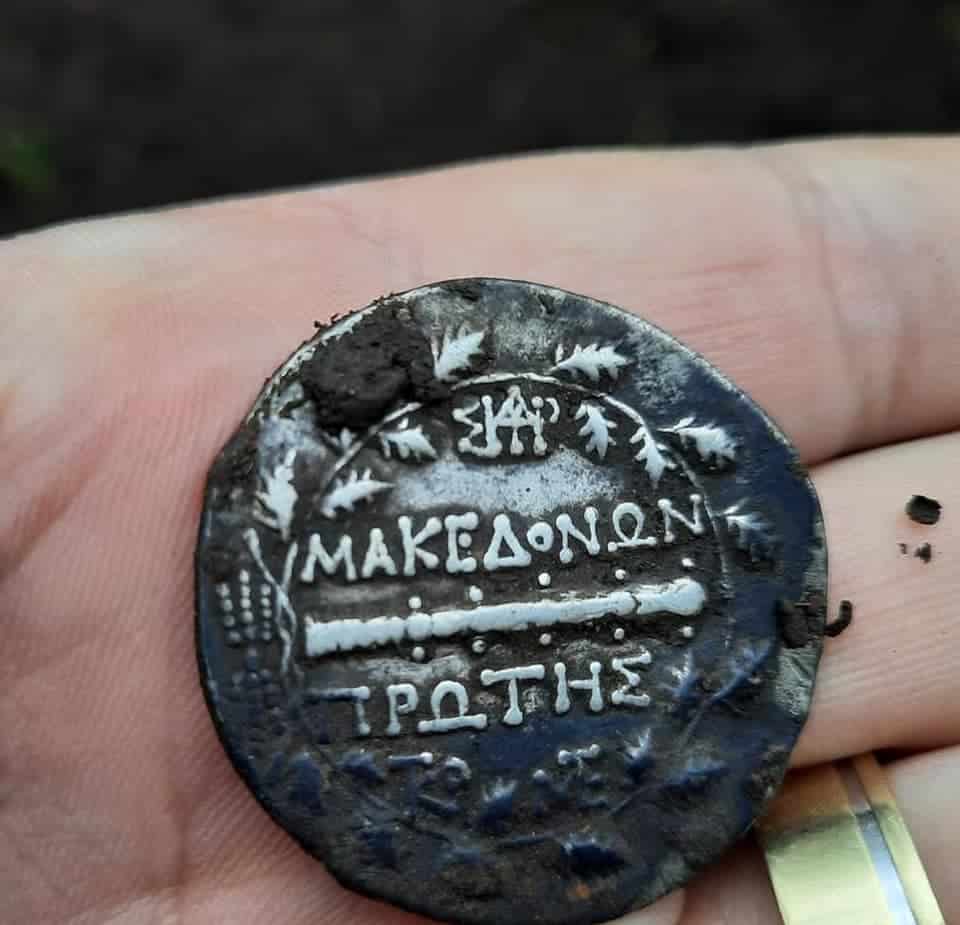
68 Ancient Greek silver coins were discovered two days ago by a retired police officer in the Romanian village of Radomirești, 120km west of Bucharest and 40km north of the Bulgarian border.

They bear the inscription “MAKEDONON FIRST” and are perfectly decorated with oak branches, Infognomon reported.

The silver coins were handed over to the police department and will be sent to the Ministry of Culture to have the authentication verified and time of minting.

This kind of coins is already on display at the Amphipolis Archaeological Museum in Greece.

 I get a lot of questions from readers, and most of the time, the answers are fairly short. When I feel the question or the reply would be valuable to others as well, I make a post with a collection of them and post them in one go. Today is one of those posts.


"Do you believe that Ancient Greek should be learned or at least studied? There's conflicting opinions amongst people who consider themselves Greek Reconstructionists."

The short answer is 'yes', but I will tell you right away that I haven't yet invested the time. It's a matter of convenience--I already have so many projects that I simply would not know where to find the time--and avoidance because I am terrible at learning languages. I have years and years of built up high school frustration from taking German and French language courses and ultimately failing them both. I swear to the Gods that I only learned English because I was a hard-core 'Buffy: The Vampire Slayer'-fan and I quoted entire episodes.

It's not mandatory in Hellenismos to speak (ancient) Greek but I would love to be able to read the hymns, myths and plays I base my practice on in their original language and form. Translations are lovely but there is always artistic freedom. Besides, for me, it's the language of the Gods. I believe it should be studied as a way to get closer to Them. Of course, to each their own; I just know it's on my to-do list.


"Can I offer one libation to more than one god? Like, I don't know, a shared libation or something?"

The ancient Hellenes very rarely gave sacrifice to just one God at a time. The big sacrifices were usually an animal and since animals are expensive and sacrifice establish kharis between the devotee and the God, it just makes sense to honour more that one God with one sacrifice. Beyond that, the ancient Hellenes were vary aware that they were worshipping a pantheon of Gods, not just loose entities thrown together; Apollon was worshipped with His sister and mother, and it was always prudent to worship Hestia and Zeus, and if you give sacrifice to Zeus you really should also give sacrifice to Hera because there may be tension with her otherwise because you are worshipping Zeus'  illegitimate child with another woman, etc. The main goal may have been to give sacrifice to Apollon, but there are many Gods connected to Him either through genealogy or function.

Say, for example, that you were giving sacrifice to Apollon for health, you would naturally include Asklēpiós and His daughters as well, and Hestia and Zeus, of course, and then Hera as well, maybe, and onwards. During animal sacrifice, hymns and prayers were given to each God in turn before, during, and after the sacrifice burned. It's fairly the same with libations: the Gods worshipped were also grouped and they were called on and prayed to in turn. Each one got a little pouring out of liquid. So yes, you can definitely give libations to more than one God during the same ritual. In fact, it's expected.


"Hi, I was just wondering if there was a different way to work with a patron in comparison with who you devote yourself to? Is there different way of doing rituals etc. Thank you for taking the time to read my ask :)"

So, I would love to answer your question, but I don't know how. Personally, I don't believe in personal patronism in Traditional Hellenism--which is the branch I subscribe to. Now, I don't have anything against it as a practice, it's just not Traditional. I wrote about the how's and why's of personal and professional patronism (more aptly named 'tutelage') on my blog a while back, which might be an interesting read. To summarize, modern patronage, in this context, is the support or encouragement of a patron, where the patron or patroness is a divine being. In these relationships, the active party is often the deity in question, who claims the passive human. Some will describe a sense of 'being owned' by their patron. The human becomes a conduit for the work and will of the patron in question, and is required to spend large portions of their lives in active service to that deity.

In ancient Hellas, there were priests; most of them were chosen through hereditary lines and often served short terms in the temple of a deity their family was connected to, either through the family line or by choice. There were also priests who chose to come into the service of a God; they were voluntary priests and they devoted themselves to the God(s) they were drawn to or especially thankful to. Neither type of priest would have worshipped only the deity they were in service to, and all would have attended state festivals, and most likely had a household practice that included a large number of deities. Note that the active party in these relationships is the human, not the deity in question.

Modern patronage is a beautiful thing and if you feel you have been claimed by a God or Goddess, then go for it. I am just not the right person to give you advice. Perhaps someone who reads this might have that for you and add a comment. Be well!

On the day of the Hene kai Nea, I post a monthly update about things that happened on the blog and in projects and organizations related to it. I will also announce Elaion's coming PAT rituals.


Statistics:
PAT rituals for Elaphebolion:
  • Elaphebolion 6 - March 20 - Elaphebolia - festival in honor of Artemis
  • Elaphebolion 8 - March 22 - Asklepieia - festival in honor of Asklēpiós
  • Elaphebolion 10-17 - March 24 - 31 - Greater (City) Dionysia in honor of Dionysos
  • Elaphebolion 16 - March 11 - Sacrifice to Semele and Dionysos at Erkhia
  • Elaphebolion 17 - April 7 - Pandia - festival in honor of Zeus, following the Greater Dionysia
  • Elaphebolion 14 - April 8 - Galaxia - festival in honor of the Mother of the Gods (Rhea), Kronos, Zeus and Hera

Anything else?
Are you looking for an online shop to buy incenses and other Hellenistic basics from? Try The Hellenic Handmaid on Etsy.

Would you like to support me? Buy me a coffee.

From 4 to 21 September 2020, the Ephorate of Underwater Antiquities carried out systematic underwater archaeological research off Kythira of the historic shipwreck “Mentor”, headed by archaeologist Dr. Dimitris Kourkoumelis. During this year’s research, the trench opened in 2019 at the western tip of the ship’s surviving hull continued being investigated and excavated. 

A lot of timber was discovered in the trench both from the ship’s hull, and parts of the frames. These parts were randomly scattered, evidence of the total destruction that took place at the shipwreck’s site both at the time of its sinking and during the subsequent shipwreck stages. The picture of the ship’s catastrophe was particularly unsettling, with parts of the frames found trapped under rocks, indicative of the intensity of the swell in the region caused mainly by south winds affecting the seabed at a great depth.

Found at the trench site, just as in the previous 2019 excavation season, was a significant number of wooden and metal objects mainly related to the rigging of one or two of the ship’s masts. Wooden blocks used to raise the main sail’s halyard up the mast, wooden blocks to prevent the coiling of ropes, wooden cleats for tying ropes, single or double pulleys of various sizes, some of which still retain parts of their mooring ropes (to date, 35 pulleys, intact or in pieces, have been hoisted up from the shipwreck, out of a total of 120 required for the rigging of a ship the size of the Mentor). 

All in all, results from the research confirm that the excavated site corresponds to that of one of the ship’s two masts (the Mentor being a two masted brigg) and probably that of the stern, since some of the wooden components are connected with the rigging of the mast’s halyard. Moreover, during this year’s research, it became possible to hoist up two sections of the ship’s frames and photograph them in 3D. The frames were not in their original position having been moved when the ship was shattered and after being photographed they were replaced in the trench.

The other movable finds that were hoisted were also particularly interesting. Parts of leather shoes and buckles were located for the first time, as well as items such as a small coin / token used mainly in card games. It is known from the testimonies of both crew and passengers that during the accident they lost all personal belongings, including their clothes. This has been confirmed by the findings of this year’s excavation. In addition to the above, various other small items were hoisted up, such as two chess pieces (in previous years another six had been found, probably from the same set), coins and fragments of cooking utensils.

Participating in the 2020 underwater research were a total of 18 people of various specialties and scientific expertise; archaeologists, marine biologists, diving instructors, surveyors / engineers, antiquity conservationists and seabed equipment technicians. 

When a whole family gets uplifted into the sky, the breakdown of their constellations gets a little repetitive over time, sorry about that. When we last saw the Aethiopia ruling family, we discussed the constellations Androméda and Cassiopeia. Today, we close the trilogy with Capheus, father of Andromeda, and husband to Cassiopeia, and add a good bit of info to the myth.

Cepheus was king of Aethiopia when he heard his wife Cassiopeia boast that her daughter was more beautiful than the Nereids. Shocked, he tried to silence his wife, but it was too late. The father of the Nereids, the sea God Nereus, heard Cassiopeia's prideful boast and brought his grievance to Poseidon. Poseidon ruled in favor of Nereus and sent Cetus, a huge sea monster, to ravage the coasts of Aethiopia. It destroyed villages, kept fishermen off of the sea and caused huge floods that killed hundreds at a time. A cry went up from the people for Cepheus to remedy the situation and to appease the Gods. Cepheus, desperate, traveled to the oracle of Apollon (or Zeus) to hear how he could solve the suffering of his people. The Oracle told him that Nereus would only be appeased when he sacrificed his daughter to Cetus.

Stricken with grief, Cepheus raised his hands to the sky--the position he was immortalized in--and prayed for another resolve of the situation that would not lead to the death of his much beloved daughter. The Theoi, however, remained silent. Cepheus resisted the oracle's message as long as he could, but eventually, the anguish of his people became too much for a king to withstand. In other versions of the myth, Androméda (like Iphigeneia) offered herself up to be sacrificed, as she realized her life was not worth the lives of all those who were dying now.

Androméda was chained to the cliffs near the palace, and awaited her faith there, while both Cepheus and Cassiopeia looked on with immense sadness. Thankfully, Androméda was rescued from her fate by Perseus, on his way back from defeating Médousa. King Cepheus hosted a huge wedding banquet at his palace to celebrate the wedding. There was one problem, however: Androméda had already been promised to Phineus, Cepheus' brother. While the celebrations were in progress, Phineus and his followers bursted in, demanding that Androméda be handed over, which Cepheus refused to do--too grateful to Perseus for rescuing his daughter from certain death. Ovid has described the battle that ensued in the Metamorphoses, but before the battle begins, we first get a speech by Cepheus to his brother, who begs him to let his claim to Androméda go:

"Hold, brother, hold; what brutal rage has made your frantick mind so black a crime conceive? 
Are these the thanks that you to Perseus give? This the reward that to his worth you pay, whose timely valour sav'd Andromeda? Nor was it he, if you would reason right, that forc'd her from you, but the jealous spight of envious Nereids, and Jove's high decree; And that devouring monster of the sea, that ready with his jaws wide gaping stood to eat my child, the fairest of my blood. 

You lost her then, when she seem'd past relief, and wish'd perhaps her death, to ease your grief 
With my afflictions: not content to view Andromeda in chains, unhelp'd by you, her spouse, and uncle; 
will you grieve that he expos'd his life the dying maid to free? And shall you claim his merit? 
Had you thought her charms so great, you shou'd have bravely sought that blessing on the rocks, where fix'd she lay: but now let Perseus bear his prize away, by service gain'd, by promis'd faith possess'd; 
To him I owe it, that my age is bless'd still with a child."

Phineus refused to listen to reason, and threw a spear at Perseus, who barely managed to dodge it. After that, all hell broke loose. Perseus cut down many of his attackers, turning the remainder to stone by showing them the head of Médousa. Eventually, he hailed victorious, and got to carry off his bride. In doing so, he left Cassiopeia and her husband to the fate of Poseidon, who would still have His revenge. As such, He took both Cassiopeia and Cepheus up into the sky and placed them near each other in the heavens. Poseidon placed Cassiopeia close to the North Celestial Pole on her throne, spending half of her time clinging to it so she does not fall off. In old portraits of the constellation, she is seen as either tied to her throne--which most often resembles a torture device--or desperately clinging to it. Later on, she was depicted as holding a mirror (or palm leaf) to show her vanity. 

However, because Cepheus had nothing to do with Cassiopeia's original declaration, because he had done everything in his power to make things right afterwards, and he had plead his case to the Gods again and again, Cepheus was placed into the sky unchained--either regally on his throne or with his hands raised in pious prayer--and a little further away from the pole. He still circles it in punishment, but his position is a lot less precarious than that of his wife. 

The constellation Cepheus is visible at latitudes between +90° and −10°, and best visible at 21:00 (9 p.m.) during the month of November, the same as the constellations of his wife and daughter.

 The striking, nearly 5-foot tall Dipylon Amphora, from approximately 700 BC, is a masterpiece of the art of Ancient Greek pottery. Its exquisite painted exterior shows a funeral scene with wasp-waisted human and stylized animal figures alongside geometrical shapes and patterns. Discovered in Kerameikos, Athens at a gate called Dipylon at the entrance to an ancient cemetery there, the maker of this gigantic piece, along with all the others who created ancient Greek masterpieces of pottery, has always been assumed to be male. Indeed, the artisan here is always referred to by historians as the “Dipylon Master.” But what if the creator of this striking grave marker, and many other pieces of pottery, was actually female? Sarah Murray, a classical archaeologist from the University of Toronto, along with two of her undergraduate students, are questioning long-held beliefs in this arena.

They believe that not only did females participate in the making of artistic pottery but that they were primarily responsible for the creation of ceramics in the early Greek Iron Age, which lasted from 1050 BC to 700 BC. Unfortunately, there are no written records extant which date back to that era. Indeed, pottery itself serves as much of the historical record of these times in Greece. Murray says in a new article in the American Journal of Archaeology:

“Pottery is the anchor of everything we say about the society—but I think that’s problematic. No one had really thought that women were involved in making this pottery. There was no argument. It was just taken as the default.”

Indeed, most indisputable historical records from all the eras in Greek history show that it was for themes part a clearly male-dominated society. However, Murray and her team posit the theory that, due to huge societal shifts which took place between the preceding Bronze Age, which represented a high point in artistic expression of every kind in Greece, and the Iron, women may have taken on new roles and begun to create pottery as well.

The Iron Age differed from the previous era in many ways — there was a measurable drop in population from the previous Bronze Age, something which, Murray says, leads to women stepping into the breach and beginning to create pottery themselves.

This situation may not have continued into what is called the Archaic Age, with its rebound in population and the concomitant social classifications which accompanied it — but for this time period, it is entirely possible, according to Murray, that females put their mark on the Ancient Greek art of fine pottery.

Additionally, as seen on the Dipylon vase above, there is a sudden and marked emphasis on geometric patterns such as zigzags and diamonds, representing an enormous change from prior pottery decoration.

Murray believes that this may actually be a recreation of the geometric patterns used in weaving — which was purely a female art at the time. 

“The fact that the style seems to be inspired by textiles is kind of like the big, blaring horn. Women are almost always the weavers.”

The fact that the Dipylon vase itself portrays mourners is another tell for Murray, who explains that women always had played a huge role in funeral rituals, including preparing the bodies and even being professional mourners, roles which go across nearly all human civilizations.

Additionally, most Iron Age pottery carries motifs of women’s daily lives — weaving and doing other typically female chores. Later pottery from the Archaic period often was decorated with battle scenes and even poetry, retelling epic battles.

At the present time there is research being undertaken to closely examine pottery for impressions of the fingerprints of the ancient potters, which may shed light on the gender of the person who created the piece.

Julie Hruby, a classicist from Dartmouth College, is zeroing in on using this new technology to finally determine who these ancient potters might be, creating a new method for analyzing prints. She states 

“I would be surprised if I found fingerprint evidence that refuted what was in (Murray’s) article.”

In 2007, the crew of a Dutch ship crossing the Mediterranean Sea unearthed a well-preserved ancient Greek helmet near the Israeli city of Haifa. As required by local law, the dredging vessel’s owner promptly handed the find over to archaeologists from the Israel Antiquities Authority (IAA). Now, reports the Greek City Times, researchers have offered new insights on the object, which is the only intact helmet of its kind found along Israel’s coast.

Crafted in the sixth century B.C., the Corinthian armor was likely used during the Persian Wars, which pitted Greek city-states against the Persian Empire in a series of clashes between 492 and 449 B.C.  Kobi Sharvit, director of the IAA’s Marine Archaeology Unit, said in a statement:

“[It] probably belonged to a Greek warrior stationed on one of the warships of the Greek fleet that participated in the naval conflict against the Persians who ruled the country at the time.”

After spending 2,600 years on the seafloor, the helmet’s cracked surface is heavily rusted. But scholars could still discern a delicate, peacock-like pattern above its eyeholes. This unique design helped archaeologists determine that craftsmen made the armor in the Greek city-state of Corinth.

According to Ancient Origin’s Nathan Falde, metalworkers would have fashioned the piece to fit tightly around the head of a particular person—but not so tightly that it couldn’t be swiftly and safely removed in the heat of battle.

“The helmet was expertly fabricated from a single sheet of bronze by means of heating and hammering,” notes the statement. “This technique made it possible to reduce its weight without diminishing its capacity for protecting the head of a warrior.”

As Owen Jarus wrote for Live Science in 2012, archaeologists excavated a similar helmet near the Italian island of Giglio, which is about 1,500 miles from where the crew found the recently analyzed artifact, during the 1950s. That headgear—also around 2,600 years old—helped modern scholars determine when craftspeople manufactured the Haifa Bay armor.

Experts speculate that the headpiece’s owner was a wealthy individual, as most soldiers wouldn’t have been able to afford such elaborate gear. Sharvit and scholar John Hale stated in a research summary quoted by UPI:

“The gilding and figural ornaments make this one of the most ornate pieces of early Greek armor discovered.” 

One theory raised by researchers speculates that the helmet belonged to a mercenary who fought alongside the Egyptian Pharaoh Necho II, per the Express’ Sebastian Kettley. Another explanation posits that a Greek soldier stationed in the Mediterranean donned the headpiece, only to drop it into the water or lose it when his ship sank.

Though archaeologists aren’t sure exactly who owned the artifact, they do know that the warrior sailed the seas at a time when Persia controlled much of the Middle East. As Live Science’s Jarus explains in a more recent article, the Persians attempted to invade Greece around 490 B.C. but were defeated near Athens during the Battle of Marathon.

A second attack by the Persians culminated in the Battle of Thermopylae, which saw a heavily outnumbered group of Spartans led by King Leonidas mount a doomed last stand against Xerxes’ Persian forces. (The 480 B.C. clash is heavily dramatized in the film 300.) But while Thermopylae ended in a Greek loss, the tides of war soon turned, with the Greeks forcing the Persians out of the region the following year.

In the decades after the Persians’ failed invasions, the Greek military continued the fight by campaigning against enemy troops stationed in the eastern Mediterranean. Ancient Origins notes that the helmet’s owner was likely active during this later phase of the war—“when the Persians were often on the defensive” rather than offensive—and may have served on either a patrol ship or a battleship.