You might find yourself surprised that poetry came out of a warrior-heavy society like Sparta but actually, Sparta was renowned in its own time for its poetry, as well as its music and dance. Sadly, only fragments of these work have survived the centuries. The only Startan works of poetry that survive to form a relative whole are those of Tyrtaeus. Tyrtaeus (Τυρταῖος Tyrtaios) was an Hellenic lyric poet from Sparta who composed verses around the time of the Second Messenian War, the date of which isn't clearly established, but sometime in the latter part of the seventh century BC. He is known especially for political and military elegies, exhorting Spartans to support the state authorities and to fight bravely against the Messenians, who had temporarily succeeded in wresting their estates from Spartan control. 


Tyrtaeus was predominantly an elegiac poet. The three longest fragments of surviving verse (fr. 10–12) are complete or virtually complete poems describing the ideal warrior and the disgrace or glory that attends his personal choices. Critics these days say it's not particularly good poetry but I enjoy it none the less. What follows was a marching song, for the soldiers to keep pace as they set off for war. Imagine how impressive that would have been to behold, if you will!


"Ye are of the lineage of the invincible Heracles; so be ye of good cheer; not yet is the head of Zeus turned away. Fear ye not a multitude of men, nor flinch, but let every man hold his shield straight towards the van, making Life his enemy and the black Spirits of Death dear as the rays of the sun. For ye know the destroying deeds of lamentable Ares, and well have learnt the disposition of woeful War; ye have tasted both of the fleeing and the pursuing, lads, and had more than your fill of either.
 
Those who abiding shoulder go with a will into the mellay and the van, of these are fewer slain, these save the people afterward; as for them that turn to fear, all their valour is lost —no man could tell in words each and all the ills that befall a man if he once come to dishonour. For pleasant it is in dreadful warfare to pierce the midriff of a flying man, and disgraced is the dead that lieth in the dust with a spear-point in his back.
 
So let each man bite his lip and abide firm-set astride upon the ground, covering with the belly of his broad buckler thighs and legs below and breast and shoulders above; let him brandish the massy spear in his right hand, let him wave the dire crest upon his head; let him learn how to fight by doing doughty deeds, and not stand shield in hand beyond the missiles.
 
Nay, let each man close the foe, and with his own long spear, or else with his sword, wound and take an enemy, and setting foot beside foot, resting shield against shield, crest beside crest, helm beside helm, fight his man breast to breast with sword or long spear in hand. And ye also, ye light-armed, crouch ye on either hand beneath the shield and fling your great hurlstones and throw against them your smooth javelins, in your place beside the men of heavier armament." [CURFRAG.tlg-0266.7]

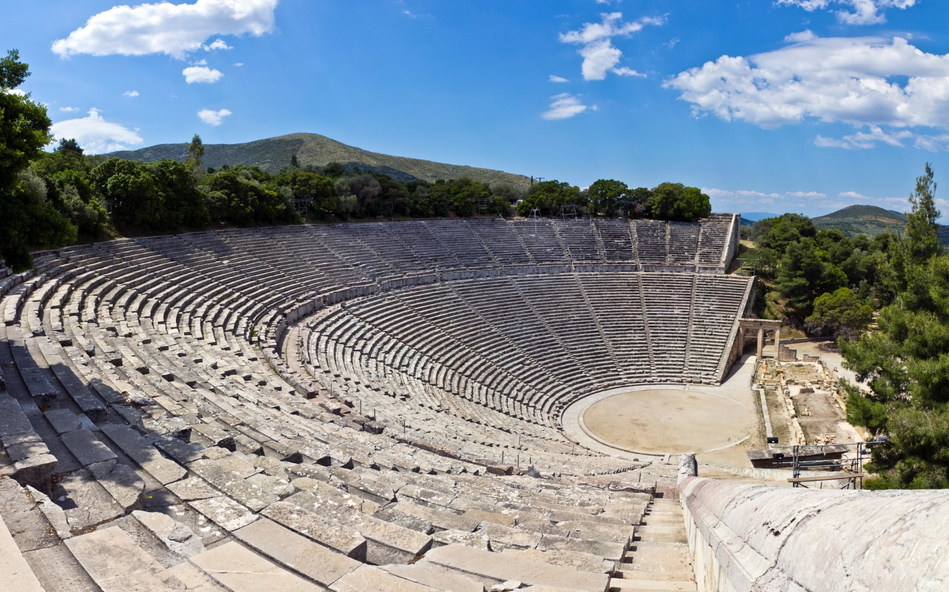
As the world is still reeling from the pandemic and exploring new ways to re-ignite theatre in the COVID-19 era, the Athens Epidaurus Festival invites international audiences to the most beautiful theatre of the ancient world for a live broadcast of Aristophanes' comic masterpiece The Frogs, by acclaimed director Argyro Chioti in her Ancient Theatre of Epidaurus debut. The play includes a stellar cast of renowned Greek theatre actors and a strikingly original musical performance.

Following last year's hugely successful live streaming of The Persians by the National Theatre of Greece, watched by over 100,000 viewers worldwide, The Frogs will be streamed live on July 10 at 21:00 Athens time (GMT +3), with the support of the Hellenic Ministry of Culture and Sports, in collaboration with Google Greece. The performance will be available worldwide (with the exception of Greece) and exclusively through livefromepidaurus.gr and at the Festival's official YouTube channel, Athens Epidaurus Festival, free of charge, although donations are welcome. The performance will be in Greek, with English subtitles, and lasts approximately 1 hour and 45 minutes.

Written in 405 BC, at the end of the Golden Age of Pericles, The Frogs is one of Aristophanes' timeless and most beloved masterworks. The play tackles the descent of god Dionysus to the Underworld, where he embarks on a quest to bring the best tragic poet back to the world of the living, in an attempt to restore theatre to its former glory. Thank to this play, culminating in an iconic scene of poetic "duel" between Aeschylus and Euripides, Aristophanes provides a scathing commentary on the bankrupt political values of his time. A delightful gem by a writer whose work remains as relevant as ever.


www.livefromepidaurus.gr

 I get a lot of questions from readers, and most of the time, the answers are fairly short. When I feel the question or the reply would be valuable to others as well, I make a post with a collection of them and post them in one go. Today is one of those posts.


"Hi! Skiraphoria, Stenia, and Thesmophoria are the three festivals that only women are allowed to attend. What if i'm nonbinary? Should i not celebrate them? I look forward to read your answer :)"

There is no easy answer to this. The ancient Hellenes believed in the binary. Their entire society was based on that binary. It literally controlled every social interaction, every job, every ritual. It governed laws, politics, and even science and philosophy. It even dictated sexuality and the roles in homosexual contact. Ancient Hellas was divided in two.

Personally, I think the binary does not exist. As such, I tend to look at the function of rituals, and then give my opionion and advice. And I always, always, go by mind, not physique. Unless otherwise specified, I will always mean 'someone who identifies as' when saying 'male' or 'female'. So what of the non-binary?

The Stenia, Thesmophoria, and Skiraphoria are all tied to the Eleusinian Mystries and thus to the fertility of the land, agriculture, and harvest.

The Skiraphoria was one of the few days when the women of ancient Athens would gather in public to honor Demeter and bless the harvest. They refused to sleep with the men on this day and took part in a very odd tradition: casting piglets down into a chasm where they were left to rot until the Stenia.
The Stenia was dedicated solely to Demeter and Persephone and was held three days before the Thesmophoria. During the Stenia, women came together and begun the extensive purification rituals needed to partake in the Thesmophoria. How, exactly, the women purified themselves is unknown but it is known that the women engaged in Aiskhrologia, insulting each other and using foul language, in honor of Iambe, who cheered up a grieving Demeter by either lifting her skirts or making a dirty joke. At the Stenia, some women, called 'Bailers', hiked to the chasm where the piglets had been thrown into months ago. Then, in a gruesome display of devotion, the women hauled out the rotting corpses of the piglets and carried them to the Thesmophorion, a site probably on the hillside of the Pnyx.

During the Thesmophoria, there was a male and female encampment at the Thesmophorian and the division was clearly set; no men were allowed in the female encampment, and no women in the male encampment. Sex was not allowed. All free women, except for maidens, were allowed to participate. On the first day, called Anodos ('ascent') and Kathodos ('descent'), the women sacrificed the rotting piglets to Demeter and Persephone. The remains were mixed with seeds and would be plowed into the earth after the festival to assure a good harvest. The second day was called Nēsteia ('feast of lamentation'). On this day, the women did not eat. They recreated the time before Demeter taught humankind to cultivate the fields. The third day, Kalligeneia ('she who is of beautiful birth'), was a happy one. The women prayed to Demeter and Persephone for fertility for themselves, their loved ones and the earth. They celebrated the magic of new life, fertility and the kindness of the Gods.
The Skiraphoria and Stenia, in my opinion, are fairly 'stretchable' when it comes to who can attend. Traditionally it were women only, but the focus is fertility of the land, so I see no issue for those who are non-binary and identify with the festival in some way to attend.

So how about the Thesmophoria? The Thesmophoria ha an additional element: female fertilty, the act of human life growing in a uterus. So here the field is narrower. Do you identify with the biologically female side of reproduction? With motherhood? With pregnancy? Then join in. The same goes for cis-females, trans* women, those women who do not have children, and those women no longer physically capable of having them. It's a squishy line and it depends on the person.

My advice--for anyone--is to read up on the festival and look inside yourself to see if this is a ritual you can wholeheartedly celebrate.

***

"So what are your views on the creation of the world? I was curious about how you think about it."

The ancient Hellenic philosophers and mythographers were pretty much in agreement that the Gods created the universe--or are the universe itself. The most famous account of how everything came to be comes from Hesiod. His 'Theogogy' is a complete recounting of the story, starting with Khaos:

"Verily at the first Chaos came to be, but next wide-bosomed Earth, the ever-sure foundations of all  the deathless ones who hold the peaks of snowy Olympus, and dim Tartarus in the depth of the wide-pathed Earth, and Eros, fairest among the deathless gods, who unnerves the limbs and overcomes the mind and wise counsels of all gods and all men within them. From Chaos came forth Erebus and black Night; but of Night were born Aether and Day, whom she conceived and bare from union in love with Erebus. And Earth first bare starry Heaven, equal to herself, to cover her on every side, and to be an ever-sure abiding-place for the blessed gods. And she brought forth long Hills, graceful haunts of the goddess-Nymphs who dwell amongst the glens of the hills. She bare also the fruitless deep with his raging swell, Pontus, without sweet union of love. But afterwards she lay with Heaven and bare deep-swirling Oceanus, Coeus and Crius and Hyperion and Iapetus, Theia and Rhea, Themis and Mnemosyne and gold-crowned Phoebe and lovely Tethys. After them was born Cronos the wily, youngest and most terrible of her children, and he hated his lusty sire." [ll. 116-138]

He goes on to list a great many deities, cutting out a rough shape of the cosmos while doing so. There are many variations of this family tree, and in the ancient writings, there are also creation stories that range beyond this basic framework. Many of them match very well with science, though.

I believe in the theory of the Big Bang, where the universe was in an extremely hot and dense state and began expanding rapidly. After the initial expansion, the universe cooled sufficiently to allow energy to be converted into various subatomic particles, including protons, neutrons, and electrons. Giant clouds of these primordial elements later coalesced through gravity to form stars and galaxies, and the heavier elements were synthesized either within stars or during supernovae (courtesy of Wikipedia, because of ease). I see no issue in overlaying this theory with Hesiod's cosmology, however. The Big Bang theory does sound like first there was Khaos, and from that, matter came into being to eventually form the Earth as it is now. So as far as the creation of the universe and the Gods goes, I will go with Hesiod and his explanation, although a variation of his work is also fine by me.


***

"Hi Elani! I've been binding my hair for 15 months (and counting!) and while it feels right to me for many reasons, I'm curious to know more about it. Specifically, miasma. I read your post on your blog about binding hair, and you mentioned that unbound female hair is miasmic. Why is that? Also, why only female hair? Is it to do with length (and if so, if a man has long hair, is it miasmic too)? Or because of the association with funerary rites? Any information would be appreciated :) Thank you!"

Hair has long had an important role in society and religion. During the classical period female citizens wore their hair long except when they were in mourning during which they cut their hair short. Before the fifth century BC women's hair was allowed to fall over the shoulders and back, but it was often fastened by a headband or diadem, and the front section of the hair was restrained. After that, hair was often restrained.  Female citizens, especially, wore their hair long, and after their marriage--usually at a very early age--they wore their hair up in elaborate styles. Typically, only their immediate family and servants saw Hellenic women with their hair undone.

Within a religious framework, hair was done up as well, unless otherwise specified. Many Dionysian rites, for example, encouraged women to literally 'let their hair down', and join in the revelry. For (married) women, it was extremely uncommon to wear their hair down outside of the oikos, and to do so must have helped them get out of their comfort zone. For other religious ceremonies, wearing the hair up was a way to apply katharmos, and prevent miasma from entering the ritual setting. This is a practice is still applied today, by yours truly included.

Plutarch (Ploútarkhos, Πλούταρχος) was a Greek historian, biographer, and essayist, who later in his life became a Roman citizen. As such, he was extraordinarily qualified to write two standard works: the 'Quaestiones Graecae' (Αἴτια Ἑλληνικά, or 'Greek Questions'), and the 'Quaestiones Romanae' (Αἴτια Ῥωμαϊκά, or 'Roman Questions'). These essays are part of the book series 'Moralia' (Ἠθικά, loosely translatable as 'Matters relating to customs and mores'), and can be found in book IV of the series. The Greek Questions contain fifty-nine questions, the Roman version hundred-thirteen, and all pertain to matters concerned with their respective culture. Many of the answers are names or customs, and because Plutarch often refers (back) to Hellenic customs, both are extremely valuable for research on ancient Hellenic life.

He writes in the 'Quaestiones Romanae': 'why do sons cover their heads when they escort their parents to the grave, while daughters go with uncovered heads and hair unbound?' and answers, partly, with the following:

"Is it because fathers should be honoured as gods by their male offspring, but mourned as dead by their daughters, that custom has assigned to each sex its proper part and has produced a fitting result from both? Or is it that the unusual is proper in mourning, and it is more usual for women to go forth in public with their heads covered band men with their heads uncovered? So in Greece, whenever any misfortune comes, the women cut off their hair and the men let it grow, for it is usual for men to have their hair cut and for women to let it grow." [14]

Women were supposed to wear their hair bound, and even veiled. In a Kthonic situation (like a death, or festival for a Kthonic deity), this would have been reversed, as everything in the rites was reversed--nighttime instead of daytime, unmixed wine instead of mixed wine, etc.--I am going to guess that because of this, unbound hair on women became associated with miasmic situations and thus they were not allowed to wear their hair down during Ouranic religious rites (and daily life). for me, that's enough to tie my hair.

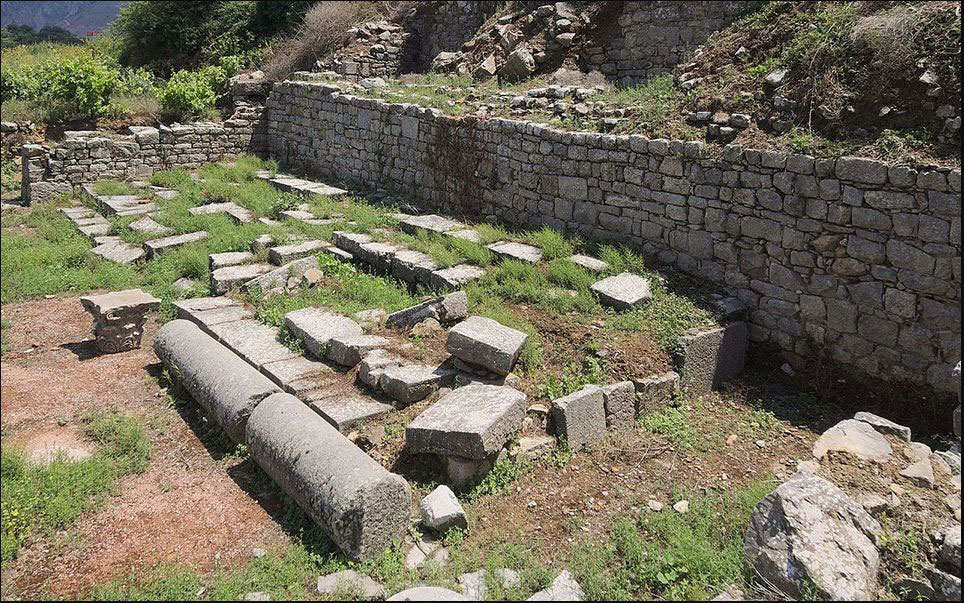
For the first time in almost 40 years, new excavations started in ancient Lyttos or Lyktos of Heraklion ‒ a city that for many archaeologists could upstage Knossos in the future. Evans himself wanted to dig in the area but this never happened and the last time systematic excavations took place was in the early 1980s. Now, the excavations are part of a major Greek-American project.

Excavations in the region will last a month, as part of a five-year programme. It is a collaboration between the Princeton Institute for Advanced Studies and New York University with an international team of 15 archaeologists and archaeology students from various universities.

During the Minoan era the city of Lyktos, or Lyttos, perhaps the oldest city of Crete, had a dominant presence in eastern Crete, in fact Lyktos took part with an army in the Trojan War. As can be seen from excavation data and many inscriptions, Lyktos also distinguished itself during the Roman period. More modern excavations at the Acropolis of Smari, with finds from the Middle Minoan era onwards, confirm the important role of the area since very ancient times.

The directors of the excavation are Mr. Angelos Chaniotis, from Princeton, and Mr. Antonis Kotsonas, from New York, in collaboration with Mrs. Vasso Sythiakaki, curator of Heraklion Antiquities. 

Mr. Chaniotis explains that since the site is large, the excavations will start in three areas with two citadels, many cemeteries and a wall. Archaeologists will focus on three spots: a public building- bouleuterion/court house excavated in the early 1980s by George Rethemiotakis, a public building of the Archaic or Classical period, and a Byzantine basilica.

Mr. Chaniotis says that if Evans had gone ahead with excavations in Lyttos we would have had a different picture of Cretan archaeology.

"We have chosen three sites, representing three different historical periods: as we know from Plutarch and Polybius, the Archaic / Classical period was the most important one in Crete, the island’s Roman period still remains relatively unknown, and data from Gortyna and Eleftherna give us most information on the Early Byzantine period."

Mr. Chaniotis notes that the research aims not only to shed light on Lyttos but on the whole of Cretan history.

"The history of Crete is a history of continuity, it does not stop at the Minoan civilization. We can see the transition from antiquity to Byzantium, then to Venetian rule down to our times."

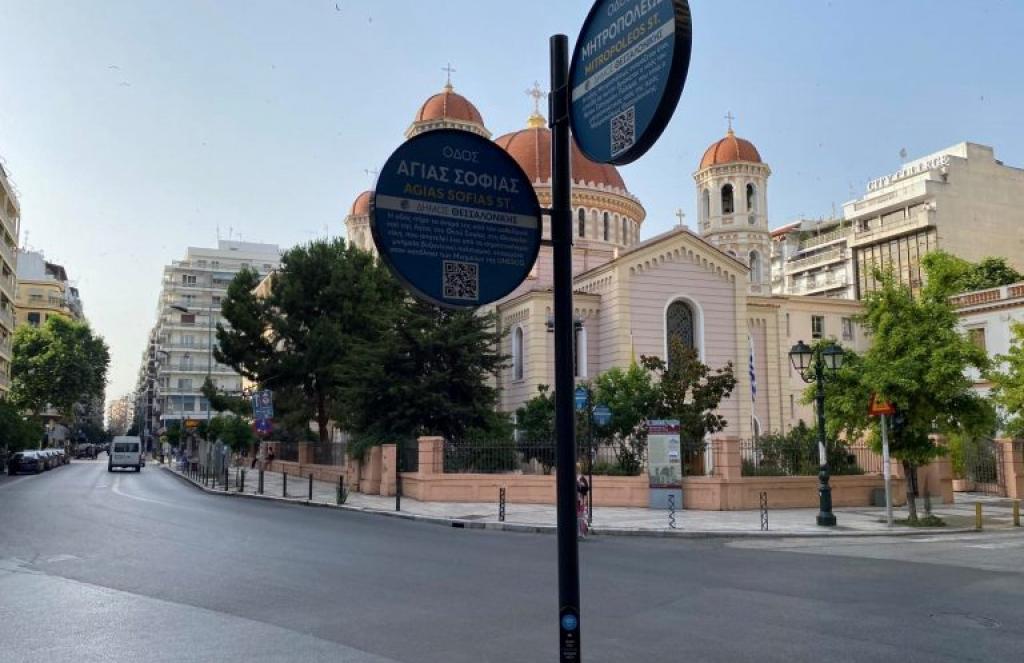
The streets of all cities carry secrets and stories that are hundreds of years old. With time, the past is gradually erased as people forget the things that have happened and where they have taken place. As such, we walk around our cities unaware of the events that have once transpired on their streets. Taking a case in point, Thessaloniki in Greece has a history that is 24 centuries old as the city was founded in 315 AD. Now, its municipality has worked together with the company Diamantis Masoutis SA to make this rich history known to residents and tourists. More specifically, smart signs have been installed to reveal the secrets and stories of the city's streets.

With the use of QR Codes and Near-Field Communication (NFC) technology, the smart signs will allow visitors to access information regarding the history of Thessaloniki's streets on their mobile devices. Furthermore, they will be able to read about the events which have occurred in both Greek and English.

On 1 July, the first smart signs were installed in front of Agia Sofia. This was done in the presence of the Mayor of Thessaloniki Konstantinos Zervas and the Director of Digital Transformation of the company Diamantis Masoutis SA Savva Tortopidis. Both parties expressed their delight with the project, noting that it will highlight the history of the city and increase its attractiveness.

Tortopidis further commented on the role companies play in enhancing the reputation of their cities: “We gladly accepted the request of the Mayor and we supported and strengthened the idea for the smart signs. Our aim is to highlight how large organisations can transfer the know-how they have developed to help improve the daily lives of citizens.

Masoutis, through the program ΄Daily Actions', is constantly next to people and the environment, strengthening society, where there is a need. In this case, through this action, in collaboration with the Municipality of Thessaloniki, we went one step further, modernising the city's infrastructure, applying technological innovations and confirming that together we can move forward.”

The Municipality of Thessaloniki and Diamantis Masoutis SA are planning to install a total of 450 signs by the end of this summer.

 Xenelasia (ξενηλασία). Xenelasia was 'the right possessed and exercised by the Lacedaemonian magistrates of expelling from Sparta (and Doric Krete) any stranger whose presence was injurious to the public order or morals'.

In order to explain that, I need to give a bit of history on Sparta and the way it was ran. Sparta (Σπάρτα), or Lacedæmon (Λακεδαίμων), was a prominent city-state in ancient Hellas, located on the banks of the River Eurotas in Laconia, in south-eastern Peloponnese. It emerged as a political entity around the 10th century BC, when the invading Dorians subjugated the local, non-Dorian population. Sparta was an oligarchy (oligarkhía, ὀλιγαρχία)--a form of power structure in which power effectively rests with a small number of people. The state was ruled by two hereditary kings of the Agiad and Eurypontid families, both supposedly descendants of Hēraklēs and equal in authority, so that one could not act against the power and political enactments of his colleague. The kings were in charge of religious festivals, judicial matters, as well as the military. Over time, the kings became mere figureheads except in their capacity as generals in war, but their power waned slowly, and democracy was never instituted in the polis.

From about 650 BC onwards, Sparta rose to become the dominant military land-power in ancient Hellas. Sparta was one of the city-states that never adopted a democratic political system; instead, they had the family as a model for the organization of the state; a family they protected from corruption by outside forces. Like a true family unit, Sparta had its own customes, holidays, and drunk uncles, and they were preserved as much as possible. In order to accomplish this, Lacedæmonian magistrates had the duty and authorization to expel any person who posed a threat to public order and morals

Foreigners were allowed into Sparta for religious festivals and missions of state but they were not allowed to live in the environs. Special exceptions were given to friends and allies who were called 'laconophiles'; lovers of Sparta. On the reverse side, the general populace was forbidden foreign travel. These laws were intended to preserve the native character of the Doric tribe from any taint of foreign influence. Plutarch, in 'The Lives of the Noble Grecians and Romans', wrote:

"And this was the reason why he [Lycurgus] forbade them to travel abroad, and go about acquainting themselves with foreign rules of morality, the habits of ill-educated people, and different views of government. Withal he banished from Lacedaemon all strangers who would not give a very good reason for their coming thither; not because he was afraid lest they should inform themselves of and imitate his manner of government (as Thucydides says), or learn anything to their good; but rather lest they should introduce something contrary to good manners. With strange people, strange words must be admitted; these novelties produce novelties in thought; and on these views and feelings whose discordant character destroys the harmony of the state. He was as careful to save his city from the infection of foreign bad habits, as men usually are to prevent the introduction of a pestilence."

Lycurgus (Lykoûrgos, Λυκοῦργος), pictured above, was the legendary lawgiver of Sparta, who established the military-oriented reformation of Spartan society in accordance with the Oracle of Apollo at Delphi. All his reforms were directed towards the three Spartan virtues: equality (among citizens), military fitness, and austerity. It is said that after his reforms--which included the laws governing xenelasia--he left for the Oracle of Delphi to check with the Gods if they agreed. Before he left, he made every Spartan swear to uphold his laws while he was gone. Once at the Oracle, she told him that his laws were excellent, and Lycurgus prompty disappeared or starved himself so his laws would always remain in effect.

Xenelasia was part of any interaction with outsiders, be it in trade, in entertainment, during religious functions, and even applied to whom Spartans could ahve sex with and marry. While it sounds like these laws would interfere with xenia, they didn't; foreigners were welcome, but they were never considered truly Spartan. Only Spartans were Spartans. Even if you loved the polis, you would never truly be a part of it.

The laws of xenelasia were controversial in ancient Hellas, but they were a defining factor in what made Sparta great; its character caused Spartans to band together, to make their family unit proud, and it helped them accept the sacrifice of their individuality in favor of the greatness of the polis. In the end, however, it is suspected that their unwillingness to open up to the influence of others contributed to the demise of the once-great polis; there was simply no buffer to accommodate losses in battle.

Image property: Wikipedia Commons

Today I am doing another constellation post, and this time it is about a bit of an oddity: a constellation that the ancient Hellenes saw only as a part of another constellation. Often the names we use for the constellations are Roman, but the ancient Hellenes at least identified the constellation in the same way. Not so with Libra: to the ancient Romans, Libra represented scales, to the ancient Hellenes, the claws of the constellation Scorpio. As such, it was known by two names: Zyygos (the Scales) or Khêlai (the Claws).


The constellation Scorpio--which we will get to at a later date--was placed into the sky because of mythology that connexts him to Orion, the great hunter. In ancient times, the constellation Libra was almost solely identified with the scorpion, but eventually, another connection came to pass--to the constellation Virgo. The above image represents both connections. Hyginus, in his Astronomica, makes the connection between the scorpion and the scales best:

"This sign is divided into two parts on account of the great spread of the claws. One part of it our writers have called the Balance." [II. 26]

Hyginus (64 BC – AD 17), however, was a Latin author. Earlier work--for example by 3rd century BC poet Aratos, reveals nothing about scales. In his Phaenomena, he discusses the placement of Libra repeatedly:

"Toward the Crown leans the Serpent’s jaw, but beneath his coiling form seek thou for the mighty Claws [Libra]; they are scant of light and nowise briljant. [...] There too are the most swift courses of the Ram [Aries], who, pursued through the longest circuit, runs not a whit slower than the Bear Cynosura – himself weak and starless as on a moonlit night, but yet by the belt of Andromeda thou canst trace him out. For a little below her is he set. Midway he treads the mighty heavens, where wheel the tips of the Scorpion’s Claws and the Belt of Orion. [...] The constellation of Centaur [Centaurus] thou wilt find beneath two others. For part in human form lies beneath Scorpio, but the rest, a horse’s trunk and tail, are beneath the Claws. [...] In it [the equater] are the Belt of the well-starred Orion and the coil of the gleaming Hydra: in it, too, the dim-lit Crater and the Crow and the scanty-starred Claws and the knees of Ophiuchus are borne. [...] In it is the Crag; after the Crab the Lion and beneath him the Maiden; after the Maiden the Claws and the Scorpion himself and the Archer and Aegoceros, and after Aegoceros Hydrochoüs. [...] Nor can the rising Claws [Libra], though faintly shining, pass unremarked, when at a bound the mighty sign of Boötes rises, jeweled with Arcturus. Aloft is risen all of Argo, but the Hydra, shed as she is afar over the heavens, will lack her tail. The Claws bring only the right leg as far as the thigh of that Phantom that is ever On his Knees, ever crouching by the Lyre – that Phantom, unknown among the figures of the heavens, whom we often see both rise and set on the selfsame night. Of him only the leg is visible at the rising of both the Claws: he himself head-downward on the other side awaits the rising Scorpion and the Drawer of the Bow. For they bring him: Scorpion brings his waist and all aforesaid; the Bow his left hand and head. Even so in three portions is he all brought up piecemeal above the horizon. Half the Crown and the tip of the Centaur’s tail are upraised with the rising Claws." [88, 225, 436, 511, 544, 607]

About the connection to the constellation Virgo, many later writers have something to say, although very few of those words are in the public domain. Two Goddesses were identified with the scales by (mostly) the Romans: Astraia (Αστραια), daughter of Zeus and Themis, and Tykhe (Τυχη), daughter of Zeus. There is no Hellenic source to tie either of them to the constellation.

Manilius, a Roman poet, astrologer, and author from the 1st century AD, in his 'Astronomica' spoke of the influence of Libra for those born under it, writing:

"Balancing night with the length of day, the Scales will bestow the employment of weights and measures and a son to emulate the talents of Palamedes, who first assigned numbers, and to these numbers names, fixed magnitudes and individual symbols. He will be acquainted with the tables of law, abstruse legal points, and words denoted by compendious signs; he will know what is permissible and the penalties incurred by doing what is forbidden; in his own house he is a people's magistrate holding lifelong office… Indeed, whatever stands in dispute and needs a ruling the pointer of the balance will determine." [Loeb p.239]

Libra, especially for the Hellenes, was a minor constellation--part of another constellation, and barely connected to mythology. In modern times, however, the failt constellation has gained its share of fame. The constellation Libra is visible at latitudes between +65° and −90°, and best visible at 21:00 (9 p.m.) during the month of June.