Busy day, sorry, so have a hymn to Poseidon, hidden away in Aristophanes's The Knights. It's sung by two of the characters and is quite lovely, so I thought I'd share.


Oh, Lord! Oh, Lord, protector and lover of horses!
Lover of the brazen clang and thud of the horses’ hooves, lover of the horses’ neighing. Lover, too, of the swift war ships with their blue emblems of rams at the prow!
Oh, God, whose heart gladdens at the sight of the rich booty those ships carry! A heart that also gladdens at the sight of young men in contest, particularly when they climb proudly upon their chariots chasing their Fate -victory or defeat, no matter!
Come, God of the horse, come now and join our dance!
Poseidon, God of the golden trident, come join us!
God, chief of the dolphins!
God whose name is praised at Sounion!
God, son of Kronos, Geraestus!
God, most loved by the folk of Phormion to whom you granted a naval victory!
God most loved by all the citizens of Athens at this hour of their naval need!

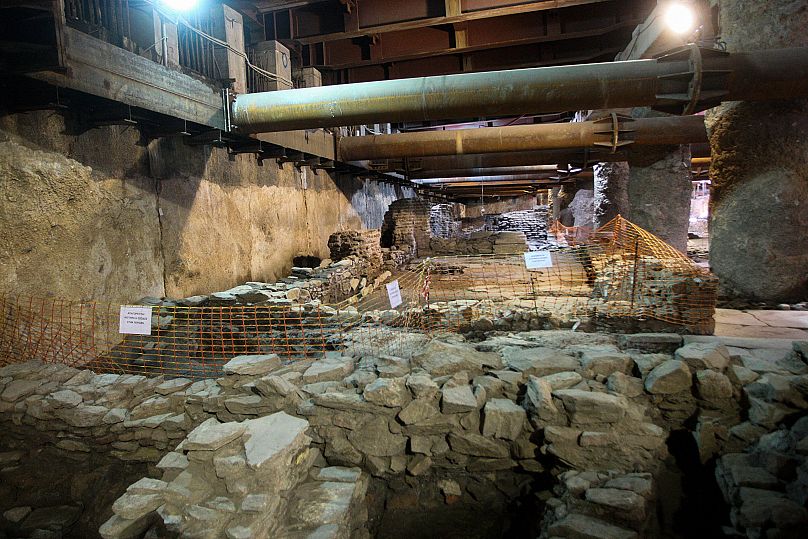
I'm sharing this opinion piece by Alexis Georgoulis for you to make up your own mind. In Greece, an archaeological site of incalculable value is today at great risk of being irretrievably damaged. In 2013, the construction of the Venizelos metro station in Thessaloniki led to the discovery of impressive remains dating back to the Late Roman and Early Byzantine period (4th-9th century AD), a time when Thessaloniki was considered a multicultural city at the crossroads of East and West.

These archaeological findings are of immense historical and cultural importance because nowhere in the world has archaeology found a city’s central urban area belonging to this period which is so well preserved and boasts such a sprawling surface (the site covers over 1,500 m²).

The monumental ensemble includes parts of the Roman marble paved avenue Decumanus Maximus, its intersection with the main road of the city (the cardo maximus), workshops, shops and residencies, and portions of a square surrounded by colonnades. Some experts are even referring to the complex as the "Byzantine Pompeii" because it is found in excellent condition, and, as in the case of Pompeii, it gives a clear idea of how everyday life looked like back then.

But the way the Greek government has decided to handle the spectacular discovery has sparked a fierce debate, both at national and international level, and deserves the attention – and perhaps the intervention – of the European institutions.

In March 2020, despite the significance of this monumental complex and against the majority opinion of the archaeological community, the government decided to dismantle the ancient findings into bits and pieces and temporarily move them to a storage unit outside the city, with the intention of placing them back after the station’s construction. The main argument behind this decision was the need to finish the station’s construction in time and avoid any repercussions by the European Investment Bank, which finances the works of Thessaloniki’s metro.

In doing so, the government ignored a scientifically and technically solid solution for a win-win construction plan to build the station in time while keeping the antiquities in situ. This alternative scenario, which is both realistic and respectful, was proposed by a group of experts: to excavate and build the station under the archaeological layers.

According to archaeologists, the procedure of removing the findings destroys underlying archaeological strata and exposes them to external risks.

Moreover, the project of moving the delicate pieces is remarkably time-consuming: in case of removal, a new archaeological excavation must take place because under the level of the current complex lie another three meters of archaeological layers, estimated to be 700 years old.

The Greek government should learn the lessons from previous unsuccessful attempts. A similar plan was implemented when extremely important findings were discovered near the square of Hagia Sophia, also in Thessaloniki. The archaeological site was dismantled and stored outside the city. Unfortunately, after construction work was concluded, the effort to put the findings back in their original place proved to be impossible because they could no longer fit in the space from which they had been extracted.

We must make sure the remains found in the Venizelos station do not suffer the same fate.

Public opinion is overwhelming opposed to the removal: according to a recent survey, two out of three residents in Northern Greece don't support the extraction .

Neither does international law approve the strategy: all the international conventions on cultural heritage – namely the Charter for the Protection and Management of the Archaeological Heritage (Lausanne, 1990), UNESCO’s World Heritage Convention (revised on 10th of June 2019), the Nara Document on Authenticity (1994) and the Venice Charter (1964) – underline the need to preserve monuments of cultural importance in the location where they are originally discovered.

This is an essential precondition, regarding integrity and authenticity, for any monument to be considered for the World Heritage Monument list of UNESCO.

A possible awarding of the new archaeological site as a World Heritage Monument would be most beneficial for Thessaloniki, helping to promote the city as a tourist destination and bringing economic gains. It would be a pity to lose this potential title and all its advantages.

For all the above reasons, cultural institutions, such as Europa Nostra and the International Council on Monuments and Sites (ICOMOS), academics, civil society and legislators are being mobilised in order to stop the removal process and prevent a destructive scenario from happening.

Time is running out: Greece's highest administrative court, the Council of State, has already green-lighted the extraction, rejecting all three appeals by a thin margin of 13 out of 25 votes.

This problem concerns the whole Europe – and only Europe can act now.

My colleagues of the European Parliament and I have already addressed a question to the European Commission, asking if the executive intends to intervene and defend the preservation in situ of the Thessaloniki antiquities before the damage becomes irreparable. Going forward, the European Union must establish guidelines for similar cases to guarantee the substructure works doesn't entail the erosion of our ancient history.

We must seize this unique opportunity to build a modern metro line that benefits the city's development and connectivity while preserving and highlighting our common European cultural heritage.

 I greatly enjoy watching the Olympics. I enjoy watching sport in general, but this is a competition which started in Greece, by the people who worshipped the same Gods as I do, people whose lives I'm trying to reconstruct. Watching the Olympics is religious for me. Did you know all of this about the Olympics?


An artist's impression of Altis, the sanctuary in Olympia
  1. The Olympic Games were held every four years, like they are now, from 776 B.C. to A.D. 394. They were, however, part of a cycle of sports events, known as the Panhellenic Games. The Olympic Games were dedicated to Zeus, were held in Olympia, Elis, and were held every four years. The Pythian Games were dedicated to Apollon, were held in Delphi and were held every four years, starting three years after the Olympic Games. The Nemean Games were dedicated to Zeus also, were held in Nemea, Corinthia, and were held every two years. Lastly, the Isthmian Games were dedicated to Poseidon, were held in Corinth, and were also held every two years.
  2. The most important events at the Olympic Games weren't the sport events; they were the sacrifices, offerings and other dedicatory practices which were continually performed during the five day event. There were also artistic happenings; writers, sculptures and painters showed what they could do in their given trade. Palmistry was practiced, wine flowed freely and there were a lot of prostitutes, who made more money in these five days than in the whole of a year without the sporting event. The Olympics were a festival unlike any other and every four years Hellas went nuts for it.
  3. The opening ceremony was as spectacular as it is today, but in an entirely different manner; athletes filed into the arena and were presented to the audience. Then, they were presented to a towering statue of Zeus, who carried a thunderbolt and a heft scowl. They swore on a bloody slice of boar's meat that they would obey the rules of the competition and not cheat to gain victory.
  4. The torch relay I take great joy in, was not practiced in Ancient Greece. In fact, it was introduced in 1936 by Hitler in response to an idea by Carl Diem to further the reign of the Nazi's and, in their eyes, glorify the Aryan super race, the Spartans. 
  5. Not everyone was allowed to participate in the games; non-Hellenics and women were unable to compete. There were exceptions made for non-Hellenics, like Roman Emperor Nero, when the situation called for it, but women were never allowed to compete. Married women weren't even allowed to enter the arena. There was, however, a secondary series of sporting events held in honor of Hera where women competed.
  6. The Olympic sport events back then were: chariot racing, wrestling, boxing, pankration, foot races, and the pentathlon which consisted of wrestling, stadion, long jump, javelin throw, and discus throw. Pankration was a fighting sport in which everything went. It was a kind of mixed martial-arts event in which broken bones were the norm, choke holds were encouraged and the only thing that you really couldn't do was gauge someone's eyes out. Everything else went. You won when the other guy went K.O.
  7. Except the chariot races, all Olympic sports were performed naked. This included the Pankration, so you can imagine where most of the pain was inflicted. The woman weren't completely naked, but participated with one breast exposed, in honor of the Amazonian women who were said to be so incredible at sports and warfare alike. 
  8. Over 40.000 people came to watch the Games. Olympia was in the middle of nowhere. If you came from Athens, it meant a 340 kilometer (210 mile) long walk just to get to Altis. Because of the festival and the presence of the Gods, all these people traveled the distance anyway.
  9. The end of the Olympic Games is guestimated to 394 A.D. after a decree to cease all pagan festivals by Christian emperor Theodosius I.
  10. Winners of the Olympic Games got rather minor rewards; Olympic winners received a garland of olives, Pythian winners received a laurel wreath, Nemean winners received a wild celery garland and the Isthmian winner received a pine garland. There was no runner-up; you won or you lost. All athletes were bathed in fame and glory until they lost, but the winner was brought home to his polis a king. He would never have to work again, was covered in riches and women, and his name and family name would be forever remembered and honored.

It's Olympics time again! And as conflicted as I am about this version (hello, covid, hello, discrimination, hello host of issues!), they do hold a special place in my heart. One thing is certain: the ancient Hellenes would have trouble recognizing the Olympics in its current carnation, not in the least because they practiced very different sports. Especially towards the end of the Games, there was great variety in sporting events, although not as much as the modern Olympics give us. Today, I want to discuss these various sports.


Harmatodromia (ἁρματοδρομία) - Harmatodromia, or chariot racing, was one of the most popular ancient Hellenic sports. In the ancient Olympic Games, as well as the other Panhellenic Games, there were both four-horse (tethrippon, τέθριππον) and two-horse (synoris, συνωρὶς) chariot races. Distances varied according to the event. The chariot racing event was first added to the Olympics in 680 BC with the games expanding from a one-day to a two-day event. We don't know when they were added to the other Panhellenic games, but probably around the same time or a little later.

Hómēros in his Iliad describes a chariot race in vivid detail:

"As one, they raised their whips, shook the reins, and urged their teams on. Swiftly the horses galloped over the plain, leaving the ships behind. A whirlwind cloud of dust rose to their chests, and their manes streamed in the wind. Now the chariots ran freely over the solid ground, now they leapt in the air, while the hearts of the charioteers beat fast as they strove for victory, and they shouted to their horses, flying along in the storm of dust. 
It was not till the galloping horses were heading back towards the grey sea that each team showed its mettle, and the charioteers forced the pace. Eumelus’ swift-footed mares shot to the front, chased by Diomedes’ stallions, hot on their heels, as if they might  mount  Eumelus’ chariot, and their heads were at his back as they flew, blowing hot breath on his neck and shoulders. Diomedes would have passed him now, or at least drawn level, if Phoebus Apollo in resentment had not struck the gleaming whip from his hand. Diomedes saw the mares run on, while his own horses slowed without the effect of the whip, and tears of anger filled his eyes. But Athene saw that Apollo had interfered, and speeding after, returned the whip and inspired the team. Then in her anger she chased down Eumelus, and shattered the yoke of his chariot, so the mares swerved from side to side and the broken pole struck the ground, while Eumelus himself was hurled to the earth beside the wheel. The skin was stripped from his elbows, nose and cheeks, his forehead bruised, while his eyes filled with tears and he was robbed of speech. 
Meanwhile Diomedes passed the wreck and drove his powerful horses on, far in the lead. Athene had strengthened his team and given him the glory. And red-haired Menelaus, the son of Atreus, ran second. But Antilochus called to his father’s team: ‘On now, show me how you can run. You’ll not catch Diomedes’ pair, for Athene grants them strength and him the glory. But chase down Menelaus’ team, don’t let them beat you, or Aethe the mare will put you to shame. Why so slow, my beauties? I’ll tell you this, if we win a lesser prize, there’ll be no sweet fodder at Nestor’s hands, he’ll slit your throats with his keen blade. So on, as fast as you can, and I’ll contrive to pass them where the course narrows: that’s my chance.’
With this the horses, responding to his threat, speeded up for a while, and soon the steadfast Antilochus saw a narrow place in the sunken road ahead, where a stream swollen by winter rain had eroded the track and hollowed out the course. Menelaus drove on assuming no one could overtake, but Antilochus veered alongside, almost off the track. Then Menelaus called to him, in alarm: ‘Rein in Antilochus, that’s recklessness! The track’s wider further on. Pass there if you can, mind my chariot, don’t wreck us both!’
He shouted loud enough, but Antilochus, pretending not to hear, plied his whip and drove the more wildly. They ran side by side a discus length, as far as a young athlete testing his strength can hurl it from the shoulder, then Menelaus held back, and his pair gave way, fearing the teams might collide and overturn the light chariots, hurling their masters in the dust, for all their eagerness to win. Red-haired Menelaus stormed at Antilochus: ‘You’re a pest Antilochus, we Achaeans credited you with more sense. All the same, you’ll not win a prize, when I force you to answer on oath to this.’ 
With that he addressed his team: ‘Don’t flag, and don’t lose heart. Their legs will weaken sooner than yours, they’re carrying more years.’ And his pair, responding to his call, increased their speed and closed on the pair in front.
[...] Diomedes soon arrived, whipping the high-stepping horses hard, as they sped towards the goal. Showers of dust clung to him, and the wheel rims hardly left a trace on the powdery ground, as the swift-footed pair flew onwards pulling the chariot, decorated with gold and tin. He drew to a halt in the centre of the ring, sweat pouring to the ground from his horses’ chests and necks. He himself leapt to the ground from his gleaming chariot, and leant the long whip against the shaft. Nor did his squire Sthenelus lose a moment in claiming the prize, but eagerly his joyful friends led away the women and carried off the eared tripod, while he un-harnessed the horses." [Bk XXIII:362]

Pále (πάλη) - This event was similar to the modern wrestling sport--with three successful throws necessary to win a match. It was the most popular organized sport in Ancient Hellas and was the first competition to be added to the Olympic Games that was not a footrace. It was added in 700 BC. An athlete needed to throw his opponent on the ground, landing on a hip, shoulder, or back for a fair fall. Biting and genital holds were illegal.

Pankration (παγκράτιον) - This rough contact sport was a combination of boxing and wrestling. Biting and gouging an opponent's eyes, nose, or mouth with fingernails was not allowed, but everything else was allowed. Deaths happened. Unlike at the boxing competitions, the fighters did not wrap their hands, so it was a bare knuckle fight.Like the other combat sports, a fighter could surrender or fight until knock out. Pankration was not a free-for-all, though; fighters were in excellent form, and there were a large variety of fighting stances and techniques. In fact, many of these are still known, or have been reconstructed and especially in modern Greece, pankration is a sport you can take part in today.

Pentathlon (πένταθλον) - A pentathlon incruded a combination of five separate disciplines: discus, javelin, jump, running, and wrestling. The event was first held at the 18th Ancient Olympiad, around 708 BC. The discus throw was similar to the modern event, with the implement made from stone, iron, bronze, or lead. The javelin event was also similar to the modern event, although the javelin was made of wood and had a thong for attaching the thrower's fingers. Unlike in the modern jumping events, the participants held onto lead or stone jump weights (called halteres (ἁλτῆρες)) which were thrown backwards during the jump to propel them forward and increase the length of their jump. Halteres were made of stone or metal, and weighed between 12 and 35 kg (26 and 77 lb).

The running event was called the 'stadion' (στάδιον), and was a a 200-yard (about 180-metre) sprint. From the years 776 to 724 BC, the stadion was the only event that took place at the Olympic Games and the victor gave his name to the entire four-year Olympiad. This allows scholars to know the names of nearly every ancient Olympic stadion winner. For a description of the wrestling matches, see 'Pále' above.

Pygmachia (Πυγμαχία, 'fist fighting') - Pygmachia, or boxing, was a brutal sport, and had few rules. There were no rounds, and if an opponent was down, he was fair game. Also, the fighters were chosen by lot, and there were no weight categories: if luck was not at your side, you could end up facing a much heavier opponent. Winners were declared by K.O. of the other fighter, or if the other fighter surrendered. Instead of gloves, ancient boxers wrapped leather thongs called 'himantes' around their hands and wrists which left their fingers free. These were thongs of ox hide approximately 3 to 3.7 meters long that were wrapped around the hands and knuckles for protection and extra punch. Somewhere prior to 400 BC, 'oxys' were introduced to boxing. They consisted of several thick leather bands encircling the hand, wrist, and forearm. A sweatband wrapped around the arm was also added. Around 400 BC 'sphairai' were introduced, which were essentially himantes, but they contained a padded interior and the exterior of the thong was more rigid and hard. The Boxer of Quirinal (depicted left) dated to about 300–200 BC shows these straps.

We actually have a very good description about how these boxing matches would have gone: Hómēros in his Iliad describes the boxing match between Epeius and Euryalus:

"Godlike Euryalus alone stood up to fight him, the son of King Mecisteus, Talaus’ son, who at the funeral games for Oedipus, in Thebes, defeated every Cadmeian opponent. Diomedes, the spearman, eager to see him win, helped Euryalus to prepare, and gave him encouragement. He buckled on his belt, and bound the ox-hide thongs carefully on his hands. When the two contestants were ready, they stepped to the centre of the arena, and raising their mighty arms, set to. Each landed heavy blows with their fists, and they ground their teeth, as the sweat poured over their limbs. Euryalus sought an opening, but noble Epeius swung and struck his jaw, and he went straight down, his legs collapsing under him. Like a fish that leaps in the weed-strewn shallows, under a ripple stirred by the North Wind, then falls back into the dark wave, so Euryalus leapt when he was struck, but the big-hearted Epeius, lifted him and set him on his feet, and all his friends crowded round, and supported him from the ring his feet trailing, his head lolling, as he spat out clots of blood. He was still confused when they sat him down in his corner, and had to fetch the cup, his [second] prize, themselves." [Bk XXIII:651]

Riding - Riding--like the chariot races--were for the wealthy. The winners were not the riders themselves, but the owners of the horse. As such, there were actually women who won equestrian events. In the Olympic riding events, held over 6 laps around the track (about 4.5 miles), the jockeys rode bareback. There were separate races for adult horses and foals.


Running - The Olympic Games originally contained one event: the stadion (or "stade") race, a short sprint the length of the stadium. Runners had to pass five stakes that divided the lanes: one stake at the start, another at the finish, and three stakes in between.

The Diaulos (Δίαυλος), or two-stade race, was introduced in 724 BC, during the 14th Olympic games. The race was a single lap of the stadium, approximately 400 metres (1,300 ft), a turn around a post (either an individual one, or a single one) and then the return journey.

A third foot race, the Dolichos (Δόλιχος), was introduced in 720 BC. The length of the race was somewhere between 18–24 laps, or about three miles (5 km). At Olymia, the race started and ended at the stadium, but then wound its way throughout the grounds, passing by important shrines and statues, including the Nike statue by the temple of Zeus. This race was closest to our modern marathon.

The last running event added to the Olympic program was the Hoplitodromos (Ὁπλιτόδρομος), or 'Hoplite race', introduced in 520 BC and traditionally run as the last race of the Olympic Games. The runners would run either a single or double diaulos (see above) in full or partial armour, carrying a shield and additionally equipped either with greaves or a helmet. The armor was a huge hindrance for the otherwise bare runners, as an armor avaraged out between 50 and 60 lb (27 kg). Although many events on the Games were throwbacks to war, the hoplitodromos emulated the speed and stamina needed for warfare. As depicted to the side, runners sometimes dropped their shields because of the weight, and runners would have to jump over it to keep from falling.

From Hómēros, we again have a description:

"Swift Ajax the Lesser, and Odysseus, the cunning, stepped forward, with the fastest of the young men, Antilochus, Nestor’s son. They took their places at the start, and Achilles pointed out the turning post. Off they ran, and  Ajax, son of Oïleus, hit the front, with noble Odysseus at his heels, as close as a woman weaving holds the shuttle to her chest, as she draws it along skilfully passing its spool through the warp. He trod in Ajax’s footsteps before the dust had settled, and his breath beat on Ajax’s neck as they ran swiftly on. The Greeks shouted for Odysseus as he strained for victory, urging him on to the utmost. As they were nearing the finish, Odysseus prayed urgently in his heart to bright-eyed Athene: ‘Goddess, hear me, help me if you will and quicken my legs.’ He prayed and Athene heard, making his limbs seem lighter, and just as they reached the line, Pallas Athene made Ajax slip on a patch of offal from the sacrifice of bellowing bulls that fleet-footed Achilles had made in honour of Patroclus. He fell and his mouth and nostrils were filled with offal, while Odysseus came in first, and claimed the silver bowl, leaving the ox for noble Ajax. He stood there, spitting out the offal, grasping the ox’s horn, and complained to the Argives: ‘There, did you see how the goddess made me slip, she who’s always at Odysseus side, helping him!'" [Bk XXIII:740]

 I get a lot of questions from readers, and most of the time, the answers are fairly short. When I feel the question or the reply would be valuable to others as well, I make a post with a collection of them and post them in one go. Today is one of those posts.


"Regarding the overhaul to the setup of the blog: I only have one item that I'm concerned about, and that's the fact that all posts appear to be undated now. I liked having dates, as it makes it easier to cite entries on this blog as sources for academic purposes. Can we have the dates back, please? :)"

So, I hadn't even noticed that! Thank you for pointing it out! It's back now, in the bottom beam, next to the share buttons, above the labels. I'm still tweaking things, by the way, on the new lay-out. Nothing major but still. If you notice something amiss or missing, let me know!


***

"I was curious if there was a specific reason that milk wasn't drunk by the Ancient Greeks?"

Mostly, the ancient Hellenes considered anything their non-Greek speaking neigbours did 'barbaric'--and their neighboors drank milk. Peasants drank milk--because hey, precious food--but most likely they used most of the milk they got from their sheep, cows, and goats to make cheese. It's an old custom to link milk to barbarism, by the way. It's already in Hómēros' 'Odysseia' in which the cyclops that tried to eat Odysseus and his crew drank milk:

"He curdled half the milk and set it aside in wicker strainers, but the other half he poured into bowls that he might drink it for his supper." [IX]

This observation follows after it's minutely detailed how the crew ate only cheese and sacrificed only cheese as well. Speaking of sacrifice: milk was also an oft-given gift to the dead. We, generally speaking, avoid eating things we associate with the dead to avoid miasma. So cheese is fine, yoghurt is fine, but milk is not.


***

"Can I be a Hellenic Polytheist if I worship just a few Olympian gods, and two of them aren't Zeus and Hera? I mean... I don't want to be disrespectful to any of the Theoi, is just that I don't feel a connection with the 12 (and Poseidon kind of scares me) but if worship all the Olympians is the 'right' thing to do, I will do it the best I could. Sorry if my doubts are dumb, i'm new in this."

There are no dumb questions, I promise. Okay, so, short answer: yes, technically, you can be an Hellenic Polytheist as long as you worship more than one Hellenic God. 'Recon' is out but 'Polytheist' would still work. This is technically. Personally, I feel anyone who wishes to call themselves an Hellenic Polytheist needs to understand that the Theoi come as a package deal, a family, a world ecompassing whole that cannot function if a piece is missing.

Roughly divided, all our Gods and heroes (who were often raised up to become Gods in their own right) fit into five generational categories. These are the:
  • Protogenoi
  • Uranides
  • Titanes
  • Olympic Gods
  • Heroes/deified mortals
The Protogenoi are the Gods from which the universe is made. They are Gods like Khaos, Gaia, Ouranos, and Nyx. In general, these Theoi are more abstract and less defined than, say, the Olympians. They are cruder, more powerful Gods who, together, form the tapistry of earth and life. We simply could not live without Them as They are the air we breath, the earth we walk on, the water we drink and the death that eventually lays us to rest. and yet, neither we, nor the ancient Hellenes revered them often. They are distant and hav very little to do with the individual's lifecycle.

The Uranides formed the world created by the Protogenoi into the world we know now. They are the children of the Protogenoi and They are in charge of  more specific domains. They give us the constellations, intellect, light, memory, navigation, and many other things without which we simply would not be able to live the life we live. Like the Protogenoi, these Gods make up the tapestry of the universe and did not recieve much direct worship in state festivals.

The Titanes are Gods with whom we are more familiar. They are Helios, Hekate, Lêtô, Selênê and many others. This is the first generation of Gods we are more familiar with by name than function--and also the first generation whose names don't always directly relate to the domains they are familiar with, although we know them through mythology. Lêtô, for example, is identified as the Goddess of motherhood and protectress of the young while we mostly know her as mother of Apollon and Artemis. These Gods often times--but not always--recieved individual worship and were sometimes included in state festivals. They feature in mythology and possess well-rounded personalities that we know (unlike, say, the Protogenoi).

We all know the Olympic Gods. They are the Gods we worship most. They are also the sole 'generation' of Gods who span two generations: they are the children of the Uranides (like the Titanes), and the children of the Olympians. Zeus and His brothers and sisters for example, were born from Rhea and Kronos (both Uranides), but Their children (Hēphaistos, Artemis, Apollon, etc.) are also counted amongst the Olympians. In general, if a Gods is said to reside on Mount Olympos, They are known as an Olympic God. Alternatively--or perhaps erroneously--the Olpmpic Gods are interpreted to be solely the Dodekatheon, the Twelve Olympians who ruled over humanity and the Gods from the top of the mountain. The most canonical version of the Dodekatheon is: Aphrodite, Apollon, Ares, Artemis, Athena, Demeter, Hēphaistos, Hera, Hermes, Hestia, Poseidon, and Zeus. Theoi who were held in high regard in a certain city-state would have held the thrones, according to the people who lived in that city-state, and many different Gods have been counted amongst the Dodekatheon over the centuries. Needless to say, most (state) worship in ancient times focussed on the Olympians.

The heroes of Hellenismos recieve(d) quite a bit of worship. Many heroes were local ones, but we have all heard of Hēraklēs, of Perseus and Theseus, of Atalanta and Odysseus. These heroes represent the most powerful, most virtuoes of all humans and teach us the qualities the Theoi enjoy seeing in us. Many of these heroes were fathered (and sometimes mothered) by the divine and they are thus part of the divine line. In fact, the heroes can be counted amongst the Olympians.

While the main body of our worship focusses on the Olympians, the Olympians did not come to power in a vacuum. The Old Gods presided over the building blocks of the previous generation, like the Olypmians preside over the building blocks of all three. Looking over the list, it's easy to trace the domains of the Olympians back to their predecessors--or even the God or Goddess They hold sway over directly. While the Olympian generation of Gods rule our daily lives, They operate in the framework of the Titans, the Uranides and the Protogenoi. These intricate lines built a web that is of vital importance to see in order to understand not only Hellenic mythology but also the Gods themselves.
Hellenic Recons (and a portion of Hellenic Polytheists) are aware of these generations and they can trace familial lines of influence down through the generations of the Gods. They understand that all Gods play a vital role in the tapestry of the world and that they need to be revered alongside Their brothers, sisters, parents, and sometimes even Their children.

Seeing the Gods as separate from each other like we often do in modern Paganism would not even have occurred to the ancient Hellenes. They did not see themselves separate from their spouse, their children, their parents, their cousins, etc., so why would they think of the Gods that way?

That said, not every God needs to be worshipped daily. The cycle of festivals provided enough moments to honour all major Gods throughout the year, after all. every household focussed on those Gods that were inportant to their family, either through (percieved) geneology, experience, or practical matters like making a living. A soldier would pay regular homage to Ares and Athena, a blacksmith to Hephaistos, and so on. But even if they only paid homage to Asklepios during His festivals, they would go to His temple to pray in case someone fell ill. If a sea voyage was in the cards, the family would pay tribute to Poseidoneven if they never sacrificed to Him during household worship.

I don't know if the ancient Hellenes thought any Ouranic God was frightening. I doubt it. All of the Gods were revered with respect and proper etiuette so as not to upset Them. That's simply good form when drawing the attention of someone a lot more powerful than you onto yourself.

So, that's the long answer: yes, you can, but I can't think of a reason why you would want to if you truly wish to commit to the ancient Hellenic Gods.
Welcome to another installment of the Constellation series! This will be short and sweet; quite a feat as the Lyre is actually a complicated constellation.


There are actually a good few interpretations of why the lyre was placed into the sky, but they almost exclusively trace back to Orpheus. Hyginus describes most of the theories in his 'Astronomica'. I'm going to quote the whole thing and then disect it later on:
 
"The Lyre was put among the constellations for the following reason, as Eratosthenes says. Made at first by Mercury [Hermes] from a tortoise shell, it was given to Orpheus, son of Calliope and Oeagrus, who was passionately devoted to music. It is thought that by his skill he could charm even wild beasts to listen. When, grieving for his wife Eurydice, he descended to the Lower World, he praised the children of the gods in his song, all except Father Liber [Dionysos]; him he overlooked and forgot, as Oeneus did Diana [Artemis] in sacrifice. Afterwards, then, when Orpheus was taking delight in song, seated, as many say, on Mt. Olympus, which separates Macedonia from Thrace, or on Pangaeum, as Eratosthenes says, Liber is said to have roused the Bacchanals against him. They slew him and dismembered his body. But others say that this happened because he had looked on the rites of Liber. The Muses gathered the scattered limbs and gave them burial, and as the greatest favour they could confer, they put as a memorial his lyre, pictured with stars, among the constellations. Apollo and Jove consented, for Orpheus had praised Apollo highly, and Jupiter granted this favour to his daughter.
 
Others say that when Mercury first made the lyre on Mount Cyllene in Arcadia, he made it with seven strings to correspond to the number of Atlantides, since Maia, his mother, was of their company. Later, when he had driven away the cattle of Apollo and had been caught in the act, to win pardon more easily, at Apollo’s request he gave him permission to claim the invention of the lyre, and received from him a certain staff as reward. When Mercury, holding it in his hand, was journeying to Arcadia and saw two snakes with bodies intertwined, apparently fighting, he put down the staff between them. They separated then, and so he said that the staff had been appointed to bring peace. Some, in making caducei, put two snakes intertwined on the rod, because this seemed to Mercury a bringer of peace. Following his example, they use the staff in athletic contests and other contests of this kind.

But to return to the subject at hand. Apollo took the lyre, and is said to have taught Orpheus on it, and after he himself had invented the cithara, he gave the lyre to Orpheus."
 
Some also have said that Venus and Proserpina came to Jove for his decision, asking him to which of them he would grant Adonis. Calliope, the judge appointed by Jove, decided that each should posses him half of the year. But Venus, angry because she had not been granted what she thought was her right, stirred the women in Thrace by love, each to seek Orpheus for herself, so that they tore him limb from limb. His head, carried down from the mountain into the sea, was cast by the waves upon the island of Lesbos. It was taken up and buried by the people of Lesbos, and in return for this kindness, they have the reputation of being exceedingly skilled in the art of music. The lyre, as we have said, was put by the Muses among the stars.
 
Some say that because Orpheus first favored love for youths, he seemed to insult women, and for this reason they killed him." [II.7]

According to myth, Orpheus (Ὀρφεύς) was a legendary musician, poet, and prophet, who was literally so good with the lyre, he could charm anyone with his music. He is so good, in fact, that when his wife dies of a snakebite, Orpheus travels to the Underworld, charmes everyone in it, talks to Hades, and brokers a deal: if he trusts Hades to send his wife Euridice after him, up to the surface, he will have her back. Orpheus needs to look straight ahead--never back. He amost makes it to the surface before he does check to see if his wife is there; she is, but has to return to the Underworld now Orpheus broke his end of the deal.

Hyginus describes quite well how the lyre came to be and how it came in Orpheus' possession. The last sentence needs some more explination, though. Hyginus mentions what happens to Orpheus in the first paragraph, but not very clearly.

After his failed attempt to resque his wife, only music brought joy to Orpheus. He rejected the Gods--all but Apollon, whom he saw as the sun. Orpheus became a wanderer, moving about to bring his music to people. One day, he stumbled upon Maenads--female followers of the God Dionysos--who scorned him for not worshipping their God anymore and tore him to shreds. It is said that his head still sung, even after it was torn off.

Orpheus inspired an entire cult movement, and his impact on the ancient Hellenic religion is notable even today. Many of the mystery cult's works--including the Orphic Hymns--remain. I must now return to the plumber, but hope the constellation Lyra can keep you entertained for the time being! 

 Time for another bit of ancient beauty! I love little gems like this. It is not truly a hymn as such, but more an invocation: a short work that is meant to supplicate. This one is to Apollon and the muse Kalliope, the muse who presides over eloquence and epic poetry. It was written by Mesomodes.


Mesomedes of Krete (Μεσομήδης ὁ Κρής) was a Roman-era Greek lyric poet and composer of the early 2nd century AD. Two epigrams by him in the Greek Anthology are extant, and a hymn to Nemesis as well as one to Helios. The hymn is one of four which preserve the ancient musical notation written over the text. A total of 15 poems by Mesomedes are known. Prior to the discovery of the Seikilos epitaph in the late 19th century, the hymns of Mesomedes were the only surviving written music from the ancient world. The hymns to Nemesis, the muse Kalliope, and Helios can be read here and listened to here.

This version was reconstructed by Christodoulos Halaris and has been recorded on his album 'Music of Ancient Greece'. Greek composer and scholar Christodoulos Halaris is a leading expert on the study and reconstruction of ancient Greek and Byzantine music. He turned to musicology and composing after studying mathematics in Paris. Taking his cues from religious iconography and traditional popular Greek music, Halaris began reconstructing fragmentary (and sometimes nonexistent) old Greek music documents. He has published more than fifty CD's of this music and helped create the Museum of Thessalonica, devoted to Greek music. The English translations are from Ancient Greek Music by M. L. West, Oxford University Press, 1992.


Invocation to Apollon and Kalliope

Sing for me, dear Muse,
begin my tuneful strain;
a breeze blow from your groves
to stir my listless brain.
 
Skilful Calliope,
leader of the delightsome Muses,
and skilful instructor,
son of Leto, Delian Paian,
favour and be with me.