The vast majority of World Heritage Sites (WHSs) in the Mediterranean are already at risk of irreparable damage due to manmade climate change, according to this study. The findings, published in the journal Nature Communications, analysed 49 locations in Europe and the Middle East and found over 75% of them to be in danger of rising sea levels and coastal erosion. Even more concerningly, that percentage is only projected to rise as time marches on. Unless swift and definitive action is taken to limit our carbon and methane emissions, wonders such as the ancient city of Carthage or the Leaning Tower of Pisa could soon become confined to the depths of the ocean and the annals of history alone.


The research was conducted by a team of scientists from Kiel University in Germany and focused on 49 UNESCO heritage sites in and around the Mediterranean Sea, each of which is located no more than 10m (33ft) above sea level. The country with the most at-risk sites was Italy with 15, while Croatia had seven and both Greece and Tunisia had four.

By using sophisticated computer modelling technology, the team were able to predict what would happen in four different scenarios depending on how our greenhouse gas (GHG) emissions vary over the period from the year 2000 to 2100. Unfortunately, even the most optimistic model showed that the majority of sites are already under threat.

37 of 49 WHSs included in the investigation are already at risk from flooding caused by rising sea levels, with that figure projected to reach 40 in the most pessimistic projection. 42 of the 49 are already threatened by coastal erosion, and all but two (Xanthos-Letoon in Turkey and Medina in Tunisia) are expected to be at risk by the turn of the century.

Venice in Italy, nicknamed the Floating City, is believed to be most at risk from flooding due to its world-famous networks of canals. Indeed, Venice became inundated almost 10 years ago after heavy rains and high winds struck it in December 2008, while late last month, more inclement weather led to around 75% of the city becoming submerged. The experts behind the most recent research say that figure could rise to 98% if a once-in-a-century-strength storm were to hit it.

Meanwhile, the Lebanese city of Tyre - once the capital of the ancient civilisation of Phoenicia - is the most at-risk from coastal erosion. With its location on the Mediterranean coast, the heavy sand composition of its soil and the high waves which strike it (regularly reaching up to 0.7m or 2.3ft), Tyre is at grave risk of irreparable damage. Pythagoreion and Heraion of Samos, an ancient architectural site dedicated to Hera, is next on the list of vulnerable hotspots.

While modern science is continually developing better and more sophisticated ways to anticipate extreme weather events (the recent dry spells which plagued Europe were predicted over six weeks in advance, for example), more affirmative action is needed to limit the effects of global warming. Otherwise, these stunning marvels of the ancient world - and the tourism revenue they bring with them - could soon be a thing of the past.

The 2020 Olympic Games, which began last month in Tokyo, are the first to be postponed due to a pandemic and the first to go without in-person spectators. But look back to their humble origins at Olympia, a valley in the northwestern corner of the Peloponnese region of Greece, and it's clear there have been an enormous number of Olympic firsts in the past 3,000 or so years. Don't expect to see the iconic torch and podium, or even women, at these games. Discover Magazine put together a list of five facts you may not know about the first Olympics.


1. The first dozen ancient Olympics had just one event

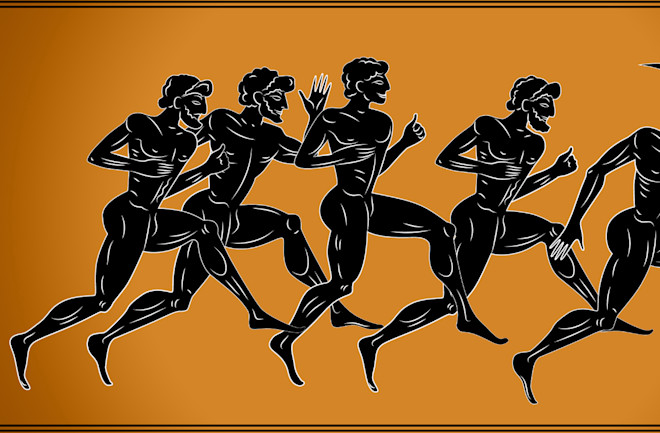
Although this year’s summer Olympics include 33 sports, in the beginning there was only one: a 192-meter sprint called the stadion, or stade. Legend has it that organizers chose this distance because it was how far the mythical hero Heracles (Hercules) could run on a single breath. The track ran the length of the stadium, with the start and finish marked only by dirt lines. 

Stephen G. Miller, a retired professor of classical archaeology at the University of California, Berkeley, says the event likely drew only a few dozen local competitors and spectators at its origin — far from the tens of thousands that attended in later centuries, and further still from the hundreds of thousands today. “The first two winners in the list were both locals from Elis, the second two were from nearby Messene, and then again a winner from Elis,” Miller says. “Indeed, the winners for the first forty years were all from the neighborhood.” 

A cook named Koroibos won the first stadion, but many of the athletes at the time were shepherds and farmhands. Anyone who was male, Greek and free could participate; women, serfs and foreigners could not. 


2. An ancient Greek dating system revolved around the Olympics… 

Just as today, the Olympics were held every four years. The ancient Greeks referred to the period between two Olympics as an “Olympiad,” and it eventually became the basis of a national dating system. Each Olympiad was named after the athlete who won the previous stadion and ancient historians used the system mainly to reconcile historical events. 

For example, Dionysius of Halicarnassus dated the foundation of Rome to the first year of the seventh Olympiad, corresponding to about 751 B.C., and Diodorus Siculus dated the Persian invasion of Greece in 492 B.C. to “the seventy-fifth Olympiad, that in which Astylus of Syracuse won the stadion.” 


“[The system] was based on a list of the winners of the stadion footrace every four years,” Miller says. “But that list was only compiled around 400 B.C. and its accuracy has been debated.” 


3. …but even they didn’t know when the games began

“The Greeks themselves didn’t really know when the games started,” says Paul Christesen, a classics professor at Dartmouth College. “They didn’t keep records about that sort of thing. It’s only about 400 years later that someone who lived near Olympia decided it would be interesting to try to write a book about the history of the Olympics.” 

That person, Hippias of Elis, was the first to compile a list of Olympic victors. Born some 300 years after Koroibos won the first ever stadion, he supposedly counted the number of names on the list and then multiplied that number by four (because the games were held every four years) to determine the year that the Olympics began — 776 B.C. The math is simple enough, but archaeologists have debated Hippias’ work for over a century. 

For one, Hippias didn’t have access to any written records; how could he compile his list of victors? It was known at the time that a man named Lycurgus, guardian to the Spartan King Charilaos, helped found the games. Christesen believes that Hippias actually used a list of Spartan kings (each assigned an average number of years on the throne) to figure out how long ago Charilaos reigned. Then, to cover his tracks, Hippias likely fudged the list of Olympic victors with the names of ancestors from powerful Spartan families. 

“We see it as a big problem to invent that kind of information, but the Greeks just didn’t,” Christesen says. 


4. It was largely a religious event

The ancient Greeks put Olympia on the map around 1100 B.C. when they began using it as a religious sanctuary, says Christesen. They believed that Zeus, king of the gods, took up residence there when the Eleans conquered the surrounding area — and that he hurled a lightning bolt into the olive grove there to prove it. 

Archaeologists deduce from the religious offerings and dedications left in the area that visitors began coming from a much wider geographic area around 700 B.C. Around this time, says Christesen, the sanctuary was expanded to accommodate more people (mainly in the form of additional water wells). The first stadium, built on a floodplain between two rivers, was a simple one: the Greeks merely leveled its rolling hills to create a flat and dry space and the only event, the stadion, finished at the altar of Zeus. During years not marked by an Olympics, the empty land was planted with wheat. 

Over the course of centuries, the site grew to include a bordered sacred area, which contained temples, altars and treasuries, and a secular area that contained training and competition sites. At the height of the games’ popularity in the second century, it is estimated that at least 40,000 people attended — including not just competitors and spectators, but also artists and artisans who hoped to put their talents on display. 

Despite this growth, the ancient Olympics always retained its religious roots. “The third day... was always timed to coincide with the full moon, and that whole day they did nothing but sacrifices to Zeus,” Christesen says. “They sacrificed 100 bulls, just an enormous amount of meat, and then they did a lot of barbecuing and a lot of drinking. It was some sort of pre-game, parking lot sort of deal.” 


5. There were no gold (or silver or bronze) medals

While gold, silver and bronze medals are a familiar sight at the modern Olympic games, prizes for ancient athletes were a little more rustic. Many archaeologists believe first-place winners received a victory wreath, snipped directly from Olympia’s olive trees. “It seems likely to me that the crown of victory was always from Zeus’s sacred olive tree,” Miller says. 

For the ancient Greeks, wreaths were the highest possible reward and represented the esteemed honor of its holder. Additionally, winners may have received a woolen ribbon, called a taenia, to wrap around their heads and a palm frond to brandish. 

After the games, the victorious became important figures in their respective hometowns — often taking on political roles and receiving assorted benefits for life. Each had the opportunity to commission a statue of himself in the sanctuary at Olympia (although only the affluent could afford to do so), ask a poet to write about his gods-granted feat or even have coins made in his likeness. 

In a way, those traditions continue today; Olympic winners hailing from Great Britain can receive stamps featuring their image and the postbox of their hometown in gold. When weightlifter Hidilyn Diaz won the first gold medal for the Philippines this summer, the country’s government and businesses banded together to award her a house, condo and a chunk of change equivalent to about $660,000 U.S. dollars. And a German sponsor once offered free beer for life to whoever brought home the gold. Sadly, for today's Olympians, the offer is no longer valid.

Firefighters continue to battle major fires in Greece, including one that could put the archaeological site of the first ancient Olympic games at risk. Large forces were deployed near the village of Ancient Olympia to protect the site in the west of the Peloponnese peninsula. Ancient Olympia, usually crowded with tourists, was evacuated on Wednesday, along with six other nearby settlements.


After burning some 20 houses, "the fire front is now heading towards the area of Lala," a mountainous forest area northeast of the ancient site, prefect Nektarios Farmakis said on Thursday morning, interviewed by Greek news agency ANA.

Two residents and two firefighters were slightly injured and hospitalised, according to ANA.

On Thursday morning, more than 170 firefighters, helped by about 50 vehicles and six helicopters and water-bombing planes were still battling, assisted by army reinforcements, according to the fire brigade.

Equivalent forces were deployed on the huge island of Evia, some 200 km east of Athens, the scene of a violent and uncontrolled fire that broke out on Tuesday in a mountainous and wooded area, dried out by the scorching temperatures of recent days.

Hundreds of houses were burned as well as more than 25,000 hectares of pine forest, according to initial estimates.

About 90 people were evacuated by sea on Wednesday from Rovies beach in the northwest of the island by the Greek coastguard.

Greece has been battling dozens of fires for the past week in what Prime Minister Kyriakos Mitsotakis called the "worst heatwave" in more than 30 years, with temperatures hovering between 40 and 45 degrees Celsius.

The prime minister stressed "the need for studies" to be done to "avoid further disasters". "If some people are still wondering whether climate change is a reality, let them come here to see the intensity of this phenomenon," he said.

According to Giannis Tsapourniotis, the mayor of Mantoudi, a village in Evia, the raging fire is moving on four fronts, one of which is moving uncontrollably west of the St David's monastery, which was forcibly evacuated on Wednesday. But on Thursday morning, the wind had strengthened and air assets were struggling to fly over the fires as visibility was limited due to thick smoke, according to ANA.

Firefighters said on Thursday morning that they had had to deal with 92 forest fires in the past 24 hours in Greece, out of the 118 counted on Wednesday evening by Deputy Civil Protection Minister Nikos Hardalias. "We are making a titanic effort on several fronts," he also said at a press briefing.

Another fire was underway in Messinia, in the southern Peloponnese, where six municipalities were evacuated as a precaution, according to fire officials.

In honor of the Olympic Games, I'm posting something every now and again about the ancient version of the Games. Today, I would like to discuss some of the specifics of Olympia, the location of the ancient games.


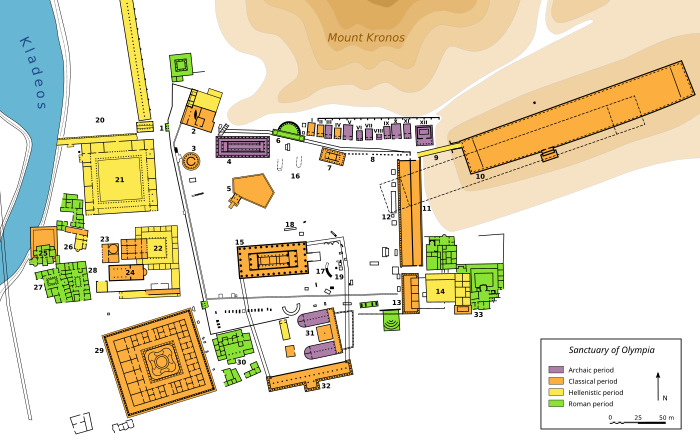
Olympia was a rural sanctuary in a fertile valley between two rivers. It was named for Mount Olympos, home of the Gods. The sanctuary, known as the Altis, consists of an unordered arrangement of various buildings. Enclosed within the temenos (sacred enclosure) are the Temple of Hera (or Heraion/Heraeum), the Temple of Zeus, the Pelopion, and the area of the altar, where the sacrifices were made.

To the north of the sanctuary stood the Prytaneion and the Philippeion, as well as the array of treasuries representing the various city-states. The Metroon lay to the south of these treasuries, with the Echo Stoa to the east. The hippodrome and later stadium were located east of the Echo Stoa. To the south of the sanctuary is the South Stoa and the Bouleuterion, whereas the Palaestra, the workshop of Pheidias, the Gymnasion, and the Leonidaion lie to the west.

The map above displays the location of: 1. Northwest Propylon, 2. Prytaneion, 3. Philippeion, 4. Temple of Hera, 5. Pelopion, 6. Nymphaeum of Herodes Atticus, 7. Metroon, 8. Treasuries, 9. Crypt (arched way to the stadium), 10. Stadium, 11. Echo Stoa, 12. Building of Ptolemy II and Arsinoe II, 13. Hestia stoa, 14. Hellenistic building, 15. Temple of Zeus, 16. Altar of Zeus, 17. Ex-voto of Achaeans, 18. Ex-voto of Mikythos, 19. Nike of Paeonius, 20. Gymnasion, 21. Palaestra, 22. Theokoleon, 23. Heroon, 24. Pheidias' workshop and paleochristian basilica, 25. Baths of Kladeos, 26. Greek baths, 27. and 28. Hostels, 29. Leonidaion, 30. South baths, 31. Bouleuterion, 32. South stoa, 33. Villa of Nero. Treasuries. I. Sicyon, II. Syracuse, III. Epidamnus(?), IV. Byzantium(?), V. Sybaris(?), VI. Cyrene(?), VII. Unidentified, VIII. Altar(?), IX. Selinunte, X. Metapontum, XI. Megara, XII. Gela. [Courtesy of Wikipedia]

Its many foundation myths were emblazoned in sculptures on the fifth-century BC. temple of Olympian Zeus:

- The games were held in celebration of Zeus defeating his father Kronos at Olympia and seized supreme power
- After cleansing the Augean stables and then defeating the local king in battle, Herakles inaugurated the early Games in Zeus’ honor, at this place
- Pelops, Zeus’ grandson, established the games, having won the hand of a local princess, Hippodameia, after sabotaging her father’s chariot to win a race, for which she was the prize. Her father died as a result, and Pelops set up the early competitions in his honor

Whatever the case, the games were a fact and established at Olympia. Most impressive about the temple of Zeus were not the sculptures but the seated statue of Zeus that stood inside the temple. The seated statue, created by the Greek sculptor Phidias, was thirty-nine feet, or twelve meters, tall. Ancient accounts say that, if Zeus would have stood, he would have unroofed the temple.

The statue was richly decorated with ivory and gold-plated bronze. The sculpture was wreathed with golden olive shoots and sat on a grand throne  cedarwood, inlaid with ivory, gold, ebony, and precious stones. He held a small statue of crowned Nike, goddess of victory, in his right hand, and in his left hand, a sceptre inlaid with gold, on which an eagle perched.

The statue was eventually destroyed, either in the fire that also destroyed the temple, or before, when it was carried off by Romans who either used the stone and precious metals to create something new, or to repurpose the statue as a representation of one of their own emperors. While it stood at Olympia, it was the literal seat of Zeus' power, and a focal point of His worship.
As the Roman Stoic philosopher Epictetus wrote:

“You journey to Olympia to gaze on the statue of Zeus and every one of you would think it a great misfortune to die never having seen it.”

The tempe to Hera was used to store some of the key paraphernalia of the Olympic Games, including a discus on which were inscribed the terms of the 'Olympic Truce', proclaimed by itinerant heralds months before the festival began to ensure that participants and spectators could enjoy safe passage.

 I get a lot of questions from readers, and most of the time, the answers are fairly short. When I feel the question or the reply would be valuable to others as well, I make a post with a collection of them and post them in one go. Today is one of those posts.


"I don't read or speak Greek and want to get some ancient texts in book form. Should I get the English versions or the one in my native language? I have looked at those in my native language and most seem greatly influenced by Christianity. "

In general, it helps getting a version translated from the Greek, not the English, if you go for one in your native language. I have a few translations of various books and I have found that those based upon English translations usually base them on order ones--which are greatly influenced by Christian thinking. In general, if you are okay with English, I would go for an English translation.
 
***

 "I wonder, as God of War may involve the main character killing off Olympic gods, if you might find that game blasphemous?"

You know what, I think about things like that a lot, actually. I wonder about it when watching some TV show which does something horrid with the Theoi or play a game or whatever. Is this blasphemous?  And then I read some of the ancient plays and remember that even the ancient Hellenes had no issue at all with using representations of the Gods for their amusement. And the Gods never seemed to mind. There is a difference between the Gods and the characters in these games, movies, and series. Those characters are not my Gods. I think, in general, that distinction is very important to remember.


***

"Is there a certain ceremony I should do to devote myself to Apollon or should I just speak with him and tell him my wishes?"

Oh boy, am I ever not the right person to ask about the Neo-Pagan side of Hellenic Polytheism! Okay, what you ask sounds like personal patronage to me and I feel like that has no place in Hellenismos. Not in the Recon version I practice, anyway. Hellenism has its own beautiful system of kharis, and because of that, there is no need to bring in a modern concept like patrons. Modern patronage is a beautiful thing but unfortunately, I can't answer any questions about it because it's foreign to the ancient Hellenic religion. Sorry.


***

"Should I use diluted or undiluted wine (I only have red is that fine?) in my libation? And if diluted how much should my water to wine ratio be?"

That depends, are you worshipping 'Ouranic' or 'Khthonic' Gods? 'Ouranic' is a term that applies to Theoi and practices who reside or that are associated with Mount Olympos, home of many of the Theoi. As such, Ouranic deities are also referred to as 'Olympians'. Ouranic deities tended to receive wine libations that were mixed with water. 'Kthonic' refers to deities or spirits of the Underworld or the earth, and the rituals associated with Them. Khthonic deities received either wineless libations (water, milk, and honey, usually), or wine libations of unmixed wine.

It's unclear how diluted the wine was for Ouranic libations. Sources state that for a Symposium--a (non-religious) assembly--the best mix (depending on the wine, of course) was one part wine to about three or four parts water, but a dilution of 1/20 appears in the writings of Hómēros. Personally, from experience, I would say that a mixture of one part water to two or three parts water is best. This way the libation doesn't murder your fire.


***

"I've heard some say among our tradition that after death we either become Gods ourselves (Orphic Hellenismos) like Heracles, while others say we pass on to Elysium. I was wondering because you are very much a spiritual leader what you believe on the subject and any details you may provide."

Let me start off by saying I am not an expert in Orphism. I don't follow a Mystery Tradition in my own practice, after all. That having been said, let me give this a try.
 
Orphic ideas of the soul and afterlife are most often defined by explicit contrast with the Homeric view of the afterlife, which is taken as the standard view for ancient Hellenic culture. The Homeric afterlife is that of a grim, joyless and tedious existence in the Underworld. The Underworld of Homeros exists solely--at least for the now departed mortal--of the Asphodel meadows. The dead drink from the river Lethe and forget who they were. Sacrifical (animal) blood returns a sense of life to the shades and they recover their memories for a short time. In this tradition, life is lived while you are alive. One you die, you are dead. You might cling to life, but you will never truly be part of it again.
 
The Orphics were an ancient mystical cult with affinities to Indian religious systems. They believed in reincarnation and the possibility of liberation. Orpheus, the movement's legendary founder, is said to have taught that soul and body are locked together during life; the soul is divine, immortal and aspires to freedom, and during life, the body acts as a prison to the soul. Death releases the soul for a short while, but is then captured by another body until that, too, dies, and so the soul moves from body to body--both human and animal--until it can attain the highest good: liberation. In order to reach liberation, the Orphic way teaches to turn to God by ascetic piety of life and self-purification: the purer the life lived, the higher will be the next reincarnation, until the soul has completed the spiral ascent of destiny to live for ever as God from whom it comes.
 
The ancient Hellenes called this process 'Metempsychosis' (μετεμψύχωσις). It is a philosophical term which refers to the transmigration of the soul, especially its reincarnation after death. The notion that the human soul enters another body upon death, though unfamiliar in Hellenic religion, was widespread in Hellenic philosophy. The doctrine of transmigration is first associated with the Pythagoreans and Orphics and was later taught by Plato and Pindar. For the former groups, the soul retained its identity throughout its reincarnations; Plato indicated that souls do not remember their previous experiences. Although Herodotus claims that the Hellenes learned this idea from Egypt, most scholars do not believe it came either from Egypt or from India, but developed independently.
 
My personal believes of life after death have shifted over the years. I transitioned into Hellenismos from Eclectic Religious Witchcraft and in my former Tradition, reincarnation was the primary belief. Since the ancient Hellenes had a version of it in metepsychosis, I simply went with that. Now, the older I get and the better my understanding becomes of the ancient Hellenic culture and religion, the more I pull to a more Homeric version of the afterlife. A bit later, perhaps, where Elysium is an option for those who live the highest, purest, of lives. I long for the meadows now. I don't strive for Elysium; I don't think it's for the common folk like me. Give me the meadows and the water of the river Lethe. Let me live life to the fullest. Let me live its up and downs. Give me the completion of my goals and my challenges, and then let me forget and wander in contentment, remembered sometimes--hopefully fondly--by those I leave behind.

Wicker baskets filled with fruit that have survived from the 4th century BC and hundreds of ancient ceramic artefacts and bronze treasures have been discovered in the submerged ruins of the near-legendary city of Thonis-Heracleion off the coast of Egypt.

They have lain untouched since the city disappeared beneath the waves in the second century BC, then sank further in the eight century AD, following cataclysmic natural disasters, including an earthquake and tidal waves.

Thonis-Heracleion – the city’s Egyptian and Greek names – was for centuries Egypt’s largest port on the Mediterranean before Alexander the Great founded Alexandria in 331BC. But the vast site in Aboukir Bay near Alexandria was forgotten until its re-discovery by the French marine archaeologist Franck Goddio two decades ago, in one of the greatest archaeological finds of recent times. Colossal statues were among treasures from an opulent civilisation frozen in time. Some of the discoveries were shown in a major exhibition at the British Museum in 2016.

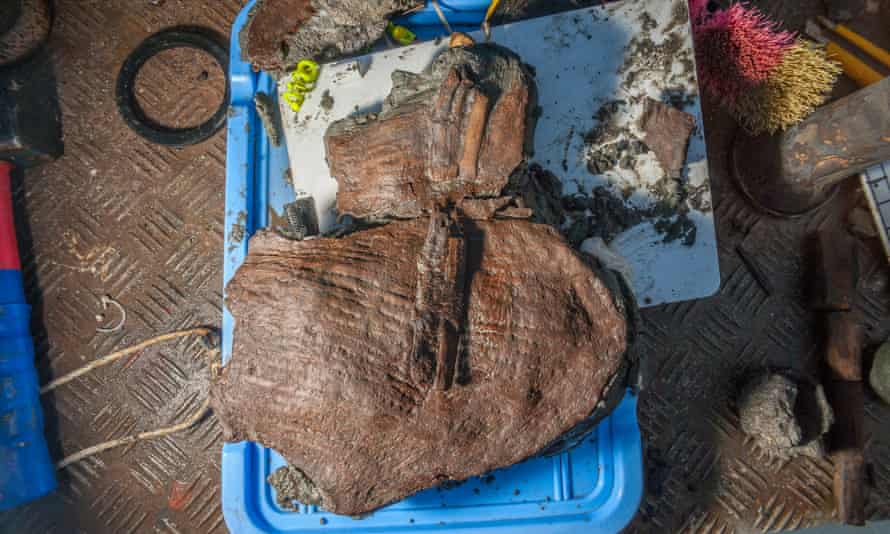
Goddio has been taken aback by the latest discoveries. He told the Guardian that the fruit baskets were “incredible”, having been untouched for more than 2,000 years. They were still filled with doum, the fruit of an African palm tree that was sacred for the ancient Egyptians, as well as grape-seeds.

“Nothing was disturbed. It was very striking to see baskets of fruits.”

One explanation for their survival may be that they were placed within an underground room, Goddio said, noting a possible funerary connotation. It is within an area where Goddio and his team of archaeologists have discovered a sizeable tumulus (a mound raised over graves) – about 60 metres long by 8 metres wide – and sumptuous Greek funerary offerings.

They date from the early fourth century BC when Greek merchants and mercenaries lived in Thonis-Heracleion. The city controlled the entrance to Egypt at the mouth of the Canopic branch of the Nile. The Greeks were allowed to settle there during the late Pharaonic period, constructing their own sanctuaries. Goddio said of the tumulus:

“It is a kind of island surrounded by channels. In those channels, we found an unbelievable amount of deposits made of bronze, including a lot of statuettes of Osiris [the ancient Egyptian fertility god]. On that island, something totally different. We found hundreds of deposits made of ceramic. One above the other. These are imported ceramic, red on black figures from Attic.”

The finds are all the more intriguing because there were vast quantities of miniature ceramics – high-quality Ancient Greek examples, including amphorae– under the tumulus. Bronze artefacts were around the tumulus, including mirrors and statuettes.

Goddio also found extensive evidence of burning, suggesting a “spectacular” ceremony that led to people being barred from entering this site again. It appears to have been sealed for hundreds of years as none of the artefacts found were from later than the early fourth century, even though the city lived on for several hundred years.

“There’s something very strange here. That site has been used maybe one time, never touched before, never touched after, for a reason that we cannot understand for the time being. It’s a big mystery.”

He hopes to find answers within some of the treasures, which include the well-preserved remains of a wooden sofa for banquets, a large Attic vase and a gold amulet of “exquisite quality”.

About 350 metres away, the archaeologists also found a unique Ptolemaic galley, 25 metres in length. While built in the classical tradition, with mortise-and-tenon joints, it also contains features of ancient Egyptian construction, with a flat-bottomed design that would have been perfect for navigation on the Nile and in the delta.

The European Institute for Underwater Archaeology, led by Goddio, works in close cooperation with Egypt’s ministry of tourism and antiquities and with the support of the Hilti Foundation. The finds will be studied and preserved before being put on display in museums.

The potential for further discoveries is tantalising. Even after conducting repeated excavations over the past two decades, Goddio estimates that only about 3% of the area has been explored so far.

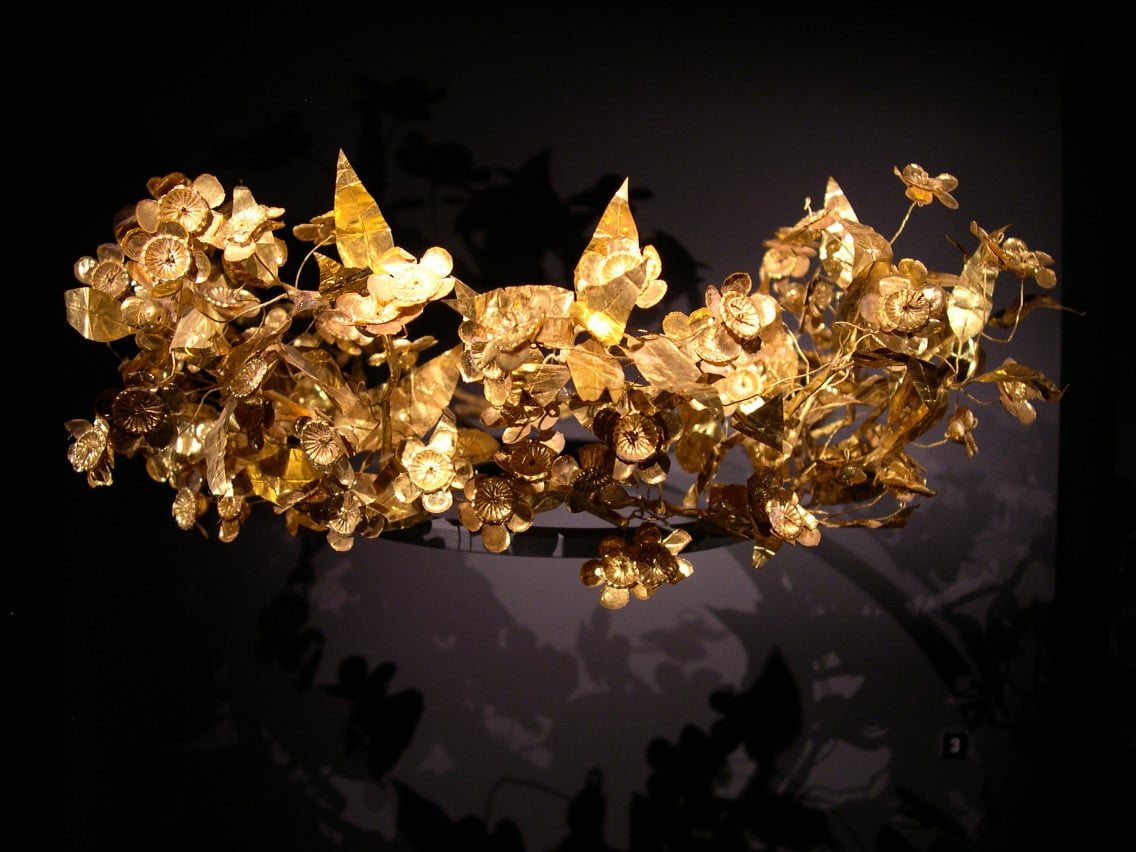
In Somerset, England, a British pensioner who wishes to remain anonymous found a 2,300-year-old ancient Hellenic crown packed up in some crumpled up newspapers in an old cardboard box under his bed. According to Daily Mail, which interviewed the man, he had had many possessions left to him by his grandfather, who was a seasoned world traveler and collector.

“I inherited quite a lot of things from him and I just put this to one side for almost a decade and didn’t really think anything of it.”

He took the golden crown, along with some other items, to be appraised by a nearby auction house, Duke’s of Dorchester, about five years ago. It was there that the crown was discovered by one of the appraisers, Guy Schwinge; he described that unforgettable moment to the Daily Mail. 

“When the owner pulled the gold wreath from a tatty cardboard box filled with paper, my heart missed a beat. When I went to the cottage the last thing I expected to see was a piece of gold from antiquity.”

The handmade crown, made of pure gold, is approximately eight inches across and weighs about 100 grams (about 11 ounces, less than one pound). The rare find surprised both the owner as well as the appraiser.

“I knew my grandfather traveled extensively in the 1940s and 50s and he spent time in the northwest frontier area, where Alexander the Great was, so it’s possible he got it while he was there. But he never told me anything about this wreath.”

The mystery, therefore, will remain.

The crown is believed to be from antiquity in Northern Greece, dating as far back as the Hellenistic period, which took place from the death of Alexander the Great in 323 BC and the emergence of the Roman Empire at the Battle of Actium in 31 BC. It has been reported that the crown is worth as much as £100,000 to £200,000.

It is not easy to trace the exact lineage of the crown since it has no paper trail or documents, but because it was found with traces of dirt, it is believed that it may have been buried at some point in time.

“It is notoriously difficult to date gold wreaths of this type. Stylistically it belongs to a rarefied group of wreaths datable to the Hellenistic period and the form may indicate that it was made in Northern Greece.”

Crowns such as the one discovered usually depicted branches of laurel, myrtle, oak and olive trees, all symbolic of the ideals and morals held in ancient Hellas such as wisdom, triumph, fertility, peace and virtue.

The crowns, which are extraordinarily fragile, were typically worn on special occasions or dedicated to the gods and placed as offerings at the graves of aristocratic people in ancient times.