On the day of the Hene kai Nea, I post a monthly update about things that happened on the blog and in projects and organizations related to it. I will also announce Elaion's coming PAT rituals.


Statistics:
PAT rituals for Pyanepsion:
  • 6 Pyanepsion - 13 October - Proerosia - agricultural festival for Demeter held at Eleusis
  • 7 Pyanepsion - 14 October - Pyanepsia - festival in honor of Apollon and Theseus
  • 7 Pyanepsion - 14 October - Oskhophoria - festival of the vintage (grapes)
  • 8 Pyanepsion - 15 October - Theseia - festival in honor of Theseus
  • 9 Pyanepsion - 16 October - Stenia - women's festival in honor of Demeter and Persephone
  • 11-13 Pyanepsion - 18 - 20 October - Thesmophoria - festival in honor of Demeter
  • 14 Pyanepsion - 21 October - Sacrifice to The Heroines at Erkhia
  • 16 Pyanepsion - 24 October - Apatouria - paternity festival. The first day (Dorpia) was celebrated with a communal feast within the brotherhood, the second day ('Anarrhusis') sacrifice were made to Zeus Phratrios and Athena Phratria, and the third day ('Koureotis') young boys admitted to their father's brotherhood.
  • 30 Pyanepsion - 5 November - The Khalkeia - festival in honor of Athena and Hephaestus.

Anything else?
Are you looking for an online shop to buy incenses and other Hellenistic basics from? Try The Hellenic Handmaid on Etsy.

Would you like to support me? Buy me a coffee.

I get a lot of questions from readers, and most of the time, the answers are fairly short. When I feel the question or the reply would be valuable to others as well, I make a post with a collection of them and post them in one go. Today is one of those posts.


"Hello there. I have always felt a weird connection to the old greek gods, even when I was a child and now that I am an adult I finally want to try out my spiritual side. I finally want to try out something, maybe a prayer or ritual, but I don't want to offend the gods on accident. So, do you have a tip for me? I really need your help..."

First off, let me say I am very happy to hear you are looking to find a way to start honoring the Theoi--the Hellenic Gods. I can understand how this could be daunting. I'm going to provide a few links to get you started on some reading and watching and from there on, I think you'll be more able to ask direct questions for which I might provide the answer.

The Beginner's guide to Hellenismos: Introduction
The beginner's guide to Hellenismos: Traditional versus Reformed
The Beginner's guide to Hellenismos: Ritual and sacrifice in Hellenismos
The Beginner's guide to Hellenismos: Ouranic versus Khthonic

These should get you started on the basic theory and thinking behind the practice of Hellenismos. then there is the practical side. For that, I'd like to reffer you to some of my videos, which show some of the basics. If you would like to read more about ancient Hellenic ritual and prayer (and adapting it to modern times), please see these two posts: Ancient Hellenic festival rituals, and their modern day versions and On prayers and hymns.

I want to leave you with a last link, one on hubris. You express a concern of 'doing it wrong'; I don't believe in that. This post explains why and it might offer some comfort and encuragement.

~~~
 
"I was wondering about the liquids used in libations. I currently use a dark red wine for my morning and evening rituals as well as for most of the festivals What I was wondering about was when it would be more appropriate to use something other than wine as a libation. I've read several conflicting accounts where the dead and Chthonic deities are not given wine as a libation and others where it is instead un-mixed wine. Also, how do you determine if a deity is chthonic?"

Ouranic deities tended to receive wine libations that were mixed with water. Khthonic deities received either wineless libations (water, milk, and honey, usually), or wine libations of unmixed wine. 'Ouranic' is a term that applies to Theoi and practices who reside or that are associated with Mount Olympos, home of many of the Theoi. As such, Ouranic deities are also referred to as 'Olympians'. 'Kthonic' refers to deities or spirits of the Underworld or the earth, and the rituals associated with Them. Then there are some we know from the ancient writings.

So, some examples: Apollon (ouranic) recieves mixed wine libations. Gaia (kthonic, earth) recieves water libations (usually khernips), or milk, or honey. Water for the nymphs (kthonic, earth), unmixed wine to Persephone (kthonic), milk (usually kykeon) to Demeter (kthonic, earth), etc.

~~~

"Just a few days ago was the Diasia, in honor of Zeus Meilichios. I've read that sacrifices to Zeus Meilichios are made as a holokaustos. This got me wondering, when else would you make offerings as a holokaustos? For the dead, certainly, but where else would such a sacrifice be appropriate, and how do you decide when to perform it in lieu of the more common sacrifice where you consume a part of it?"

Some definitions first: worship in ancient Hellas typically consisted of sacrificing at the altar with hymn and prayer. Holokautein (ὁλοκαυτεῖν) were sacrifices in which the sacrifice--domestic animal, fruits, cakes, wine, etc.--was utterly destroyed and burnt up, as opposed to thyesthai (θύεσθαι), in which the sacrifice was shared with the Gods in question and one's fellow worshippers. In the case of a latter animal sacrifice, the edible parts of the sacrificed animal were roasted or boiled and distributed for festive celebration, whereas the inedible parts were burned or placed on the altar, those being the Gods' share.

Let me now say that there is no list; well, I could probably make one but that would be highly impracticle and I would most likely forget two thirds of divinities and others who recieve(d) sacrifice. I can make a general working formula for you though: Ouranic deities (so any deity (!) who lives on the Earth, on Olympos, or in the sea) were honored with thyesthai. The Khthonic, or Underworld, deities, malign deities, heroes, the dead, ghosts and nymphs and their ilk recieved holókautein.

This distinction is very black and white, but there were variations, especially between city-states, but sometimes even within a single city-state. Context was important, but as a working model, the distinction above is useful. So, why this divide?

Sacrifices to the Ouranic deities were given to establish kharis: the act of giving to the Gods so They might give something in return. It's religious reciprocity. It is important to realize that even a sacrifice where the worshippers share in the sacrifice is essentially a holókaustos: the entire sacrifice is given to the Gods in question, but as part of kharis, the Gods do not take all of it, but give part of it back to Their worshippers to sustain them and reward them for their worship. So the entire sacrifice is property of the Gods as soon as it is dedicated to Them (a procession to the altar is sufficient for that, but hymns and prayers aid this proccess), but They share it with us. This way, kharis is established right away: I give to You, You give to me, and so we sustain and honor each other.

For holókautein, I am going to disregard the nymphs for a bit and come back to them later. Kharis need not be established with Khthonic deities: for us humans, we will go to the Underworld regardless of good standing. As with Ouranic sacrifices, the entire sacrifice belongs to the intended force as soon as it is dedicated to them, be it Underworld Gods, or the dead in any form (heroes, after all, are dead as well). As humans, we try not to get in contact with the Underworld, as it brings miasma with it: miasma describes the lingering aura of uncleanliness in regards to a person or space through which contact is made with the Gods.

If we were to partake from food that belongs to the Underworld (because we gave it to its deities), we would take something of the underworld inside of us, and as the myth of Persephone clearly states, this means you would become part of the Underworld itself. In my opinion, this is the main reason why we give holókautein to the Underworld deities and the dead.

As for the nymphs: they are a story unto themselves. We have very little factual information on the worship of nymphs. We know it took place, we know they receive libations (mostly of honey and water), and we know they had sactuaries which were sometimes tended to full time by self-appointed priests. There are, however, many forms of the nature spirits we call nymphs. Some are Ouranic in character, some Khthonic, so it varies what kind of sacrifice they got and get. Even more so, some source material (including Oedipus at Colonus by Sophocles) features libations of water and honey to non-specified nymphs, but which seem to have an Ouranic character. As such, I tend to give holocaustal sacrifices to the nymphs, just to be on the safe side.

~~~
 
"What are your thoughts on libations to Heroes? Is there any difference in the ritual or offerings from the template you presented in your video? It feels appropriate to me to make offerings in honour of Emperor Julianos and Hypatia of Alexandria, and I want to be correct in going about it."

Heroes and heroines have a special place in Hellenismos, as they had in ancient Hellas. These were humans--most with at least a part divine heritage--who were considered so brave, so skillful, so extraordinary in their lifetime that they became revered. Some were priests or priestesses of a temple, some excelled in battle, others were skilled healers or good rulers. Once they passed to the realm of Haides, their names were remembered at least once a year on a special ocassion, because the ancient Hellenes believed that if the name and deeds of a person were remembered, they would live forever and potentially look out for those they had looked out for before.

Although linked, hero worship in ancient Hellas was not the same as ancestoral worship; heroes and heroines transcended family bonds.Archeological evidence suggests that hero worship was closer to Khthonic sacrifices in execution than Ouranic ones the further back in time you go; especially in the archaic period, it seems that hero worship consisted of destructive sacrifices--sometimes in the form of a holókaustos where the entire animal was burned, sometimes in a sacrifice where only a part (most often 'a ninth' of the animal) was burned and the rest remained on the altar for the heroes to eat from until gone.

The sacrifices were generally burned in an offering pit known as a bothros. The food offered to heroes consisted of meat, blood, and 'food eaten by men' like grains, fruits and other every-day dishes. These were usually offered to the heroes on a table--known as a trapeza--and the heroes were sometimes offered chairs or a bench to sit on. As time went on, the living began to eat part of the meal laid out for the heroes, joining them in celebration.

~~~

"This might be a stupid question but, well... How do you burn your offerings to the Theoi? I use ethanol (96º) as fuel, but libations, when poured, even small quantities, just put the fire out. Constantly refueling and relighting the fire distracts me from ritual and I'm considering just not burning my offerings, but I'd like to know if I'm doing something wrong. Thanks in advance!"

For me, the answer is to use a healthy pouring of ethanol, a small measure of liquids per libation, poured out along the edge so it can slide in from the side, and to use small chunks of sacrificial material when solid. The shape of your bowl might also have something to do with your issues: fire needs oxygen. In a narrow, high bowl that is a lot trickier than with a wide, low bowl like I use. Also: this issue was the exact reason Hellenic worship is supposed to include the whole family (at least). That way, one person can tend the fire throughout the ritual.

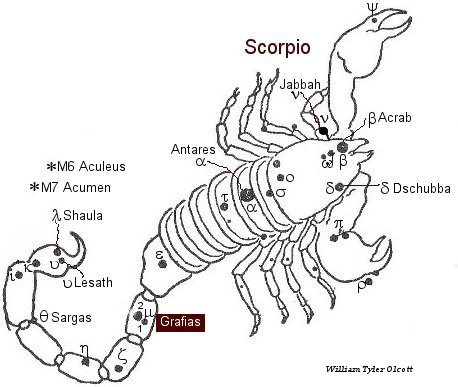
Today I'd like to present you with another constellation as part of my Constellation Series. We have gotten to the constellation Scorpio, the scorpion.


In Hellenic Mythology the myths associated with Scorpio almost invariably also contain a reference to Orion. Orion (Ὠρίων) was a famed hunter who has a lot of mythology to his name. He is the son of Poseidon and has the ability to walk on water. It is said that he once, when drunk, tried to force himself upon Merope, the daughter of Oenopion and was blinded and exiled because of it. Hēlios eventually healed his injury and restored his eyesight. After a failed vengeance attempt, Orion came to Krete and begun  to hunt with Artemis. According to Hyginus' Astromomica, this eventually lead to his downfall:

"Orion since he used to hunt, [...] felt confident that he was most skilled of all in that pursuit, said even to Diana [Artemis] and Latona that he was able to kill anything the produced. Earth [Gaea], angered at this, sent the scorpion which is said to have killed him. Jove [Zeus], however, admiring the courage of both, put the scorpion among the stars, as a lesson to men not to be too self-confident. Diana, then, because of her affection for Orion, asked Jove to show to her request the same favour he had given of his own accord to Earth. And so the constellation was established in such a way that when Scorpion rises, Orion sets." [2.26]

In this scenario, the Scorpion was admitted into the heavens as well, along with his hunting pack and his greatest hunt: the Lepus the hare. In some old descriptions the constellation of Libra is treated as the Scorpion's claws. Libra was known as the Claws of the Scorpion. Hyginus makes the connection between the scorpion and the scales best:

"This sign is divided into two parts on account of the great spread of the claws. One part of it our writers have called the Balance." [II. 26]
 
The constellation Scorpio is visible at latitudes between +40° and −90° and best visible at 21:00 (9 p.m.) during the month of July.

The Tomb of Nestor’s Cup, a burial that contained one of the oldest known Greek inscriptions, housed the cremated remains of at least three individuals, it turns out. A new study sheds some light on this enigmatic burial from nearly 2,800 years ago on a southern Italian island, but still doesn’t tell us who exactly was laid to rest there, or why they were memorialized with a dirty limerick that mocks the epic poetry of Homer’s Iliad and Odyssey.

First uncovered in the 1950s, the tomb was one of thousands of burials in the necropolis of Pithekoussai, one of the first overseas colonies of the ancient Greeks, located on the picturesque island of Ischia, just off Naples.

The burial contained a rich set of grave goods, including a silver brooch and two dozen fragmented pottery vessels. But what captured the attention of the archaeologists was a small ceramic wine cup dated to second half of the eighth century B.C.E.

Decorated with simple black geometric motifs, the cup had been imported from the Greek island of Rhodes. At some point after it was made, somebody scribbled on it the following text: “I am Nestor’s cup, good to drink from. Whoever drinks this cup empty, straightaway desire for beautiful-crowned Aphrodite will seize him.”

The inscription is fragmentary so the exact translation is a matter of some debate, and some scholars read the first part as reciting “Nestor’s cup was good for drinking, but whoever drinks from this cup… etc. etc.

The text is a clear, if somewhat parodic, reference to Nestor, king of Pylos and one of the Greek heroes in Homer’s Iliad. Nestor owned a giant golden chalice so heavy that, when it was filled with wine, “another man could scarce have availed to lift that cup from the table.” (Iliad, book 11, 635)

Previous studies of those fragments concluded that the tomb belonged to a child ages 10 to 14. That was even more surprising: yes, children in ancient Greece could be the introduced to wine as early as age 3 (especially since alcohol could often be safer than water taken form polluted sources). But still, a funerary offering with an inscription promising lustful delights seemed more suited for a raucous banquet than a child’s burial.

Now, a new study, published Wednesday in the journal PLOS ONE, has reexamined those burnt fragments performing a microscopic analysis of the bone tissues.

Of 195 fragments in the tomb, only about 130 were human, while at least 45 belonged to animals, including goats and possibly dogs. These may have been included as food and/or companions for the deceased, says Melania Gigante, a bioarchaeologist at the University of Padua, who led the study.

As for the human fragments, Gigante and colleagues analyzed the amount of bone remodeling that had occurred in the remains. During our lifetime, old bone tissue is constantly being replaced with newly formed bone, in a process that leaves microscopic evidence of how much remodeling has occurred, Gigante explains. This in turn can give us an indication of an individual’s age at death, she says.

The bone fragments could be grouped into three distinct age groups, the researchers found, meaning that at least three individuals were buried in the tomb. While heat damage from the cremation made it impossible to determine their ages with precision, none of the bones belonged to a child, Gigante and colleagues conclude.

The triple burial is unique in Pithekoussai’s necropolis, where all the tombs that contained non-cremated remains were found to house one or two individuals at most, Gigante tells Haaretz. Burial within the same tomb usually indicates there was a bond between the deceased, but whether in the Tomb of Nestor’s Cup these ties were familial, social or of some other kind we will probably never know. The extensive damage from the cremation fire makes it impossible to extract DNA from the remains to check whether the deceased were kin, she notes.

Still, Gigante hopes future research will be able to reveal more about those buried with Nestor’s Cup. This artifact and its context have fascinated scholars for decades, for a number of reasons.

Firstly, the cup gives us some crucial information about the history of Homer’s poems and their composition. It suggests that by the eighth century B.C.E. the oral traditions that formed the epic story of the Trojan war must have already been put in writing and widely circulated across the Mediterranean – to the point that they could inspire satirical imitation at Pithekoussai.

The inscription also gives us information about the early history of the alphabet itself. Nestor’s Cup is considered one of the two earliest known texts written in the Greek alphabet. The other is the Dipylon inscription, a shorter text which was found in the Dipylon Cemetery in Athens. It too is dated to the second half of the eighth century B.C.E. and scribbled on a wine jug (apparently the ancient Greeks really liked to drink and write).

The phonetic alphabet that eventually became the basis for most modern western writing systems is believed to have first been developed nearly 4,000 years ago by Canaanite laborers in Egypt who couldn’t handle hieroglyphics. Over the centuries, the alphabetic system spread back to the Levant and was adopted by the Phoenicians. Sailing from the coast of what is today northern Israel and Lebanon, Phoenician merchants and colonists spread throughout the Mediterranean taking with them their script and giving rise to variants of their alphabet used to write Hebrew, Arabic, Greek, Latin and other languages.

We don’t know exactly where the Phoenicians and the ancient Greeks first met, but Pithekoussai was most probably one of the earliest points of contact. The settlement on Ischia was founded by Greeks from the island of Euboea in the early eighth century B.C.E. – and is considered the first Greek colony in the western Mediterranean. At the same time the Phoenicians had already expanded across the region, founding colonies like Carthage, in today’s Tunisia, which would later play its own key role in history.

Pithekoussai was in an ideal position to function as a key trading post, not only with the Phoenicians, but also with the Etruscans, Latins and other local Italic peoples.

And in fact, archaeological finds at the ancient settlement and its necropolis have shown that the residents of the colony, who numbered in the thousands, likely hailed from all these groups and formed a cultural melting pot. 

Different funerary rites, like the co-existence of cremation and burial; artifacts of Greek, Italic and Phoenician origin; and ancient written sources all point to “Pithekoussai as a mixed society composed of different cultural and ethnic identities where people with non-native ancestries and origins lived together with the locals,” Gigante says.

Nothing exemplifies better this Mediterranean melting pot as Nestor’s cup: a ceramic vessel from Rhodes, inscribed with a reference to Greek myths on a war in Anatolia written in an alphabet influenced by the Phoenicians, buried in a tomb on an Italian island.

Perhaps Nestor’s Cup and its bawdy limerick were nothing more than the result of a drinking game or the halting debut of an aspiring poet, but for us they open up a glimpse onto an entire world from thousands of years ago. This world has long turned to dust, but it has also influenced our present in more ways than we can imagine – including by shaping the letters you are reading right now.

How about a little overview today? An overview of the fertility gods of Hellenismos. I'm going to start off with a lesser known deity: Priapos (Πριαπος), protector of sheep, goats, bees, the vine and of all garden produce. He was depicted with a huge male member, and can be petitioned for aid with any issues regarding the male genitalia. He was native to the Mysian city of Lampsakos on the Hellespont but the ancient Hellenes adopted the God as the son of either Hermes or Dionysos. His mother was usually Aphrodite. Fun fact: primitive statues of Priapos were traditionally set-up in vegetable plots to promote fertility with the added benefit of functioning as a type of 'scarecrow' scaring away birds.


Rhea (Ρεα), wife of Kronos, is a female fertility Goddess--amongst other things. She also looks after mothers and children, and is one of the great mother Goddesses in the pantheon having obviously given birth to the Olympians. Anything female-related (including issues with fertility) can be put before Her. Hera, by the way, has many of the same domains as Her mother--logical as she is the new generation's mother figure.

Aphrodite is also a fertility Goddess. She along with Zeus, Hera, Eileithyia and Hymenaios were the Theoi Gamelioi (Gods of Marriage) who presided over the wedding rites. She was invoked as the Goddess of the consummation of marriage and the fertility of the bride.

Speaking of which, Eileithyia (Ειλειθυια) is the Goddess of childbirth and labour pains. According to some there were two Eileithyiai, one who furthered birth and one who protracted the labour. Her name means 'she who comes to aid'.

Demeter and Persephone were regarded as fertility Goddesses in the Eleusinian Tradition, and during Their Thesmophoria festival, women actively asked for fertility from Them. Demeter, especially, is obviously also very important for the growth of plant life.

Dionysos is mostly associated with the fertility of the soil, and especially in regards to the grape vine, but human fertility is amongst His descriptors. Pan is regarded as much the same, as are many of the Satyrs and daimons connected to Them--like Tykhon, Konisalos, and Orthannes.

Phanes (Φανης) is the Protogenos of procreation in the Orphic cosmogony. He is the primal generator of life, and was the driving force behind reproduction in the early cosmos. Phanes was hatched from the world egg when it was split into its constituent parts by the ancient gods Khronos and Ananke. Arguably, He still drives the process of reproduction, be it in plants, animals, or humans.

In a potentially game-changing development in Athens’ near 40-year campaign to repatriate the Parthenon Marbles, currently exhibited at the British Museum, a UNESCO committee has issued a decision urging the United Kingdom to enter into talks with Greece over the dispute.

Sources told Ekathimerini the decision by the “Return and Restitution” intergovernmental committee, also known as ICPRCP, at its session in Paris late September “shook” British officials as it effectively elevated the dispute between Greece and the London-based institution into a government-to-government issue.

The decision marks a shift in ICPRCP policy, which had over the past 34 years issued 17 recommendations.

Speaking to Ekathimerini, a spokesperson for the British Museum did not directly comment on the development.

“Museums holding Greek works… are naturally united to show the importance of the legacy of ancient Greece,” the spokesperson said, adding that the institution “is committed to playing its full part in sharing the value of that legacy.”

“The trustees want to strengthen existing good relations with colleagues and institutions in Greece, and to explore collaborative ventures directly between institutions, not on a government-to-government basis,” the spokesperson said. 

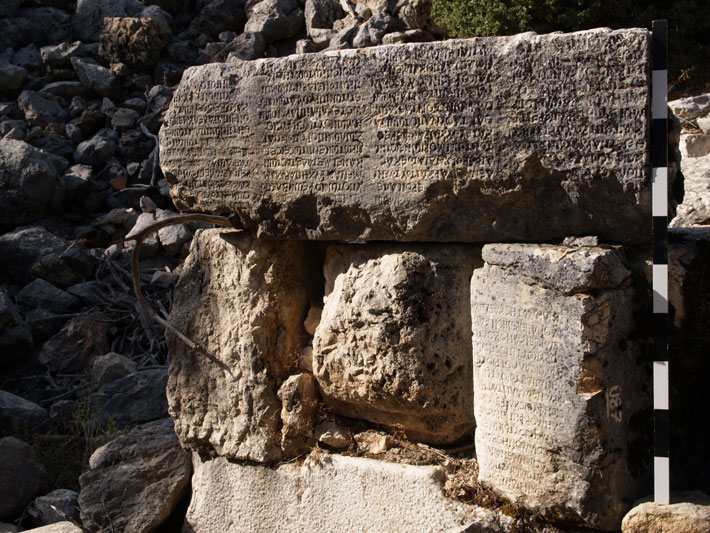
At a remote site in Turkey, archaeologists recently discovered fragments of the ancient world’s most massive inscription — and of course, it was in Greek — touting the benefits of the philosophy of Epicureanism.

The inscription, a quote from the Second century AD philosopher Diogenes, exhorts readers to follow Epicureanism, the way of life that encourages its adherents to seek modest, sustainable pleasure in the form of a state of ataraxia (tranquility and freedom from fear) through knowledge of the workings of the world, and limiting their desires.

One of ancient Hellas’s most notable schools of philosophy, it was created by Epicurus, who lived in the fourth century BC. Originally meant as a challenge to Platonism, it propounded the avoidance of all things that would cause pain in life along with the seeking of all that was just and desirable. Later opposed by the Stoics, it has at times been equated with the inordinate love of food and all things sensual, but this was far from the ideal as espoused by Epicurus.

One of the many schools of the ancient Hellenic philosophers, Epicureanism had one of its most zealous believers in Diogenes of Oenoanda, a wealthy disciple, who had a portico wall inscribed with tenets of the philosophy erected in the ancient Hellenic city of Oenoanda, Lycia.

Epicurus was an atomic materialist, leading him to assail the evils of superstition and divine intervention in every single event — such as weather — that occurred on the Earth.

Although Epicureanism is a form of hedonism insofar as it declares pleasure to be its sole intrinsic goal, its concept that the absence of pain and fear constitutes the greatest pleasure, and its advocacy of a simple life, make it very different from hedonism, or the unbridled pursuit of bodily pleasures.

Epicureanism flourished in the Late Hellenistic era and during the Roman era, and its followers established their own communities, such as those in Antiochia, Alexandria, Rhodes, and Herculaneum.

By the late 3rd century AD Epicureanism all but died out, however, being opposed by other philosophies (mainly Neoplatonism) that were now in the ascendant, as well as early Christianity. But interest in Epicureanism was resurrected in the Age of Enlightenment and it continues today in the modern era.

In Oinoanda, we can see just how much the philosophy meant to Diogenes, who inscribed his words in support of Epicureanism on the wall of a stoa, or portico, in a public square. Later dismantled and reused as building material by the Ottomans, the monumental rock with its inscription has at least survived to this day, a testament to a bygone world.

In the winter of 1884, two young French epigraphers who were exploring the ruins of the ancient city, located in what is now southwestern Turkey, discovered five stone fragments inscribed with the writings of the long-forgotten philosopher now known as Diogenes of Oinoanda.

Scattered in ruins on a hilltop that was by then covered in cedar trees, they found the massive stone with its inscription, in which Diogenes explains why he committed his thoughts to posterity.

“The majority of people suffer from a common disease, as in a plague, with their false notions about things, and their number is increasing. …I wished to use this stoa to advertise publicly the (medicines) that bring salvation.”

His words, now made immortal by having them carved into stone, make clear that he hoped Oinoandans and others who gazed at the stone would consider his words and be converted to the Epicurean school of thought.

After the discovery of the five fragments was published and their significance understood, French and Austrian archaeological teams visited the area between 1885 and 1895, recovering another 83 fragments of the inscription.

Today, it remains the only ancient philosophical text from the Hellenic and Roman world to have survived in its original form, according to Archaeology Magazine. A translation of the entire stone reads, in part: 

“As for the first bodies, also called elements, which on the one hand have subsisted from the beginning and are indestructible, and on the other hand generate things, we shall explain what they are after we have demolished the theories of others.”

Epicureanism argued that pleasure was the chief good in life, advocating living in such a way as to derive the greatest amount of pleasure possible during one’s lifetime, yet doing so moderately in order to avoid the suffering incurred by overindulgence in such pleasure.

The philosophy is often misunderstood, with an emphasis actually placed on pleasures of the mind rather than on physical pleasures. Unnecessary desires were to be suppressed, according to Epicurus.

The philosopher also sought to eliminate the irrational fear of the Gods and of death, seeing those two fears as chief causes of strife in life. He also actively recommended against passionate love, as an unnecessary desire that should be avoided.

“I learn that your bodily inclination leans most keenly towards sexual intercourse. If you neither violate the laws nor disturb well established morals nor sadden someone close to you, nor strain your body, nor spend what is needed for necessities, use your own choice as you wish. It is sure difficult to imagine, however, that none of these would be a part of sex because sex never benefitted anyone.”

Epicurus taught and gained followers in Mytilene, the capital of the island Lesbos, and then in Lampsacus and Athens, Epicurus bought a property in Athens for his school, which he called the “Garden.” Emphasizing friendship as an important ingredient of happiness, the Epicurean schools were very open to new adherents and fairly cosmopolitan by Athenian standards of the day — even including women and slaves among their ranks.

Epicurus laid such emphasis upon developing friendships as the basis of a satisfying life that he said, as quoted by Cicero:

“Of all the things which wisdom has contrived which contribute to a blessed life, none is more important, more fruitful, than friendship.”

The philosophy’s popularity grew and it became, along with Stoicism, Platonism, Peripateticism, and Pyrrhonism, one of the dominant schools of Hellenistic philosophy, lasting through the later Roman Empire.

Deciphered carbonized scrolls obtained from the library at the Villa of the Papyri in Herculaneum contain a large number of works by Philodemus, a late Hellenistic Epicurean, and even Epicurus himself, attesting to the school’s enduring popularity.

While the pursuit of pleasure formed the focal point of the philosophy, this was largely directed to minimizing pain, anxiety and suffering. In fact, Epicurus referred to life as a “bitter gift” in his “Letter to Menoeceus”.

“When we say … that pleasure is the end and aim, we do not mean the pleasures of the prodigal or the pleasures of sensuality, as we are understood to do by some through ignorance, prejudice or wilful misrepresentation. By pleasure we mean the absence of pain in the body and of trouble in the soul. It is not by an unbroken succession of drinking bouts and of revelry, not by sexual lust, nor the enjoyment of fish and other delicacies of a luxurious table, which produce a pleasant life; it is sober reasoning, searching out the grounds of every choice and avoidance, and banishing those beliefs through which the greatest tumults take possession of the soul.”

The Epicurean understanding of justice was inherently self-interested; it was deemed good because it was seen as mutually beneficial.

Epicureanism rejects immortality. From this doctrine arose the Epicurean Epitaph, “Non fui, fui, non sum, non curo (“I was not; I have been; I am not; I do not mind.”), which is inscribed on the gravestones of his followers and seen on many ancient gravestones of the Roman Empire.

Regarding ataraxia (tranquility, freedom from fear) and aponia (absence of pain) as the height of happiness, Epicurus considered prudence an important virtue, and perceived excess and overindulgence to be contrary to the attainment of ataraxia and aponia.

Epicurus preferred “the good”, and “even wisdom and culture”, to the “pleasure of the stomach,” dividing pleasure into two broad categories: the pleasures of the body and the pleasures of the mind.

One can only experience pleasures of the body in the moment, meaning they only exist as a person is experiencing them, while pleasures of the mind involve mental processes and states; feelings of joy, the lack of fear, and pleasant memories.

These pleasures of the mind do not only exist in the present, but also in the past and future, since memory of a past pleasant experience or the expectation of some potentially pleasing future can both be pleasurable experiences. Because of this, the pleasures of the mind are considered to be greater than those of the body.

“Vain and empty” desires, according to Epicurus, are neither innate to humans nor required for happiness or health; indeed, they are also limitless and can never be fulfilled. Desires of wealth or fame would fall in this class, and such desires are to be avoided because they will ultimately only bring about discomfort.

Epicurus was also one of the first Western thinkers to develop the notion of justice as a social contract. The point of living in a society with laws and punishments is to be protected from harm so that one is free to pursue happiness, he believed. Because of this, laws that do not contribute to promoting human happiness are not just.

“It is impossible to live a pleasant life without living wisely and well and justly, and it is impossible to live wisely and well and justly without living a pleasant life.”

Epicureanism, which incorporated much of social contract theory, attempts to address issues with the society described in “Plato’s Republic.” The Epicurean way of life also resembles Buddhism in its temperateness, including the belief that great excess leads to great dissatisfaction.

The Epicureans believed that all sense perceptions were true, and that errors arise in how we judge those perceptions. For example, if someone sees a tower from far away that appears to be round, and upon approaching the tower they see that it is actually square, they would come to realize that their original judgement was wrong and correct their wrong opinion.

Since Epicureans thought that sensations could not deceive, sensations are the first and main criterion of truth for Epicureans. Even in cases where sensory input seems to mislead, the input itself is true and the error arises from our judgments about the input.

For example, when one places a straight oar in the water, it appears bent. The observer makes the error in assuming that the image he or she receives correctly represents the oar and has not been distorted in some way.

In order to not make erroneous judgments about perceivable things and instead verify one’s judgment, Epicureans believed that one needed to obtain “clear vision” (enargeia) of the perceivable thing by closer examination.

One adherent to the teachings of Epicurus included the poet Horace, whose famous statement Carpe Diem (“Seize the Day”) illustrates the philosophy.

“If I had time I would add to my little book the Greek, Latin and French texts, in columns side by side. And I wish I could subjoin a translation of Gassendi’s Syntagma of the doctrines of Epicurus, which, notwithstanding the calumnies of the Stoics and caricatures of Cicero, is the most rational system remaining of the philosophy of the ancients, as frugal of vicious indulgence, and fruitful of virtue as the hyperbolical extravagances of his rival sects.”