Serpens ("the Serpent", Ὄφις) is a constellation of the northern hemisphere. It is one of the 48 constellations listed by the 2nd century astronomer Ptolemy, and remains one of the 88 modern constellations defined by the International Astronomical Union. It is unique among the modern constellations in being split into two non-contiguous parts, Serpens Caput (Serpent's Head) to the west and Serpens Cauda (Serpent's Tail) to the east. Between these two halves lies the constellation of Ophiuchus, the 'Snake-Holder'.

The constellation Ophiuchus (Ὀφιοῦχος) has has had its stars interpreted in a number of ways throughout the years, and the Hellenic-era interpretations are mostly lost to us. Hyginus is our primary source on this constellation, and he was a Roman man. Many men could be represented with the constellation, but for Serpens, only one really applies: the healer-God Asklēpiós.


Asklēpiós splits Serpens into two distinct halves, as he was known for killing a snake that was resurrected because a different snake had placed a certain herb on it before its temporary death.  Hyginus has the following to say about Serpens and the affairs of this uplifting into the sky in his 'Astronomica':

"Many astronomers have imagined that he is Aesculapius, whom Jupiter, for the sake of Apollo, put among the stars. For when Aesculapius was among men, he so fare excelled the rest in the art of medicine that it wasn’t enough for him to have healed men’s diseases unless he could also bring back the dead to life. He is said most recently, according to Eratosthenes to have restored to life Hippolytus who had been killed by the injustice of his stepmother and the ignorance of his father. Some have said that by his skill Glaucus, son of Minos, lived again. Because of this, as for a sin, Jove struck and burned his house with a thunderbolt, but because of his skill, and since Apollo was his father, put him among the constellations holding a snake.
 
Certain people have said that he holds the snake for the following reason. When he was commanded to restore Glaucus, and was confined in a secret prison, while meditating what he should do, staff in hand, a snake is said to have crept on to his staff. Distracted in mind, Aesculapius killed it, striking it again and again with his staff as it tried to flee. Later, it is said, another snake came there, bringing an herb in its mouth, and placed it on its head. When it had done this, both fled from the place. Where upon Aesculapius, using the same herb, brought Glaucus, too, back to life.
 
And so the snake is put in the guardianship of Aesculapius and among the stars as well. Following his example, his descendants passed the knowledge on to others, so that doctors make use of snakes." [II.14]

Serpens is depicted as either winding around Ophiuchus in the night sky or simply passing through him, although the precise reason for either of these is unknown. In some ancient atlases, the constellations Serpens and Ophiuchus were depicted as two separate constellations, although in most they were shown as a single constellation.

Serpens is visible at latitudes between +80° and −80°, and best visible at 21:00 (9 p.m.) during the month of July.

We have all heard of Sappho, but did you know there were many other female poets whose work survives to this day? I'd like to share some of them with you today--and about the women who wrote them.


Anyte of Tegea
Anyte of Tegea (Ἀνύτη Τεγεᾶτις) was an early 3rd century BC Arcadian poet, was the leader of a school of poetry and literature on Peloponnesus, which also included the poet Leonidas of Tarentum. Antipater of Thessalonica listed her as one of the nine earthly muses. At least 18 of her epigrams, written in the Doric dialect, survive in the Greek Anthology; an additional six are doubtfully attributed to her.

"To Pan the bristly-haired, and the Nymphs of the farm-yard, Theodotus
the shepherd laid this gift under the crag, because they stayed him
when very weary under the parching summer, stretching out to him
honey-sweet water in their hands." -- Anyte, to Pan and the Nymphs

Errina
Erinna (Ἤριννα) was a Hellenic poet, a contemporary and friend of Sappho, a native of Rhodes or the adjacent island of Telos or even possibly Tenos, who flourished about 600 BC. She wrote in a mixture of Aeolic and Doric Greek. Three epigrams ascribed to her in the Palatine anthology probably belong to a later date, though some debate on the first epigram exists.

"I am of Baucis the bride; and passing by my oft-wept pillar thou
mayest say this to Death that dwells under ground, "Thou art envious,
O Death"; and the coloured monument tells to him who sees it the most
bitter fortune of Bauco, how her father-in-law burned the girl on the
funeral pyre with those torches by whose light the marriage train was
to be led home; and thou, O Hymenaeus, didst change the tuneable
bridal song into a voice of wailing dirges." -- Errina, On a Betrothed Girl

Moero
Moero (Μοιρώ) or Myro (Μυρώ) was a 3rd century BCE from the city of Byzantium. She was the wife of Andromachus Philologus and the mother (according to other sources, a daughter) of Homerus of Byzantium, the tragedian. Antipater of Thessalonica includes Moero in his list of famous poetesses. She wrote epic, elegiac, and lyric poetry, but little has survived. Athenaeus quotes from her epic poem, Mnemosyne (Μνημοσύνη), and two dedicatory epigrams of hers are included in the Greek Anthology. She also wrote a hymn to Poseidon and a collection of poems called Arai (Ἀραί).

"Thou liest in the golden portico of Aphrodite, O grape-cluster filled
full of Dionysus' juice, nor ever more shall thy mother twine round
thee her lovely tendril or above thine head put forth her honeyed
leaf." -- Moero, To Aphrodite of the Golden House

Nossis
Nossis (Νοσσίς) was an ancient Greek woman epigrammist and poet, c. 300 BCE, who lived in southern Italy, at Locri. Her epigrams were inspired by Sappho, whom she claims to rival. Twelve epigrams of hers (one of which is perhaps spurious) survive in the Greek Anthology. Antipater of Thessalonica ranks her among the nine poets who deserved the honour to compete with the Muses.

"Nothing is sweeter than love, and all delicious things are second to
it; yes, even honey I spit out of my mouth. Thus saith Nossis; but he
whom the Cyprian loves not, knows not what roses her flowers are." -- Nossis, Love's Sweetness

I love learning about women's hair from the ancient Hellenic period. Hair has long had an important role in society and religion. During the classical period female citizens wore their hair long except when they were in mourning during which they cut their hair short. Before the fifth century BC women's hair was allowed to fall over the shoulders and back, but it was often fastened by a headband or diadem, and the front section of the hair was restrained. After that, hair was often restrained.  Female citizens, especially, wore their hair long, and after their marriage--usually at a very early age--they wore their hair up in elaborate styles. Typically, only their immediate family and servants saw Hellenic women with their hair undone.

This video (link here in case the embed function craps out) shows some of the ellaborate hairstyles for women from the classical age. Enjoy! 

The source of marble for a statue of Apollon on the Greek island of Delos has been a mystery to art historians and archaeologists for decades. The stone’s chemistry pointed geochemists to the southern end of the nearby island of Naxos, but no one thought there were ancient marble quarries there. A geoarchaeologist believes he found the source.

“We had actually been told that we were not going to find what we were looking for,” says geoarchaeologist Scott Pike of Willamette University. But after two field seasons traipsing across Mediterranean shrublands, Pike believes he has found the source. He is presenting his findings on Monday, 11 October 2021 at the Geological Society of America’s GSA Connects 2021 annual meeting in Portland, Ore.

The Greek Archaic period (approximately 800 to 480 B.C.E.) is known in part for its “larger-than-life” kouros statues, which depicted young men. Together, the massive Apollon kouros on Delos would stand around ten meters (33 feet) high, although today it is broken into several parts. The massive marble chunks are white and worn; at a glance, some of the pieces hardly resemble parts of a human figure. But the statue has drawn researchers all the same. Searching for its source was sparked in part by an ambiguous inscription at its base, roughly translated as, “I am of the same stone, statue and plinth,” with a later addition stating that the kouros was “from the Naxians, to Apollo,” according to Pike.

It was not clear whether the inscription referred to the statue’s structure, being hewn from a single piece of marble, or the origin of its stone. Pike sampled various parts from the statue — a hand, the upper and lower torso, a bit of leg — and analyzed its carbon and oxygen isotopic composition. That composition can be used to trace the marble source by comparing it against other analyzed marbles, like finding a fingerprint match in a database.

“The analyses showed the marble came from Naxos, but from a region where there hasn’t been any evidence of ancient quarrying. We know that there are two quarries in the northern part of the island, where there are still large kouroi in place in the quarries. But we didn’t know of any ancient quarries in the south,” says Pike.

Pike headed to the southern side of Naxos, despite locals assuring him his efforts were in vain. He relied on local knowledge of other archaeological sites and geologic maps to guide him as he “scoured the landscape” looking for, essentially, outcrops of white marble and possible small pits. Remnants of Archaic quarries bear little resemblance to the vast open-pit mines humans create today and were difficult for Pike to find.

After a couple of weeks of searching, Pike began finding small bands of white marble that were not marked on the geologic maps. Some were close to archaeological sites, giving Pike some confidence that these small quarries could be the source.

“Finding what we were looking for was exciting because being told several times that you’re not going to find anything is discouraging, but we knew,” Pike says. “The evidence pointed to the south. I felt the most Indiana Jones I’ll ever be.”

Back in the lab, Pike analyzed his marble samples and found that two of the newly-uncovered southern white marbles were good matches for the Apollon kouros at Delos. Knowing that these early marble quarries exist in the south of the island will be helpful for tracing the source for other ancient marble artifacts, such as older Bronze Age Cycladic figurines that have puzzled geoarchaeologists. It also has implications for knowledge of commerce at the time.

“Knowing now that there is a marble source on Naxos for these Bronze Age statues and figurines will place the region more in the center of commerce, trade and influence than had been previously understood,” Pike says.


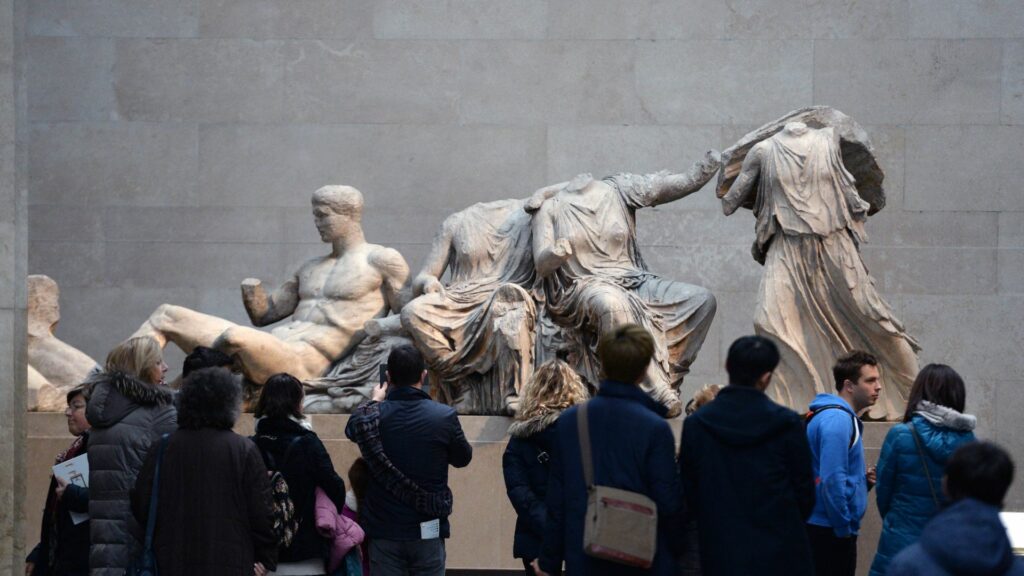
The British government has said that it will not abide by a recent UNESCO decision on the Parthenon Marbles.

It also insisted that “the Parthenon Sculptures were acquired legally” and rejected UNESCO’s call to reconsider its position and to negotiate with Greece on the return of the 2,500-year-old cultural treasures. Speaking to Greek newspaper Ta Nea, a government spokesperson said that the UK government “disagrees” with the decision, adding that it intends to challenge it before UNESCO.

The response came after the UNESCO’s Intergovernmental Committee for Promoting the Return of Cultural Property (ICPRCP) voted unanimously for the first time at its 22nd session to include the return of the Parthenon Marbles in its decision document, marking a major step forward since Greece first introduced the request to the meeting’s agenda in 1984.

ICPRCP’s decision says that Greece’s request for the return of the Parthenon Sculptures is “legitimate and rightful” and calls on Britain “to reconsider its stand and proceed to a bona fide dialogue with Greece on the matter”.

Most importantly, the Committee acknowledges for the first time that “the case has an intergovernmental character and, therefore, the obligation to return the Parthenon Sculptures lies squarely on the UK Government “.

This is in stark contrast to the UK government’s assertion that it is for the British Museum, not the government, to discuss the issue and make decisions related to it.

“We disagree with the Committee’s decision adopted in the closing minutes of the session and are raising issues relating to fact and procedure with UNESCO,” a UK government spokesperson told Ta Nea.

A British Museum spokesperson told Ta Nea that “the Trustees of the British Museum have a legal and moral responsibility to preserve and maintain all the collections in their care,” adding that “the Parthenon Sculptures are an integral part of (the Museum’s collection) story and a vital element in this interconnected world collection”.

Greece insists that it is the rightful owner of the Parthenon Marbles. The Greek government says that the sculptures were illegally removed from the Parthenon during the Ottoman occupation of Greece in the early 1800s.

In his first interview with a European newspaper since becoming the UK’s prime minister, Boris Johnson dashed Greece’s hopes of getting the Marbles back, telling Greek daily Ta Nea that they were “legally acquired by Lord Elgin under the appropriate laws of the time and have been legally owned by the British Museum’s Trustees since their acquisition.”

Britain had previously rejected Greece’s request to hold talks on returning the Marbles after Athens proposed a meeting between experts from the two countries.

“We are all very glad about the outcome of the UNESCO meeting in Paris last week, where the Parthenon Sculptures were an item on the Agenda, and this now for nearly 40 years, ever since Melina Mercouri raised the issue in 1984. We congratulate Greece for its efforts to achieve this outcome and do hope that the UK will finally reconsider its stand and enter in a dialogue with Greece”, Dr Christiane Tytgat, President of the International Association for the Reunification of the Parthenon Sculptures (IARPS), told Ta Nea.

“The Trustees and the British Museum cannot eternally ignore the growing pressure to return the Parthenon Sculptures, nor can they close their eyes for a growing consciousness when it comes to the legitimated acquisition of artefacts. The day will come when we see the Parthenon Sculptures reunited in the Acropolis Museum. At least, there they can be seen, shining through the glass wall of the Parthenon room, even if the Museum is closed, day and night, 7 days a week, at the foot of the Acropolis, in visual contact with the Parthenon,” Dr Tytgat added.


The British Museums’ comment to Ta Nea in full:

“The British Museum has a long history of collaboration with UNESCO and admires and supports its work. The Trustees of the British Museum have a legal and moral responsibility to preserve and maintain all the collections in their care and to make them accessible to world audiences. The Trustees want to strengthen existing good relations with colleagues and institutions in Greece, and to explore collaborative ventures directly between institutions, not on a government-to-government basis. This is why we believe that working in partnership across the world represents the best way forward. Museums holding Greek works, whether in Greece, the UK or elsewhere in the world, are naturally united to show the importance of the legacy of ancient Greece. The British Museum is committed to playing its full part in sharing the value of that legacy.

“The Museum takes its commitment to be a world museum seriously. The collection is a unique resource to explore the richness, diversity and complexity of all human history, our shared humanity. The strength of the collection is its breadth and depth which allows millions of visitors an understanding of the cultures of the world and how they interconnect – whether through trade, migration, conquest, conflict, or peaceful exchange.

“The Parthenon Sculptures are an integral part of that story and a vital element in this interconnected world collection, particularly in the way in which they convey the influences between Egyptian, Persian, Greek and Roman cultures. We share this collection with the widest possible public, lending objects all over the world and making images and information on over four million objects from the collection available online.

“The approach of the Acropolis Museum and the British Museum are complementary: the Acropolis Museum provides an in-depth view of the ancient history of its city, the British Museum offers a sense of the wider cultural context and sustained interaction with the neighbouring civilisations of Egypt and the Near East which contributed to the unique achievements of ancient Greece”.

The team of archaeologists working in the ancient city of Soli Pompeiopolis in southern Turkey announced that the site will be converted to an archaeopark on Friday.

Remzi Yağcı, who is the leader at the site, said that converting the site into an archaeopark will draw attention to the region and poses an educational opportunity as well.

“Our aim is to establish the connection between the areas we’re excavating and turn this place into an archaeopark. Turning it into an archaeopark will boost interest in the ancient city. People will be able to see everything that can be found in an ancient city.”

The team recently completed their 23rd season of excavations at the site, and are seeking to expand their efforts in every way, adding more people to their dig team for next season so that they can landscape the area and conduct restoration work.

Soli Pompeiopolis was a major port during the 2nd and 3rd centuries BC in ancient Greece. It is now located in present-day Turkey. The site is home to millennia-old columns. 

“[Visitors] will establish the connection between the monumental structures above and below the ground. When they enter the port, they’ll see that it’s one of the largest in the Eastern Mediterranean and that the sea comes all the way to the south of the colonnaded street. Considering the places we’ve excavated, we see that the history of Soli stretches back to the Neolithic period, as does that of the Yumuktepe Mound,” 

He is referencing the close by excavations of the ancient Yumuktepe site that dates back to 7,000 BC. Yağcı and his team had discovered the memorial tomb of the Greek poet and astronomer Aratus, who was born in 315 BC, earlier this summer.

One of the first people in the world to observe the moon scientifically, Aratus is so well known and respected by astronomers that when astronauts took the first step on the moon, the first crater they named was for Aratus.

According to the archaeologist, the discovery is of lasting importance to the history of the area and will be of great interest to travelers who will want to see the monument.

Speaking to interviewers from the Anadolu News Agency, Yağcı said “For the first time, a memorial tomb has been unearthed linked to the archaeology of the ancient city of Soli Pompeiopolis.”

“Aside from more familiar structures, such as the colonnaded streets, the ancient port, the theater, and the bathhouse, something very unique has been found. This find brings dynamism to the ancient city and can influence tourism in the region – for both those interested in cultural heritage and general visitors to the region.”

The unearthing of the ruins has been ongoing since July 20 of 2020, Yağcı said. Showing photographs of the unique discovery, he indicated the two rows of hexagonal structures and arches around the memorial tomb that had been unearthed by his workers.

 Hellenismos believes in free will of humanity; not even the Gods can end the will of a human being, but they can certainly influence the lives we live and instil in us through our environment a need to serve, a need to find Them, a need to honour Them. They might have been doing that since the reign of the ancient Hellenes, but we have only restored the ancient practices a few decades ago, and before that, I doubt anyone really knew what to do with that wiring and just channelled it into Christianity, or in beautiful poetry like from those who were later remarked on as being 'pagan' because they related so well to the societies of years past.


The concept of free will was a grateful one to the ancient Hellenic philosophers. After all, free will in a religious world poses a problem: if you believe in the Gods, and that the Gods have powers beyond ours--foresight, mostly, and a claim to the end of our lives--how can you make the case for free will? If I believe my fate has been foretold at birth by the Moirae, then how can I claim to have full control over my own actions?

In the early days, a form of compatibilism was found where the idea that causal determinism and logical necessity are compatible with free will. Yes, the Moirae predict our deaths, but we are free to do whatever we want in between, and the way we die is of our choosing as well, it has simply been foretold when/what will happen. Because we are not privy to that information, we are not influenced by it.

As time and philosophy progressed, great thinkers like Anaximander and Heraclitus around the sixth century BC--who collectively came to be known as 'physiologoi' or 'cosmologists'--came up with theories to grapple with the supernatural as it ruled over the natural while leaving free will intact. Their resolution was to assign earthy causes to physical events like floods, taking them out of the realm of the supernatural and into the realm of the natural. Their thinking lead to a dualism: it separated the mind from the body and left both open to be influenced by different forces.

In a quest to give humanity back a sense of responsibility for their own actions, materialist philosophers Democritus and Leucippus posed a new theory: that everything--including humans--existed from atoms from the same source. The way these atoms moved and reacted to each other controlled causal laws. This is an incredibly simple explanation of a mechanism I might devote an entire blog post on soon, so just take it as is: we are all made of the same stuff, and the way all that stuff reacts together causes us to experience certain things.

Interestingly enough, this way of thinking led Leucippus to create two dogmas of determinism that go entirely against the concept of free will: the dogma of physical determinism and the dogma of logical necessity. Especially the latter is interesting. It reads:

"Nothing occurs at random, but everything for a reason and by necessity." 
οὐδὲν χρῆμα μάτην γίνεται, ἀλλὰ πάντα ἐκ λόγου τε καὶ ὑπ’ ἀνάγκης

In light of Democritus theory of the atoms and their causal connection, the dogma makes sense: everything has a cause, which means there is a single source where all action originated from. This way of thinking also paved the way for later idea of a single God who put into motion the universe.

It were great thinkers like the Pythagoreans, Socrates,  Plato, and Aristotle who attempted to reconcile an element of human freedom with material determinism and causal law, in order to hold man responsible for his actions. Aristotle, especially, introduced the notion of 'accidents' into Leucippus' thinking, paving the way for an element of chance to be introduced into the theory. He was aware of the human need for repetition and predictability, but also felt that some things just happened, without anyone having a hand in it. It was still a causal connection, but it was an unintended one; an accident. In his Physics and Metaphysics he states the following:

"It is obvious that there are principles and causes which are generable and destructible apart from the actual processes of generation and destruction; for if this is not true, everything will be of necessity: that is, if there must necessarily be some cause, other than accidental, of that which is generated and destroyed. Will this be, or not? Yes, if this happens; otherwise not." (Book VI, 1027a29)

Aristotle's views were the foundation for a slew of new theories that built upon his, the most famous, perhaps, being Epicurus, who thought human agents had the ability to transcend necessity and chance. He argued that as atoms moved through the void, there were occasions when they would 'swerve' from their otherwise determined paths, thus initiating new causal chains. We now know that atoms do now swerve, but they do move unpredictably whenever they are in close contact with other atoms. Only very large objects are not bound by this unpredictable behaviour because their momentum is too great to veer them off course before collision. Epicurus' intuition of a fundamental randomness was thus correct, and paved the way for Lucretius, who saw the randomness as enabling free will.

"If all motion is always one long chain, and new motion arises out of the old in order invariable, and if first-beginnings do not make by swerving a beginning of motion so as to break the decrees of fate, whence comes this free will?"

It was the Stoic school of philosophy that solidified the idea of natural laws controlling all things, including the mind. Their influence persists to this day, in philosophy and religion, even though most of their work on free will has been lost--most likely to the Christian church, who preached a dogma of determinism by way of an omnipotent God.

There is much more to say about the concept of free will--especially in view of philosophy--but perhaps it's interesting to look at the practical side a moment. Mythology dictates that our fate is pre-destined, although we can fail to live up to it. Fate, here, is often a promise of greatness; heroes are told they will be heroes but must work for it, requiring the help of the Gods to rise above their own potential. Others have been granted potential by becoming kings and queens, but squander it by petty human behaviour. Often, these mythological figures end up punished by the Gods. We don't know if this was pre-determined, but the Gods never give us the idea they were aware of the coming failures of these men and women.

Free will is powerful: it gives us the agency we need to aspire to greatness. It gives us a sense of control over our lives. We choose to become servants to the Gods--we are not forced to do so, even though it might be destined we become servants; this makes all the difference in our joy of the execution of the Divine will. If we felt pressured and ordered into it, we would not find the same joy in it as we do now we are free to choice our path--or believe we are free to choose our path. Personally, I believe in accidents, and I think that sometimes, the universe drops the ball on us. Sometimes, things go wrong. We are then put at the mercy of the Gods to fix the ramifications of whatever pothole our lives hit, and this is why we built kharis with Them. My life may have been mapped out in advance, but I need help along the way to get to the destination the Gods have in store for me. This is a large reason why I serve, and while this way of thinking is not for everyone, it's my (free) will to do so--and I do so gladly.