Poseideon is the sixth month of the Hellenic calendar and we are slowly moving towards it. Poseideon is a special month; it was the month that would have been repeated (in a minor way) should the ancient calendar not line up with the phases of the moon (which it didn't, after a while). You can read more about that here as it is beyond the scope of this post. What I would like to talk to you about today is the divine triad that oversaw Poseideon (the quartet, actually, but we'll get to that) and its significance.

Poseideon was ruled by Poseidon (honoured during the Poseideia), Zeus (during the Plerosia and a seperate sacrifice to Zeus Horios) and Dionysos (during the Lesser Dionysia and secondarily during the Haloa). Poseideon is the first true winter month; the first harvest was over, seafaring had ceased and thus war had come to an end. The focus was on the home and preparation for true, deep winter: the weather turned and the crops needed protecting. Because of this, it was also a month of threat; if the crops failed, if the seas became too rough when a daring fisherman was out on it, or if a river went out of bounds and flooded a well populated area there would be death.

I get on my soapbox a lot on my blog. One of my main points is that everything is connected in the ancient Hellenic religion. That everything was constructed the way it was for a reason; the pantheon, the calendar, the festivals, the way festivals were celebrated--if you spend time to sort out the why, you will discover it's all part of an intricate web that formed an entire civilization. Nothing--absolutely nothing--in our religion and in the ancient civilization it was formed in ended up in it by accident. We have lost a lot of knowledge and understanding of this society but we can try to piece things together if we put in the effort. So today I will put in a little effort to explain why Poseideon was ruled by Poseidon, Zeus and Dionysos. And why it mattered that it were Them.

During the Poseideia, Poseidon as savior of ships, protector of those who voyage in ships, and God of the lapping waters both salt and fresh important for agriculture, is thanked for the many gifts that came from faraway places that were likely given at that time. The immense trade and distribution was nearly all through shipping, relatively little overland, whether it be perfume from Cyprus or pottery from Corinth. One of Poseidon’s epithets is prosklystios, 'of the lapping water'. He is also invoked as Poseidon phytalmios which implies natural fertility and human procreation.

The Plerosia is a harvest festival of sorts. It was held to honour Zeus but presumably als Demeter. Poseideon marks the time to return home, take stock, and stay warm. It's a time to thank the Theoi for all that has been recieved and all that will get us through the winter. The word ‘plerosis’ means fulfillment, satiated, filled. Important note: the Plerosia seems to have been a women-only festival, perhaps because now that winter is upon us, we turn to the domain of the women: the house(hold). As such, it is her prerogative to thank the Gods for the food she can feed her family with.

The lesser Dionysia, a vintage festival, was celebrated in the various demes of Attica in the month of Poseideon. It was probably a very ancient festival, perhaps not originally associated with Dionysos. The Dionysia was a time when classes came together in order to celebrate their shared origins in the natural world; it was a vintage festifal for all.

The Haloa was held in honor of Demeter, Dionysos and a little bit in honor of Persephone. Like all festivals of Demeter and Persephone's 'Kore' persona, women were the only ones who were allowed to handle the religious and sacrificial side of it. The Haloa is assumed to be a celebration of the pruning of the vines and the tasting of the wine after its first fermentation, or it may be to encourage the growth of corn from the seed.

A few links between Poseidon, Zeus and Dionysos are clear instantly from the descriptions of these festivals. Poseidon and Dionysos are linked through water--moisture, actually. Plutarch already noted that Dionysos was a God of moisture--in particular the moisture associated with life and vigour as can be seen in plants and trees and most telling in the wine produced from the fruits of the vine. Poseidon is all but the personification of water of all kinds. Furthermore, one of the epithets of Dionysos is Dendrites, ‘of the trees’, connects him to branching life. The tree was similarly a metaphor for rivers whose branching nature was morphologically similar. This links Dionysos to Poseidon even more.

And what of Poseidon and Zeus? Poseidon is the brother of Zeus and Hades, and together they form a triumvirate who represents the dominion of the sea, the sky and the underworld respectively. In Hellenic mythology, the underworld is seen as an exact mirror and equally valid version of the ‘celestial’ world. In other words: Zeus is Hades inverted and Poseidon is the synthesis of both. Dionysos therefore unifieds these god-themes and manifested them in the mundane world.

This brings us to Hades, the fourth member of this triad. He is worshipped too, just not directly--never directly. the ancient Hellenes very rarely honoured Hades, not even Plouton, His ouranic epithet. But Hades' influence was most definitely felt; he's the third of the triumvirate, He is prevalent in the threat of death that hangs over the month and He is appeased though a medium who is perhaps unlikely: Demeter.

Mythological and epithological links exist between Demeter and Hades. Hades was celebrated as an important divine figure in the Eleusinian Mysteries. The seasonal drama of nature was said to depend on her annual passage into the underworld in the depths of winter when fruitfulness and vegetation dies back. Through Kore (Persephone) Hades and Demeter rule over the harvest. Hades takes and Demeter gives--or more accurately: Hades causes Demeter to take instead of give. In praying for fruitfulness of the earth to Demeter, it is also Hades who is spoen to and appeased, which makes Him an unofficial member of the triad (this is likewise true for Demeter and even Kore/Persephone).

To compelete the circle, Dionysos and Demeter are worshipped together during the Haloa, which drives home the agricultural ties all these five deities have  and the way they link to the mundane issues of this time of year; Demeter and Hades (Plouton) through the fruitful earth (underworld), Zeus through mild weather (sky) and Poseidon and Dionysos through sweet water (the intermediate). Because of Their links and domains, it can be only these deities that govern Poseideon.

Epictetus (Ἐπίκτητος) was a Greek-speaking Stoic philosopher who lived from 55 – 135 AD. He was born a slave at Hierapolis, Phrygia (present day Pamukkale, Turkey), and lived in Rome until his banishment, when he went to Nicopolis in north-western Greece for the rest of his life. His teachings were written down and published by his pupil Arrian in his Discourses and Enchiridion.


Epictetus' primary philosophical lesson was that philosophy is a way of life and not just a theoretical discipline. To Epictetus, all external events are beyond our control; we should accept whatever happens calmly and dispassionately. However, individuals are responsible for their own actions, which they can examine and control through rigorous self-discipline. In short: a true Stoic. In 'Discourses' Epictetus' views come to light best, and I would like to share some of his wise words today, because my life has been a little rough and I have been using some of these as a mantra.


"The gods then, as was but right, put in our hands the one blessing that is best of all and master of all, that and nothing else, the power to deal rightly with our impressions, but everything else they did not put in our hands." [Bk.1, Ch. 1]

"If it were possible I [Zeus] would have made your body and your possessions (those trifles that you prize) free and untrammelled. But as things are—never forget this—this body is not yours, it is but a clever mixture of clay. But since I could not make it free, I gave you a portion in our divinity, this faculty of impulse to act and not to act, of will to get and will to avoid, in a word the faculty which can turn impressions to right use." [Bk.1, Ch. 1]

"If a man could only take to heart this judgement, as he ought, that we are all, before anything else, children of God." [Bk.1, Ch. 3]

"Miserable man, there is only one place to seek it [virtue]—where your work lies. Where does it lie? It lies in the region of will; that you may not fail to get what you will to get, nor fall into what you will to avoid; it lies in avoiding error in the region of impulse, impulse to act and impulse not to act: it lies in assent and the withholding of assent, that in these you may never be deceived." [Bk.1, Ch. 4]

"O great good fortune! O great benefactor, who shows us the way! And yet—though all men have raised temples and altars to Triptolemus, for teaching us the cultivation of the crops, yet what man of you ever set up an altar in honour of him who found the truth and brought it to light and published it among all men—not the truth of mere living, but the truth that leads to right living? Who ever dedicated a shrine or an image for this gift, or worships God for it? I say shall we, who offer sacrifices because the gods gave us wheat or the vine, never give thanks to God that they produced this manner of fruit in the mind of men, whereby they were to show us the true way of happiness?" [Bk.1, Ch. 4]

"Zeus, send me what trial Thou wilt; for I have endowments and resources, given me by Thee, to bring myself honor through what befalls." [Bk.1, Ch. 6]

Oedipus Rex, also known by its Greek title, Oedipus Tyrannus (Οἰδίπους Τύραννος), or Oedipus the King, is an Athenian tragedy by Sophocles that was first performed around 429 BC. Originally, to the ancient Hellenes, the title was simply Oedipus (Οἰδίπους), as it is referred to by Aristotle in the Poetics. It is thought to have been renamed Oedipus Tyrannus to distinguish it from another of Sophocles' plays, Oedipus at Colonus. In antiquity, the term “tyrant” referred to a ruler with no legitimate claim to rule, but it did not necessarily have a negative connotation.

Of Sophocles' three Theban plays that have survived, and that deal with the story of Oedipus, Oedipus Rex was the second to be written. However, in terms of the chronology of events that the plays describe, it comes first, followed by Oedipus at Colonus and then Antigone. Prior to the start of Oedipus Rex, Oedipus has become the king of Thebes while unwittingly fulfilling a prophecy that he would kill his father, Laius (the previous king), and marry his mother, Jocasta (whom Oedipus took as his queen after solving the riddle of the Sphinx). The action of Sophocles' play concerns Oedipus' search for the murderer of Laius in order to end a plague ravaging Thebes, unaware that the killer he is looking for is none other than himself. At the end of the play, after the truth finally comes to light, Jocasta hangs herself while Oedipus, horrified at his patricide and incest, proceeds to gouge out his own eyes in despair.

Oedipus Rex is regarded by many scholars as the masterpiece of ancient Hellenic tragedy. In his Poetics, Aristotle refers several times to the play in order to exemplify aspects of the genre.

Disney's "Hercules" (1997) is a beloved animated retelling of the classic Hellenic myth, but even die-hard fans may not have caught all these hidden gems. The film is full of references to Hellenic mythology, including the tale of the Titans and the divine guests at Zeus and Hera's party. There are also jokes related to more recent cultural phenomena, like "Buns of Bronze" and the Marilyn Monroe constellation. Did you catch them all? Insider did!


One of the Muses is attracted to Hercules.

The Muses are the musical goddesses who narrate the movie. All of them are fans of Hercules, and throughout the movie they praise him for his heroic feats. However, one of the Muses in particular — Thalia, the muse of comedy — focuses on Hercules' attractiveness and calls him "Hunk-ules." She also says that she'd "like to make some sweet music with him" while lying next to his image before another Muse interrupts her.

Though this movie only shows Megara as Hercules' love interest, in Greek mythology, the demigod had several wives throughout the course of his life. So, this blatant showing of other women's attraction to him could be a subtle acknowledgment of that.

The Muses explain some pretty accurate Titan mythology.

The story of the Titans that the Muses sing about at the beginning of the film is mostly accurate to Greek mythology. They explain that the Titans wreaked havoc until Zeus overthrew them, which follows the Greek myth where Zeus imprisons the Titans and ends their rule over Earth. However, "Hercules" only shows four Titans, and there are actually 12 in the classic myth. 

There's an alcohol reference that kids likely don't understand.

The Muses describe life on Mountain Olympus as "neat and smooth as sweet vermouth." Vermouth is a wine that is used in a variety of mixed drinks. Although the alcohol can be "neat and smooth," so it makes sense in the Muses' metaphor, this reference would presumably go over the heads of the young audience that the movie is aimed at. 

Several recognizable gods and goddesses are shown at Zeus and Hera's party.

There are many gods and goddesses in attendance at the party that  Zeus and Hera throw on Mount Olympus when Hercules is born. Hermes delivers a gift to Zeus, a fitting act for the messenger of Mount Olympus, and he's shown wearing his famous winged cap and sandals. In another brief scene, Narcissus, famous for his self-love, is seen looking at himself in a mirror. There are also several non-speaking gods and goddesses scattered in the background with distinct physical characteristics that make it clear who they're supposed to represent.

A goddess with long, heart-shaped hair and a heart clip on her toga appears to be Aphrodite, the goddess of love. A god with a massive helmet and sword is identified as Ares, the god of war. One god with a fin on his head and a trident in his hand is recognizably Poseidon, the god of the sea. And another goddess in the background of the scene is shown holding an owl, the symbol of Athena, the goddess of wisdom and war. 

Zeus uses the major cloud types when making Pegasus.

Zeus makes Hercules' winged-horse companion, Pegasus, out of clouds, and as he does this, he mentions each cloud type he's using by name. The god of the sky makes Pegasus out of three of the main cloud types: cirrus (high-level ice clouds), nimbostratus (mid-level rain clouds), and cumulus (low-level fair-weather clouds).

Zeus and Hercules have matching medallions.

During Hercules' party scene, viewers can see that Zeus and Hercules are both wearing medallions with the same symbol. Zeus has his pinned to the shoulder of his toga, and Hercules wears his as a necklace. Both medallions show a cloud with a lightning bolt, and this symbol is later described by Hercules' adoptive mother as "the symbol of the gods."

Hades travels across a river of dead souls.

Viewers first see the Underworld when Hades returns after visiting Mount Olympus for the party. He travels across a river, but instead of water, there are floating ghost-like people under his boat — which may have been a little jarring for any child who noticed.

This is reflected in Greek mythology, which depicts the Underworld as having five different rivers that Hades and other gods can travel on by boat. Later, when Hercules rescues Meg from the Underworld, it's clear that the transparent people in the river represent the souls of people who have died. 

The movie makes some odd word choices, such as "lugubriousness" and "furshlugginer."

This movie includes not only references but also words that children aren't likely to know. Two examples of this that particularly stand out are "lugubriousness" and "furshlugginer." Pain, one of Hades' henchmen, calls Hades "your most lugubriousness" the first time he is on screen. Lugubrious means exaggeratedly mournful or brooding, which is certainly fitting for Hades, but it's odd that the word is included offhandedly as though children will understand it.

Later in the film, Phil refers to Achilles' famed weakness as "that furshlugginer heel of his." Furshlugginer, which is a slang word with Yiddish origins that means foolish, is also somewhat out of place in a film geared toward kids.

The Fates kill a woman during their first scene.

The Fates, magical women who can see into the past, present, and future, only have one eye between the three of them. They're typically remembered for the humorous scenes in which they take turns using this eye, but if you pay attention, they have a pretty dark introduction. When viewers are first introduced to the Fates, they are holding and cutting a thread — a symbol traditionally included in the Fates mythology — that they say is connected to a mortal's life. Immediately after they cut this thread, a woman screams and appears in the Underworld, showing that they did indeed kill her.

There are only six planets shown during the prophecy scenes.

The Fates tell Hades that in 18 years, if he releases the Titans while the planets are aligned (and Hercules does not interfere), he will have the chance to usurp Zeus. However, the image that's shown alongside this prophecy only depicts six planets. Later, when the prophecy comes true, six planets are again shown instead of eight. 

The decision to leave out a few of the planets from our modern knowledge of the solar system may have been done to accurately reflect Ancient Greece's understanding of the planets. At that time, Mercury, Earth, Mars, Venus, Jupiter, and Saturn had been identified, but Uranus and Neptune had not. 

Hercules' human parents are accurately named after their mythological counterparts.

In the film, Hercules' adopted mortal parents are his mother, Alcmene, and his father, Amphitryon. Alcmene and Amphitryon are accurate names from the Hercules myth, but their roles are depicted a little differently in the Disney film. In Greek mythology, Zeus cheats on his wife and has Hercules with the human Alcmene — which explains Hercules' demigod status. This differs from the movie, which shows Hercules being born to Zeus and Hera before becoming a demigod when Hades arranges for him to drink a poisonous potion. 

Philoctetes' interaction with the wood nymphs shows classic satyr behavior.

Hercules first finds Philoctetes in a forest where he is watching a group of wood nymphs. Phil runs after the nymphs, trying to catch them, but they turn into flowers and trees before he can reach them. Phil, who appears to be half-goat, half-man, tells Hercules that he is a satyr. In Greek mythology, satyrs are fertility spirits known to engage in sensual acts with nymphs, making Phil's chase scene accurate — but perhaps a bit inappropriate for a kid's movie.

Phil brags about training some major mythological figures.

Phil's home is full of objects related to some of the heroes he used to train. Hercules hits his head on what Phil says is the mast of the Argo — a ship that belonged to Jason, the mortal hero of the Argonauts, in Greek mythology. This head bump is also ironic because Jason died after a rotting beam of the Argo fell on him. Phil then mentions that he trained the Greek legends Odysseus, Perseus, Theseus, and he shows off a giant statue of Achilles, his most promising hero-in-training. 

There's a visual pun to go along with the term "greenhorn."

When Hercules first starts training with Phil, he struggles to complete the practice drills the satyr arranges for him. As part of his big song "One Last Hope," Phil complains about having to work with a "greenhorn," which roughly translates to mean an amateur. As Phil sings the line, "I get the greenhorn," there's a clever visual pun to go along with it. Green olives get stuck on his horns, making him look as though he actually has green horns.

There's also a visual reference to "The Karate Kid" in the training montage.

In the same training montage that takes place during "One Last Hope," Phil, Hercules, and Pegasus stand on wooden posts and strike fighting poses in front of a setting sun, which resembles one of Daniel LaRusso's famed training sequences in "The Karate Kid" (1984). 

The centaur Hercules fights plays into a traditional Greek myth.

Hercules first meets Meg when he saves her from a centaur, and when Meg and Hades are talking afterward, they mention that the centaur's name is Nessus. Nessus the centaur is a creature from Greek mythology who Hercules fights to save one of his wives. But in contrast to the movie, it wasn't Megara, it was his second wife, Deianeira. 

Thebes is compared to New York City multiple times.

Hercules and Phil journey to the city of Thebes, where Hercules can accomplish his heroic feats. As they travel there, Phil calls the city "the Big Olive," a pun that seems to be a take on New York City's nickname, "the Big Apple." In the same scene, Phil tells Hercules, "If you can make it there, you can make it anywhere," a phrase from the popular Frank Sinatra song "New York, New York." Later on in the film, Meg also uses the phrase "in a Peloponnesian minute," which, with all the other references to New York, seems like a play on the phrase "New York minute."

There's a not-so-subtle Roman numeral joke.

While pretending to be trapped under a boulder, Hades henchmen Pain and Panic appear as young boys crying for help, and one of them shouts, "Somebody call IX-I-I!" That's the Roman-numeral equivalent of 9-1-1, which seems like a clever way to include a modern American cry for help in an era-appropriate numerical style. However, the film takes place in ancient Greece, not ancient Rome, so Greek numerals would've been the norm in Thebes.

Modern references are made while describing Hercules' new popularity.

Throughout the film, there are a few allusions to modern culture. While singing about Hercules' popularity, the Muses remark that he can make an arena "SRO," which is usually used as a concert term that stands for "standing room only." Phil also advertises Hercules-themed merchandise, including a "Buns of Bronze" workout scroll, which is likely a reference to the "Buns of Steel" workout videos that were popular in the 1990s when the film was made. Another merch item featured in the film, "Air Hercs," seem to be a take on Nike's famous Air Jordan sneakers. But the reference is even more meaningful when you remember that Nike is the Greek goddess of victory. 

Hercules passes a constellation that imitates a famous Marilyn Monroe scene.

During "Zero to Hero," Hercules rides Pegasus through the sky and we see a constellation in the shape of a woman with short hair wearing a halter-neck dress. When Hercules rides past this group of stars, the woman's dress flies up and she uses her hands to push it back down. This, along with her appearance, makes it clear that the constellation is a recreation of Marilyn Monroe's most famous movie moment from "The Seven Year Itch" (1955).

There's also a reference to Grauman's Chinese Theatre in "Zero to Hero."

After the Marilyn Monroe reference, Hercules and Pegasus are shown leaving their handprints (or hoof prints) in wet cement, much like celebrities do in front of LA's famed TCL Chinese Theatre (also known as Grauman's Chinese Theatre). If you look closely, Hercules' signature is addressed "To Sid," which is likely a reference to the original owner of the Chinese Theatre, Sid Grauman. 

Scar from "The Lion King" makes an unfortunate appearance.

Three years before Hercules hit US theaters, "The Lion King" (1994)introduced the Disney fandom to one of the studio's most despicable villains, Scar. However, the brother-murdering lion seems to have gotten what was coming for him seeing as he makes a brief appearance in the 1997 film as a dead lion's mane that the Hercules wears while he's getting his portrait painted. We get a clear view when Phil uses the thwarted villain as a wipe to remove paint from his face, and it's a little creepy that his pricing green and yellow eyes are still intact. 

Hercules and Meg see a play about Oedipus.

When Hercules and Meg return from spending the day together, they talk about having gone to a restaurant and seeing a play about "that Oedipus thing." This is most likely a reference to the Ancient Greek play "Oedipus Rex." In the play, and classic Greek mythology, Oedipus was the ruler of Thebes, so it makes sense that they would be performing it there. However, the real joke comes with Hercules' next line, "Man, I thought I had problems," which is probably a reference to Oedipus' romantic relationship with his mother. 

The film tries to answer the age-old question of how a famous statue lost its arms.

At the end of his date with Meg, Hercules skips a stone in a fountain and accidentally breaks the arms off of a statue of a woman. The result resembles the famous Venus de Milo statue by Greek sculptor Alexandros of Antioch that is well known for its mysterious lack of arms. As the statue's name refers to the Greek goddess, its appearance in the movie adds another reference to mythology while also providing a fun explanation for why the real statue is armless.

The Muses recreate a scene from Disney's popular Haunted Mansion ride.

During "I Won't Say I'm in Love," the Muses transform themselves into stone busts that are arranged in an eerily similar way to the singing busts on Disney's famed Haunted Mansion attraction. Six years after "Hercules," the busts also made an appearance in Disney's live-action movie, "The Haunted Mansion" (2003). 

Hades uses legal terminology when describing his contract with Hercules that ends up thwarting him in the end.

Hades makes a deal with Hercules in which the demigod agrees to give up his strength for a day as long as Meg is safe. While explaining the contract to Hercules, Hades describes the deal as "boilerplate," which is a legal term that refers to a standard contract format. Interestingly, boilerplate provisions call for rules for how the contract will be interpreted, which in this case should have included a definition of what Meg's safety entailed. Since Meg's injury is what breaks the contract and returns Hercules' strength, Hades probably should have been a bit more careful with the wording of the deal he drew up.

The different monsters Hercules fights at the end of the film include some of his most famous mythological enemies.

Some of Hercules' most famous accomplishments in mythology were part of his 12 Labours. The 12 Labours of Hercules was a series of tasks he completed as part of a punishment. Fighting a Hydra and the three-headed dog Cerberus were two such tasks, both of which are included at the end of the movie. The "Zero to Hero" montage also shows Hercules fighting a boar, a lion, a bird, and a bull — all creatures that were part of his 12 Labours. 

For image proof, visit Insider!

An invocation is a request for the spiritual presence and blessing of a deity during a rite. To invoke is to call upon earnestly, so an “invocation” in the context of prayer is a serious, intentional calling upon a God or Goddess. In Hellenic ritual, it's common for prayers of invocation to be offered every time a new deity is invoked, so we can be sure They will the hymns and prayers of petition offered to Them. Invocations fit into the rite like so:


- Lighting of the incense burner with frankincense
- Invocation to Demeter: Khaire Demeter, you who taught us to work the earth and provides for us so bountifully…
- Libation of a kykeon and sacrifices
- Orphic Hymn 40 To Eleusinian Demeter
- Prayers

A few days ago, I put up a list of invocations from the Iliad. People seemed to like it, so let's do another one today: from the Odysseia, because that is the logical step! The Odyssey (Ὀδύσσεια) is, in part, a sequel to the Iliad, the other work ascribed to Homeros. The Odyssey was composed near the end of the 8th century BC and focuses mainly on the hero Odysseus, king of Ithaca, and his journey home after the fall of Troy. It takes Odysseus ten years to reach Ithaca. In his absence, it is assumed Odysseus has died, and his wife Penelope and son Telemachus must deal with a group of unruly suitors, who compete for Penelope's hand in marriage. Needless to say, Odysseus keeps his lady love! There aren't as many invocation in this story as most of the characters tell their story themselves, but there are a few.

Artemis:
"Great Goddess Artemis, daughter of Zeus..."

Athena:
"Hear me, daughter of Aegis-bearing Zeus, unweariable..."

Eos:
"Rosy-fingered Eos, child of morning..."

Poseidon:
"O thou that encirclest the earth, vouchsafe to grant the prayers of thy servants that call upon thee..."

Themis:
"I pray you by Themis, who is the beginning and the end of councils..."

Zeus:
"Hear me, O King..."
"Father Zeus, and all you other gods who live in everlasting bliss..."
"Father Zeus, you who rule over heaven and earth, you have thundered from a clear sky without so much as a cloud in it, and this means something for somebody; grant the prayer, then, of me your poor servant who calls upon you..."

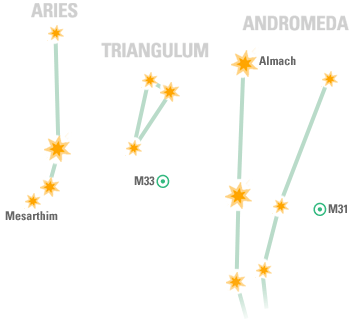
Did you know there was a constellation called 'the triangle'? And that the ancient Hellenes were aware of it, too? Triangulum is a small constellation in the northern sky. It was one of the 48 constellations listed by the second century astronomer Ptolemy, and so named for its three brightest stars, which form a long and narrow triangle. The Ancient Hellenes called Triangulum 'Deltoton' (Δελτωτόν), after the upper-case letter delta (Δ). Hellenic astronomers such as Hipparchos and Ptolemy called it Trigonon (Τρίγωνον).


There is not a lot of mythology connected to this tiny constellation, but the lore that it has is quite important. Hyginus, in his 'Astronomica' explains the options:

"This constellation, which has three angles like the Greek letter Delta, is so named for that reason.
Mercury [Hermes] is thought to have placed it above the head of Aries, so that the dimness of Aries might be marked by its brightness, wherever it should be, and that it should form the first letter in the name of Jove [Zeus] (in Greek, Dis).
Some have said that it pictures the position of Egypt; others, that of Aethiopa and Egypt where the Nile marks their boundaries. Still others think that Sicily is pictured there.
Others, say that three angles were put there because the gods divided the universe into three parts." [II.19]

The latter is the only one that might need some explaining. Zeus, the greatest of the Olympian Gods, and the father of Gods and men, was a son of Kronos and Rhea, a brother of Poseidon, Hades, Hestia, Demeter, Hera. When Zeus and His brothers drew lots for the rule of the world, Poseidon obtained the sea, Hades the lower world, and Zeus the heavens and the upper regions, but the earth belonged to them all. To quote the 'Iliad' by Hómēros:

"Poseidon was very angry and said, "Great heavens! strong as Zeus may be, he has said more than he can do if he has threatened violence against me, who am of like honour with himself. We were three brothers whom Rhea bore to Kronos--Zeus, myself, and Hades who rules the world below. Heaven and earth were divided into three parts, and each of us was to have an equal share. When we cast lots, it fell to me to have my dwelling in the sea for evermore; Hades took the darkness of the realms under the earth, while air and sky and clouds were the portion that fell to Zeus; but earth and great Olympus are the common property of all." [XV.187]

The constellation Triangulum is visible at latitudes between +90° and −60°, and best visible at 21:00 (9 p.m.) during the month of December.

 I get a lot of questions from readers, and most of the time, the answers are fairly short. When I feel the question or the reply would be valuable to others as well, I make a post with a collection of them and post them in one go. Today is one of those posts.


"I really want to start doing daily rituals but I just don't know how to start or who to worship. Can you help me?"

Daily worship can be a very rewarding practice, but it is hard to get into. In ancient Hellas, the courtyard of the home often held a bômos, a free standing, raised, altar where the majority of household worship took place. Some houses also had a wall niche, an indoor worship area, either in a room especially designated for worship, or in the main family room. These altars were used to worship the Ephestioi (Εφεστιοι), the most personal of the household Theoi. These almost always included: Hestia, Zeus Ephestios (Overseer of the Hearth), Zeus Kthesios, and Agathós Daímōn. Worship of these deities was highly personal and many other Theoi could be added to this worship list.
 
If you wish to get into the routine of daily worship, these Theoi can be used as a base for ritual. Add to this short list any Theoi you feel drawn to or whose influence you feel you need in your life. My list can be found here. Pro tip: start with a short list and build up once you feel comfortable and you have found your rhythm.
 
~~~
 
"How should I celebrate the Noumenia?"

The goal of the Noumenia is to start fresh and to honor the household deities. It is a day of family, family meals, and the celebration of the new month. Part of that celebration can be to prepare for the new month by planning out important events--religious or secular--and writing them down, preferably with the whole family present. Offer sacrifices of honey cakes to Apollon Noumenios, Hestia,Hermes and Zeus Kthesios and refill your kathiskos.
 
~~~
 
"Some tragic events occurred and ever since I have felt odd working with Hermes or any gods. What would be a way I could find out if Hermes still wants to work with me, and if so what things would you suggest doing to work with him (altar suggestions, etc)? Thank you."

One thing that is generally hard for people to understand is that the attention the Theoi pay us does not waver and They do not pick favourites. They accept any and all worship and They are always there. What wavers is the level of attention we pay Them or the amount of time and brainpower we have to spare for Their worship. This is miasma, this is the disconnect between the Theoi and us. Think of it as a radio signal where the Theoi are the broadcasting party: They are always on but depending on the amount of interference and obstacles on our receiving end, the reception is clear or muddled. The ancient Hellenes understood this and that is why they were adamant about a daily practice and regular, state funded, festivals. Hermes is there. He is always there. I dislike the term ‘work with’ but if you wish to honour Him, then do so by any way you have already done. Give libations and sacrifices at your household shrine, read His mythology, meditate. He will be receptive.

~~~
 
"Were Elves or Faeries worshiped by the Ancient Hellenes? We know that there was influence from the Celts and maybe even the Nordics in ancient Hellas. Hence the Hyperboreas."

That's a complicated question to answer. And an easy one. No, Tolkien's Elves are not found in Hellenic mythology and neither was Tinkerbell. So, the question is: how do you define 'Elves' and how do you define 'Faeries'?

An elf, mythologically speaking, is a type of supernatural being in Germanic mythology and folklore. Back then mention of them was very uncommon and served as a race to offset the Giants. An elf in classical Eddaic poetry was male and prominently associated with sexual threats, seducing people and causing them harm. Needless to say, the image has changed since then.

The concept of 'fairy' in the narrow sense is unique to English folklore, conflating Germanic elves with influences from Celtic and Romance (French) folklores, and later made 'diminutive' according to the tastes of Victorian era fairy tales for children. These Celtic roots stem mostly from the The Tuatha Dé Danann, a race of supernaturally-gifted people in Irish mythology. They are thought to represent the main deities of pre-Christian Gaelic Ireland. Many of the Irish tales of the Tuatha Dé Danann refer to these beings as fairies, though in more ancient times they were regarded as Goddesses and Gods.

The ancient Hellenic empire was pretty large but Gaul (France and Belgium), Hispania (Spain) and Britannia (Britain) were reached mostly during the Roman occupation of these regions or provinces. Their influence did not carry over to ancient Hellas. That said, ancient Hellenic mythology does have its Dryads and Nymphs, so there are nature spirits that received worship, but no, no elves and no fairies.

~~~
 
"Do you use the Orphic Hymns in your practice?"

I do! I use as many ancient sources as I can, so that includes the Orphic hymns, the Homeric ones and any ohers I can find. I borrow from plays and philosophical texts as well. If it's ancient and about the Theoi, I'll use it in my rites.