I'm sorry this post is a day late; yesterday was pretty hectic, and I just could not do a post like this justice. So here we are, with the first of the 'Q's for the Pagan Blog Project. I have been dreading these two weeks for the entire year. Not only is the letter 'Q' not part of the ancient Hellenic alphabet, there are not that many interesting English words starting with the letter 'Q' which can be applied to ancient Hellas or modern Hellenistic practice. For the first 'Q', I have decided to explore the 'Quaestiones Graecae', written by Plutarch in the first century AD.

Plutarch (Ploútarkhos, Πλούταρχος) was a Greek historian, biographer, and essayist, who later in his life became a Roman citizen. As such, he was extraordinarily qualified to write two standard works: the 'Quaestiones Graecae' (Αἴτια Ἑλληνικά, or Greek Questions), and the 'Quaestiones Romanae' (Αἴτια Ῥωμαϊκά, or 'Roman Questions'). These essays are part of the book series 'Moralia' (Ἠθικά, loosely translatable as 'Matters relating to customs and mores'), and can be found in book IV of the series. The Greek Questions contain fifty-nine questions, the Roman version hundred-thirteen, and all pertain to matters concerned with their respective culture. Many of the answers are names, or customs, and the Greek Questions are thus valuable for research on ancient Hellenic life.

The questions have a wide range of usefulness, but many of the answers give insight into the lives of the ancient Hellenes, the important familial lies, and clues into the duties of those concerned with divine issues. Question number three, for instance reads: "who is She that Kindles the Fire (hypekkaustria) among the people of Soloi?", to which Plutarch replies:

"This is the name which they give to the priestess of Athena because she performs certain sacrifices and ceremonies to avert evil."

Soloi (Σόλοι) was an ancient city and port in Cilicia, in present day Turkey. As such, it cannot be said that all temples of Athena would have had a hypekkaustria on hand, but it does mean there is recorded precedence for the custom.

The nature of the  is thus that some of Plutarch's answers are informed guesses: to some of the questions posed, he does not know the actual answer, but in keeping with the style of writing, he answers them regardless, sometimes with multiple answers. Question number 31, for example, reads: "why is it that at the Thesmophoria the Eretrian women cook their meat, not by fire, but by the rays of the sun; and why do they not call upon Kalligeneia?". His answer:

"Is it because it happened that the captive women whom Agamemnon was bringing home from Troy were celebrating the Thesmophoria at this place, but when conditions for sailing suddenly appeared favourable, they put out to sea leaving behind them the sacrifice uncompleted?"

Answers--and even questions--like these give valuable clues about Eretria (Ερέτρια), a town in Euboea, facing the coast of Attica across the Euboean Gulf, but also about the Thesmophoria festival and religious festivals in general. For example, from the question, it becomes clear that meat is typically 'cooked' (which can mean any type of preparation, but the original Greek may be clearer on this) over a fire during the Thesmophoria (and perhaps other religious festivals), and that the Thesmophoria was at least partially dedicated to Kalligeneia (Καλλιγενεια), the Nymph nurse of the goddess Demeter and of her daughter Persephone. From other sources, we know that Kalligeneia was worshipped in the Eleusinian Mysteries, and thus ties the mention of her by Plutarch the Thesmophoria to the Mysteries in a minor way--a tie that other writers strengthen.

The Quaestiones Graecae are a treasure-trove of information for the well-informed and questioning Hellenist, and making time to read all the questions and answers is most certainly time well spent. All the questions and answers can be found here.
New discoveries about ancient Hellas are still being made every day, every week, every month of every year. All of these discoveries have the potential of not only building on our existing knowledge base, but also of upheaving all our preconceptions about ancient Hellas... and guiding our household worship. The ritual altar inscribed with Linear A found at Zominthos is an excellent example.


"The newly discovered inscribed stone libation altar from Zominthos is carefully
lifted from its hiding place" [Credit: To Vima]

The Archaeological News Network reports that "[a]rchaeologists excavating at Zominthos, a small plateau in the northern foothills of Mount Ida (Psiloritis) on the Greek island of Crete, have unearthed a rare stone libation altar inscribed with the enigmatic Minoan Linear A script. [...] Dr. Effie Sapouna-Sakellarakis, who discovered the rare artifact a few days ago during the excavation of the large building complex at Zominthos."
The altar is 20x20 cm, and consists of three stepped tiers or levels that extend upwards from the base. A small hollow cavity is found on the altar’s otherwise flat surface, and each of the altar’s twelve sides or registers is inscribed with symbols of the Linear A script.

Zominthos (Ζώμινθος) is a small plateau in the northern foothills of Mount Ida, οn the island of Krete. It is roughly 7.5 kilometers west of the village of Anogia, on the path from Knossos to Idaion Andron, the great sanctuary cave near the peak of Ida. Zominthos is best known for the large Minoan building discovered there; signs of permanent settlement date back to about 1800 BC. According to Dr. Sapouna-Sakellarakis:

“The study of the inscription will take time and will certainly be conducted by specialists of the Minoan script in the hope that it will reveal important information about the rituals that took place at Zominthos around 3,500 year ago”

Personally, I get very excited when finds like these are made. The Minoan culture is a very specific culture, and while it influenced the culture of Hellas, it did not equate it. Still, even evidence of the predecessors of ancient Classical culture could tell us something about them. When that translation comes in, I'll get the information to you. In the mean time, you can keep up to date on information concerning the Zominthos excavations here.
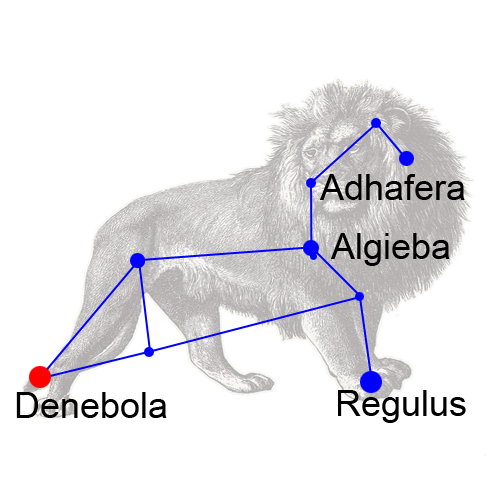
It's been a while since the last constellation! The constellation Leo is one of the most recognizable in the sky, and is obviously one of the constellations tied to the zodiac. Not surprisingly, it is therefor also tied to Hēraklēs.
The lion was considered the King of Beasts by the ancient Hellenic writers. For this reason, Hyginus--our primary source of ancient information on constellations--describes the constellation almost entirely as such, mentioning Hēraklēs in passing only:

"He is said to have been put among the stars because he is considered the king of beasts. Some writers add that Hercules’ first Labor was with him and that he killed him, unarmed. Pisandrus and many others have written about this. " [II.24]

The firs labour of Hēraklēs is, of course, to slay the Nemean lion. You can read about the start of Hēraklēs' life here, but for this constellation, all you need to know is that he was stricken mad by Hera, and killed his wife and children while he was out. As a result, he went on a long journey to cleanse himself of the miasma caused by these killings. First, he visited the oracle at Delphi, who, unbeknownst to him, was whispered to by Hera. The Oracle told Hēraklēs to serve the king of Tiryns, Eurystheus, for ten years and do everything Eurystheus told him to do. Eurystheus gladly provided Hēraklēs with these labors--ten of them, one for each year--and eventually ended up adding two more, resulting in the Twelve Labors of Hēraklēs.

The first of the twelve labours was to slay the Nemean lion. As the lion was terrorizing the area surrounding the mountain, Eurystheus must have seen in the lion a worthy opponent of Hēraklēs, whose tales of bravery and brute strength has proceeded him. He ordered the hero to return with its skin. And so, Hēraklēs went to the cave of the lion after picking up a bow and quiver of arrows, because he was unaware he would not be able to harm the creature with mortal weapons. After a long fight, Hēraklēs eventually chokes the lion, and hails victorious.

The Latin writer Seneca had a beautiful description of the constellation Leo, in the words of our great hero:

"See where the lion, my first toil, glows in no small part of heaven, is all hot with rage, and makes ready his fangs. Forthwith he will seize some star; threatening he stands with gaping jaws, and breathes forth fires, and shakes the mane upon his flaming neck; whatever stars sickly autumn and cold winter with its frozen tracts bring back, with one bound will he o’erleap, and attack and crush the neck of the vernal Bull." [II.942]

I want to add one more thing to he description of this constellation: Hyginus tells another tale about the constellation Leo: the story of Berenikē (Βερενίκη). The name translates to 'bearer of victory', and this version of the story refers to Berenikē II, who lived from about 267 - 221 BC. She was the daughter of Magas of Cyrene and Queen Apama II, and the wife of Ptolemy III, the third ruler of the Ptolemaic dynasty of Egypt. Prior to her marriage to Ptolemy III, she was married to Demetrius the Fair, a Macedonian prince, whom she had killed after he chose to become the lover of her mother Apama. Berenikē was quite the woman, and participated in the Nemean Games even the ancient Olympics. Her own son, Ptolemy IV eventually had her killed, but she was deified and to be honored from that moment on. The following story concerns her, her husband Ptolemy III, and Aphrodite.

"Above his likeness in the sky nearest the Virgin are seven other stars near his tail, arranged in a triangle, which Conon, the mathematician, and Callimachus call the Lock of Berenice. When Ptolemy had married his sister Berenice, daughter of Ptolemy and Arsinoe, and after a few days had set out to attack Asia, Berenice vowed that if Ptolemy returned as victor she would clip off her hair. She placed the lock, consecrated by this vow, in the temple of Venus Arsinoe Zephyritis, but on the following day it couldn’t be seen there. When the king was distressed by this, Conon the mathematician, whom we mentioned above, desiring to win the favor of the king, said that he had seen the lock among the constellations, and pointed out seven stars without definite configuration which he imagined were the lock.

Some authors along with Callimachus have said that this Berenice raised horses, and used to send them to Olympia. Others add that once Ptolemy, Berenice’s father, in panic at the number of the enemy, had sought safety in flight, but his daughter, an accomplished horse woman, leaped on a horse, organized the remaining troops, killed many of the enemy, and put the rest to flight. For this even Callimachus calls her high-souled. Eratosthenes says that she ordered returned to the girls of Lesbos the dowry left to them by their parents, which on one had released, and she established among them right to bring action of recovery."

The constellation Leo is visible at latitudes between +90° and −65°, and best visible at 21:00 (9 p.m.) during the month of April.
My girlfriend of  eight and a half years is currently on a boat with her father, enjoying some of the finest lakes The Netherlands has to offer. Besides having the house to myself and having to sleep alone for the week, my girlfriend's absence raises some interesting religious questions for me. During my daily prayers, I will pray for both of us. I will use 'our oikos' and 'us'. Now my girlfriend is away, I want to be clearer that whatever I pray to the Theoi for, I also pay for that for the wonderful woman on a boat who belongs to my oikos.

I haven't done the research on this but I assume that when the husband left home in ancient Hellas, his task as kurios was taken over by either his father or his son. Women rarely left the house for long periods of time, and probably not without her husband if she did, so the ancient Hellenes probably never had the challenge I am facing now: including a female significant other in prayers when you are not married by law.

During ritual, I call my girlfriend my wife. I don't doubt the Theoi's ability to understand the concept of same-sex romantic girlfriend, but in a religious sense, she feels like my wife to me. We have shared our oikos for five years now, and as far as I can tell, we are heading into a live-log commitment. I want to marry her, and by law, we are allowed. It just hasn't happened yet for practical reasons.

Marriage in ancient Hellas, and ancient Athens specifically, was a family affair. The father of the groom--who was often in his thirties by the time he got married--opened negotiations with the family of a bride in her teens. The two families came to an agreement about dowry, a contract was signed by the father of the groom and the father of the bride in front of witnesses, and the groom met his new wife--often for the first time--at the marriage ceremony before taking her to bed.

Wedding rituals were diverse, and were directed towards a large number of deities. Zeus Teleios, Hera Teleia, Aphrodite and Artemis would have received sacrifice the night before the wedding. Artemis was offered the girl's toys and playthings, so as to signal the end of her childhood. Both bride and groom took a purificatory bath.

On the day of the wedding, the houses of both parties were decorated with olive and laurel branches. The father of the bride held a sacrifice and banquet. The bride was veiled and wreathed. A young boys whose parents were still alive went 'round with bread in a basket and a thorny wreath on his head, saying 'he had banished evil and found good' as a purification rite. The bride brought a pan, a young boy a sieve, and a mortar and pestle were hung by the door to the bedchamber. The couple received gifts.

A torchlight procession took the bride from the house of her father to the house of her new husband. Songs were sung to Hymen, God of marriage as the bride was transported by cart. The groom's parents would welcome her, feed her cake of sesame and honey, and show her around the house. then, she was introduced to the hearth, and she was showered with nuts and dried figs to signal she was now part of the oikos. Then, the pair retired for the night, for anything but sleep, presumably.

The next day, there was another banquet, and further sacrifice. The pair would also get more presents. Then, the two were officially husband and wife, and procreation could commence.

Spartan wives were older, and their hair was shaved off before the ceremony. They were dressed up in a man's cloak and sandals, and waited in a dark room of her future husband's house for him to 'capture her'. Elsewhere, we find evidence of false bards, phallus objects and other role-reversal tools, probably intended to establish exactly the typical gender roles.


I hope to have a somewhat traditional Hellenic wedding some day, although my girlfriend is not religious, and the religious part is thus going to be a private affair. I am alright with that, really. It is what it is, and there are two people (and a boatload of friends and family) involved in the ceremony. To be fair, my girlfriend would feel equally uncomfortable with a Christian-style wedding. It's the religiosity of it that is the issue, not the deity of deities prayed to.

We will have our private ceremony, she has agreed to that, and perhaps I will have found other Hellenists in the area willing to preside over it, and bar witness. I don't think my girlfriend would mind that.

Would you like a traditional wedding, or have you had one? I would love to hear your stories!
Many Hellenists live by the circular practice of kharis: religious reciprocity between God and man. Reciprocity might hint at a symmetrical relationship, but even the ancient Hellenes knew our connection to the Theoi is fundamentally asymmetrical--we can never hope to repay the many gifts bestowed upon us by the Gods. That said, if we assume our relationship to the Theoi to be asymmetrical, then the word and practice of kharis takes on new meaning: not just to reciprocate, but to give thanks.

In general, I think it is fair to say that the ancient Hellenes performed rituals and sacrifices for three reasons: they could be offered to propitiate the Gods, to ask for something, or for thanksgiving. I would even say that these three followed one after the other in a circular patters where the Gods were propitiated, petitioned for aid, and then thanked afterwards, when the gift was granted. Sometimes there would also be rituals simply to thank for the many gifts bestowed upon a person--especially those gifts that were never explicitly requested. Xenophon has a beautiful example of this in Cyropaedia:

"Zeus, god of my fathers, and thou, O Sun, and all ye gods, accept this sacrifice, my offering for many a noble enterprise, and suffer me to thank you for the grace ye have shown me, telling me all my life, by victims and by signs from heaven, by birds and by the voices of men, what things I ought to do and what I ought to refrain from doing. Deep is my thankfulness that I was able to recognize your care, and never lifted up my heart too high even in my prosperity. I beseech you now to bless my children also, and my wife, and my friends, and my fatherland; and for myself, may my death be as my life has been." [VIII.C7]

There are many ways to show gratitude to the Theoi. The giving of gifts is one way. Many votives and thank-offerings were left at temples and sanctuaries. The sanctuaries and temples themselves could be considered gifts. Votives were gifts promised to a Theos or Theia in advance--so in relation to a vow made to a Theos or Theia--while thank-offerings were given in relation to an unexpected event, or as a sign of long-term devotion. Sacrifices--be they of animals, fruit, or cakes--were also considered gifts and just before the quote from Xenophon above it is mentioned that:

"Straightway he took victims and offered sacrifice to Zeus, the god of his fathers, and to the Sun, and all the other gods, on the high places where the Persians sacrifice, and then he made this prayer."

There is no reason to assume that gifts are only physical. The actual prayer, as well as hymns that were performed, and music that was played, and dances that were danced, were just as much gifts as votives, wine, and meat. Anything given or spoken aloud within the boundaries of standard ritual practice would have most likely been considered a gift.

A while ago, I had a chance to perform a ritual of thanksgiving for blessings I had not noticed at the time, but which added up to a great blessing, indeed. Yesterday, I was lucky enough to feel the need to give one again, alongside a great friend of mine. I want to share part of a prayer with you today, in the hope that it will inspire you to look over your life and see if there is anything there that you have not yet given thanks to the Theoi for. I feel there is no kharis without gratitude, and that there are few things more fulfilling than thanking those who have blessed you so.

"Blessed Zeus, King of the Gods, accept our prayers and the kharis with them, and if it was not to You we should address our prayers, carry these words forth unto snowy Olympos, and let not our prayers and sacrifice fall upon deaf ears. 

Almighty Zeus: Councilor, Fulfiller, Savior; may you accept the kharis and words of your supplicants and our offerings in gratitude and as a token of our love for Thee and all the Theoi: 
To You we direct these words of humble gratitude: You who saw fit to bestow so many blessings upon your mortal supplicants. We offer you sweet wine and incense of blessed mien, for time has opened our eyes to all you have granted us as we take up and continue Your worship, but also before when we questioned and searched. You have led us to the worship of the Blessed Theoi and guided us in honoring Them, whom we were meant to serve from birth. You molded our fate so we would meet as kindred spirits of one mind and one heart who prays to You, son of Kronos, King of the Gods. You have granted us love, acceptance, and knowledge, in so many ways. You who have placed us, always, although we do not always see, onto the path of greatness and accomplishment, accept this humble sacrifice. These offerings would never measure against all You and Yours have given us, yet, these offerings are given with love, and in pious dedication. With our eternal gratitude, and in the deep knowledge of the Blessed Divine."
The International Federation of Philosophical Societies (IFPS), or the Fédération Internationale des Sociétés de Philosophie (FISP) is an International Federation of Philosophical Societies, whose member-societies arguably include every country where there is significant academic philosophy. It was established in 1948, and every five years, the society sponsors the World Congress of Philosophy. This year it was held in Athens, which is described as the home of philosophy.


Being in the Hellenistic (on-line) community for a while (Dutch Hellenists, send me an e-mail if you read this? I would love to meet!), I think the inclusion of philosophy as part of Hellenismos is perhaps the biggest disagreement we still have to work through. Whether you are a philosophy buff, or a practitioner without direct ties to any philosophical school, one cannot deny that philosophy was a part of ancient Hellenic life, and it was and is one of the driving examples of the status ancient Hellas has as the foundation of civilized life.

According to Wikipedia, the World Congress of Philosophy is a global meeting of philosophers held every five years in a different country under the auspices of the International Federation of Philosophical Societies (FISP). First organized in 1900, these events became firmly established after the Second World War. Each World Congress is sponsored by one of the member societies, which assumes responsibility for the organization of that Congress. The purpose of these events is to contribute to the development of professional relations between philosophers of all countries, promote philosophical education, and contribute to the impact of philosophical knowledge on global problems. This year, the congress came to Athens, and they looked at a weighty subject, indeed: the crisis in modern Greece. According to this article on the Congress:

"It's very important to find oneself in the place where philosophy was born," said Ivorian professor Tanella Boni, one of over 2,000 philosophers from 105 countries who attended the seven-day event which wrapped this weekend. [...] "To have the congress at this time of crisis is important because it is a reminder that Greece has a huge history and heritage," said Marietta Stepanyants, a Russian professor of comparative philosophy. [...] "For philosophers it is something special since every place here has a special meaning to us," added Stepanyants, who is also the vice-president of the FISP congress organisers. And for crisis-hit Greeks, "it's moral support" to be reminded of their country's special history, she said."

Those attending discussed topics ranging from philosophy of politics, language, science and religion to ethics, cosmology and contemporary interpretations of the writings of Aristotle, Descartes, Heidegger, Kant, Nietzsche, Plato, Rousseau, Socrates and Spinoza. The setting? the Athens University's philosophy department, but also Plato's Academy, the Pnyx--a hill near the Acropolis that hosted citizen assemblies in classical antiquity--and the Lyceum of Aristotle, which is not yet open to the general public as excavations are still underway.

Kant specialist Scott Forschler was quoted in the article, saying that: "One thing that philosophy can give us is perspective.... It emanates from ordinary life, not some special place. Philosophy gives you the big picture, what is important beyond the daily thing."

While philosophical schools are not important to me in my daily practice, I do think about the nature of the Theoi a lot, and I might turn to the philosophers eventually to compare notes. Forschler has a good point saying that philosophy stems from, and encompasses, daily life and should not be seen as something separate.

Personally, I would love to have been part of this Congress, and not just because it was held on Greek soil. I like philosophical discussions, and find them wonderful fuel for thought. At the end of the day, though, philosophy in ancient Hellas was optional. It was your own choice if you wanted to interpret the divine and mythology along the lines of another's thought process. It still is today. I have enough of a philosophical base to interpret both to my satisfaction, so I do not feel the need to know and apply the way Plato saw the world and the divine, or the Stoics, or any other group. I might foray into their thought domains on occasion, but I do not need them to relate to the Theoi. Others disagree, feeling that understanding the divine and themselves though philosophy is one of the greatest goods the ancient Hellenes left us.

This philosophical debate has not yet ran is course. Where you stand is wholly up to you; I just wish for you a fulfilling household practice and life, and for you to enjoy philosophy--as much or as little of it as you wish to incorporate.
The Moũsai are fickle mistresses. As someone whose religious practice is heavily dependent upon a daily dose of inspiration, I am very well aware of this fact. I write about what I am inspired to write about; without that touch of inspiration, I can't write. Well, I can put words on paper, but it doesn't... flow.

Writing, for me, is a process. I generally wake up with an idea about what to write. When I don't, I've learned that I need to keep my eyes open during the day: something will come upon my path. Unfortunately, that 'something' can also appear, or be found, half an hour before the post is supposed to go live the next day, and I will have spent the entire day before, hunting for clues, and getting something down on paper just in case nothing comes.

I love to write. It's been a religious tool for me for as long as I can remember, but I started to actively dedicate my writings to the Gods when I founded Little Witch magazine. It was a way for me to regularly give to the Gods, a way of creating something in Their name that might benefit others. I think I've written before about how the process of creating Little Witch--from idea, to the registration of the domain name, to creating a website--took a couple of hours, max. I woke up one morning, knowing this was something I had to do, and I did it.

I founded Baring the Aegis in much the same way. I woke up one morning, knew this was something I had to do--daily writing about Hellenismos, both as a way to further my own knowledge and practice, as well as to create a place for seekers to find information--registered the blog with the name I knew it should have, and started blogging. I haven't missed a day since, although there have been days when I had to settle on an interesting video, or a poem. With an average of about two and a half hours spent per post--and that is on the low side--and 550 posts published, the rough estimation is that I have put in a thousand-something hours into this blog. For me, that's a thousand-something hours of service to the Theoi.

Every word I write on this blog, I write to make myself a better worshipper, to get to know my Gods better, to understand the culture in which They rose to greatness, and to find ways to deepen my devotion. Occasionally having to hunt for inspiration is a small price to pay for that, and I am blessed I get to start every day with a dose of something I love to do.