Disclaimer: I own the first Assassin's Creed game but only played it for an hour or two because the controls made me want to break things. Assassin's Creed is a franchise centered on an action-adventure video game series developed by Ubisoft. It depicts a centuries-old struggle pitting the Assassins, who fight for peace and free will, against the Templars, who believe peace comes through control of humanity. The series features historical fiction mixed with real-world historical events and figures. The series took inspiration from the novel Alamut by the Slovenian writer Vladimir Bartol, while building upon concepts from the Prince of Persia series.


Ubisoft already confirmed Assassin’s Creed Odyssey last month, following a keychain that leaked the game’s existence. Now, a set of leaked gameplay screenshots confirms all kinds of additional details, including the previously reported ancient Hellas setting.

Mission text in the images mentions Athenian items, and one of the screenshots is of the world map, which features the Peloponnese peninsula and numerous Greek islands, including Crete and Mykonos. Speaking of islands, it appears from the images that players will be sailing all over the Mediterranean Sea to get around in Assassin’s Creed Odyssey. In addition to sailing, at least one of the images shows a mission in which the character has to destroy Athenian ships.

The screens were leaked by way of Gematsu, which said it discovered them on GamePro’s servers. Ubisoft is expected to detail Assassin’s Creed Odyssey at its E3 2018 press briefing, which is scheduled for 1 p.m. PT on Monday, June 11.


Two researchers from Universidad Politécnica de Madrid (UPM) in collaboration with a researcher from Czech University of Life Sciences Prague (CULS) have developed a methodology to detect archaeological elements invisible to the naked eye.


Starting from photographs taken with common digital cameras and the range of the visible spectrum, a team of researchers from School of Land Surveying, Geodesy and Mapping Engineering at UPM and Faculty of Environmental Sciences from CULS suggest a new non-invasive methodology of archaeological documentation and analysis to show digital elements that are invisible to the naked eye. The method consists of applying techniques of both remote sensing and spectral treatment in order to uncover hidden elements and later carry out their morphometric analysis.

Mercedes Farjas, Aroa Gutiérrez and José Antonio Domínguez started by studying a limestone mold in the lab. The first goal was to assess the influence of the angle of the light of the photographs. Later, after studying the effect of diverse filters on the mold, the researchers carried out combination tests of the filters in order to create a protocol of sequential application that allowed them to obtain conclusive results. As a result of these tests, they selected a set of filters and established an order of application. Mercedes Farjas says:

"The digital treatment protocol starts with different taken photographs. After a selection of the optimal pictures, we apply a convolution filter and morphology, a texture filter and a standardized index of prints that allows us to reject aspect within the image."

Additionally, in order to study the existing pigments on the engraving, researchers applied additional techniques of detection such as the supervised classification and 3-D rendering algorithms to assess the surface from a single photograph.

After numerous lab trials, the verification and validation of the complete methodology of the processing were carried out in various caves of a high archaeological value from the Tamanart Valley in Morocco and the Casares Cave in Guadalajara, Spain.

The results show the viability of the proposal to detect hidden information in engravings and to provide researchers with digital supports to carry out a detailed study of the geometries. Aroa Gutiérrez says:

"We especially recommend this methodology for studies about the deterioration of national heritage since this methodology can provide information on erosion the stone and carry out relevant qualitative and quantitative analysis."

The deterioration of the support material does not allow a unique reading and interpretation of the texts and to define the content is of great importance for the historical reconstruction of the facts.

The study is published in Archaeological and Anthropological Sciences.
Swamped, sorry! It seems like my life has been ruled by Dionysos this week and I'm going to spend my Saturday unraveling some of the mess. So, for what it's worth, here's a tribute to Dionysos for you. May he be kind!


Euripides’ Bacchae, First Chorus (part 1): 64-119

From the Asian land
After leaving sacred Tmôlos I speed—
A toil for Bromios that is sweet,
And a worn but happy weariness—
Crying out to the Bacchic god.

Who is in the road? Who is on the road?
Who is in the palace? Have every person come out!
Have each one hold a quiet tongue in sacred silence. 

I am hymning Dionysus
In the customs that are always used.
You are blessed if you are lucky
To know the rites of the gods
And lead a pure life;
And join your soul to the band
Of Bacchic revelers on the mountains
In the sacred cleansing worship.

Taking care of the Great mother’s mysteries
Shaking the thyrsus all about
once you are wreathed in ivy,
you tend to Dionysus!

Go, Bacchae, Go Bacchae,
Lead on this Bromios, a divine child of a god,
Dionysus

From the Phrygian mountains on
To the streets of Greece, wide-enough for dances.
Once, his mother went
Into the forced labors of birth
From Zeus’ thunder in flight
She released him from her womb
Too early, and lost her life
At the lightning’s strike.
But Zeus, Kronos’ son
Immediately welcomed him
Into his hands
And hid him in his thigh—

He sewed him up with golden pins
To keep him a secret from Hera.
When the Fates made him grow,
He gave birth
To a bull-horned god
And crowned him with wreaths of snakes.
This is why the Maenads weave
Beast-eating serpents in their hair.
Thebes, the nurse of Semele,
Crown yourselves with ivy!
Flourish, Grow with the green
Leaves flush with fruit.
Make yourselves Bacchae too
With branches of oak or pine.

Adorn your clothes of stitched fawn
With strands of white wool.
Make sacred the arrogant wands.

Right now the whole earth will dance
As Bromios leads out his bands
To the mountain, to the mountain where
the woman-born mob stands
driven mad from their shuttles and looms
by Dionysus.
Τhe underwater archaeological survey in the sea off southern Naxos is into its third year, with the collaboration of the Ephorate of Underwater Antiquities, the Norwegian Institute at Athens and the Norwegian Maritime Museum, Oslo.


Research has begun since 2016 with the aim to locate and document underwater antiquities, particularly ancient harbours in the sea along the island’s southern coastline, from Alykos to Panormos.

In this year’s field survey lasting from May 2 to May 10, extensive and very deep areas of the sea were explored, thus completing the three year project of collaborative research.

During the surveys, seabed prospecting was carried out with a 680 KHz side scan sonar. The locations with morphological abnormalities (targets) recorded during the sonar scanning were then checked with the use of a Remote Operated Vehicle which showed the target’s image on a computer screen. The microtopography was thus mapped of a significant sea area that had remained unexplored till now.

Research was carried out using a traditional caique which has the ability to maintain a steady low cruising speed of 1.5 knots, required for the many hours of seabed prospecting with a sonar torpedo.

In all, 6.2 square kilometres of sea area were scanned and 15 locations were observed with the Remote Operated Vehicle. Twelve potential sites of archaeological interest were recorded. Two sites were also located, one in the sea area off Panormos and the other off the Moni Peninsular, with a scattering of ceramics originating mainly from amphorae of Roman and Late Roman times.

Research was headed by archaeologists Dr Angeliki Simosi on behalf of the Ministry of Culture and Sports and Dr Sven Ahrens of the Norwegian Maritime Museum, Oslo, with scientific associates Aikaterini Tagonidou, diving architect–engineer of the EUA and Frode Kvalø, Norwegian archaeologist and in charge of equipment. Also participating was Jean-Gregoire Kmerian, constructor and operator of the ROV. Significant aid to the research was provided by Manolis Bardanis of the local diving centre “Naxos Diving”, and by Yannis Bardanis, captain of the research vessel.

Visit The Archaeological News Network for many more images!
Sotheby’s fine-art brokers are taking Greece’s Ministry of Culture to court over the ownership of an ancient Greek bronze horse. The auction house has made this unusual legal attempt “to clarify the rights of legitimate owners” after a large number of claims by countries-of-origin of antiquities.


The report in the U.K.’s Financial Times newspaper claims that the lawsuit was filed in a New York court by the auction house and the owners of the antiquity, the family of the late collectors Howard and Saretta Barnet, who bought the 14cm high bronze horse in 1973. The value of the eighth century BC statuette is estimated at $150,000 to $250,000 and it was to be auctioned by Sotheby’s in New York on May 14.

However, a day before the auction Greece’s culture ministry sent Sotheby’s a letter demanding it withdraw the ancient artefact from the sale and proceed with returning it to Greece. According to the letter seen by the Financial Times, the Greek authority claimed that there was nothing in its archives to indicate the object “had left the country in a legal way” and it reserved “the right to take the necessary legal action” to repatriate it.

The auction house pointed to a 1967 sale of the statuette at a public Swiss auction before it passed into an art dealer’s hands and from there to Barnets’ collection. Nonetheless, it pulled the statue from the sale in the last minute, since the existence of the claim damaged its marketability.

The auction house filed the lawsuit because the Greek ministry had not provided any clear evidence that the bronze horse had been removed from the country illegally. The lawsuit asks the New York court “to clarify the rights of legitimate owners of ancient works of art and protect clients against baseless claims”.

The report says that in previous such cases, owners and auction houses would typically withdraw an object from sale and negotiate behind closed doors with the accusing country to sell it the work.
However, in recent years countries with rich archaeological heritage have started to pursue cultural artefacts more aggressively. Italy, Egypt, Greece, Turkey and more recently China often intervene in transactions involving archaeological objects, the report says.

The 25th of the month of Thargelion marks the day of the Plynteria festival. This minor festival was held solely in Athens and surrounding areas and was in honor of Athena Polias, protector of the city. It was considered an auspicious day by the ancient Athenians because on this day, they did not have the protection of Athena. Around the time of the Pynteria the Kallunteria also took place, a festival during which the temple of Athena was cleaned thoroughly and Her sacred fires relit. Elaion will organize PAT rituals for both celebrations and invites you to join us on 9 and 12 June. Note! The Plynteria is a nighttime festival and thus not at the usual 10 am EDT.


Plutarch, in his 'Life of Alkibiades' describes the Plynteria festival beautifully:

"But while Alcibiades was thus prospering brilliantly, some were nevertheless disturbed at the particular season of his return. For he had put into harbour on the very day when the Plynteria of the goddess Athene were being celebrated. The Praxiergidae celebrate these rites on the twenty-fifth day of Thargelion, in strict secrecy, removing the robes of the goddess and covering up her images. Wherefore the Athenians regard this day as the unluckiest of all days for business of any sort. The goddess, therefore, did not appear to welcome Alcibiades with kindly favour and good will, but rather to veil herself from him and repel him. However, all things fell out as he wished, and one hundred triremes were manned for service, with which he was minded to sail off again; but a great and laudable ambition took possession of him and detained him there until the Eleusinian mysteries." [34.1]

During the Plynteria, the wooden statue of Athena was disrobed of the Peplos that she received during the Panathenaia by Her priestesses, veiled, and then taken down to the sea for a wash. Veiling a Theos' image from head to toe was considered apophras, unlucky, as it removed Their presence.

The women who removed the robe and jewelry from the ancient wooden image and then veiled her, were part of an Athenian family traditionally entrusted with this task. They were called the Praxiergidai. The procession to the sea, several miles away, was a city-affair. As all other sanctuaries and temples in Athens remained closed on this day, it's likely many attended.

In front of the procession was a single woman, carrying a basket of fig pastries (known as 'hegeteria'), for the fig was believed to be the first cultivated food, and was--like the sea water--a purifier. Mounted young men, known as 'epheboi' escorted the statue deep into the water before coming back to shore. Thee, it was bathed by two girls, the bathers (loutrides). A single priestess was most likely in charge of washing the peplos of the Goddess. her title has not survived. In the evening, a torch-lid procession brought the statue back to Her temple and she was redressed by the Praxiergidai. The statue may have remained veiled for the remainder of the day.

There is another, smaller, festival connected to the Plynteria: the Kallunteria, which was celebrated somewhere in the vicinity of the Plynthria. During this festival, the temple of Athena was swept out--the name of the festival means 'sweeping out' or 'to beautify by sweeping'--and cleaned thoroughly, so that the washed statue would have a clean home to return to. The lamp of Her eternal flame was also refilled and relit by the priestesses on this day. The lamp was a golden vessel, created in the late fifth century by Kallimakhos, and was big enough to hold enough oil to burn day and night for the whole year. It's therefor logical to assume that the festival was held on a day close to the twenty-fifth, possibly the twenty-fourth or twenty-sixth. Ancient sources state that the festival must have taken place after the Bendideia. From Proklos' 'Timaeus of Plato':

"For they say, that the Bendideia were celebrated in the Piraeus on the twentieth day of [Thargelion], but that the festival sacred to Minerva followed these."

Mikalson, in his 'The sacred and civil calendar of the Athenian year', gives the 24th as the date but stresses that the 24th is merely a estimation, and we, in fact, do not know when the festival was held. He assumes it could even have taken place after the Plynteria, and places the Kallunteria between the 24th and the 28th of the month, with the exception of the 25th, as that was the date of the Plyneria. Christiane Sourvinou-Inwood in 'Athenian Myths and Festivals' sets the date as the 27th with a somewhat unshakable certainty. We have accepted the 27th as the possible date of the Kallunteria festival for our PAT ritual although we again stress that the date of the Kallunteria is unknown.

The rituals for the event can be found here for the Plynteria and here for the Kallunteria, and you can join the community page for the Plynteria here, and that of the Kallunteria here.
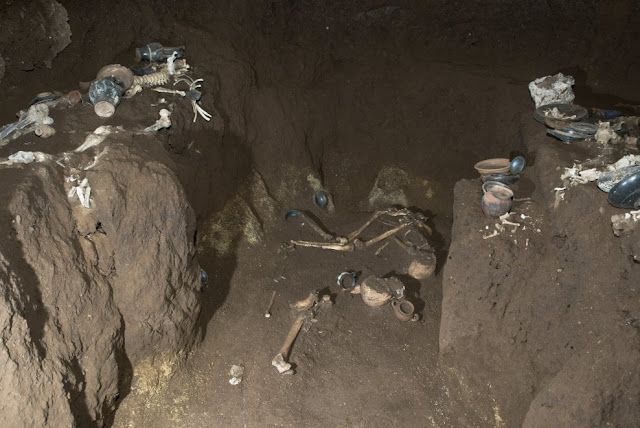
An exceptional tomb dubbed 'The Athlete's Tomb', found in exactly the same condition it was left 2,300 years ago, has been discovered outside Rome in the Case Rossse area during an aqueduct extension excavation, sources said Friday.

2,300 year old 'Athlete's Tomb' found intact outside Rome
Rome archaeologists also called it the tomb of the strigils, the instruments used for cleaning olive oil off sweaty bodies. Four skeletons, of three men and a woman, were found in the tomb with their ceremonial burial accoutrements, archaeologists said.
Archaeologists said they had been lucky to find the tomb intact since it lay relatively close to the surface, only two metres below the field where it was found.


The bodies were accompanied in their last journey by splendid black-painted ceramic works, some decorated with vegetal and geometric motifs, a coin in bronze alloy with the helmeted head of Minerva and the word "Romano" on the back, as well as plates with the remains of food offerings including rabbit, chicken and goat, and two iron strigils, used by athletes to clean themselves after sweaty physical activity.