A team of Bulgarian archaeologists has begun excavations of a site near the Greek border at the village of Benkovski, uncovering what they believe is a Thracian royal residence dating back more than 2000 years.

(The round altar found at the site. Screenshot: BNT)

The site includes a palace, a sanctuary, at least five royal burial sites in a necropolis and a 500m fortress wall. This, with several large buildings and a round altar, has led to the conclusion it was a Thracian royal residence.

Archaeology Professor Nikolai Ovcharov, a consultant on the dig, said that during excavations in the area in 2016, a double grave, believed to be of a person of nobility, and ornaments, including silver and bronze jewellery, dating from the fourth to the third century BCE were found.

The large wall found in what is today forest is thought to have enclosed a royal residence.
The head of the archaeological dig team, Associate Professor Zdravko Dimitrov, said that the wall so far had remained unexamined.

"So far, we have no data on its chronology, but it actually encloses the entire complex. All this has led us to think that this is on complex, and we have to investigate whether it really is. Most likely, we will find here all the elements of the Thracian culture, including a sanctuary, the necropolis, of course, and a settlement."

The complex near Benkovski is similar to the Thracian Kozi Gramadi residence near Starosel.
The excavations, which are privately funded, will continue until the end of October 2018.
On October 18th, we'll host a PAT ritual for the Stenia. The Stenia is connected to the Eleusinian Mysteries, Demeter, and Persephone.


The Stenia is celebrated on 9 Pyanepsion. It was a festival dedicated solely to Demeter and Persephone and was held three days before the Thesmophoria. Not much information about this festival has survived, but because bits and pieces have survived of the Thesmophoria and the preceding Skiraphoria, we can put parts of the festival back together.

A little background first: On 12 Skirophorion, the Skiraphoria was celebrated. The Skiraphoria was one of the few days when the women of ancient Athens would gather in public to honor Demeter and bless the harvest. They refused to sleep with the men on this day and took part in a very odd tradition: casting piglets down into a chasm where they were left to rot until the Stenia.

During the Stenia, women came together and begun the extensive purification rituals needed to partake in the Thesmophoria. How, exactly, the women purified themselves is unknown but it is known that the women engaged in Aiskhrologia, insulting each other and using foul language. To understand this practice, it's important to know the mythology behind it. Nearly all festivals where Demeter is included, recount the myth of Kore/Persephone who was abducted by Hades. While Demeter grieved and vowed to get her daughter out, Persephone was seduced to eat of the pomegranate fruit. This decision allowed Hades to keep Persephone in the Underworld for a part of the year, while she was allowed to rejoin her mother for the rest of it. While Demeter grieved, there was only one who could make her laugh: the strange old woman Iambe. From the Homeric Hymn 2: To Demeter:

"But Demeter bringer of seasons and giver of perfect gifts, would not sit upon the bright couch, but stayed silent with lovely eyes cast down until careful Iambe placed a jointed seat for her and threw over it a silvery fleece. Then she sat down and held her veil in her hands before her face. A long time she sat upon the stool without speaking because of her sorrow, and greeted no one by word or by sign, but rested, never smiling, and tasting neither food nor drink, because she pined with longing for her deep-bosomed daughter, until careful Iambe - who pleased her moods in aftertime also - moved the holy lady with many a quip and jest to smile and laugh and cheer her heart." [188]

I believe that a large part of the Stenia was to make the other women laugh by shouting witty insults, making crude jokes or any other way they could think of that was out of character and liberal. It's a laughing day. Yet, there was also a serious note to it. At the Stenia, some women, called 'Bailers', hiked to the chasm where the piglets had been thrown into months ago. Then, in a gruesome display of devotion, the women hauled out the rotting corpses of the piglets and carried them to the Thesmophorion, a site probably on the hillside of the Pnyx, in preparation for the Thesmophoria.

The Stenia is a female only festival, sorry guys! We can't really provide you with laughter and jokes, so here is my suggestion: get all your friends together and have a girl's night. Find Magic Mike on Netflix and break out the wine and popcorn. The ritual will focus on the religious part. You can find the ritual here and chat amongst yourselves here.
The third excavation campaign of a five-year research project conducted by the Ephorate of Antiquities of Korinthia at the Mycenaean cemetery at Aidonia in Nemea, has been completed.


The Mycenaean cemetery of Aidonia was discovered about four decades ago after it had been extensively looted. The site became more widely known in the 1990s after a collection of Mycenaean jewellery originating from the Aidonia cemetery was recovered while being sold abroad and subsequently exhibited in the Nemea Museum. The excavations by the Archaeological Service, which commenced soon after the repatriation of these artefacts, have brought to light a cluster of 16 rock-carved vaulted tombs each with a dromos, entrance and burial chamber.

In recent years, the Mycenaean cemetery of Aidonia has been the focus of new excavations conducted by the Ephorate of Antiquities of Corinth under the direction of Dr. Konstantinos Kissas, former Head of the Office and Assistant Professor at the University of Graz and his associate Dr. Kim Shelton, Professor of the University of California at Berkeley and Director of the Centre for Classical Archaeology in Nemea.

The 2018 campaign saw the completion of the excavation of an unlooted vaulted tomb of the Early Mycenaean period (c.1650-1400 BC), one of the largest found in the Aidonia necropolis.

The newly revealed tomb is distinguished by the short, but very wide, dromos and the circular-ellipsoid burial chamber, the dimensions of which exceed six metres in parts. Both the dromos and the chamber exhibit morphological features typical other mid-sized vaulted tombs of the early Mycenaean period.

On the floor of the burial chamber were four large pits, covered with megalithic slabs, another element which recalls early Mycenaean vaulted tombs. These pits contained earlier burials which were accompanied by ceramic tableware and storage vases, some of which were monumental, like the 'palace-style' pithamphora with symbolic decoration inspired by the plant and marine worlds.

Copper knives, daggers and swords were also found in the pits, as well as numerous arrow heads of copper, obsidian, and pyrite. Jewellery, necklace beads of various raw materials, fibulae and other prestigious items, such as sealstones, were also collected.

Necklace with amethyst and gold beads, c.1600/1500 BC [Credit: Greek Ministry of Culture]
The use of the monument continued during the Late Mycenaean period (c.1400-1200 BC), to which the burials found on the tomb's floor date, though the grave goods are more frugal than those of the previous period. The excavation also found evidence suggesting that part of the tomb's roof had collapsed shortly after it had ceased to be used.

The intensive use of the site both in the Archaic/Early Classical period and Roman Imperial times, as well as during the transition from the Middle to the Late Byzantine period contributed to the accumulation of thick deposits which essentially preserved the Mycenaean monument.

It is hoped that with the discovery of this unplundered tomb in Aidonia, like the interdisciplinary study of burial groups, will shed new light on the nature of the local ruling class of the Early Mycenaean period.

Many more images of the find to be viewed here.
On the day of the Hene kai Nea, I post a monthly update about things that happened on the blog and in projects and organizations related to it. I will also announce Elaion's coming PAT rituals.

Statistics:
PAT rituals for Pyanepsion:
  • 6 Pyanepsion - 15 October 2018 - Proerosia - agricultural festival for Demeter held at Eleusis
  • 7 Pyanepsion - 16 October 2018 - Pyanepsia - festival in honor of Apollon and Theseus
  • 8 Pyanepsion - 17 October 2018 - Oskhophoria - festival of the vintage (grapes)
  • 8 Pyanepsion - 17 October 2018 - Theseia - festival in honor of Theseus
  • 9 Pyanepsion - 18 October 2018 - Stenia - women's festival in honor of Demeter and Persephone
  • 11-13 Pyanepsion - 20-22 October 2018 - Thesmophoria - festival in honor of Demeter
  • 14 Pyanepsion - 23 October 2018 - Sacrifice to The Heroines at Erkhia
  • 16 Pyanepsion - 25 October 2018 - Apatouria - paternity festival. The first day (Dorpia) was celebrated with a communal feast within the brotherhood, the second day ('Anarrhusis') sacrifice were made to Zeus Phratrios and Athena Phratria, and the third day ('Koureotis') young boys admitted to their father's brotherhood.
  • 30 Pyanepsion - 8 November 2018 - The Khalkeia - festival in honor of Athena and Hephaestus.

Anything else?
Are you looking for an online shop to buy incenses and other Hellenistic basics from? Try The Hellenic Handmaid on Etsy.

Would you like to support me? Buy me a coffee.

As you may have noticed, it's a new month and thus many festivals are taking place in the coming days. Two today: the Pyanepsia and the Oskhophoria. The Pyanepsia will take place on the 16th of September, at 10 am EDT and the Oskophoria on the 17th at the same time.

The Pyanepsia


The Pyanepsia (Πυανέψια) was one of the many harvest festivals of the season, but instead of focussing on the actual harvest, the Pyanepsia focusses almost completely on the myth of Theseus and the Minotaur.

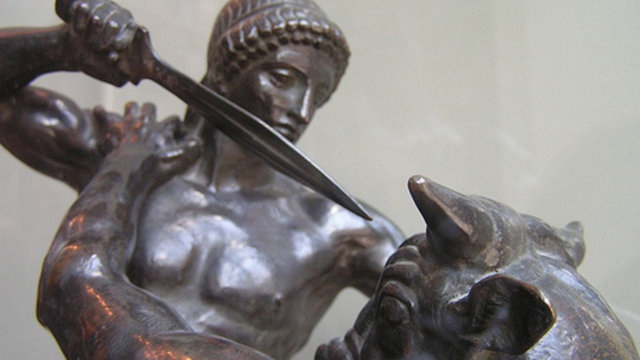
Theseus (Θησεύς) was fathered by Aegeus and Poseidon, whom had both slept with his mother Aethra, and was thus destined to become a hero. In order to claim his rightful place as ruler over Athens, he had to uncover his father's sandals and sword from under a stone in his mother's birth land where Theseus grew up, and bring it to his mortal father. He did, taking the long and dangerous route over land, and fought many Khthonic creatures and mortal bandits in the process. This was long before he would vow to bring down the Minotaur and thus, set in motion the events that led up to the strange festival of Pyanepsia.

Theseus' father, Aegeus, had taken Medea as his new wife. Afraid hat Theseus would claim the throne and take her position of power from her, Medea pressed Theseus to capture the Marathonian Bull. This, he did, but upon returning, Medea tried to poison him. Aegeus recognized his son just in time and Medea fled while father and son reunited. Theseus then heard about the Minotaur of Crete, and the nine-yearly sacrifices to it. These sacrifices were a punishment by King Minos of Crete for the death of his son Androgeus, at the hands of Athenian assassins.

Theseus offered to be one of the youths who sailed for Crete. Once there, Ariadne, daughter of the king, fell for him and offered him a ball of yarn so he would be able to find his way out off the labyrinth that housed the Minotaur the youths would be sacrificed to. Theseus defeated the Minotaur and took Ariadne and her sister Phaedra from their home in thanks for their help. That night, they slept on the beach but Athena woke up Theseus and told him to sail out now, and to leave Ariadne and Phaedra behind. He did, although it pained him greatly. In his dismay, he forgot to sail with the white sails he had promised his father to sail with if he was alive. As he reached the main land, Aegeus saw the black sails and figured his son dead. He then cast himself off of the cliffs overlooking the sea, and drowned.

Theseus blamed himself for his father's death, but was very relieved to be home none the less. He wished to thank Apollon for his safe journey and his victory over the Minotaur and thus, he ordered his men to gather all the foodstuffs that remained. This was mostly beans and grains, and he ordered the food to be cooked up for a feast and a sacrifice.

In celebration, Theseus then put together an eiresiône (εἰρεσιώνη), a branch of olive or laurel bound with purple or white wool. It was decorated with fruits of the season, pastries, and small jars of honey, oil and wine. The eiresiône was also called a 'supplicant branch', as it was intended as a thank-offering for blessings received, and at the same time as a prayer for similar blessings and protection against evil in future. He walked through the streets of Athens with his eiresiône, to signal his victory and the end of scarcity.

In ancient Hellas, and especially Athens, both observances were conglomerated into the Pyanepsia, and boys tended to carry their home made eiresiône through the streets in a Halloween-esque manner. They knocked on the doors of every house and sang a song. In return, they expected a gift. The eiresiône song from Plutarch, Life of Theseus, 22.5, goes as follows:

'eiresiône suka pherei kai pionas artous
kai meli en kotulêi kai elaion apopsêsasthai
kai kulik' euzôron, hôs an methuousa katheudêi.'

Modern Greek pronunciation:
(Capitalized syllables are emphasized according to the poetic meter)
'EE-re-si-ON-NE SEE-ka fe-RE KE PEE-on-as AR-tous
KE me-lee EN ko-tee-LEE ke e-LE-on a-POP-SEE-SAS-the
KE kee-lik EF-ZO-RON, OS AN me-thee-OU-sa ka-THEV-dee.'

Plutarch has the song:
“Eiresione for us brings figs and bread of the richest,
brings us honey in pots and oil to rub off from the body,
Strong wine too in a cup, that one may go to bed mellow.”

A special eiresiône was brought to the temple of Apollon by a boy whose parents were both alive. He was encouraged to recite the song during the procession. By the Classical Period an eiresione was hung over almost every door in Athens and remained here a full year before being replaced by a new one.

The sacrifice to Apollon was upheld for a long while as well. The ship Theseus used on his return from Crete to Athens was kept in the Athenian harbor as a memorial for several centuries. It was maintained and kept in proper shape. Often, this meant replacing parts of the ship, a practice which led to the question if the ship could still ethically be called the ship of Theseus after so much of it had been replaced. This dilemma became known as the 'Ship of Theseus paradox'. 

At any rate, the ship was sailed out to the island of Delos--which housed a sanctuary of Apollon--yearly after Theseus' return. To ensure the sanctity of the sacrifice, executions were not allowed to take place during the weeks it took to sail to Delos and back.

You can join us for this event on Facebook. The ritual for it can be found here. We would love for you to share your experiences and images of your eiresiône.


The Oskhophoria


The Oskhophoria (ὀσχοφόρια), or Oschophoria when Latinized, was an ancient Hellenic festival dedicated to Dionysos, Ariadne, Athena Skiras, and Apollon. This month, festivals are either related to the Eleusinian Mysteries or the mythology surrounding Theseus. This festival is one of the latter. It was a vintage festival and we would like to invite you to join us for it at 10:00 am EDT on September 17th.

The Oskhophoria falls during the vintage season in Attica. The principal feature of this festival, the procession, featured ripe grapevines. As such, we can assume that this festival was a thanksgiving for the grape harvest. In fact, branches of vines with fresh grapes were carried in a great procession from the temple of Dionysos in Athens, to the ancient temple of Athena Skiras in Phalerus. This was the main feature of the festival. After Theseus, hero and king, the festival was augmented to include the recounting of his many exploits with accommodation to earlier traditions. It seems that this recounting was done at the banqueting after the ritual and there would be much recounting indeed. Because the festival adopted features from mythology, Apollon also became one of the Theoi sacrificed to, as He is closely tied to the mythology of Theseus.

Many sources have snippits of information about the Oskhophoria and most disagree, as we have come to expect. We can be fairly certain the ancient Hellenes attributed the mythical foundation of the festival to Theseus, however, and many details of the festival relate back to his journey to Krete:
  • the procession featured two youthful men in female attire, said to recall the trick of Theseus in which he substituted two of the seven female tributes with young male fighters
  • mothers carrying dinner baskets also featured, representing the mothers of the fourteen tributes who made a last meal for their children before they sailed
  • the Oskophoria was an ocassion for storytelling, as the youths sailing to Krete would have needed their spirits raised
Plutarch's account, in 'Theseus', recounts the origins of the festival as follows, obviously trying to make a coherent whole out of contradictory evidence:

"The feast called Oschophoria, or the feast of boughs, which to this day the Athenians celebrate, was then first instituted by Theseus. For he took not with him the full number of virgins which by lot were to be carried away, but selected two youths of his acquaintance, of fair and womanish faces, but of a manly and forward spirit, and having, by frequent baths, and avoiding the heat and scorching of the sun, with a constant use of all the ointments and washes and dresses that serve to the adorning of the head or smoothing the skin or improving the complexion, in a manner changed them from what they were before, and having taught them farther to counterfeit the very voice and carriage and gait of virgins so that there could not be the least difference perceived, he, undiscovered by any, put them into the number of the Athenian maids designed for Crete. At his return, he and these two youths led up a solemn procession, in the same habit that is now worn by those who carry the vine-branches.
Those branches they carry in honour of Bacchus and Ariadne, for the sake of their story before related; or rather because they happened to return in autumn, the time of gathering the grapes. The women, whom they call Deipnopherae, or supper-carriers, are taken into these ceremonies, and assist at the sacrifice, in remembrance and imitation of the mothers of the young men and virgins upon whom the lot fell, for thus they ran about bringing bread and meat to their children; and because the women then told their sons and daughters many tales and stories, to comfort and encourage them under the danger they were going upon, it has still continued a custom that at this feast old fables and tales should be told.
 For these particularities we are indebted to the history of Demon. There was then a place chosen out, and a temple erected in it to Theseus, and those families out of whom the tribute of the youth was gathered were appointed to pay tax to the temple for sacrifices to him. And the house of the Phytalidae had the overseeing of these sacrifices, Theseus doing them that honour in recompense of their former hospitality."

In the myth of Theseus and the minotaur, Theseus, looking to become king of Athens, hears about the Minotaur of Krete, and the nine-yearly sacrifices to it. These sacrifices were a punishment by King Minos of krete for the death of his son Androgeus, at the hands of Athenian assassins. Theseus offered to be one of the youths who sailed for Krete. Once there, Ariadne, daughter of the king, fell for him and offered him a ball of yarn so he would be able to find his way out off the labyrinth that housed the Minotaur the youths would be sacrificed to. Theseus defeated the Minotaur and took Ariadne and her sister Phaedra from their home in thanks for their help. That night, they slept on the beach but Athena woke up Theseus and told him to sail out now, and to leave Ariadne and Phaedra behind. He did, although it pained him greatly. It was here, Dionysos found Ariadne and fell in love with her. He would later end up marrying her and she became his immortal wife.

Because the Oskophoria is in many ways two festivals in one, it is a hard one to pin down in terms of modern worship. The Oschophoria was essentially a banquet celebration in honor of Theseus and the rescue of youths and maidens and even more so, an older celebration of the vintage combining traditions of Salamis and Athens. Well into the fourth century BC, two branches of the Salaminians were involved in preparation, were Deipnophoroi, and received equal portions of the meat. The vintage rituals of the Salamic Goddess Skiras became associated with Athena Skiras and naturally Dionysos. The various Theseus mythos was explained through the numerous recounting which we have added to the ritual.

We hope you join us in celebrating this festival. You can join the Facebook community here and find the ritual here.
In the daylight hours of the 15th of October, on 6 Pyanepsion, we will celebrate and host a ritual for the Proerosia which, in Attica, honoured Demeter and Apollon first and foremost as Goddess of the harvest and oracular deity who insured bountiful harvest. It seems that in Myrrhinus, the primary recipient of worship during the Proerosia was Zeus. Will you join us on the 15th of October, at 10 AM EDT?


The Proerosia (Προηροσία) was a festival for Demeter’s blessings in preparation for the ploughing and sowing at the beginning of the agricultural season. In ancient times it was held at Eleusis. The name serves to convey the essence of the rites: 'sacrifice before ploughing'.

The myth goes that the whole of Hellas was suffering from a terrible famine or plague, and the oracle of Delphi was visited to ask how to stop this terrible affair. The Delphic Oracle said that Apollo ordered a tithe to Demeter of the first harvest on behalf of all Hellenes. Except for disruptions during the Peloponnesian War, offerings arrived annually at Eleusis from all over Hellas. While Athens wasn't a big contributor to the rites--perhaps because they already made their own offerings of grain and first fruits to Demeter--most other city-states contributed generously, and the Athenians were welcome during the rites. For His help, Pythian Apollon also received an offering during the Proerosia.

There is some confusion over the dating of the festival. Many modern sources date the festival on the fifth of Pyanpesion, but new research shows that, because of the placement of the Pyanepsia festival, in honour of Apollon and Theseus, the Proerosia could only have been celebrated in the daylight hours of the sixth.

The festival can be celebrated with first fruit-offerings, any offering related to grains (like bread, cakes, or pancakes), or a kykeon libation. The kykeon was made of barley, water, herbs, and ground goat cheese. Sometimes honey was added. Herbs that are described as part of the kykeon are mint, pennyroyal and thyme, although it seems any herb that was found to flavor the drink, was acceptable.

You can join our community for the event here, and find the ritual here.
Regular readers will have heard the term "Thessaloniki metro dig" before on this blog. I've been covering the developments at the sites for years now. A crash course on the project for those who are new to the blog. 


In March of 2013, I blogged about an excavation conducted at the Venizelos metro station which brought to light a very well preserved 70-meter section of a marble-paved road, the remains of buildings dating back to the sixth to ninth centuries AD, as well as big public buildings of the 7th century; a rarity for the Byzantine world. Trouble was (and is) that the site of the find is part of a new subway tunnel and platform which are being built to transport 250,000 passengers daily, and thus decrease traffic congestion and air pollution in the city. The entire subway project has a price-tag of 3.5 billion euros (4.6 billion dollars), and was co-financed by the European Union. To keep the road, the entire subway project would have to be abandoned. To save the subway project, the road would need to be moved, or destroyed--the same thing, according to archaeologists.

By April it looked like Thessaloniki's government and archaeological institutions had found a solution to the problem: they were going to temporarily remove the finds during the station's construction and then restore about 85 percent to 95 percent after the station was completed. The solution proposed had a low cost--0,6 percent to 0.8 percent of the budget--with zero or only a few months delay to the works’ completion. Only a 45 square meter space (out of the area’s 1.600 square meters) would not be restored, due to the placement of vents and escalators.

By February of last year, word got out that the removal of the antiquities from the construction site was suspended in July of last year following a decision reached by the Council of State. In the beginning of April I blogged about the estimation that it will take at least another three years and some 40 million euros for the excavation of ancient ruins to be completed. Well, it seems that that was a careful estimate: the new numbers weren't pretty. the new completion date was somewhere in 2020 and it might cost another 42 million euros in funding for the archaeological work it has lined up to complete the digs, on top of 92 million already spent.

In September, 2015, a new decision issued by the Central Archaeological Council (KAS) favored the in situ preservation of the antiquities found, however, KAS rejected the proposal about the enhancement of the monument on the ground of lacking documentation and asked the Municipality to conduct a complete architectural proposal in collaboration with the relevant services of the Cultural Ministry and the Attiko Metro. The Thessaloniki Municipality claimed that the ministerial decision violated the constitutional principle of proportionality, but the court ruled that the ministerial decisions were legal and in line with the constitution.

Five excavations were undertaken in 2016 at the main stations of metro line from Pylea Station to New Railway Station with a stopover on the 'Decamanus Maximus' which for centuries was the commercial heart of the city. The pre-Cassandrian settlement of the 4th century BC at the Pylea Station, the monumental complex at the junction of the main Roman road 'Decumanus Maximus' (Egnatia Odos) and the 'cardo' of Aghia Sofia (located on the axis of two important Early Christian monuments at the site of the Aghia Sofia church), and the rich burials from two ancient cemeteries spread over three other stations, brought to light major discoveries.

In 2017, they continued to work at the sites and even today, in 2018, excavations are undertaken on a daily basis. The GreekReporter gained unique access to visit the archaeologists who work alongside construction workers at various Thessaloniki Metro sites, revealing an ancient city under the City. I have included the video they made above and it's worth the watch even if you don't speak a word of Greek!