On the fourth of Thargelion, in the deme of Erkhia, located approximately twenty kilometers (twelve miles) east of Athens, a series of sacrifices were held. Most likely, these were in relation to the Thargelia which was soon to follow. Preporatory rites, of a sort. Elaion will hold a PAT ritual to follow in their footsteps on 16 May at the usual 10 am EDT. Will you be joining us?
On the day of the Hene kai Nea (or sometimes the day after, like this month), I post a monthly update about things that happened on the blog and in projects and organizations related to it. I will also announce Elaion's coming PAT rituals.
- A little over 1.882.000 views right now!
- 21.000 of those hits happened in the last month
- The top five most popular posts were: The three types of souls of Aristotle (2080), No, Sappho didn't give broccoli to her lesbian lovers (684), PBP: Symbols of Hellenismos (314), On the three types of ethos according to Aristotle (101), and The Beginner's guide to Hellenismos: Ritual and sacrifice in Hellenismos (78).
- Thargelion 4 - May 16 - Sacrifice to Leto, Pythian Apollon, Zeus, Hermes & Dioskuri at Erkhia
- Thargelion 6-7 - May 18 - 19 - Thargelia - birthday of Apollon and Artemis
- Thargelion 16 - May 28 - Sacrifice to Zeus Epakrios at Erkhia
- Thargelion 19 - May 31 - Bendideia - festival in honor of Thracian Goddess Bendis
- Thargelion 19 - May 31 - Sacrifice to Menedeius at Erkhia
- Thargelion 25n - June 5n - Plynteria - festival of washing, where the statue of athena was removed from the city of Athens to be cleaned. Auspicious day.
- Thargelion 27 - June 8 - Kallunteria - spring cleaning of the Temple of Athena
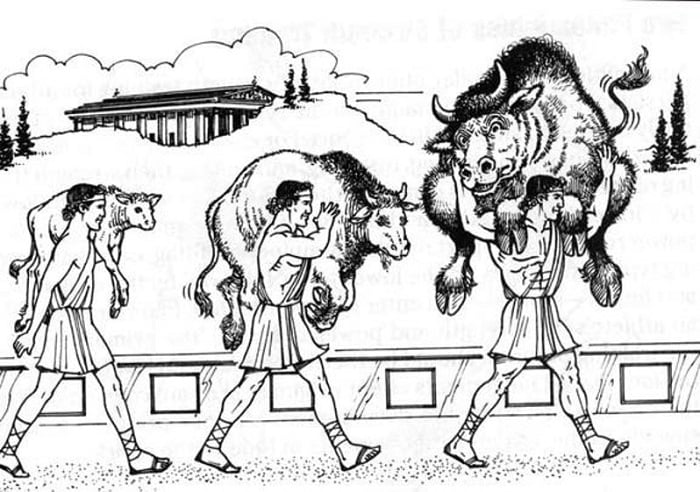
During his childhood (or so goes one legend), the future Olympian wrestler Milo of Croton owned a young calf he used to lift onto his shoulders and carry around for a spell. Milo is said to have done this every single day: as it got bigger, he grew stronger. Four years later, Milo could be seen wandering around with this fully grown pet bull resting on his manly shoulders.
Nearly 2,500 years ago, Milo of Croton was regarded as the strongest person who had ever lived in the known world. A man of incredible strength and athleticism, he taught us the three basic principles of building muscle: Start very light, don’t miss workouts, and increase training in very small increments.
Milo, from Croton in Magna Graecia, today’s southern Italy, was almost certainly the most successful wrestler of his day, becoming six-time wrestling champion at the Ancient Olympic Games. In 540 BC, he won the boys’ wrestling category and then proceeded to win the men’s competition at the next five Olympic Games in a row. He also dominated the Pythian Games (7-time winner), Isthmian Games (10-time winner), and Nemean Games (9-time winner).
Other legends say he carried his own bronze statue to its place at Olympia. One report says the wrestler was able to hold a pomegranate without damaging it while challengers tried to pry his fingers from it, and another report says he could burst a band fastened around his brow by inhaling air and causing his temple veins to swell.
The Ancient Hellenes typically attributed remarkable deaths to famous persons — in keeping with their characters throughout life. The date of Milo’s death is unknown, but according ancient historians, Milo was walking in a forest when he came upon a tree-trunk split with wedges. In what was probably intended as a display of strength, Milo inserted his hands into the cleft to rend the tree. The wedges fell from the cleft, and the tree closed upon his hands, trapping him. Unable to free himself, the wrestler was devoured by wolves.
If you want to be as strong as Milo, here are some anchient work-out tips and tricks. Be on the look-out for wolves, though!
1. Drunk Athletes Still Have to Exercise (Just Not as Strenuously)
Intoxication wouldn’t excuse you from fitness lessons. The Greco-Roman gymnastics guru Philostratus realized that people couldn’t train as effectively while under the influence. Nevertheless, he maintained that tipsy pupils should still complete their regularly scheduled workouts, just with a bit less intensity than usual.2. Ease Up on the Barley
Denouncing high-carb diets is nothing new; many Roman gladiators bulked up by consuming a dense barley porridge loaded with beans. Claudius Galen—a celebrated Roman physician—believed this made them too flabby for serious combat and criticized the practice.
3. Your Pre-Workout Routine Should Include Lots of Body Oil
Ancient Hellenic sportsmen were known to lather themselves in natural oils before exercising, which gave their bods a distinctive glisten. At the time, scholars claimed that doing so kept athletes from getting cold while toughening their skin.
4. Run Through Sand For Extra Stamina
Anacharsis, a Mediterranean philosopher who spent much of his time traveling through Athens during the 6th century BCE, once wrote a detailed description of how the Hellenes trained their sprinters. “The [practice] running is not done on hard, resistant ground,” he noted, “but in deep sand where it is not easy to plant a foot solidly or get a grip with it since it slips away from underneath the foot.” As an added bonus, these young men were also instructed “to jump over a ditch, if necessary, or some other obstacle carrying lead weights that are as large as they can hold.”
5. Wanna Get Toned? Try Digging.
If your goal is to build chiseled, well-defined muscles without using techniques that involve “violent movement,” the aforementioned Galen recommends digging, rope-climbing, and extending the arms while a workout buddy tries pulling them downwards.
6. Pick Short and Simple Exercises.
Seneca the Younger would’ve been a terrible Phys Ed teacher. The Roman philosopher believed that strenuous exercise was, ultimately, pointless. However, if somebody absolutely had to work out, Seneca favored keeping it quick. “There are short and simple exercises which will tire the body without undue delay,” he conceded, “[such as] running, swinging weights about, and jumping—either high jumping or low jumping… But whatever you do, return from body to mind very soon.”
7. Nobody Likes a Noisy Weightlifter
Say what you will about Seneca, but at least one of his fitness observations was spot-on. The following rant—inspired by an especially obnoxious breed of bodybuilder which frequented Rome’s urban bath-houses—might as well have been written about a present-day gym:
"Conjure up in your imagination all the sounds that make one hate one’s ears. I hear the grunts of musclemen exercising and jerking those heavy weights around; they are working hard, or pretending to. I hear the sharp hissing when they release their pent breath."And the bellyaching didn’t stop there. “Add to this,” Seneca moaned, “the racket of a cocky bastard, a thief caught in the act, and a fellow who likes the sound of his own voice … plus those who plunge into the pool with a huge splash of water.”
-
Wednesday, May 12, 2021
Anacharsis ancient Hellenic culture galen Milo of Croton Philostratus Roman Seneca
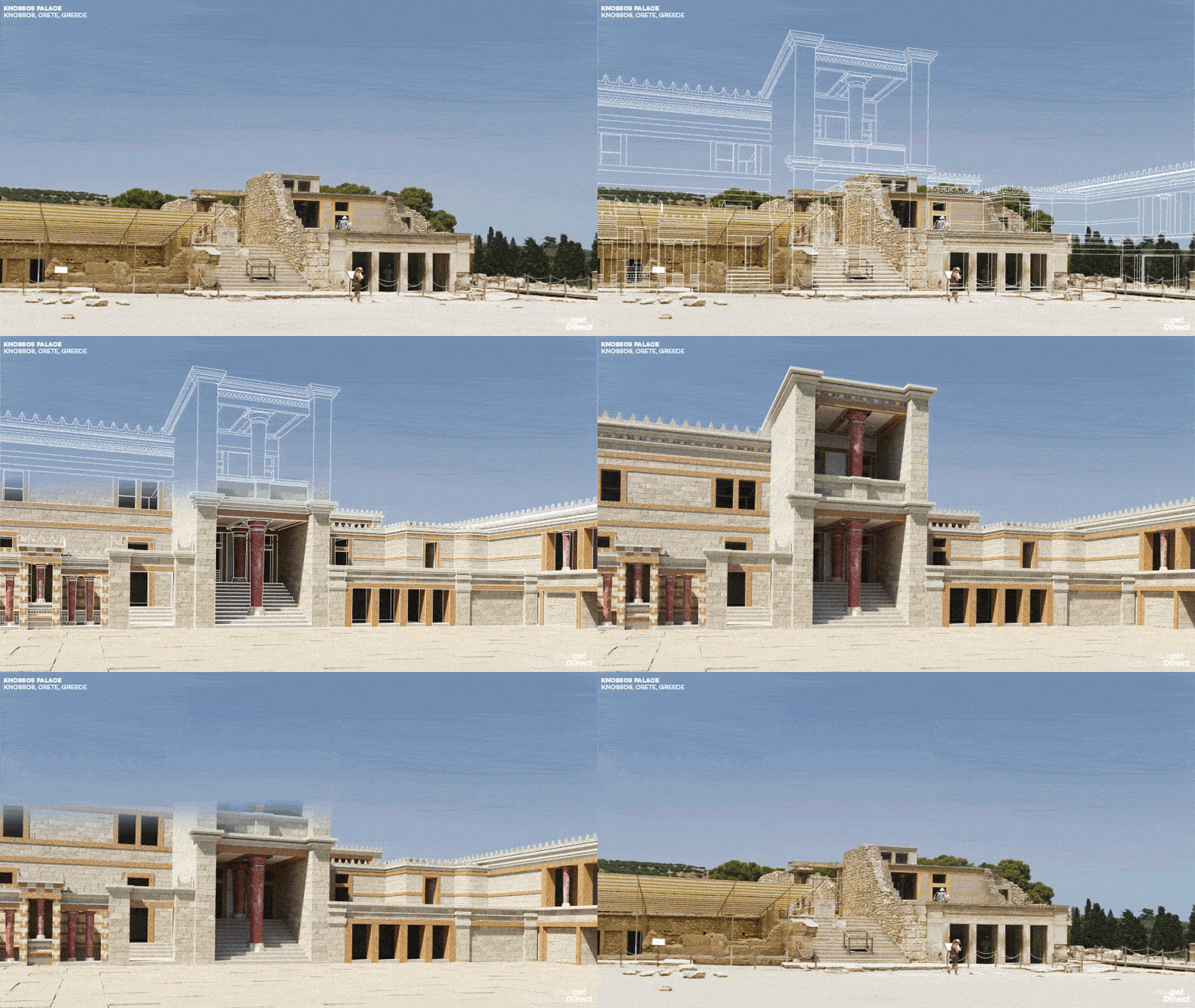
Following on from the popularity of their reconstruction of European Castles and Ancient Wonders award winning Australian insurance company Budget Direct decided to restore a selection of palaces from across the globe, one of these being Greece’s Ancient Knossos Palace. For this project, with the help of a team of architects and a lot of desk research, Budget Direct virtually reconstructed seven ruined palaces around the world including the Knossos Palace.
The town of Knossos, which surrounds Knossos Palace, is considered to be Europe’s oldest city. It was settled as early as the Neolithic period around 700BC and by 1500BC had a population of 100,000 people. The largest Bronze Age archaeological site on Crete, the Palace of Knossos is located just south of modern-day Heraklion near the north coast of Crete.
Constructed around 1700BC, Knossos Palace is the most complex in Greece and thought to be the first palace built in the Middle Minoan IO period.The palace was abandoned sometime in Late Minoan IIIC, 1380 – 1100BC, for reasons which are largely unknown.
During the Bronze Age, Knossos Palace was the ceremonial, religious, economic and political centre of the Minoan Civilization. The archaeological site of Knossos Palace covers about 20,000 square metres, spread over three acres of land and comprises over 1,500 rooms. Excavation of the site has provided historians with a wealth of insight into the Minoan Civilization. Tools such as clay and stone incised spools and whorls are indicative of a cloth-making industry in existence.
Artefacts as well as the many vibrant frescoes on the wall of the ruins provide a further understanding of the Minoan culture. Painted in a style emphasising movement and grace, these frescoes illustrate scenes of lithe young athletes, ladies gossiping and dancing, and dolphins and other animals in magical gardens. One frescoe depicts the ancient sport of bull-leaping, a sport which may have given rise to the legend of the mythical Minotaur, a creature of later Hellenic mythology that was half- man and half bull.
The possibility that there existed a Minotaur became more acceptable once it was understood that, in the Minoan sport of bull-jumping, the male athlete ‘became one with the bull’ as he vaulted over the bull’s horns. It could therefore make sense that this sport may have evoked in ancient consciousness the ‘myth’ of the Minotaur through the impression that these athletes were half men and half bulls.
The ruins of the palace foundations reveal a vast interconnected maze of small corridors, staircases and private rooms containing residential dwellings, workshops, administrative areas. Since the intricate interior of Knossos Palace has been uncovered it has been speculated that this complex structure, combined with bull symbolism ever-present throughout the ruins, has provided the distant inspiration behind the labyrinth in the Greek myth of Theseus and the Minotaur. Timber stairways led to large upper rooms have not survived the ages, but probably once rose five stories in height.
An elaborate and advanced system of drains, conduits, and terra-cotta pipes provided water and sanitation. Vertical shafts in the structure known as light-wells were designed to bring natural light to the lower levels, created an airy and comfortable atmosphere.
Despite the fact that Knossos Palace was first excavated a century ago, it is still somewhat shrouded in mystery and researched have many questions about the palace and the people who inhabited it. The controversial restoration of parts of the palace over the years has remained the centre of historical debate, with many saying that the rebuilding has been based on “historically incorrect creative licence.”
The constellation Draco (from the Greek Drakon, meaning dragon) is identified--funnily enough--with some dragons in Hellenic myth but not others. There are quite a few creatures, after all, who would qualify as a dragon in Hellenic myth. For a dragon or hydra not connected to the constellation, think of the one Kadmos vanquished, for example, or the one Apollon vanquished at Delphi, or even the dragon who guarded the Golden Fleece and was slain by Iásōn. In truth, only two dragons were associated with the myth in ancient times, most notably by Hyginus in his Astronomica: Drakon Hesperios, the Hesperian Dragon, and Drakon Gigantomakhios, the Gigantomachian Dragon.
The first of the myths associated with the constellation is the legend of the Drakon Hesperios (Δρακων Ἑσπεριος), who was slain by Hēraklēs during one of his Labours. I will tell the whole myth of the labour soon enough, but I will share what Hyginus wrote about this labour, and Hēraklēs' encounter with Ladôn (Λαδων), as the dragon was often called.
The sole other dragon this myth is linked to is Drakon Gigantomakhios (Δρακων Γιγαντομαχιος), who rose up during the Gigantomachy. When the Olympians rose to power, they first fought the Titans during the Titanomachy. Vanquishing them, the Theoi thought They had won. Yet, there was one who sought revenge for the defeat of his father: Typhôeus, the most-feared son of Tartaros and Gaea. Some versions of the myth say that Typhôeus was actually the Drakon Gigantomakhios, or one of his offspring. Hyginus shares what happened to the dragon:
The constellation Draco is visible at latitudes between +90° and −15°, and best visible at 21:00 (9 p.m.) during the month of July. Tomorrow, we will talk a little more about the types of dragons in Hellenic myth, because I suddenly realized the association with medieval dragons is very easily made when reading 'dragon', but I assure you, the ancient Hellenes were unaccustomed to giant, fire breathing, lizards.
-
Monday, May 10, 2021
astronomy Athena Constellation series Gaea Gigantomachy Hera Hēraklēs Hyginus Iásōn Ptolemy Titanomachy
With the stories of heroes triumphing over gods, the appearance of spine-chilling ancient beasts, and a variety of other-worldly locations, mythology in games is a trend that is sure to never cease, with fans being treated to a variety of great titles over the years. The Gamer put together a list of games based on real-world mythology.
For players looking to brush up on their Hellenic mythology, there are plenty of games out there that will deliver you to the dazzling temples of Olympia, or delight you with their lore and references based on their ancient tales. From stories of the mythological gods, valiant fabled protagonists, fearsome beasts, and modern games with a Grecian twist, here are some of the best games with lore-based within ancient Hellas.
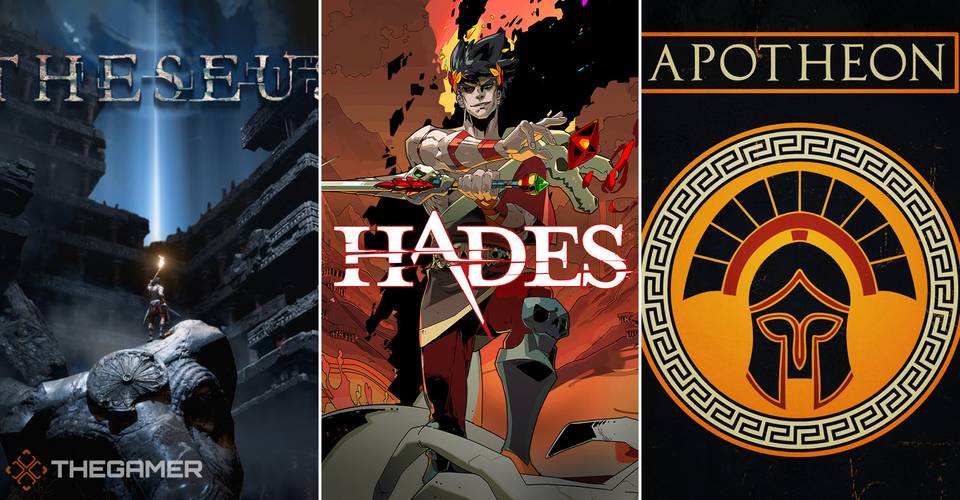
10 - Theseus
Theseus is an immersive VR experience that places you straight into the story of the Minotaur. The Minotaur, a mythical creature with the head and tail of a bull and the body of a man, was born from King Minos of Crete's wife, Pasiphae, after Poseidon made her fall in love with a bull as revenge on the King Minos of Crete. The Minotaur was then placed into an elaborate labyrinth constructed at King Minos' request by Daedalus and his son Icarus.
The game almost perfectly recreates the legend, with you playing as Theseus, the Athenian Hero who traverses the maze and slays the Minotaur. It mixes exploration of the maze with survival, combat, and some cinematic story elements before your eventual run-in with the large foe.
9 - NyxQuest
NyxQuest sees you playing as Nyx, the embodiment of night within ancient Hellas. Nyx befriends Icarus when he flies into her realm within the sky, but when he disappears without warning, she then heads to the surface to search for him in the crumbling ancient Hellenic landscape.
The mesmerizing setting and game design seem to jump straight out of the artwork of Grecian amphora and temple friezes from the time. Nyx is aided on her journey by the Olympians as she traverses crumbling ruins and defeats ancient monsters like the Hydra with special powers such as manipulating objects, controlling the wind, and casting powerful rays.
8 - Kid Icarus
Kid Icarus first jumped onto screens in 1986, quickly becoming one of the more popular games for NES. It's a cult classic and often centers around the protagonist Pit and his quest to equip sacred treasures, traverse platforms, and defeat bosses in order to save the Grecian-inspired world of Angel Land and the Goddess Palutena, who is thought to be based on Athena.
Kid Icarus has come a long way from his humble NES beginnings, with 3DS game Kid Icarus: Uprising being released in 2012 and Pit, Dark Pit, and Palutena becoming recurring characters in the Smash Bros franchise.
7 - Persona 3
Persona 3 is the game that set the tone of what was to become the success of every Persona game to follow it and is still thought of today as one of the best JRPG's of the 2000s. You play as a character that attends a modern Japanese high school during the day whilst exploring Tartarus in the evening. Tartarus was a location in Hellenic mythology, described as the deep abyss used for the torment and suffering of the wicked, and the prison for the Titans.
Persona 3 has a vast collection of characters you need to maintain relationships with, all of which have Personas based within Hellenic and Roman mythology. Journeying to Tartarus also puts you face to face with a plethora of monsters, including the final boss Nyx, the embodiment of night.
6 - Okhlos
In Okhlos, you play as a mob of ancient Hellenic civilians, warriors, slaves, and animals who have become sick and tired of the abuse and antics of the Gods, and so take up arms to destroy every building, temple, Grecian monster, and Olympian in their path.
Okhlos embodies the scenery and settings of ancient Hellas with lush temples and large fearsome Gods, but that's nothing but an obstacle to your mob of toga and sandal-wearing ruffians. Okhlos is a one-of-a-kind battle game, and can even see you wielding the power of iconic Grecian figures such as the hero Heracles, Pandora, and even Socrates.
5 - Apotheon
A 2D action-adventure game that sees you playing within the minimalist artwork from the pottery of ancient Hellas. Apotheon sees you playing hero Nikandreos as he traverses a vibrant artistic world to ascend Mount Olympus and take on the Pantheon of Gods to save humankind.
In Pantheon, the Gods of Olympus have abandoned the humans, leaving you to traverse Artemis' forests, Apollo's palace, and climb Mount Olympus to take their powers for yourself. The heroic narrative is a direct look into the heroic tales of ancient Hellenic lore, with the game even tying in excerpts from famous stories like the Iliad.
4 - Assassins Creed: Odyssey
Assassins Creed Odyssey places you onto the lush streets and volcanic islands of ancient Hellas, moving from an unknown outcast to a living Spartan legend amongst humans and Gods as you play through a struggling, war-torn world during the mythological Peloponnesian war.
Assassins Creed Odyssey sees you forge your own path and destiny through ancient Hellas, influencing the history of the stories and land around you as you fight a list of formidable Grecian foes from Aegean naval fleets on the sea to legendary beasts of myth such as the Minotaur, Nemean Lion, and even Medusa, the legendary Gorgon.
3 - Immortals Fenyx Rising
Immortals Fenyx Rising is a new take on ancient Hellenic lore, as you play as Fenyx, a newly recruited winged Demigod on a quest to not destroy the Hellenic Gods, but save them! There is also the DLC 'The Lost Gods' which sees you play as Ash, a mortal hero who ventures to the Pyrite islands in order to locate the missing Gods.
This is a grand open-world Hellenic myth adventure brought to life, giving you the ability to wield the powers of heroes and Gods alike from Achilles Sword to Daidalos' wings to battle monsters such as the Cyclops, Cerberus, and Gorgons, as well as encountering rare mythological creatures such as Griffins.
2 - God Of War
The God of War franchise has recently seen lore-based within Norse mythology but began its journey in ancient Hellas, following the story of protagonist Kratos.
Kratos was a war general forced to kill his wife and daughter unknowingly under Ares command. After exacting revenge on Ares and ascending to godhood himself, he then goes on to seek revenge against the Olympians, Titans, and his own father for their betrayal. God of War is based in an alternate 495 BC Hellas, and as well as Gods and beasts also features critical moments from Grecian tales such as Heracles' 12 Labors, Jason and the Argonauts, and the sinking of Atlantis.
1 - Hades
Hades is a rogue-like dungeon crawler where you defy your father, Hades. You'll battle your way through a vivid reimagination of the Grecian Underworld as the immortal prince Zagreus, This game is renowned as one of the best games of its kind to have come out in recent years.
Hades is a new take on the Grecian theme, seeing you hack and slash your way through the underworld to break free of Hades' grip. Zagreus is helped on his journey by the Olympians, who grant him an assortment of powerful boons that help you take on the Underworld's monsters, courtesy of Gods such as Zeus, Athena, and Hade's wife and Zagreus' own mother, Persephone.
Untold stories recounting the glories of ancient Hellas contain the name Pausanias, who lived in the second century AD. But few people appreciate the man behind these ancient chronicles, focusing instead on the subjects he portrayed in his works.
The historian was born approximately 110 AD into a Hellenic family who most likely lived in Lydia; he was certainly familiar with the western coast of Asia Minor, but his travels extended far beyond the limits of Ionia. Before visiting Hellas itself, he had been to Antioch, Joppa, and Jerusalem — even to the banks of the River Jordan.
In Egypt, he had seen the pyramids. While at the temple of Ammon at Siwah, he had been shown the hymn once sent to that shrine by Pindar. In Macedonia, he appears to have seen the tomb said to be that of Orpheus in Libethra (modern Leivithra). Crossing over to Italy, he visited some of the cities of Campania, as well as Rome. He is one of the first known to write of seeing the ruins of Troy, Alexandria Troas, and Mycenae.
Pausanias’ Description of Greece, or Periegesis, is in the form of ten books, each dedicated to some portion of Hellas, with a heavy emphasis on the glories of ancient Hellas — although he lived at a time of Roman domination of the area.
His many works are geared toward a Roman audience, since Romans wanted to know everything about the glories of ancient Hellas — and many times adopt Hellenic ways for themselves. The project is more than topographical; it is a cultural geography of ancient Hellas — in a way, a snapshot taken in time to capture what was left of the height of Classical Greece.
Pausanias often digresses from his description of architectural and artistic objects to review the mythological and historical underpinnings of the society that produced them, giving us today a much clearer picture of how mythology and culture are interwoven into the Hellenic landscape. He begins his tour in Attica, where the city of Athens and its demes dominate the discussion.
He describes what he saw at Athens’ Temple of Olympian Zeus, which is of course still extant in the city, although of course greatly changed over the millennia.
“Before the entrance to the sanctuary of Olympian Zeus – Hadrian the Roman emperor dedicated the temple and the statue, one worth seeing, which in size exceeds all other statues save the colossi at Rhodes and Rome, and is made of ivory and gold… before the entrance, I say, stand statues of Hadrian, two of Thasian stone, two of Egyptian. Before the pillars stand bronze statues … The whole circumference of the precincts is about four stades, and they are full of statues; for every city has dedicated a likeness of the emperor Hadrian, and the Athenians have surpassed them in dedicating, behind the temple, the remarkable colossus. Within the precincts are antiquities: a bronze Zeus, a temple of Cronus and Rhea and an enclosure of Earth surnamed ‘Olympian.’ Here the floor opens to the width of a cubit, and they say that along this bed flowed off the water after the deluge that occurred in the time of Deucalion, and into it they cast every year wheat meal mixed with honey.”
Pausanias’ subsequent books describe Corinthia, Laconia, Messenia, Elis, Achaea, Arcadia, Boetia, Phocis and Ozolian Locris (Λοκρῶν Ὀζόλων).
As a Hellenic man writing at the zenith of the Roman empire, he was in an awkward cultural space, between the glories of the Hellenic past he was so keen to describe and the realities of a Hellas that was now beholden to Rome as a dominant imperial force.
He was not technically a naturalist, although he commented on the physical aspects of the Hellenic landscape. He notices the pine trees on the sandy coast of Elis, the deer and the wild boars in the oak woods of Phelloe, and the crows amid the giant oak trees of Alalcomenae.
He says “Among the sights of Thesprotia are a sanctuary of Zeus at Dodona and an oak sacred to the god. Near Cichyrus is a lake called Acherusia, and a river called Acheron.” However, he tells things as he sees them with a bit of an insult here and there, saying “There is also Cocytus, a most unlovely stream. I believe it was because Homer had seen these places that he made bold to describe in his poems the regions of Hades, and gave to the rivers there the names of those in Thesprotia.”
Pausanias even touches on the natural bounty of Hellas, including the wild strawberries of Helicon, the date palms of Aulis, and the olive oil of Tithorea, and remarking on its animals, such as the tortoises of Arcadia and the “white blackbirds” of Cyllene.
The chronicler makes history come alive when he says that the Phocian War was concurrent with a man who won a race in the Olympics, saying “In the tenth year after the seizure of the sanctuary, Philip put an end to the war, which was called both the Phocian War and the Sacred War, in the year when Theophilus was archon at Athens, which was the first of the hundred and eighth Olympiad at which Polycles of Cyrene was victorious in the foot-race.”
Placing them firmly into the rich cultural history of the country, he then relates “The cities of Phocis were captured and razed to the ground. The tale of them was Lilaea, Hyampolis, Anticyra, Parapotamii, Panopeus and Daulis. These cities were distinguished in days of old, especially because of the poetry of Homer.”
Even in the most rural corners of Hellas, he is fascinated by all kinds of depictions of deities, holy relics, and many other sacred and mysterious objects. He makes a note on the ruins of the house of Pindar, and the statues of Hesiod, Arion, Thamyris, and Orpheus in the grove of the Muses on Helicon, as well as the portraits of Corinna at Tanagra and of Polybius in the cities of Arcadia.
One of Pausanias’ modern editors, Christian Habicht, stated:
“In general, he prefers the old to the new, the sacred to the profane; there is much more about classical than about contemporary Greek art, more about temples, altars and images of the gods, than about public buildings and statues of politicians. Some magnificent and dominating structures, such as the Stoa of King Attalus in the Athenian Agora (rebuilt by Homer Thompson) or the Exedra of Herodes Atticus at Olympia are not even mentioned.”
Unlike a mere travel guide, in “Periegesis” Pausanias stops in many places around the nation for a brief excursus on a point of ancient ritual or to tell a myth, in a genre that would not become popular again until the early nineteenth century.
Pausanias is fond of digressions on the wonders of nature, the signs that herald the approach of an earthquake, the phenomena of the tides, the ice-bound seas of the north, and the noonday sun that at the summer solstice, casts no shadow at Syene (Aswan). As scientists know, the observation of the noonday sun at this very place enabled the great scientist Eratosthenes to determine the circumference of the earth.
While he never doubts the existence of the deities and heroes, the cultural geographer sometimes criticizes the myths and legends relating to them. His descriptions of monuments of art are plain and unadorned, but crucially, their accuracy is confirmed by the extant remains that one can often see today.
Pausanias is perfectly frank in his confessions of ignorance in his works. When he quotes a book at second hand he takes pains to say so. This is an invaluable aid to the modern reader, who can become troubled by the fantastic observations and sometimes fabrications of ancient writers.
His life’s work, however, left only faint traces in Hellas for many centuries after his death. “It was not read”, Habicht relates; “there is not a single mention of the author, not a single quotation from it, not a whisper before Stephanus Byzantius in the sixth century, and only two or three references to it throughout the Middle Ages.”
The only manuscripts of Pausanias are three fifteenth-century copies, full of errors and lacunae, which all appear to depend on a single manuscript that survived to be copied. Niccolò Niccoli had this archetype in Florence in 1418. At his death in 1437, it went to the library of San Marco, Florence. A part of the manuscript is held at the Biblioteca Medicea Laurenziana.
Until twentieth-century archaeologists realized that Pausanias was a reliable guide to the sites they were excavating, the peripatetic chronicler had been largely dismissed by nineteenth- and early twentieth-century classicists.
Modern archaeological research, however, has tended to vindicate Pausanias in his many descriptions of his beloved country, which have gone on to form an invaluable cultural record of the glories of ancient Hellas.