In the calendar from Erkhia the heroine Basile was given a holókaustos on the 4th of the month of Boedromion. The sacrifice to Basile consisted of a white, female, lamb and was followed by a wineless libation. The colour of the animal is noteworthy, since holókaustoi have commonly been classified as khthonian sacrifices, and it is usually assumed that the victims used in such rituals were black. Basile was also worshipped elsewhere in Attica, but nothing is known of the kind of sacrifices she received at those locations. Basile seems to have been a local heroine. Nothing survives about her deeds, as far as we have been able to find, but she was important enough to warrant her own personal sacrifice--the Erkhian calendar also makes note of collective sacrifices to 'the heroines'.
Two PAT ritual announcements, both for September 10th. We will hold a PAT ritual for the Niketeria, followed by the Plataia.
The Niketeria
We are coming upon another festival celebrated in ancient Athens: the Niketeria. Surviving sources date the festival to the third of Boudromion, and it was in honor of one of the most important events in Athens' history: its naming and tutelage by Athena. We will be celebrating it at the usual 10 AM EDT.
-
Wednesday, September 8, 2021
ancient Hellenic culture Athena Athens Basile current affairs Elaion Hera Heroes Mythology 101 Nike PAT Poseidon
On the day of the Hene kai Nea, or sometimes on the day after, like this month, I post a monthly update about things that happened on the blog and in projects and organizations related to it. I will also announce Elaion's coming PAT rituals.
- A little over 1.956.000 views right now!
- 20.100 of those hits happened in the last month
- The top five most popular posts were: The three types of souls of Aristotle (717), PBP: Symbols of Hellenismos (287), The lunar Deities of Hellenismos (207), The Beginner's guide to Hellenismos: Ritual and sacrifice in Hellenismos (169), and On the three types of ethos according to Aristotle (120)
- Boedromion 2 - September 10 - Niketeria - festival in honor of Athena, Nike, and perhaps Poseidon
- Boedromion 2 - September 10 - Plataia - festival of reconciliation, sacred to Hera Daidala
- Boedromion 4 - September 11 - Sacrifice to Basile in Erkhia
- Boedromion 5 - September 12 - Genesia - public festival for the dead in honor of Gaea
- Boedromion 5 - September 12 - Sacrifice to Epops at Erkhia
- Boedromion 6 - September 13 - Kharisteria - festival in honor of Artemis Agrotera
- Boedromion 7 - September 14 - Boedromia - a festival of thanksgiving for Apollon as a god who rescues people in war
- Boedromion 12 - September 19 - Democratia - festival in honor of Democracy
- Boedromion 13-23 - September 21 - 30 - September 11 - Eleusinian Greater Mysteries - in honor of Demeter
- Boedromion 17 - September 25 - Epidauria - in honor of Asklēpiós
- Boedromion 27 - October 4 - Sacrifice to the Nymphs, Achelous, Alochus, Hermes & Gaea at Erkhia
After identifying the sanctuary of Artemis Amarysia in 2017 and discovering in 2020 the Late-Αrchaic temple with a rich foundation deposit, the Greek-Swiss excavations on the Greek island of Euboea continue in the summer of 2021 East of Amarynthos. The research programme, aiming this year to further uncover the temple, is a collaboration between the Euboea Ephorate of Antiquities headed by Dr. Angeliki Simosi and the Swiss School of Archaeology in Greece, under Professor Sylvian Fachard.
The first days of the new excavation period brought to light important findings from inside the temple, adding to the votive offerings of the second half of the 6th c. BC found in 2020. These include black-figure vases imported from Attica, vessels from local workshops, clay and bronze figurines, jewellery, seal stones, a bronze shield and an iron helmet.
Additional trenches were also excavated in other parts of the sanctuary. In one of them, at the northern end of the shrine, along with roof tiles of a building, a clay lion’s head waterspout was found in excellent condition. An archaic or classical wall was also discovered in the same area, which at that time restricted the shrine to the north.
During this year’s excavation season, research also began at the foot of the adjacent hill of Palaeoekklisies, with the aim of understanding the reason for the shift of human activities from the hill to the plain and the transformation of the prehistoric settlement into a sanctuary.
It should be noted that the prehistoric settlement at the top of the hill was already known from previous excavations by the Euboea Ephorate of Antiquities and is mentioned in a plaque inscribed in Linear B from the palace of Thebes. A medieval building was discovered directly below the surface, while part of a Bronze Age building was found at a deeper level with abundant Mycenaean pottery.
A third area of research is the surface survey between Eretria and Amarynthos, which aims to trace the sacred road mentioned in ancient sources which connected the metropolis with its most important sanctuary. As part of this research, not only will inspections be conducted in the field, but modern technological methods will also be used, such as LiDAR aerial images.
I would like to discuss heroes and hero worship. Heroes and heroines have a special place in Hellenismos, as they had in ancient Hellas. These were humans--most with at least a part divine heritage--who were considered so brave, so skillful, so extraordinary in their lifetime that they became revered. Some were priests or priestesses of a temple, some excelled in battle, others were skilled healers or good rulers. Once they passed to the realm of Hades, their names were remembered at least once a year on a special occasion, because the ancient Hellenes believed that if the name and deeds of a person were remembered, they would live forever and potentially look out for those they had looked out for before.
Hero worship was very specific and it's a concept that translates with more difficulty than straight-up deity worship. In essence, heroes are the bridge between mortals and Gods. They were born mortal (although often with a bloodline to the Gods) but through their deeds, they were rewarded with immortality themselves. They became Gods. Still, the lessons they teach us are all mortal lessons. Heroes were honored more than worshipped, and we do that today as well. So heroes, like Gods, can be called on for counsel and aid, and like the Gods, you can establish kharis--a bond of ritual reciprocity--with them. But they don't judge us, not like the Gods anyway, because they were all just like us once.
Archeological evidence suggests that hero worship was closer to khthonic sacrifice in execution than ouranic ones the further back in time you go; especially in the archaic period, it seems that hero worship consisted of destructive sacrifices--sometimes in the form of a holókaustos where the entire animal was burned, sometimes in a sacrifice where only a part (most often 'a ninth' of the animal) was burned and the rest remained on the altar for the heroes to eat from until gone. The sacrifices were generally burned in an offering pit known as a bothros. The food offered to heroes consisted of meat, blood, and 'food eaten by men' like grains, fruits and other every-day dishes. These were usually offered to the heroes on a table--known as a trapeza--and the heroes were sometimes offered chairs or a bench to sit on. As time went on, the living began to eat part of the meal laid out for the heroes, joining them in celebration.
Although linked, hero worship in ancient Hellas was not the same as ancestral worship; heroes and heroines transcended family bonds. That said, ancestor worship was performed in a khthonic manner during state festivals but as hero worship when at home. This can be explained by surmising that ancestors were considered heroes to the family and they were missed. As such the character of their remembrance was khthonic. It was also possible to honour the family line and it was actually a part of the celebration of Agathós Daímōn, the third day of the month. The goal was not to honour the people in the family line but to express pride in your blood and bring about good fortune as stemming from the family line. This type of worship was closer to hero worship and was performed at a separate shrine or at an offering pit outside. These sarcifices were generally wholly given as well and could either be an animal or, more commenly, unmixed wine.
There were regular state festivals organized for the dead (nekysia) and for the forefathers (genesia) as there were for the heroes. Unlike with rites to the heroes, on such days, graves were adorned, offerings of barley broth, milk, honey, unmixed wine, oil, water and the blood of animal sacrifices were given in the form of khoai--fully poured out libations. Graves often had bottomless amphorae placed on it on hollow columns. The libation was poured into this and seeped down into the dirt to 'feed the dead'. Heroes were not considered to be dead, they were considered to be raised up as Gods. To worship them in a khthonic manner would have been inappropriate.
Heroes and heroines were considered to be raised up to Olympos and as such to have become Gods. They were, however, never revered as Gods. They were considered part of the tapestry of life: ideals to live up to, reminders of hard times in the past, and some were remembered as reminders against hate. Others were remembered for contributions to society, or for a whole scope of other reasons that made their lives important enough to remember.
In a modern Hellenistic context, hero worship translates very well. This applies to both the ancient Heroes like Theseus and Atalanta but also to modern ones like Martin Luther King and Malala Yousafzai. More importantly, perhaps, it also translates to people in your own life and your own community; the founder of the food program for the poor in your neighborhood, the man who stopped a robbery, the woman who saved a child from drowning. These are events that change lives and communities.
There is a lot of pain and suffering in the world; anyone who stands up against that, who goes out and does something extraordinary, needs to be honored and thanked, both when they are alive and after they have passed. There are people who change our lives and communities--we all know them. Remember and honor them every once in a while, for their actions, for what they taught you, and for what they have inspired to bring into the world.
-
Sunday, September 5, 2021
ancient Hellenic culture Hellenic Reconstruction Hellenismos 101 Heroes Mythology 101
Pisces is a constellation of the zodiac. Its name is the Latin plural for 'fish'. It lies between Aquarius to the west and Aries to the east. The ecliptic and the celestial equator intersect within this constellation and in Virgo.
During the Titomanchy, the Olympians were in for a rough fight when Zeus led them against the Titans. One of their toughest fights was against the storm-giant Typhôeus (Τυφωευς), a fight so tough, in fact, that the Olympians had to flee from battle. Pisces is associated with Aphrodite and Eros, the who escaped from the monster Typhôeus, the most-feared son of Tartaros and Gaea, by leaping into the sea and transforming themselves into fish. In order not to lose each other, they tied themselves together with rope. Alternatively, the fish represent the Ikhthyes (Ιχθυες), a pair of large Syrian river fish who rescued Aphrodite and Eros when they were fleeing. Thirdly, they may be solely the fishes Aphros and Bythos, the fish-tailed Ikhthyokentauroi (Sea-Centaurs) of late classical art, who pulled Aphrodite to safety after her birth in the ocean. Hyginus says of the first option in his 'Astronomica':
Roman poet Ovid has an adaption about the second option, noted down in 'Fasti':
In all cases, the fishes were accepted into the heavens for their aid lend, and Aphrodite and Eros were safe, having escaped Typhôeus.
Pisces is visible at latitudes between +90° and −65°, and best visible at 21:00 (9 p.m.) during the month of November.
-
Saturday, September 4, 2021
Aphrodite Constellation series Eros Hyginus Mythology 101 Ovid Titanomachy
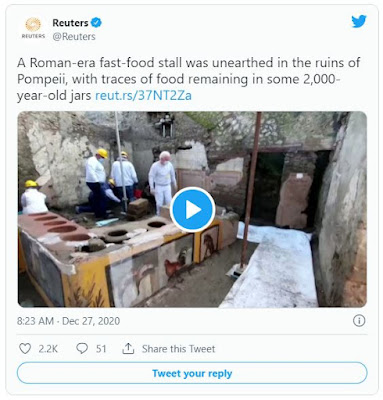
Not techically Hellenic, but one of those, "If they had them back then, odds are high they had them earlier" posts. A fascinating discovery of a spectacular street food shop was made by archaeologists in Pompeii, southern Italy, a find with provides a peek into ancient food culture.
Experts unearthed an entire food shop that sold ready-to-eat meals to passersby, in what appears to be a proper street food shop, equivalent to our modern-day fast food. The archaeologists found counters containing circular holes, where terracotta jars with food had been stored by the shop owner.
Additionally, these counters feature fantastically well-preserved frescoes depicting different animals, probably about the kind of meat that was sold in this shop. Following further analysis, archaeologists found traces of beef, pork, fish, and snails, revealing the variety of dishes the residents of this Greco-Roman city were enjoying.
This find, which was made during excavations in winter of 2020, provides incredible insight into the daily lives and diets of ancient people. The information discovered during the dig is crucial to developing our understanding of life in antiquity.
Pompeii was an ancient city located near Naples (Napoli) in the Campania region of southern Italy. The city of more than 13,000 residents, along with Herculaneum and many villas in the surrounding area was buried under volcanic ash and pumice in the eruption of Mount Vesuvius in AD 79, leaving mankind with a spectacularly vivid archaeological site. Pompeii, located in Campania, southern Italy, is an open-air museum where visitors can easily view the shockingly vivid remnants of the complete devastation of the city after the violent volcanic eruption. Nearby Mt. Vesuvius is still an active volcano, although it is currently dormant.