July 9, at 10 am EDT, we will hold a rite for Aphrodite Pandamos and Peitho, as on this day, the fourth of Hekatombaion, They were traditionally honoured during a festival of unification. Will you join us?

 
Pandêmos (Πανδημος) occurs as an epithet of Aphrodite. It identifies her as the Goddess of low sensual pleasures, and the epithet is often translated as 'common to all the people'. She united all the inhabitants of a country into one social or political body. In this respect She was worshipped at Athens along with Peitho (persuasion), and Her worship was said to have been instituted by Theseus at the time when he united the scattered townships into one great body of citizens.

According to some authorities, it was Solon who erected the sanctuary of Aphrodite Pandemos, either because her image stood in the agora, or because the hetaerae had to pay the costs of its erection. The worship of Aphrodite Pandemos also occurs at Megalopolis in Arcadia and at Thebes. 'Pandemos' also occurs as a surname of Eros.

Peithô is the personification of persuasion, seduction and charming speech. She was worshipped as a divinity at Sicyon, where she was honoured with a temple in the agora. Peitho also occurs as a surname of other divinities, such as Aphrodite, whose worship was said to have been introduced at Athens by Theseus, when he united the country communities into towns, and of Artemis.

At Athens the statues of Peitho and Aphrodite Pandemos stood closely together, and at Megara, too, the statue of Peitho stood in the temple of Aphrodite, so that the two divinities must he conceived as closely connected, or the one, perhaps, merely as an attribute of the other. For our rite, we will honour both divinities separately.

There is actually not much known about the Aphrodisia. It was most likely linked to the synoikismos, or unification, of the Attic demes into poleis, or city-states. In early Hellas, ancient society was split between the 'demos', country villages, and the 'asty', or 'polis', the seat of the aristocracy. The distinction between the 'polis' and the 'demos' was of great political importance in the ancient states. There was much antagonism between these two bodies, the country and city. In the city-states of ancient Hellas, synoecism occurred when the 'demos' combined with--usually by force--a polis to form one political union. The most notable synoikistes was the mythic or legendary Theseus, who liberated Attica from Kretan hegemony and gave independency back to Hellas under leadership of Athens. Like the Synoikia that was celebrated in a few days--which was a truly political festival and we will thus not celebrate it--the Aphrodisia seems to celebrate Theseus' efforts.

An inscription on a stele of Hymettian marble found near the Beulé Gate at the site of the aedicula on the south-west slope of the Acropolis may tell us something of the preparations for the Aphrodisia festival. Dated between 287 and 283 BC, the inscription records that at the time of the procession of Aphrodite Pandemos, Kallias, son of Lysimachos of the deme of Hermai, was to provide funds for the purification of the temple and the altar with the blood of a dove, for giving a coat of pitch to the roof, for the washing of the statues, and for a purple cloak for the amount of two drachmas.

From this and other ancient sources, we can conclude that the first ritual of the festival would be to purify the temple with the blood from a dove, which we know is the sacred bird of Aphrodite. Needless to say, we won't do this, but we do encourage you to give your altar a good scrub! Afterwards, worshippers would carry sacred images of Aphrodite and Peitho in a procession to the sea to be washed. In Cyprus, participants who were initiated into the Mysteries of Aphrodite were offered salt, a representation of Aphrodite's connection to the sea, and bread baked in the shape of a phallus (feel free to make some of those!). During the festival it was not permitted to make bloody sacrifices, since the altar could not be polluted with the blood of the sacrifice victims, which were usually white male goats. This of course excludes the blood of the sacred dove, made at the beginning of the ritual to purify the altar. In addition to live male goats, worshippers would offer flowers and incense.

As a celebration of the unfication of Attica, the Aphrodisia festival may seem redundant, since the Synoikia festival also took place in the month of Hekatombaion, between the Aphrodisia and the Panathenaia. Yet, without help of Aphrodite Pandemos and Peitho, whose powers bring people together, unification would not have been possible. While the Synoikia celebrates a very specific event that is no longer current, the Aphrodisia celebrates not only Aphrodite (and Peitho) as divine, but also represents the beauty of community, solidarity, and the end of strive. In this day and age where it seems the entire world is at war, we offer sacrifice to Aphrodite and Peitho humbly in hopes that They will interfere and lay to rest this terrible animosity.

Will you be joining us on July 9? Join the community here, and download the ritual here.
Archaeologists digging at the famous Circus of Carthage have revealed a startlingly advanced system Roman to cool down horses and chariots during races, or so Haaretz reports. It says nothing about the ancient Hellenic was in which this might have been done, but the base of this practice might stem from that time.


The ancient Romans and Hellenes were obsessed with chariot racing. But even horses can faint, certainly in the burning heat of North Africa, which is where the Circus is located, on the north coast of the continent. Pioneering, albeit preliminary, geophysical explorations in the 1970s, measured the Carthage arena at 500 meters in length, which is around 80 meters shorter than the Circus Maximus in Rome itself. American excavations in the 1980s measured the width at 77 meters, only 2 meters short of the Circus Maximus. Whereas the Circus Maximus could accommodate over 150,000 people, the capacity of the circus at Carthage seems to have been smaller.

Key to the discovery of the clever cooling system at the Circus of Carthage, the biggest sporting arena outside Rome, was the detection of water resistant mortar. Frerich Schön of Tübingen University, the water technology specialist who first spotted the material, reported to Haaretz:

"This kind of mortar is called hydraulic mortar. It's a type of waterproof lime mortar mixed with crushed and pulverized ceramics that the Romans used in hydraulic engineering."

The discovery was made at the spina, the median strip of the circus, around the ends of which the charioteers would turn during races. The spina would often feature ornate columns and statues. As was the custom in ancient racetracks, water basins had been placed along the spina of Carthage, the archaeologists realized. Sparsores – sprinklers –would dip clay amphorae into the basins, from which they would sprinkle water on the chariots, says Dr Ralf Bockmann, who is directing the excavation  together with his Tunisian colleague, Dr Hamden Ben Romdhane.

The technique is a common one; well-preserved water basins have also been found at the circus of Maxentius outside of Rome on the Via Appia. Water basins of the type are shown on a mosaic from Carthage showing the circus and the spina. As for the sparsores, this was evidently not a job for the faint of heart. Bockmann adds:

"The sparsores would usually be on foot, directly on the spina, presumably at the level of the arena, to cool down the chariot wheels driving by at high speed. How exactly the cooling was organized is not clear. But for sure, it must have been a dangerous business."
It would ahve been worth it. Taking care of the racers--and more importantly, the horses--was of vital importance. Horse racing was that time's top grossing sporting event. The games were a blood sport and involved frantic danger and excitement. Charioteers were the highest-paid sportsmen in history. One second-century Roman charioteer won almost 36 million sesterces during his career – equivalent to $15 billion today.

The charioteers wore distinct colors, and each team represented a certain group in society, either political or social. Supporters would erupt in frenzy when their favorite team appeared. Charioteers became so popular that people adorned their houses with their portraits. And clashes between rival groups of fans were as commonplace as today. For instance, the Roman historian Tacitus reports on a riot during a sporting event in Pompeii, when Pompeians brawled with fans from the neighboring city of Nucreia.

In ancient Hellas, women were not allowed to watch sports (although the practice changed slowly), let alone participate in them. They could however enter equestrian contests through ownership. The chariot race in Olympia was won by a team owned by a Spartan princess, Cynisca, not once but twice; her triumph was influential in getting other women to field teams that won.

Although we have no record of how much she won, Cynisca--daughter and sister of kings--was the first woman to have a hero shrine erected in her name and to be honored with a statue of herself in the Temple of Zeus in Olympia. Only Spartan kings were graced in this way.

Yet another discovery arising from study of the spina is that the Carthage circus had to have been built in at least two phases. Bockmann clarifies:

"We cannot say yet if these phases indicate a restructuring or enlargement, or simply are the result of distinctive actions within a single construction process."

Aside from the excavation of the spina itself, two other trenches were dug within the monumental Circus. One was to investigate the forerunners of the circus--the buildings that had existed before it, and were torn down to build it. One building seems to have been a mausoleum. Others are older and may well be of Punic origin--built by the original Carthagians, who might trace their origins to the Phoenicians and Berbers.

The second trench is investigating the 'bleachers', the section where spectators sat and cheered on their favorites. The archaeologists hope this section of the dig will enable the façade and grand stands of the circus to be reconstructed and will also shed light on the infrastructure of the organization of the games and its connection with the urban topography. Bockmann said:

"The circus of Carthage played a great role for civic life as a monument, where large parts of the population would gather to watch the races, over hundreds of years."

The circus region, which served to entertain the masses for centuries, is the only part of ancient Carthage that has not been extensively built over in modern times. The archaeologists believe that its relatively untouched nature can bring fresh insights on the development of the ancient city. For instance"

"It will be very interesting to reconstruct how the terrain was prepared for the erection of the circus, and what kind of usage dominated before. The study is just starting and is planned to go on for years."

The excavation is being jointly undertaken by the German archeological institute in Rome and the Institut National du Patrimoine of Tunisia.
On the day of the Hene kai Nea, I post a monthly update about things that happened on the blog and in projects and organizations related to it. I will also announce Elaion's coming PAT rituals.

Changes to the blog:
Statistics:
PAT rituals for Hekatonbaion:
  • 09/07 - Hekatonbaion 4 - Aphrodisia - festival of Aphrodite and Peitho (Persuasion), where the temple was purified with dove's blood, the altars cleansed, and the two statues washed
  • 17/07 - Hekatonbaion 12 -Kronia - festival in honor of Kronos
  • 20/07 - Hekatonbaion 16 - Sunoikia - community festival in Athens. Sacred to Athena.
  • 26/07 - Hekatonbaion 21 - Sacrifice to Kourotrophos, (Hekate &) Artemis at Erkhia
  • 28/07 - 03/07 - Hekatonbaion 23-30 - Panathanaia - main celebration on the twenty-eighth in honor of Athena.
Anything else?
Sea-Watch has become Pandora's Kharis' cause for Skirophoria 2016. Since the year 2000 more than 23.000 people have died trying to reach Europe’s shores. Three business partners from Germany decided to found the non-profit NGO Sea-Watch e.V. in an effort to bring down those numbers. Since November 2015 Sea-Watch is working between Lesbos and the Turkish mainland to prevent further deaths in this part of the Mediterranean Sea, recording the highest number of drowned refugees in 2015. Pandora's Kharis members and any passing kind stranger can help them achieve this goal this month.

The deadline to donate is July 5, 2016. You can do so by using the PayPal option to the side of the Pandora's Kharis website or by donating directly to baring.the.aegis@gmail.com. Thank you in advance!

Are you looking for an online shop to buy incenses and other Hellenistic basics from? Try The Hellenic Handmaid on Etsy.
The Spartans would have been proud of me yesterday. Do you remember I moved a few months back? Things are coming along great! The next project on the list: renovate the shed in order to make space for my own personal gym(nasium)! I have been missing it terribly! I am a huge fan of being active and while I walk (about 15 km a day) and cycle and mountainbike whenever I can, I miss my upper body work-outs in the form of lifting heavy things, praticing my boxing and TRX. I could have signed up for a gym for a few months while we got things sorted but I really, really, really dislike the gym for a variety of reasons. Suffice to say, I am a happy camper that somewhere this week--weather permits--we are finally starting Project Gym.

I got sidetracked a bit. What I was going to tell you about is that we have already done a lot of contruction on the house and all the construction materials and debris that came out of that had to go somewhere while we awaited gathering enough to justify the costs of renting a container to dump it all into and have it removed. The only place it could go without it being in the way was, you guessed it, the shed. So now we are on the verge of starting that renovation, all of that junk had to be taken out, piled high and covered while we await the materials that will come out of the shed renovation. Once that is completed, we're going to rent that container. So yesterday was seven straight hours of hauling heavy things--including bricks, leminate boards, insulation sheets and wood. Whew!

I am very happy to report that I am in a lot less pain than I had expected to be this morning. I'm stiff and my back is a little creaky but honestly, it's allowed. It's good to see that a few months away from the gym and getting only 'real life' exercise in hasn't damaged my upper body strength any. So today I am leaving you with some Spartan poetry, because I'm feeling particularly close to the city-state today.

You might find yourself surprised that poetry came out of a warrior-heavy society like Sparta but actually, Sparta was renowned in its own time for its poetry, as well as its music and dance. Sadly, only fragments of these work have survived the centuries. The only Startan works of poetry that survive to form a relative whole are those of Tyrtaeus. Tyrtaeus (Τυρταῖος Tyrtaios) was an Hellenic lyric poet from Sparta who composed verses around the time of the Second Messenian War, the date of which isn't clearly established, but sometime in the latter part of the seventh century BC. He is known especially for political and military elegies, exhorting Spartans to support the state authorities and to fight bravely against the Messenians, who had temporarily succeeded in wresting their estates from Spartan control. 

Tyrtaeus was predominantly an elegiac poet. The three longest fragments of surviving verse (fr. 10–12) are complete or virtually complete poems describing the ideal warrior and the disgrace or glory that attends his personal choices. Critics these days say it's not particularly good poetry but I enjoy it none the less. What follows was a marching song, for the soldiers to keep pace as they set off for war. Imagine how impressive that would have been to behold, if you will!


"Ye are of the lineage of the invincible Heracles; so be ye of good cheer; not yet is the head of Zeus turned away. Fear ye not a multitude of men, nor flinch, but let every man hold his shield straight towards the van, making Life his enemy and the black Spirits of Death dear as the rays of the sun. For ye know the destroying deeds of lamentable Ares, and well have learnt the disposition of woeful War; ye have tasted both of the fleeing and the pursuing, lads, and had more than your fill of either.
 
Those who abiding shoulder go with a will into the mellay and the van, of these are fewer slain, these save the people afterward; as for them that turn to fear, all their valour is lost —no man could tell in words each and all the ills that befall a man if he once come to dishonour. For pleasant it is in dreadful warfare to pierce the midriff of a flying man, and disgraced is the dead that lieth in the dust with a spear-point in his back.
 
So let each man bite his lip and abide firm-set astride upon the ground, covering with the belly of his broad buckler thighs and legs below and breast and shoulders above; let him brandish the massy spear in his right hand, let him wave the dire crest upon his head; let him learn how to fight by doing doughty deeds, and not stand shield in hand beyond the missiles.
 
Nay, let each man close the foe, and with his own long spear, or else with his sword, wound and take an enemy, and setting foot beside foot, resting shield against shield, crest beside crest, helm beside helm, fight his man breast to breast with sword or long spear in hand. And ye also, ye light-armed, crouch ye on either hand beneath the shield and fling your great hurlstones and throw against them your smooth javelins, in your place beside the men of heavier armament." [CURFRAG.tlg-0266.7]
Something light for you today that has nothing to do with religion but which popped in my head this morning: kids toys. I haven't been spending time with kids nor indulged in my own childhood treasures (lego anyone?) but I still thought of kids toys this morning.


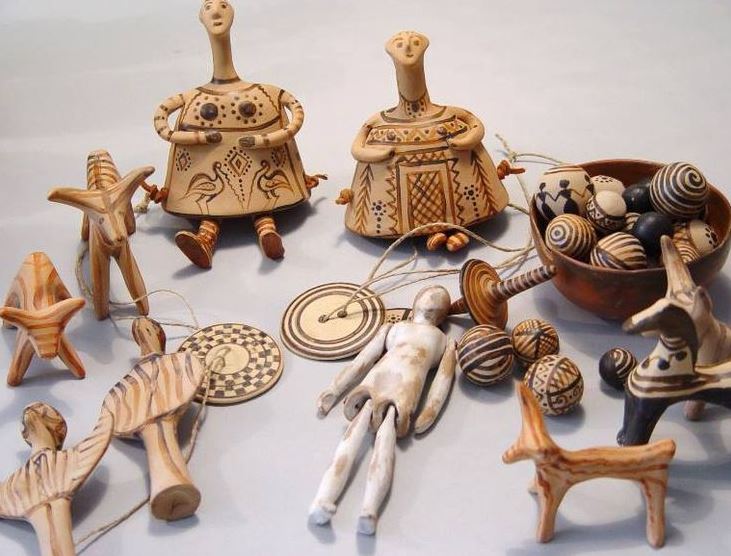
Archaeologists have uncovered all sorts of toys at sites in areas previously part og the ancient Hellenic territory. Many of the toys that ancient Hellenic children enjoyed were similar to toys of today. They played with rattles (platagi), tops (stromvos), hoops and pull toys as well as figurines in the shapes of animals (athyrma). The yo-yo, or something close to it, may have been created in ancient Hellas. It was made out of two terra cotta discs and was simply called a disc.

Marbles were very popular with Hellenic children. The earliest marbles (spheria) were most likely made from chestnuts and acorns but later they were made from polished stones. Another very popular toy was knucklebones. These were made from the ankles of sheep and goats. Players threw knucklebones like dice and often carried them around in their pouch. Knucklebones were popular toys because they were cheap. Almost all children could get them.

Like today, there were also toys meant just for girls and others meant just for boys. Boys often played with toy chariots and girls usually played with dolls. Some dolls from ancient Hellas even had moving arms and legs. Some dolls were made from ivory and glass but most were made from terra cotta. Interestingly enough, some were even made with human hair, others were made of rags, clay or wax. Some had holes in the top of their heads for a string that led up to a disk that could be held and moved to make the puppet dance.

Dolls we're just toys, however. Some of these dolls were used in religious rituals as well. When boys reached adulthood, they sacrificed their toys to Apollon. When a young woman was about to be married, she would offer her dolls to  Artemis as a symbolic leaving behind of her childhood. In ancient Hellas, Artemis was the Goddess whom prayers and offerings were made to surrounding childbirth and she was also the guardian of children. Most ususally she was revered in this role under the epithets 'Kourotrophos' (nurturer) and 'Lokheia' (helper in childbirth). During childbirth the ancient Hellenes also prayed to Hekate as a Goddess of women and nurturer of children, as well as Hera, the Queen of the Gods who sometimes served as a Goddess of childbirth in her capacity as Goddess of marriage.

Toys were generally given as gifts on religious festival days--kids didn't get many as they were expected to work, not play, but getting them must have been a joyous ocassion, indeed! That said, kids in ancient Hellas were quite capapble of entertaining themselves with what was around. Take this quote from Aristophanes' 'Clouds', for example:

"Why, when he was still a tyke this high, he could make clay houses at home, and carve boats, and fashion figwood carts, and he’d make frogs out of pomegranates as pretty as you please."[878 - 881]

I'll end this with a few more pictures of these toys--or artifacts displaying these toys. Have a playful day today, people. Now excuse me, I need to go find my yo-yo!

Aiora, swings

Balls

Dolls

Clay figurines

Hoops

Yo-Yo's

knucklebones

marbles

Spinning tops

Pull wagons
Remember how last year a huge and pretty darn beautiful mask of Pan was found in Israel? It seems Archaeologists in northern Israel may now have unearthed an entire sanctuary of Pan to go with it. The find was made in the ancient city of Hippos. Excavations by the Zinman Institute of Archaeology at the University of Haifa have uncovered a monumental Roman gate, which may have led to a compound dedicated to the worship of Pan, the God of flocks and shepherds.

 
Last year, the archaeologists discovered a bronze mask of Pan, which is unusually large compared to other such bronze masks of the Greek God that date from the same period. The researchers had said that efforts to date the item or explain the function of the mask would be difficult. With the recent discovery of the gate, Michael Eisenberg, head of the expedition, said that the researchers now have a starting point that will help them look for answers:

"Now that the whole gate has been exposed, we not only have better information for dating the mask, but also a clue to its function. Are we looking at a gate that led to the sanctuary of the god Pan or one of the rustic gods?"

The mask was found in the remains of a large stone building, and the archaeologists hoped that uncovering the rest of the building would offer context about the mask's origins. Based on what they found in the excavation, the researchers estimate that the original gateway was about 20 feet (6 meters) tall, and that the entire building was likely even taller. They’ve also dated the building to the time of the Roman emperor Hadrian, who reigned from A.D. 117 to A.D. 138. Eisenberg hypothesized that the site, which was found outside of the city limits, was possibly a compound for the god Pan, and that it had been built just in front of the entrance to Hippos.

"The mask, and now the gate in which it was embedded, are continuing to fire our imaginations. The worship of Pan sometimes included ceremonies involving drinking, sacrifices and ecstatic rituals, including nudity and sex. This worship usually took place outside the city walls, in caves and other natural settings."

Hippos, also called Sussita, overlooks the Sea of Galilee and was established in the third century B.C. and destroyed by an earthquake in the year A.D. 749. As more discoveries are made in future excavations, the researchers said that newly unearthed material will continue to shed light on the ancient city's history. According to Eisenberg:

"What kind of worship of Pan or his fellow Dionysus, the god of wine, took place here in Hippos? To answer that question, we will have to keep on digging."
Today, I would like to announce the last PAT ritual for Skirophorion, the Diisoteria. It will be held on 5 July, 10 am EDT--our usual time--and we would like you to join us in honouring Zeus, Athena, Asklēpiós, and Hygeia.


The Diisoteria was held on the last day of Skirophorion in the Piraeus, the ancient port of Athens. Fourth century accounts show that a large number of bulls were sacrificed at the festival. The sum set aside for the sacrifice in 323 BC is reported as either 50 talents or 30 talents but neither figure can be regarded as wholly realistic since Demosthenes, who was put in charge of the sacrifice for that year, was expected to pay the bulk of an outstanding fine from the money allocated. It was presided over by the archon.

The sacrifice was performed to mark the end of the old year and beginning of the new. It was held in honour of Zeus Soter and Athene Soteira, as well as Asklēpiós and Hygeia. The purpose of the sacrifice was to place the state under the protection of the God and Goddess during the forthcoming year.

Will you join us in this PAT ritual to reign in the new year? You can find the ritual here.