Delos, the mythological birthplace of the Apollon and Artemis is a three-mile-long granite outcrop in the middle of Cyclades archipelago that is one of Greece's most important archaeological sites. The ancient Greeks made Delos a cult centre for the worship of Apollo and Artemis between 900 and 100 BC, although the ancient stone huts on the island date from the third millennium BC. Under the Romans the island became a free port and the site of one of the region's largest slave markets. And now, artist Antony Gormley has unveiled Sight, an exhibition of 29 of his humanoid sculptures on the island.
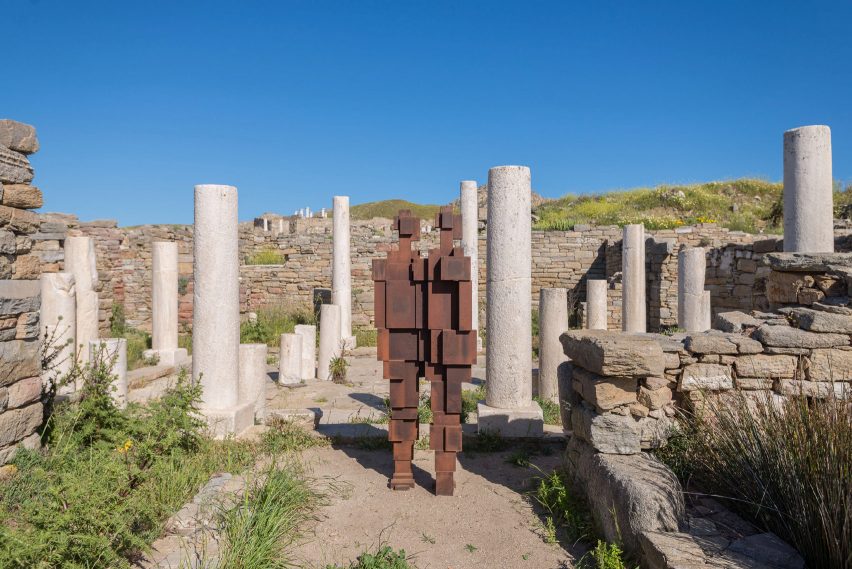

British sculptor Gormley has installed the forms across the island taking advantage of both the scenery and ruined ancient Hellenic and Roman architecture.

"In this atmosphere of light there is a feeling of timeliness, of being outside industrial time. Sculpture is a threshold to another attitude to time; it provides the invitation to escape mechanised time as we know it."

Sight, which was commissioned by nonprofit art foundation Neon, includes five new works, displayed alongside 24 existing Antony Gormley pieces. The figures are displayed across the island, including among ruined ancient columns, at the centre of an amphitheatre, at the water's edge and standing in the sea.

The project was organised in collaboration with the Ephorate of Antiquities of Cyclades. Sight was curated by director of the Whitechapel Gallery Iwona Blazwick and Neon director Elina Kountouri.
The exhibition, which is accessible via boat from Mykonos, Paros and Naxos Islands, is on display until 31 October 2019

I'm not going to lie, I'm conflicted. Considering the supervision, I doubt any harm has come to the ruins, but this is a holy site for me and many others. I also don't quite understand why the show had to be organized at that exact location.

How do you feel about this?
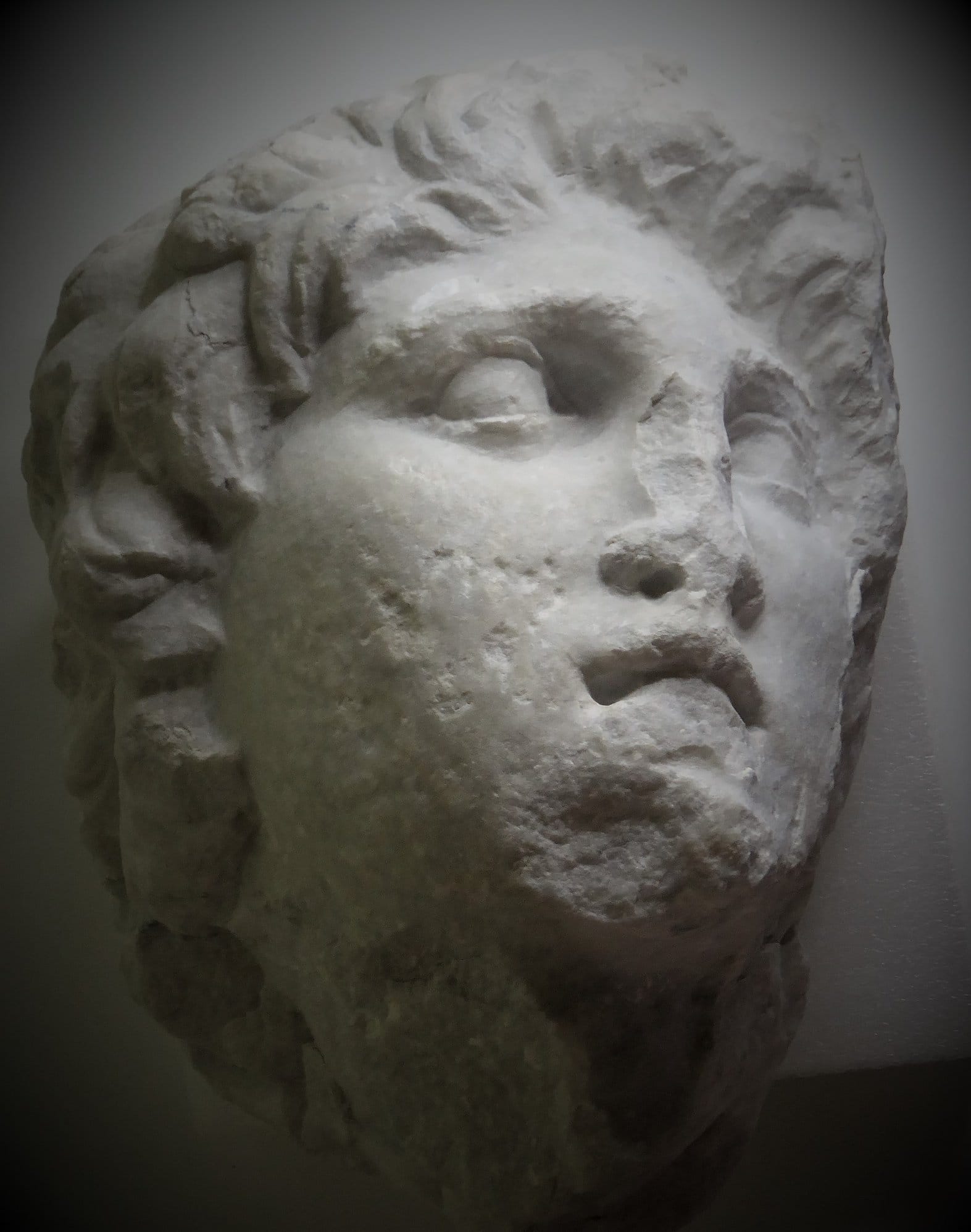
A statue of Alexander the Great has been found in the storage room of an archaeological museum in Veria. The surprising find was made by Angeliki Kottaridi, a leading archaeologist, and was announced in a Facebook post.

Kottaridi stated:

"A ‘brand new’ Portrait of Alexander, still unknown to archaeologists and art lovers…For decades lost in a dark corner of the warehouse of the archaeological museum of Veria between crates with ceramic, half under old mortars and pollutants."

The sculpture, which was initially found decades ago underneath rubble near the Greek town of Veria, was rediscovered a few weeks ago as staffers were cleaning out a storage room by chance.

The sculpture will also be featured in a major exhibition next year at the Aigai Museum.

Alexander the Great “ Ἀλέξανδρος ὁ Μέγας”, was a king of the ancient Greece  kingdom of Macedon  and a member of the Argead dynasty. He was born in Pella in 356 BC and succeeded his father Phillip II to the throne at the age of 20. He spent most of his ruling years on an unprecedented military campaign through Asia and northeast Africa, and by the age of thirty he had created one of the largest empires of the ancient world, stretching from Greece to northwestern India. He was undefeated in battle and is widely considered one of history’s most successful military commanders
I hate offering prayers for the dead. There are too many dead. Thousands upon thousands, killed needlessly, drowned searching for a home, stoned, burned, shot. Some days, I don't know how to act, so I turn to prayer. Out of helplessness. Hopelessness, maybe. I pray, that at least these things may come true.


"May Hermes Psychopompos carry the souls of the dead safely cross the river Styx.
May Hekate, as Kourotrophos, light their way.
May Hades accept them favourably, and may the judges judge them fairly.
May Asklēpiós tend to the wounds of the injured.
May Ares instill in them the passion of life, and the strength of a thousand warriors.
May Hypnos sooth their weary minds, and cloud them in sleep.
May Dionysos calm their terror.
May They offer the same to emergency personnel and passers-by who were witnesses.
May Dikē who weeps at the injustice done upon all touched by this tragedy, clutch the strong thigh of Zeus the All-wise, and beg of Him the severest of punishments.
May All-Mighty Zeus send winged Nemesis to administer swift judgement.
May Her judgement take from the guilty parties an equal or greater price than their victims have had to pay.
May Hēlios the All-seeing whisper truth to law enforcement, and guide the investigation swiftly towards those who conceived of this terrible crime.
May wise Athena led Her aid to them.
May Zeus the All-mighty bless those who ran not from the area, but towards it, in an attempt to offer aid to those wounded or dead.
May He look favourably upon those who ran away as well, as the will to live is at the core of every mortal's life.
To all Theoi: a last plea. To protect those whom the media will persecute, but are innocent of the crime.
To protect the innocent scapegoat from the actions of a species in the grips of fear and revenge."

On the day of the Hene kai Nea (or sometimes, like this month, days later because life happens), I post a monthly update about things that happened on the blog and in projects and organizations related to it. I will also announce Elaion's coming PAT rituals.

Statistics:
PAT rituals for Metageitnion:
  • Metageitnion 2 - August 3 - Herakleia - in honor of Herakles at Kunosarges gymnaisium outside Athens
  • Metageitnion 12 - August 13 - Sacrifice to Zeus Polieus, Athena Polias, and Apollon Lykeios in Athens
  • Metageitnion 16 - August 17 - Sacrifice to Kourotrophos, Hekate & Artemis at Erkhia
  • Metageitnion 19 - August 20 - Sacrifice to The Heroines at Erkhia
  • Metageitnion 20 - August 22 - Sacrifice to Hera Telkhinia at Erkhia
  • Metageitnion 25 - August 26 - Sacrifice to Zeus Epoptes at Erkhia

Anything else?
Are you looking for an online shop to buy incenses and other Hellenistic basics from? Try The Hellenic Handmaid on Etsy.

Would you like to support me? Buy me a coffee.


Very few heroes in ancient Hellas had quite the impact of Herakles. Both mythologically speaking and as a practical part of the religion, Herakles has a special place and he is honored during the Herakleia. Will you honor him with us on August 3rd at the usual 10 am EDT?
   

Herakles was conceived by Zeus upon Alkmene, as He disguised Himself as her husband, returning early from war. Alkmene accepted Him in her bed gladly, as she was happy to see her husband again. When the real Amphitryon did return later that night, Alkmene realized what had happened, and told her husband. Amphitryon accepted her in his bed, regardless, and so she became pregnant with twins, one fathered by Zeus, and one by her mortal husband.

Hera, hearing of the affair, took an instant disliking to the unborn child. When it became time for Alkmene to give birth, Hera made Zeus swear a vow that a child born in the line of Perseus on this day would become King. Zeus agreed, and Hera hurried off to delay the birth of Herakles and Iphikles, and hurry along the birth of Eurystheus (Εὐρυσθεύς), grandson of Perseus. The two had unknowingly become part of a contest of wills between Zeus and Hera, to decide who would be the hero to drive off the last of the great monsters and pave the way for the Olympians.

Eventually, Hera was tricked into allowing the children born, as She would have postponed their delivery indefinitely. Alkmene, aware of the divine spark in one of her sons, took her distance from him, but the young Herakles was taken up by Athena and taken to Hera, who did no recognize the newborn nemesis of Her candidate, and took pity on him. She fed him from Her breast, but when he suckled so hard that he caused Her pain, She realized who he was, and cast him off. Athena rescued the infant and took him back to his mortal parents. Alkmene took him back and raised him with her husband.

Herakles was a strong child, so strong, in fact, that he inadvertently killed his music teacher Linos (Λῖνος) with a lyre, for which he was tried and found not guilty. He was still made to leave the city, however. Herakles set out to perform feats of strength, starting by defeating the lion of Kithairon, which had been a bane to his stepfather for far too long. Thespios, King of Thespiae, housed Herakles for fifty days as he hunted for the lion, and every night Thespios placed one of his fifty daughters in his bed, although Herakles thought he was only sleeping with one. Herakles eventually vanquished the lion. He dressed himself in the skin, and wore the scalp as a helmet. The Gods lavished him with gifts: a sword from Hermes, bow and arrows from Apollon, a golden breastplate from Hephaistos, and a robe from Athena. His famous club he made himself at Nemea.

Next, Herakles was drawn into a war between the Thebans and the Minyans. He happened upon heralds from King Klymenos, who had won a previous battle with Thebes and now demanded tribute from them. Herakles, who had been living in Thebes, cut the ears, noses and hands off of all but one of the heralds and told the last remaining one to take them back to his king as tribute. In the battle that followed, Herakles fought bravely with the king's army, and his side eventually won, earning him his wife Megara, eldest daughter of King Kreon of Thebes.

Due to Hera's jealousy, he was stricken mad and killed the five sons he had by his wife. When he was released from his madness by a hellebore potion--provided by Antikyreus--and realized what he had done, he cried out in anguish, and went on a long journey to cleanse himself of the miasma caused by these killings. First, he visited the oracle at Delphi, who, unbeknownst to him, was whispered to by Hera. The Oracle told Herakles to serve the king of Tiryns, Eurystheus, for ten years and do everything Eurystheus told him to do. Eurystheus gladly provided Herakles with these labors--ten of them, one for each year--and eventually ended up adding two more, resulting in the Twelve Labors of Herakles.

The Herakleia (Ἡράκλεια ἐν Κυνοσάργει, Herakleia en Kynosargei) were ancient festivals commemorating the death of Herakles. In Athens, the celebration was held just outside the city walls, in a sanctuary dedicated to Herakles. His priests were drawn from the list of boys who were not full Athenian citizens (nothoi, illegitimate children, like him) and were named 'parasitoi'. The Attic cults of Herakles were often closely connected with youth: at several of his cult sites there was a gymnasion attached, and there was a mythological tradition (perhaps originating in Boeotia) that after Herakles died he was taken up to Olympus, where he married Hebe, the personification of youth. Because of this, Herakles is sometimes worshipped as a God and sometimes as a dead hero.

In Thebes, the center of the cult of Herakles, the festivities lasted a number of days and consisted of various athletic and musical contests (agones), as well as sacrifices. They were celebrated in the gymnasium of Iolaus, the nephew and eromenos of Herakles, and were known as the Iolaeia. The winners were awarded brass tripods.

Will you join us in honoring Herakles on this day? You can join the community here and find the ritual here.
The ancient Hellenes were very keen people, interested in all things nature, science and philosophy. They searched for answers to questions about their life, as well as the Theoi, and they theorized structurally about any discoveries they made, be it in health care, science or paleontology. Especially in the latter department, there are a few discoveries that might have shaped a large part of ancient Hellenic mythology and religion in general. Today, we'll be discussing some of those.

Giants:

Nichoria (Νιχώρια) is a site in Messenia, a regional unit in the southwestern part of the Peloponnese, Greece, on a ridgetop near modern Rizomylos, at the northwestern corner of the Messenian Gulf. It was the home of an Acropolis where many--what we now call--fossils were stored. The Nichoria bone was discovered by the ancient Hellenes roughly around 1000 BC. It is the blackened and petrified thigh bone of an extinct mega mammal--likely a woolly rhinoceros, or a mammoth--that roamed southern Hellas around one million years ago. The rusty-black color of the fossil bone indicates that it was most likely collected from the lignite deposits near the ancient town of Megalopolis, some 55 kilometers (35 miles) away from Nichoria. The Megalopolis basin was known in antiquity as the 'battleground of the Giants', where first the Titanomachy and then the Gigantomachy was believed to have taken place. The dense concentration of large fossil bones found at the basin inspired the belief that entire armies of giants were blasted by Zeus' thunderbolts, and the Nichoria bone--the distal end of a right femur, 15 cm (5-6 inches) wide, about twice the size of a regular human thigh bone--was most likely believed to have belonged to one of these giants. If the myth or the bone came first is unknown.

Cyclopses:
The one-eyed giants might have their origins in the recovered skulls of Deinotherium giganteum, which, loosely translated means 'really huge terrible beast'. Skulls and even tusks have been discovered in temples of the island of Krete, placed their by the ancient inhabitants. The Deinotherium is a distant relative to today's elephants. It stood about four and a half meters (15 feet) tall at the shoulder, and had tusks that extended over a meter (4.5 feet). It roamed Europe, Asia, and Africa during the Miocene (23 to 5 million years ago) and Pliocene (5 to 1.8 million years ago) eras before becoming extinct. As the image to the right shows, the large hole in the front of the skull was the anchor point for the trunk, not the eyes, but the skill of a young Deinotherium combined with the fearsome reputation of the cyclopses, makes it easy to see why the anciente Hellenes might have identified these skulls as belonging to Odysseus' captor.

Griffin's
The grýphōn (γρύφων) is a mythical creature with the body, tail, and back legs of a lion; the head and wings of an eagle; and an eagle's talons as its front feet. They feature in much Hellenic artwork, and Adrienne Mayor, a classical folklorist, proposes that the griffin was an ancient misconception derived from the fossilized remains of the Protoceratops found in gold mines in the Altai mountains of Scythia, in present day southeastern Kazakhstan, or in Mongolia. Looking at the skull of one of these dinosaurs, it really isn't a big leap; Protoceratops is about the size of a sheep or large dog, and they have a powerful jaw, and protruding bird-like beak. As a dinosaur, the rest of the skeleton would also have resembled a densely packed lion, one capable of carrying the weight of a man. The wings could simply have been assumed lost in time, or perhaps small bones found in the area would have indicated that the 'griffin' once took flight.

There are many more examples, and for anyone interested in this topic, Adrienne Mayor's book 'The First Fossil Hunters: Dinosaurs, Mammoths, and Myth in Greek and Roman Times' is an absolute must-read. From a review of the book:

"Above all, in The First Fossil Hunters Mayor proves two basic points: that many of the classic Greek and Roman myths did have a basis in fact, and that the basis for these facts were fossils. Using evidence collected from personal interviews, trips to Greek and Italian museums, and careful studies of classical myths and geology, Mayor continues to prove the two above points throughout her 360-page book. 

[...] Throughout her book Mayor continually proves the two basic points that she originally set out in the introduction: that many Greek and Roman myths had a basis in fact, and that these facts were often fossils. However, she goes beyond this basis thesis, and proves that Greeks and Romans frequently encountered the fossilized remains of mammals and dinosaurs, and that they developed very sophisticated concepts and myths to explain this bewildering and often confusing fossil evidence. Like their modern counterparts, Mayor writes, the ancient fossil hunters collected and measured impressive petrified remains and even displayed them in temples and museums. They attempted to reconstruct the appearance of these creatures through art and sculpture, and went even further in attempting to explain their creation and extinction."


Mammoth bone image source here; Cyclops image source here; Protoceratops skull image source here.
I'm going to send you over to Ancient Origins today, as they have an awesome new article up about the Myrmidons. These were allegedly fierce warriors from Thessaly that fought during the Trojan War with Achilles as their leader. The Myrmidons were considered the among the best warriors in Greece. They also were known for wearing black armor, according to some accounts. The origin of the legend of the Myrmidons is a mixture of myth and history which reflects stereotypes that the Greeks and many other cultures have about ants.


Read the article here.